



Aave traded at $90.03 at 08:52 UTC on Sunday, 3.72% lower over 24 hours and 28.4% lower over thirty days. DefiLlama puts the protocol’s trailing twelve-month fees at $585.4 million, which values the AAVE token’s $1.390 billion market capitalisation at 2.38 times what its markets collected from borrowers in a year. Aave Labs also shipped two products in the past four days. The multiple is the part an investor can price today; the two launches are the part that can change it.
What a 2.38x Fee Multiple Actually Compares
Three numbers sit behind that ratio and they are not interchangeable. Fees are everything borrowers paid: interest on loans, flashloan charges, and liquidation penalties, which is how DefiLlama’s adapter defines the line. Supply-side revenue is the portion of those fees that went to depositors, who are the actual lenders. Revenue is the slice routed to the Aave treasury, and only that slice belongs to the DAO that governs the token.
DefiLlama’s methodology is explicit about the split. Fees, it says, “Include borrow interest, flashloan fee, liquidation fee and penalty paid by borrowers.” Revenue is the “Amount of fees go to Aave treasury.” A lending protocol is a pass-through business by design: depositors take most of the interest, and the protocol keeps a spread for risk, operations and governance. Dividing a market cap by gross fees therefore measures the size of the pipe, not the cash the token can claim.
Trailing twelve-month fees came to $585.45 million. Of that, $84.59 million reached the treasury as revenue. The remaining $500.86 million, 85.5%, was paid to suppliers. Read against revenue instead of fees, the same $1.390 billion market value is 16.4 times what the DAO actually booked, and that is the more demanding of the two readings.
Two Launches That Pull Different Levers
On 25 November, Aave Labs opened the Aave App to everyone on iOS and Android. Its announcement opens with the change: “After an early access period with users in more than 170 countries, the waitlist is finally over.” The app is a savings product built on top of the protocol rather than a new market. Deposits go into Aave’s lending pools, borrowers pay interest, and the depositor earns it. Aave Labs advertises “up to 7.25% APY on your savings, paid every second, with no lockups,” and says bank transfers carry no app-side fee. Users sign up with an email address or phone number instead of a wallet, and bank rails are available to eligible users in the United States (excluding New York), the United Kingdom and the EEA.
On 26 November, the company added Leverage to Aave Pro, its advanced interface. The mechanic is a loop compressed into one transaction: “Users can now open a leveraged Aave V4 position in a single transaction,” replacing the manual cycle of deposit, borrow and swap. At launch it covers Aave V4’s Ethereum and Avalanche markets, and it only works where both assets in the position are also listed on Aave V3 on the same chain. Ethereum positions need at least $50 of net equity, because as the post puts it, “network fees take a larger share of smaller trades.” Aave Labs states the risk directly: “If a position’s health factor drops below 1, part of its collateral can be liquidated, so users should keep a buffer that fits their risk tolerance.”
The two products act on opposite sides of the same balance sheet. The app recruits supply. Leverage recruits borrow demand, because a leveraged position is a debt position. Supply without borrow demand pushes utilisation down, deposit rates fall, and the yield the app advertises gets harder to hold. Borrow demand without supply pushes rates up and makes the protocol more expensive for the traders who generate the fee stream. DefiLlama’s chain breakdown shows $11.23 billion borrowed against $16.51 billion of supplied value, a utilisation ratio of about 69% by my calculation. Supply and borrow demand are the two levers, and the launches pull them in opposite directions.
Aave Against Three Peers on the Only Number They Share
Comparing DeFi tokens on market cap alone hides how differently they are priced against the assets they secure. TVL is the value deposited in each protocol, and market cap divided by TVL is the crude ratio that lets four very different businesses sit in one frame.
| Protocol | TVL | Market cap | Market cap / TVL | 24h |
|---|---|---|---|---|
| Aave (AAVE) | $16.51 billion | $1.390 billion | 8.4% | -3.72% |
| Morpho (MORPHO) | $9.50 billion | $1.091 billion | 11.5% | -3.93% |
| Lido (LDO) | $15.98 billion | $192 million | 1.2% | -0.11% |
| Uniswap (UNI) | $2.86 billion | $2.801 billion | 97.8% | -1.54% |
The spread runs from 1.2% to 97.8%, and it follows the revenue model more than the TVL. Lido secures almost as much value as Aave but its token trades at a fraction of it, because staked ether is a commodity deposit and the protocol captures a thin fee on it. Uniswap, which collects trading fees rather than lending interest, trades at close to the value it secures. Aave sits between them at 8.4%, the largest TVL in the group and the second-smallest multiple. The ratio is a starting point for a question, not an answer, because a dollar of lending TVL and a dollar of staked ether generate different revenue.
What $1,000 Buys at $90.03, and What Doubling Would Require
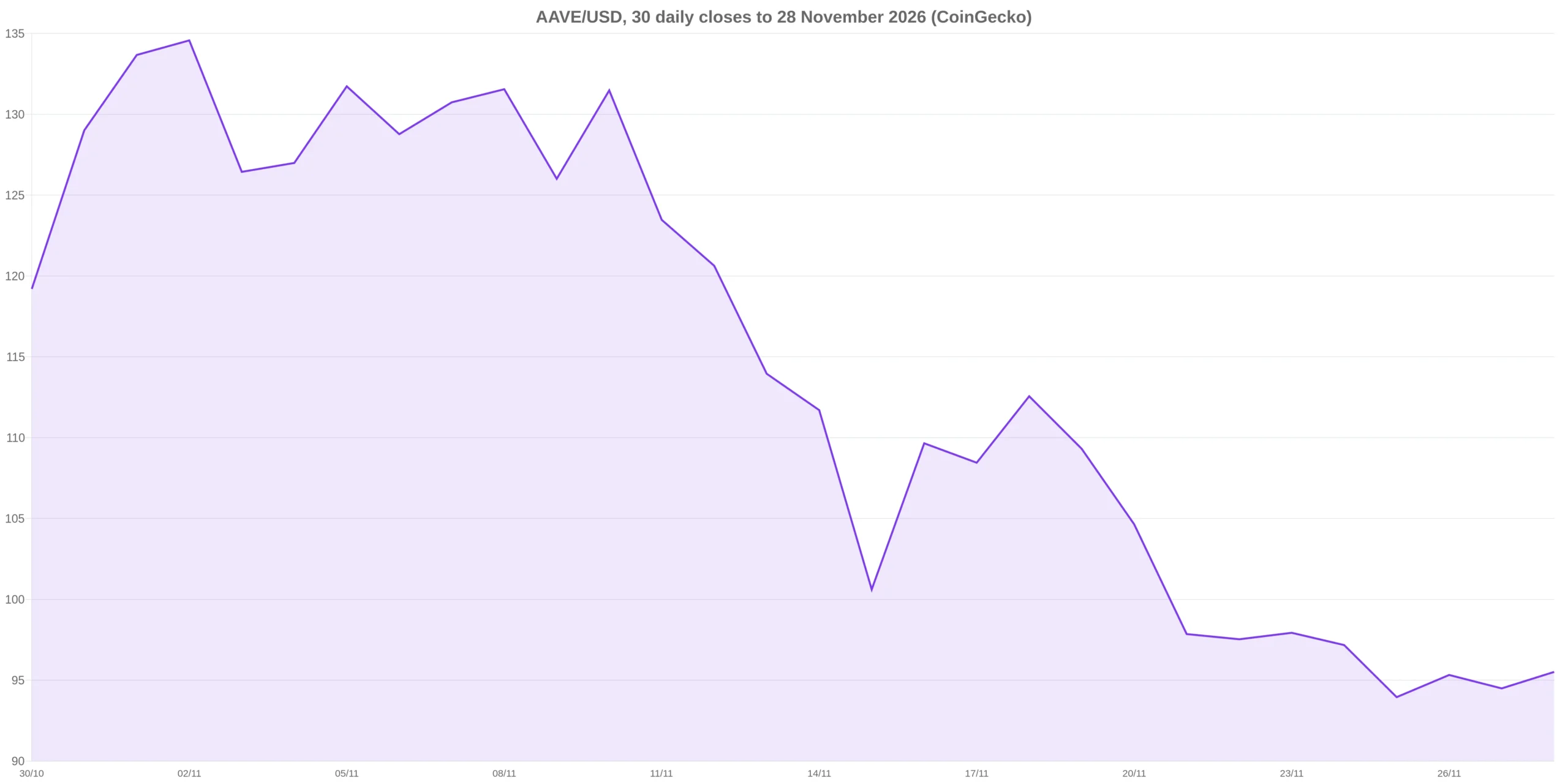
At $90.03, $1,000 buys 11.10 AAVE. A doubling of the price to $180.06 would put the token at a market value of about $2.78 billion, assuming the circulating supply stays near 15.44 million coins of the 16 million maximum. That is not a new valuation for Aave. AAVE last closed above $180 on 6 October 2026, at $184.06, so the double is a return to a level the token held seven and a half weeks ago rather than a re-rating.
CoinGecko’s ninety-session daily series puts the token’s high for the window at $184.06 and its close on 28 November at $95.51, so Sunday’s $90.03 sits 5.7% below the last completed daily close. The all-time high of $661.69 was set on 18 May 2021, and the token trades 86.4% below it.
The arithmetic sets the size of the gap, not the direction of the trade. A $2.78 billion market value on 15.44 million coins needs buyers to pay roughly double for the same supply, and nothing in the two product launches guarantees that they will.
Why the Trailing $585 Million Is Not All Recurring
Liquidation fees are inside the fee line, and a month like this one is when they are generated: bitcoin fell 24.4% and ether 26.8% over thirty days, the kind of move that forces leveraged borrowers to be closed out. Liquidation penalties are paid by the borrower, and part of them reaches the protocol. A fee total that carries a heavy liquidation quarter flatters a multiple built on it, because the interest income recurs and the liquidation income does not. DefiLlama does not publish a component split for the fee line, so the size of that slice cannot be measured from the dashboard, which is itself the reason to treat 2.38x as a ceiling rather than a floor.
The protocol’s own risk record shows how fast that side of the business can move. In late October, Aave froze V3 and V4 markets after an exploiter deposited $60 million of USDT and borrowed 19,762 WETH, a response documented in the freeze itself . A market that is paused collects nothing. The same reflex is what protects depositors, and it is also a reminder that fee income is conditional on markets staying open and borrowers staying solvent.
There is a second constraint on the upside, and it sits on the deposit side. Aave’s supply is not unlimited: risk stewards cap how much of each asset a market can hold, and those caps get raised in steps. In November, LlamaRisk lifted the V3 Core USDC borrow cap to $4 billion while cutting 34 other caps, as reported in the cap review . An app that recruits deposits faster than governance raises caps will queue against them, which limits how much of the 7.25% headline rate can scale.
What Would Move the Multiple Before Year-End
Four observable things decide whether the 2.38x holds. The first is utilisation: if borrowed value grows faster than supplied value, the fee stream grows without new deposits and the multiple compresses. The second is asset coverage on Aave Pro Leverage, which today requires both legs to be listed on V3 on the same chain. The post says “support for more assets and networks is coming soon,” and each addition widens the set of positions that can pay borrow interest.
The third is the app’s deposit base. Aave Labs describes the app as bringing “the earning power of Aave” to a savings audience, and its economics depend on those deposits landing in markets that already have borrowers. The fourth is disclosure: neither post gives user numbers, deposit totals or revenue figures, so the first hard evidence will arrive in on-chain balances rather than in a company update.
None of the four is a price signal on its own. Together they are the difference between a protocol whose consumer app expands its supply base and one that adds deposits it cannot lend out.
Frequently Asked Questions
Aave traded at $90.03 at 08:52 UTC, 3.72% lower over 24 hours and 28.4% lower over thirty days, per CoinGecko. Its market capitalisation was $1.390 billion on a circulating supply of 15,441,774 AAVE against a maximum of 16 million.
Aave fell furthest of the three but in the same direction as the market. Bitcoin fell 24.4% and ether 26.8% over the same thirty days, per CoinGecko, against Aave’s 28.4%. Aave’s own product news in the period was positive, so no protocol event explains the drop. Available evidence does not establish a single cause.
It is market capitalisation divided by trailing twelve-month fees. Aave’s market value of $1.390 billion against $585.4 million in fees is 2.38x. Measured against the $84.59 million that reached the DAO treasury as revenue, the same market value is 16.4x.
Aave App is a savings app that deposits user funds into Aave’s lending markets. Accounts use an email address or phone number and a password instead of a wallet and recovery phrase. It launched generally on iOS and Android on 25 November 2026 after early access in more than 170 countries, and it advertises up to 7.25% APY with no lockups.
It opens a leveraged position in one transaction with a health factor the user sets through the multiplier. Aave Labs warns that “if a position’s health factor drops below 1, part of its collateral can be liquidated.” At launch it works only where both assets in the position are listed on Aave V3 on the same chain, and Ethereum positions need at least $50 of net equity.
No. Aave Labs states plainly that “Aave is not a bank. Funds are not insured by any government agency, and protections may differ from those applicable to traditional financial products.” The app offers self-custody, optional two-factor authentication, a withdrawal whitelist and an opt-in biometric recovery, and says its codebase has been reviewed by nine third-party security firms.
Data: CoinGecko prices, market caps and the ninety-session daily series; DefiLlama fees, revenue, TVL and chain breakdown. Market data is a single snapshot taken at 08:52 UTC on 29 November 2026. Fees and revenue are trailing twelve-month figures from DefiLlama’s daily series. Multiples, utilisation, treasury share and the $1,000 arithmetic are calculated from those inputs. Product details are from the Aave Labs launch posts of 25 and 26 November 2026.
Disclosure: This article does not represent investment advice. The content and materials featured on this page are for educational purposes only.
The post Best Crypto to Buy Now: Aave Trades at 2.38x Its Trailing Fees appeared first on Blockchainreporter .