



Bitcoin options worth about $6.7 billion expire on Deribit on Friday, 27 November, at 08:00 UTC. The 110,254.8 BTC of open interest behind that figure is spread across 136 contracts and 68 strikes, and only 14.5% of it sits within 5% of the $60,691 index price. Calls carry 61,803.8 BTC against 48,451.0 BTC in puts. The strike where the aggregate intrinsic value of every expiring contract falls to its lowest is $70,000, about $9,300 above spot.
Those four numbers decide what the settlement means. A large notional figure on its own says little, because most of this open interest cannot change hands at a price anywhere near the current one. The Deribit options statistics page shows the same book from the exchange’s side, and the snapshot below was taken from its public API at 01:17 UTC on 27 November.
What settles at 08:00 UTC on Friday
Deribit lists 136 BTC option contracts for the 27 November expiry. Together they hold 110,254.8 BTC of open interest, which is 24.9% of the 442,950 BTC open across every Deribit bitcoin expiry. Priced at the exchange’s own index of $60,691.54, the expiring book is worth $6.69 billion.
Settlement is in bitcoin, against that index, and it is cash-settled: no coins change hands at expiry and no contract converts into spot exposure. That matters for anyone expecting the settlement to force buying or selling in the underlying market. What expires is a set of obligations to pay the difference between each strike and one index print.
The index itself has moved very little in the last day. Bitcoin changed hands at $60,728 at 01:18 UTC, up 0.06% over 24 hours, down 2.1% over seven days and down 24.7% over thirty, according to CoinGecko . From the $126,080 peak of 6 October 2025, the price is 51.8% lower. An expiry assembled while price was higher therefore settles into a market that has already left most of the strikes behind.
Where the open interest actually sits
Strike distribution is the part of the book that carries information. Grouped by $5,000 bands, the expiring open interest looks like this:
- $60,000 to $65,000: 13,282.9 BTC, or 12.0% of the expiry.
- $65,000 to $70,000: 15,853.3 BTC, or 14.4%.
- $70,000 to $75,000: 14,748.4 BTC, or 13.4%.
- $85,000 and above: 30,477.6 BTC, or 27.6%, worth $1.85 billion at the current index.
More than a quarter of Friday’s open interest sits at strikes at least 40% above spot. Those contracts expire worthless unless bitcoin rallies 40% before the 08:00 UTC settlement, so their practical contribution to settlement is a premium already paid and received. They matter for a different reason: they are the reason the headline notional number overstates how much is actually at stake.
The largest single strike in the book is $90,000, where 4,791.8 BTC of calls sit against 17.9 BTC of puts. That one strike is 4.3% of the entire expiry. By contrast, the $63,000 strike holds 2,931.9 BTC of puts and 1,118.7 BTC of calls, and $70,000 holds 2,910.7 BTC of puts against 1,395.2 BTC of calls. Puts cluster between $63,000 and $75,000; calls cluster at $80,000 and above.
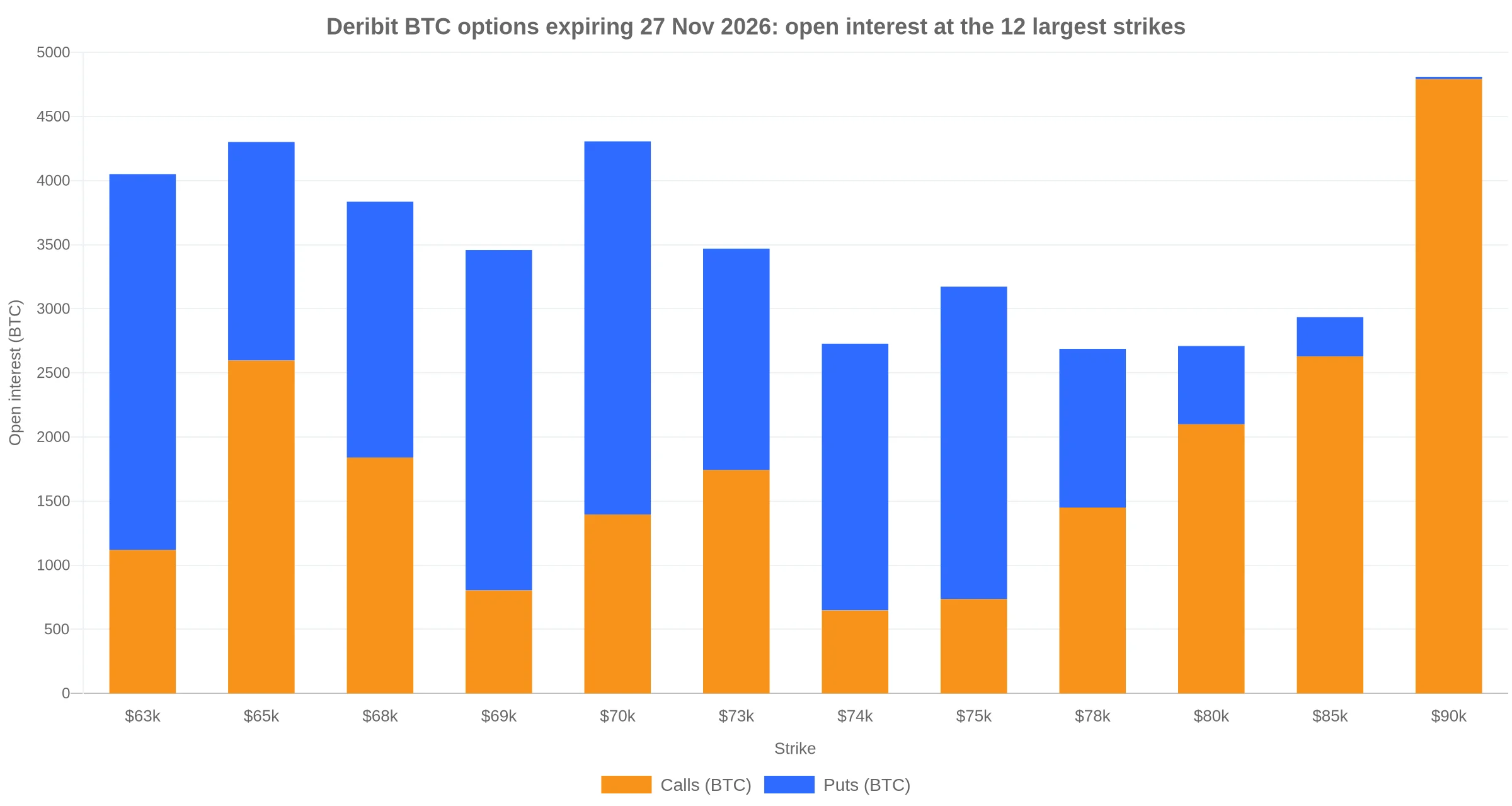
The max-pain strike is $9,300 above the index
Max pain is a simple calculation usually dressed up as a prediction. For every strike in the book, add up what holders of all expiring contracts would collect if settlement landed exactly there: calls pay the distance above their strike, puts pay the distance below theirs, and everything else expires empty. The strike with the smallest total is the one that costs option buyers the most and option sellers the least.
For Friday’s expiry that strike is $70,000. At settlement of $70,000 the aggregate payout across all 68 strikes comes to $182.4 million. At the current index of $60,691.54 the same book pays $327.1 million. The difference, $144.6 million, is what a move from spot to the max-pain strike would remove from the payout pool.
That gap is unusual in direction. Max pain normally sits close to spot, because open interest accumulates around the price where traders have been active. Here it sits 15.3% higher, which says more about the age of the book than about the direction of the market: the puts that pay the most at current prices were struck at levels bitcoin traded at weeks ago, and the call strikes that would pay at $70,000 were set well below where the market stood when those contracts were written.
None of this makes $70,000 a target. Max pain describes the shape of a liability, not the behaviour of buyers, and it is computed from open interest alone, which does not show who is long, who is short, or whether either side intends to hold to settlement.
Puts struck above spot are the older hedge
The put side carries 48,451.0 BTC, and 31,845.1 BTC of that sits at strikes above the current index. A put with a strike above spot is already in the money. Its owner bought protection when the strike was below the market, and the position has since moved from insurance into a claim.
Open interest cannot date a position, so the book does not prove when those puts were bought. What it does show is where they would pay. At the current index the largest single put payout comes from the $75,000 strike, where 2,437.4 BTC of puts are worth about $34.9 million in settlement value. The $74,000 strike adds $27.7 million, the $70,000 strike $27.1 million and the $69,000 strike $22.1 million. Together, puts struck between $69,000 and $78,000 account for 62.5% of the total payout at spot.
Calls below the index are almost irrelevant by comparison. Thirteen strikes hold in-the-money calls, and their combined payout at $60,691.54 is $7.0 million, led by the $54,000 strike at $1.8 million. The asymmetry is the story of this expiry: nearly all of the money that will change hands on Friday is owed on puts that were struck when bitcoin was above $69,000.
Volatility is coming out before settlement
Deribit’s DVOL index, which measures 30-day implied volatility on its bitcoin options, closed at 52.21 on 27 November. It printed a high of 59.19 on 25 November and has fallen since. Implied volatility usually decays into a large expiry, and this one is no exception.
What that decay does not tell you is direction. The index fell even as spot slid 2.1% over the week, because the market had already priced a wide range after a month in which bitcoin lost 24.7%. A DVOL near 52 is elevated against the calm stretches of 2025 and unremarkable against the last four weeks.
The next expiry is the one that resets the book. Deribit lists 164,787.5 BTC of open interest for 25 December, worth roughly $10.0 billion at the current index, and that book has 97,666.5 BTC of calls against 67,121.0 BTC of puts. Friday’s settlement removes a quarter of the exchange’s bitcoin option open interest and leaves the December strike ladder as the dominant hedge on the board.
What changes after 08:00, and what this cannot tell you
After settlement, the $90,000 calls, the $70,000 puts and the rest of the 27 November book stop being open interest and become realised payouts. Nothing in that process requires anyone to buy or sell bitcoin in the spot market, because the contracts settle in bitcoin against an index rather than in the underlying. Traders who want to keep a position must roll it, and the roll is where new open interest and new premium get set.
Three limits are worth stating plainly. Open interest counts contracts, not conviction: a market maker hedging a large customer trade holds the opposite side of the same contract, and the number cannot separate the two. Max pain is an arithmetic property of that open interest, not evidence of how settlement will print. And a settlement at 08:00 UTC is one print, chosen by an index that reflects spot prices on several venues, so the gap between the last traded option price and the settlement value can be wider than the strike ladder suggests.
The useful reading is narrower. On Friday, $6.69 billion of notional and 110,254.8 BTC of contracts resolve against a $60,691 index, with 27.6% of the book parked at strikes that will expire empty and 14.5% close enough to spot to matter. Whether bitcoin trades at $58,000 or $63,000 at 08:00 changes the payout by tens of millions of dollars. It does not change who is exposed, and it does not set the next move.
For readers tracking the wider flow picture, the Core PCE print that set the last price move and the ETF flow tape that has driven the November drawdown are the two inputs that have moved spot this month. The expiry is a scheduled event on top of them, not a substitute for them.
Frequently Asked Questions
Deribit settles its 27 November BTC options at 08:00 UTC on Friday. Settlement is against the exchange’s bitcoin index, which stood at $60,691.54 at 01:20 UTC, and the contracts pay out in bitcoin rather than in dollars.
The 27 November expiry holds 110,254.8 BTC of open interest across 136 contracts and 68 strikes, worth about $6.69 billion at the current index. That is 24.9% of the 442,950 BTC open across all Deribit bitcoin expiries.
It is $70,000. At that settlement price the total intrinsic value of every expiring contract is $182.4 million, against $327.1 million at the current index of $60,691.54. The calculation uses open interest at each of the 68 listed strikes and does not forecast where price will settle.
Calls. The book holds 61,803.8 BTC of call open interest against 48,451.0 BTC of puts, a put-to-call ratio of 0.78. Most of the calls sit at $80,000 and above, including 4,791.8 BTC at the $90,000 strike alone.
Not mechanically. Deribit settles in bitcoin against its index, so no spot or futures order is generated by the settlement itself. Any price effect comes from traders rolling or closing positions around 08:00 UTC, and that flow is not visible in open interest before it happens.
Data: Deribit , CoinGecko . Open interest is the 01:17 UTC snapshot on 27 November 2026, the DVOL reading is from 01:21 UTC, and the bitcoin price is the 01:18 UTC CoinGecko print.
Disclosure: This article does not represent investment advice. The content and materials featured on this page are for educational purposes only.
The post Bitcoin Options Expiry: $6.7 Billion Settles Friday With Only 14.5% Near Spot appeared first on BlockchainReporter .