Bitcoin long-term holders realize 33% losses as LTH-SOPR revisits June bottom levels. CryptoQuant identifies rare capitulation during BTC’s rebound.
Bitcoin ‘s long-term holders have begun realizing substantial losses, with a key on-chain indicator returning to levels last seen near the June 2026 market bottom.
According to CryptoQuant’s November 24 analysis , investors holding Bitcoin for more than 155 days sold coins at an average realized loss of approximately 33% on November 23, even as BTC briefly recovered toward $64,600.
The development suggests that some experienced holders are using price rebounds to exit underwater positions rather than continuing to accumulate.
Bitcoin has since surrendered those gains, trading around $60,200 on November 24.
Bitcoin Long-Term Holders Realize Losses of 33%
CryptoQuant’s Long-Term Holder Spent Output Profit Ratio (LTH-SOPR) declined to 0.67 on November 23, reflecting significant losses among coins spent after remaining unmoved for more than 155 days.
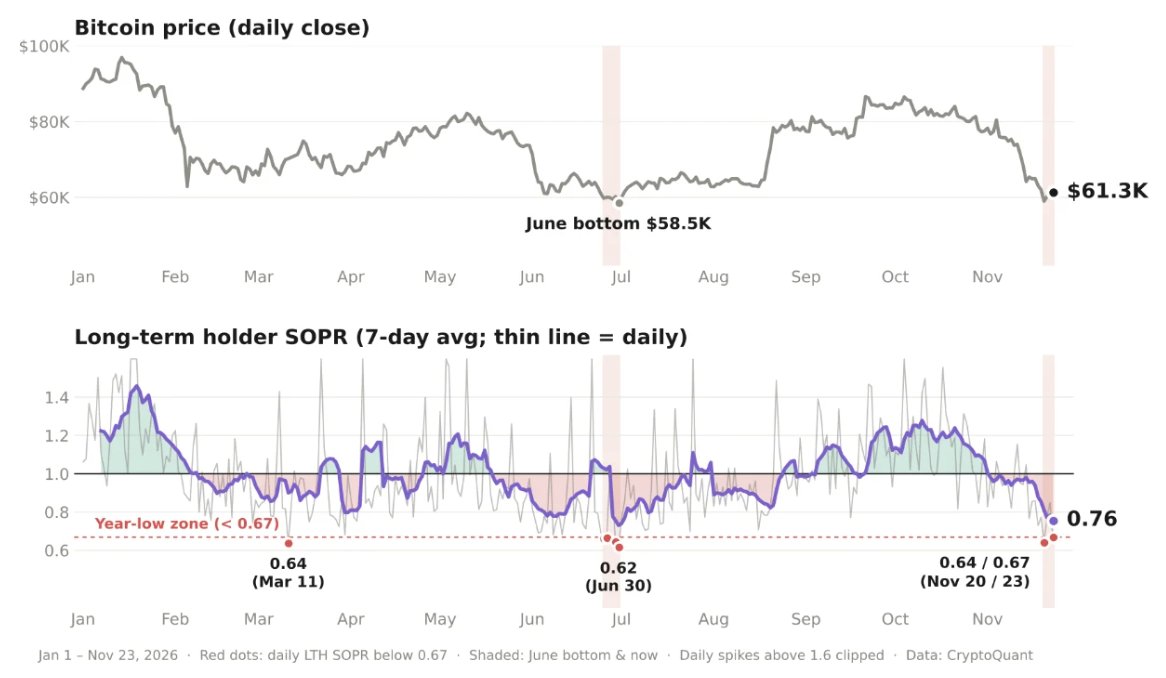
The metric compares the value of coins when spent with their value when previously acquired or moved. A reading above 1 indicates that coins are being spent at a profit, while a reading below 1 indicates realized losses.
At 0.67, the spent coins were valued approximately 33% below their previous on-chain cost basis.
Notably, the reading was even lower on November 20, when LTH-SOPR reached 0.64, indicating an average realized loss of approximately 36%. The selling pressure has persisted, with daily LTH-SOPR remaining below 1 for nine consecutive days.
As The Crypto Basic previously documented , sustained readings below 1 have historically accompanied difficult market conditions and periods of investor capitulation.
Bitcoin’s Latest Capitulation Resembles June Bottom
The November readings are particularly significant because similarly extreme losses have occurred only a handful of times during 2026.
CryptoQuant identified seven exceptionally low daily LTH-SOPR observations:
- March 11: 0.64
- June 25, 26, 29, and 30: Reaching a low of 0.62
- November 20: 0.64
- November 23: Approximately 0.67
Four of these observations occurred during the final week of June, when Bitcoin established a daily closing low near $58,500.
Following that capitulation, Bitcoin consolidated between approximately $58,000 and $65,000 for seven weeks before recovering above $80,000 in August.
However, the latest capitulation has produced only two exceptionally low readings so far, compared with June’s four-reading cluster. The seven-day LTH-SOPR average has also fallen to 0.76, approaching the yearly low of 0.73 recorded on June 30.
An earlier Bitcoin recovery assessment similarly highlighted the importance of sustained improvement in long-term holder profitability before a durable market recovery.
Bitcoin Records $1 Billion in Net Realized Losses During Rebound
Additional on-chain data indicates that selling pressure extended beyond the long-term holder cohort.
On November 23, Bitcoin recorded approximately $1 billion in market-wide net realized losses, even as the asset finished the day marginally higher.
Meanwhile, cryptocurrency exchanges registered net inflows of 2,033 BTC. These inflows indicate that more Bitcoin entered exchange wallets than left them, creating potential additional sell-side supply. However, exchange deposits do not necessarily represent completed sales.
The findings come after Bitcoin recently entered a major on-chain demand zone between $63,111 and $64,373 , where approximately 1.22 million BTC had previously changed hands.
Bitcoin’s inability to sustain its November 23 recovery above that region reinforces the challenge posed by holders looking to exit at higher prices.
What Bitcoin Needs to Confirm a Potential Bottom
The latest capitulation could represent an early stage of seller exhaustion, but the evidence does not yet confirm a market bottom.
CryptoQuant emphasized that capitulation among long-term holders has historically developed over several days or weeks rather than through a single extreme reading.
Two developments are now particularly important.
First, the seven-day LTH-SOPR average needs to recover from its current 0.73–0.76 region, indicating that the severity of realized losses is easing.
Second, daily LTH-SOPR must return above 1, signaling that coins spent by long-term holders are again realizing profits on average.
Until those conditions improve, Bitcoin rebounds may continue encountering selling pressure from investors attempting to reduce underwater positions.
The June comparison demonstrates that substantial losses can emerge near local bottoms, but confirmation of another recovery will depend on improving holder profitability and sustained buying demand.