



Abra Credit’s institutional dollar loans now post their collateral with a trust company owned by the operator of the New York Stock Exchange. Intercontinental Exchange and Abra announced the arrangement on Nov. 16: a borrower pledges Bitcoin, Ether or Solana to a segregated wallet at ICE Digital Trust , and Abra Credit writes the dollar loan against it. The pledged coins sit at the custodian for the life of the loan unless released or liquidated under the loan terms. The release says they are not rehypothecated.
That last clause is the product. A borrower who hands coins to a lender is exposed to the lender’s balance sheet, its funding costs and its other creditors. A borrower who hands them to a third-party custodian, with release conditions agreed in advance by three named parties, is exposed to price and to credit approval instead. Abra and ICE are selling the second arrangement to institutions that have spent four years asking for it.
“Historically, borrowing against Bitcoin meant trusting your lender with the asset. That model is done,” said Bill Barhydt, Abra’s founder and CEO. In the same release he described the split: “the collateral sits with a qualified custodian owned by the company that runs the New York Stock Exchange, and Abra does what it does best: lend, manage risk and run investment strategies.”
Tim Bowler, chief innovation officer of ICE’s Fixed Income and Data Services, put the case from the custodian’s side. “Institutions increasingly expect digital assets to be held to the same standard as the rest of their portfolio,” he said, adding that ICE Digital Trust “brings similar workflows and controls that we use to serve institutional stakeholders using our exchanges and clearing houses to digital asset custody.”
What the lender no longer holds
The release lays out a three-party custody flow rather than a two-party loan. Borrowers pledge Bitcoin, Ether or Solana to a segregated wallet at ICE Digital Trust. Abra Credit funds the dollar loan and monitors collateral around the clock. The custodian releases assets only under controls agreed among the borrower, Abra Credit and ICE Digital Trust.
The design points at a specific failure the market has already lived through. When the lender is also the custodian, pledged coins can be lent onward to fund another position, and the borrower discovers the shortfall only when a redemption queue forms. Segregation does not prevent losses on a loan book. It removes one route by which a borrower’s asset can leave the building without their consent.
There is a second audience in the structure. Institutions that provide funding lines to Abra Credit get “an independent record of the collateral behind each loan,” according to the release. That is the piece a warehouse lender needs to underwrite: a custodian’s record of pledged assets that does not depend on the borrower’s own reporting. Without it, a financing line against a crypto loan book is priced as an unsecured exposure with extra steps.
The release is also explicit about what ICE is not doing. “Intercontinental Exchange, Inc. and ICE Digital Trust, LLC do not make, arrange or guarantee any loan,” it states. Custody is a fee business for ICE. Credit risk stays with Abra Credit and, behind it, with whoever finances Abra Credit’s lending.
Why a New York trust charter carries the argument
ICE Digital Trust, LLC is chartered as a limited purpose trust company by the New York State Department of Financial Services to engage in virtual currency business, and it is a qualified custodian under the Investment Advisers Act of 1940. Both facts appear in Abra’s release and on ICE’s own custody page . The second one matters for a specific reason: advisory clients of Abra Capital Management, an SEC-registered investment adviser, will hold their strategy assets at ICE Digital Trust in an account the adviser maintains for its clients, with each client’s holdings recorded separately.
Under the adviser framework, client assets held by a qualified custodian are what allows a registered adviser to keep custody of client property in the first place. Move the same assets to an affiliate of the adviser without that status and the compliance question changes shape. In this arrangement the manager manages and the trust company holds, which is the division a compliance officer at a pension or an endowment will ask about before allocating.
ICE’s page describes the operational side in unusually concrete terms for a custody marketing page: cold storage with cryptographic key shares held in an offline vault, and 100% of transactions manually reviewed by an operations team member on top of multi-step authorization. Manual review is slow by design. It is also the control that a purely automated withdrawal path does not have.
None of that is insurance. The release says custody by ICE Digital Trust “does not eliminate the risk of loss,” and that digital assets are “not FDIC-insured or SIPC-protected.” A trust charter buys supervision and a named regulator. It does not buy a backstop.
Three assets that fell 10.8% to 12.8% in a week
The collateral set is narrow: Bitcoin, Ether and Solana, with more types to be added over time “subject to custody support.” All three have been falling. At 04:05 UTC on Nov. 17, Coinbase spot quoted BTC at $64,938.08, ETH at $1,829.56 and SOL at $72.56.
Daily closes tell the same story with more precision. From Nov. 10 to Nov. 17, BTC went from $73,697.87 to $64,919.20, a decline of 11.91%. ETH fell from $2,050.58 to $1,829.72, down 10.77%. SOL slid from $83.24 to $72.57, down 12.82%. The worst single session was Nov. 14: between those two daily closes Bitcoin lost 6.03%, Ether 8.29% and Solana 10.06%.
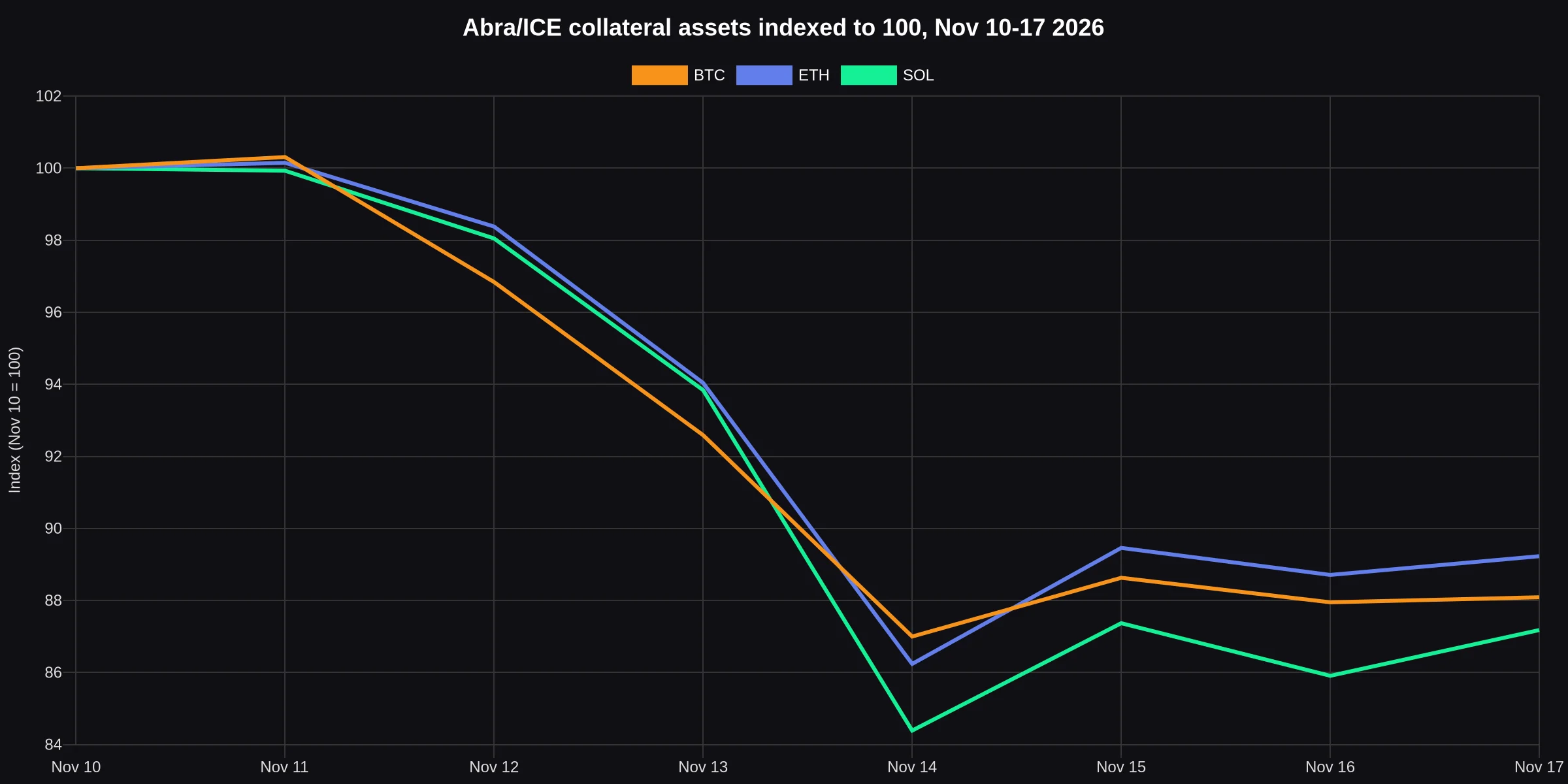
For a lending product that accepts exactly these three assets, the timing is not incidental. A program that launches into a week of double-digit declines in every eligible collateral type will find out quickly whether its margin framework works.
The arithmetic that segregation does not change
Segregated collateral can still be sold. The release states that collateral “may be liquidated, in whole or in part, if its value falls below required levels or on default.” What the release does not publish is the loan-to-value ratio, the maintenance threshold or the margin-call schedule.
The arithmetic is worth running anyway, because it explains why the custodian’s controls matter more than its brand. Take a $10 million Bitcoin pledge at Nov. 17’s spot of $64,938.08. That is 153.99 BTC. At a 50% initial loan-to-value, it supports a $5 million dollar loan. If Bitcoin falls 20% to $51,950.46, the collateral is worth $8.0 million and the loan-to-value has moved to 62.5% without a single dollar of principal being repaid.
Use this week’s actual move instead of a hypothetical one. Bitcoin is down 11.91% since Nov. 10. A loan written at 50% loan-to-value on Nov. 10 now sits at 56.76%; a loan written at 60% now sits at 68.11%. Those numbers assume nothing else changed, which is the point: price alone moves the ratio, and the borrower’s next action is set by thresholds the lender has not published.
What segregation changes is who executes. A custodian releasing assets under pre-agreed tripartite controls cannot quietly reprice the relationship by moving collateral to a different counterparty. It can still liquidate on instruction when the thresholds in the loan agreement are breached. The structure separates custody from credit. It does not separate collateral from price.
Two billion dollars of principal, annualised
The scale claim in the release is that Abra and its predecessor entities have “facilitated more than $2 billion in digital asset loans” since 2021, “measured by the aggregate principal amount of loans funded.” Spread over the roughly 60 months from late 2021 to Nov. 16, 2026, that works out to about $33.3 million of new principal a month, or roughly $400 million a year.
The definition is doing real work in that sentence. Aggregate principal funded counts loans that have been repaid, refinanced or rolled. It is not the current book, and it is not a measure of credit performance, loss rates or collateral quality. A lender that originated $2 billion and wrote off a fifth of it would report the same figure as a lender that originated $2 billion and lost nothing. What a reader would need to size the business is outstanding principal, weighted average loan-to-value and realised losses. None of the three appears in the release.
The honest read is that the program is small relative to institutional credit markets and large relative to where crypto lending sat in 2021. The initial client group is described as exactly that: initial.
ICE has been assembling this for months
The custody announcement is the third move in a sequence at ICE. In late October, ICE agreed to bring Hyperliquid perpetual futures onshore, a deal that put the exchange operator’s clearing and market-structure machinery around a decentralised venue’s contracts, as BlockchainReporter detailed in its report on ICE’s Trade[XYZ] Hyperliquid deal . Before that came the NYDFS trust charter and the qualified custodian status. Now comes the collateral.
The common thread is that ICE is monetising infrastructure rather than direction. Futures clearing, custody, collateral records and manual release controls are fee-earning functions that do not require the operator to take a view on Bitcoin’s next 20%. Bank custody desks have been making the same argument for two years, and the technology underneath is converging: Blockstream moved MPC signing inside Thales HSMs on Nov. 14 to court exactly this client base.
For Abra, the trade is credibility. The firm’s lending history runs back to 2021 and includes a retail-facing past that institutional allocators price as a discount. Borrowing the New York Stock Exchange operator’s custodian, and its charter, is a way to buy back part of that discount without changing the loan book.
What the announcement leaves out
The release omits the terms a credit analyst would ask for first: loan-to-value ratios, interest rates, minimum loan sizes, the number of initial clients and whether ICE Digital Trust earns a custody fee expressed in basis points. It also does not say whether stablecoins will join Bitcoin, Ether and Solana as eligible collateral, only that ICE and Abra “plan to add more types of eligible collateral over time, subject to custody support.”
The forward-looking statement lists the risks Abra expects to matter: digital asset price volatility that “can lead to margin calls or the liquidation of collateral,” the availability of financing for Abra Credit’s lending, demand from institutional clients, operational, cybersecurity and third-party failures, and “the continuation of the relationship between Abra and ICE.” The last item is the one to underline. The structure depends on a partnership between two companies, not on a licence that survives either one of them walking away.
Two practical notes for readers. Loans are subject to credit approval and are not available in all jurisdictions. And Barhydt’s keynote at Solana Breakpoint in London on Nov. 16 is where more detail was promised, which is a marketing venue, not a filing. Until the loan terms are documented somewhere an allocator can diligence, the structure is easier to verify than the lending itself.
Frequently Asked Questions
ICE Digital Trust, LLC is a limited purpose trust company chartered by the New York State Department of Financial Services to engage in virtual currency business, and a qualified custodian under the Investment Advisers Act of 1940. It is owned by Intercontinental Exchange, the parent of the New York Stock Exchange.
No, according to the Nov. 16 release. Borrowers’ Bitcoin, Ether or Solana sits in a segregated wallet at ICE Digital Trust for the life of the loan and is not lent out again. The custodian releases assets only under controls agreed among the borrower, Abra Credit and ICE Digital Trust.
Yes. The release states that collateral may be liquidated in whole or in part if its value falls below required levels or if the borrower defaults. Segregation changes who holds the assets, not whether price declines can trigger a sale.
No. Abra Credit originates and services the dollar loans. The release states that Intercontinental Exchange and ICE Digital Trust do not make, arrange or guarantee any loan, and that custody does not eliminate the risk of loss.
Bitcoin, Ether and Solana initially, with more collateral types planned subject to custody support. Abra says it and its predecessor entities have facilitated more than $2 billion in digital asset loans since 2021, measured by aggregate principal funded rather than outstanding balance. The lending program is open to an initial group of institutional clients.
Data: Coinbase spot , TradingView .
Disclosure: This article does not represent investment advice. The content and materials featured on this page are for educational purposes only.
The post NYSE Owner ICE Will Hold the Collateral Behind Abra’s Dollar Loans appeared first on BlockchainReporter .