


Coinbase and Broadridge published a joint technical standard on November 16 that lets an issuer send a corporate-action notice straight to the wallet holding its tokenized shares, and submitted the same document to the Ethereum Improvement Proposal process for review. The Broadridge release went out at 07:00 Eastern, together with a data oracle the company launched to give participating firms aggregate evidence that notices actually reached holders.
The scope is narrower than the headline suggests, and that narrowness is the interesting part. The specification distributes information about corporate actions. Its own documentation states that it does not establish legal rights, calculate a particular holder’s entitlement, determine eligibility, or submit votes and elections. Those functions stay with issuers, transfer agents, custodians and brokers, and settlement is untouched. What changed is the message, not the ownership.
Six Event Types, Two Specifications, and a Vocabulary Borrowed From the Incumbents
The standard is built from two documents rather than one. “Onchain Announcements” defines how a token contract publishes a disclosure: an identifier, a short description and a link to more information, with the option to group related token changes into the same blockchain transaction. It can carry information only, with no balance change and no funds moving. The “Corporate Action Schema” defines the document that sits behind that pointer, identifying the asset, the action, a revision number, the relevant dates and the terms, including holder options or meeting resolutions.
The published specifications cover six event types: dividends, stock splits, mergers, tender offers, rights issues and shareholder meetings. Each notice is meant to tell a holder whether action is required and what happens if they do nothing.
The format deliberately borrows existing vocabulary. It uses corporate-action terms from ISO 15022 and ISO 20022, the messaging standards that already govern how instructions and entitlements move between banks, custodians and depositories, and takes its type names from Broadridge’s BRx data model. That choice matters more than it looks. A format invented from scratch would need a translation layer at every hop between a blockchain and the institutions that hold the legal record; anchoring the schema to the standards those institutions already run reduces each hop to a mapping rather than a rebuild.
The operational sequence has four stages: the issuer or its authorized agent publishes the corporate-action document, the token announces it onchain, either party updates it if the terms change, and the token change is applied. Announcements are accepted only from the token itself or a source the token designates, which is the standard’s answer to the obvious forgery question in a world where anyone can deploy a contract that claims to speak for a company.
Why the Notice Chain Breaks Exactly Where Tokenized Holders Sit
A dividend or a proxy statement does not travel from a company to a shareholder in one step. It moves through a transfer agent, a custodian, a data vendor and a broker, and each of those parties re-keys the details into its own format before passing them along. The chain works because every link is a regulated intermediary with a legal obligation to forward the information. Holders who keep shares in a wallet or on an exchange sit outside that chain, which is the gap the two companies are addressing.
“Shareholder communications should be interoperable across the platforms investors use,” said Molly Abraham, General Counsel at Coinbase. “Together with Broadridge, we have developed and published a proposed standard that gives issuers, custodians and wallet providers a shared framework to evaluate and implement, rather than requiring each participant to build its own approach.”
The volume at stake is not marginal. Broadridge says its technology and operations platforms process and generate more than 8 billion communications a year, and that the company employs roughly 16,000 associates across 28 countries as part of the S&P 500. It is already inside the proxy pipeline: its ProxyVote product has been integrated into digital wallets so investors can receive materials, confirm holdings and submit votes. The new standard extends that foundation from voting to the wider set of corporate actions.
A $345 Billion Slice Sitting Inside $18 Trillion
The release puts two numbers side by side that are worth separating. Broadridge’s Distributed Ledger Repo platform, which it describes as the world’s largest institutional venue for settling tokenized real assets, tokenizes more than $345 billion of repo a day. Separately, the company’s platforms underpin the daily average trading of more than $18 trillion in tokenized and traditional securities globally.
Those are different flows, so the ratio between them is a size comparison rather than a market share. Divided out, $345 billion is about 1.9% of $18 trillion. Annualized across 252 trading days, the repo figure runs to roughly $87 trillion a year of settlement activity that already happens on a tokenized rail. The governance problem the new standard addresses is therefore already live inside the repo book, where tokenized collateral moves on every settlement day.
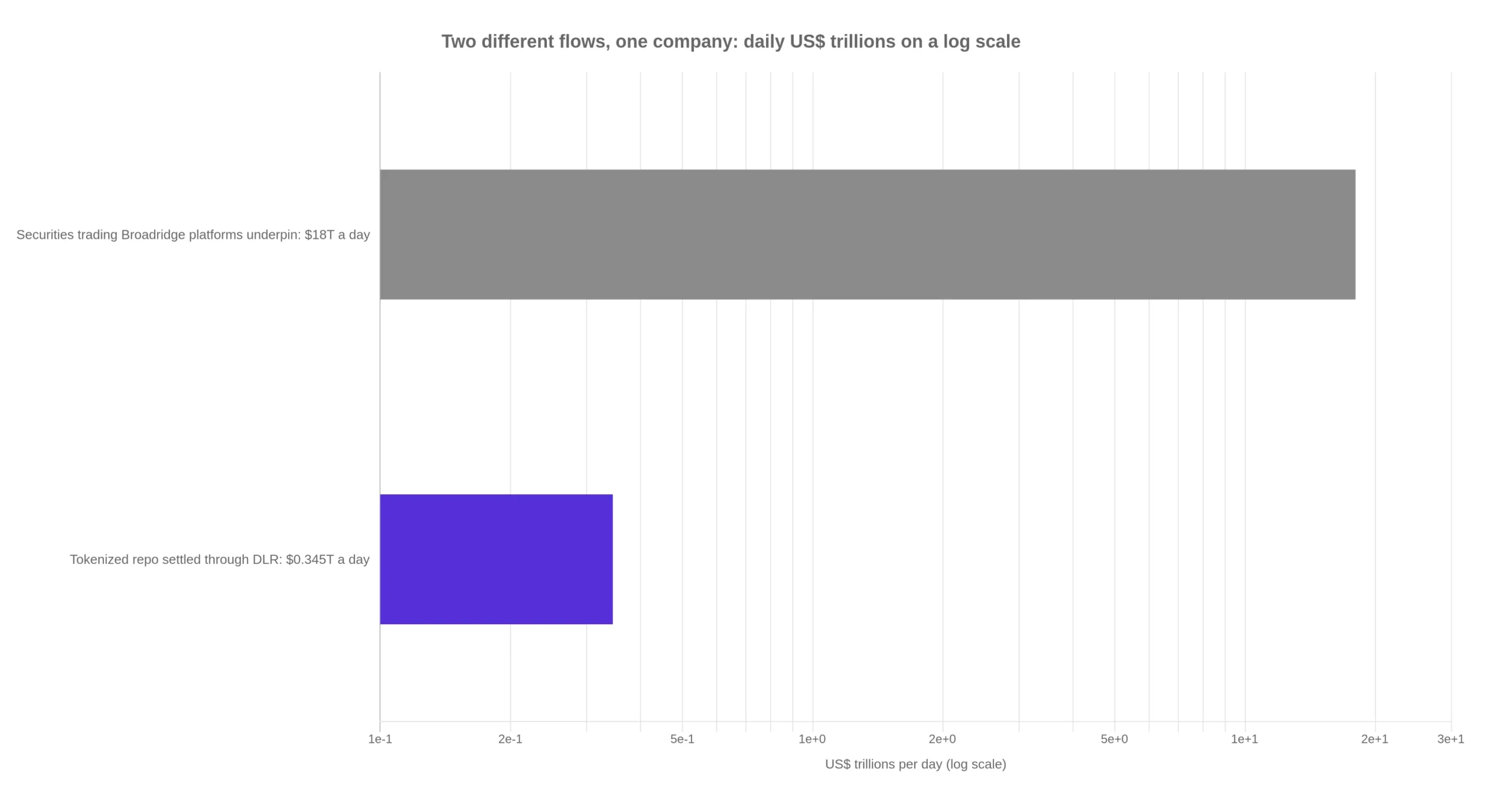
Broadridge’s October figures, reported on November 6, put the repo platform at $7.6 trillion for the month, an average of $345 billion on each settlement day, consistent with the daily figure in today’s announcement. The October volume release also described DLR as the largest institutional platform for settling tokenized real assets, a claim that rests on the company’s own measurement.
“As tokenization reshapes how securities are issued, held, and traded, solving for governance – irrespective of how they are tokenized and where they are held – is critical to scaling adoption,” said Doug DeSchutter, President of Investor Communication Solutions at Broadridge.
What the Standard Leaves Out, and Who Still Owns the Right
The documentation is unusually direct about the boundary. A notice, even a valid one with a properly structured JSON document, does not prove that an offchain payment occurred. The specifications communicate the action; they do not establish the legal right, compute what any individual holder is owed, decide who qualifies, or cast a vote. Issuers and their service providers remain responsible for those steps and for settlement.
Ownership of the standard is equally explicit. Asked who owns it, the coalition’s own answer is “Nobody. Coinbase and Broadridge are the first authors.” The specifications are released under CC0, the public-domain dedication that lets any wallet, broker or custodian implement them without a licence, and the coalition is inviting other firms to endorse, adopt or author extensions. Coverage starts with Ethereum, including EVM-compatible networks and layer 2s such as Base, with the option for a token that exists on several chains to keep one announcement feed on a home network.
Two absences are worth flagging for anyone treating this as a finished piece of market infrastructure. The release describes an Ethereum Improvement Proposal submitted for review but assigns it no EIP number, and neither the release nor the published documentation names one. Under the EIP process the proposal enters as a draft open to public comment before it can reach final status, which means the technical content can still change. And no issuer is named as a live user. The coalition’s homepage currently displays a sample notice for AMC Entertainment’s annual shareholder meeting listing three proposals, including a director election, a record date of April 15, 2027 and a vote deadline of May 19, 2027. The release does not say whether that entry is a live issuer notice or a demonstration of the format; either way, those dates sit 150 and 184 days from publication.
“With our unparalleled expertise in proxy voting, disclosure, and regulatory compliance, Broadridge is ensuring that investors and issuers can access the full range of trusted governance capabilities for tokenized securities regardless of how assets are structured or owned,” DeSchutter said.
The Countercase: Venues and Transfer Agents Already Own the Relationship
The strongest argument against reading this as a turning point is that the parties who control the holder relationship have little reason to hand it to a shared schema. A tokenized venue can publish corporate actions in its own app, in its own format, and satisfy its customers without an EIP. That road is already being built. OKXICE, the joint venture between OKX and Intercontinental Exchange, is scheduled to open its tokenized securities venue on November 23 with more than 70 assets including 59 Direxion ETFs, as detailed in the launch plan . A venue that lists tokenized shares has an incentive to own the notice, because the notice is how it keeps the customer.
The counter to that counter is fragmentation. If each venue and each issuer publishes in a private format, every wallet needs a separate integration, and holders end up with exactly the opacity the standard is meant to remove. Broadridge’s position inside the incumbent pipeline is the argument for its version: it already sits between thousands of issuers and their holders, and a format it can generate from the same data that produces the paper notice has a lower marginal cost than a format each venue invents.
Whether that is enough depends on adoption, not on technical merit. A CC0 licence removes the licensing objection and leaves the incentive objection in place. Issuers will publish onchain notices when a regulator, an exchange or an investor-relations obligation pushes them to, or when a large holder asks. Until then the standard is a capability waiting for a reason.
The Signals That Would Show This Is More Than an Announcement
Three observable events would move this from a press release to infrastructure. The first is an EIP number: a draft in the Ethereum repository with the amendments and objections that public review produces. The second is a live issuer notice on a traded token, generated by an issuer or transfer agent rather than displayed as a sample on a coalition website. The third is a wallet or exchange stating that it reads the schema, because the consumer side is what turns a format into a habit.
The macro read is that the notice layer is being constructed before the rights layer. Tokenized equities can now be described to their holders more precisely, while the ability to vote those shares onchain remains, in the coalition’s own description, the next phase. Historically the sequence ran the other way: the right came first and the plumbing followed. Building the plumbing early is a bet that the rights will follow, and it is a bet the two companies have made with their own engineering time rather than with a prospectus.
For institutions, the practical question is not whether notices arrive in a wallet. It is whether a custodian’s obligation to deliver them can be discharged by an onchain announcement, and that is a legal determination no standard can make. The release says as much. Everything else in the document is preparation for the day a regulator or an issuer decides the onchain notice counts.
This article is for informational purposes only and does not constitute financial or investment advice. The standard described here was announced by its authors and has not been adopted as final; no issuer, custodian or regulator has been named as having implemented it.
The post Coinbase and Broadridge Put Corporate-Action Notices Onchain, but Voting Still Runs Through Brokers appeared first on BlockchainReporter .