



Kraken closed its USDC.e deposit route today, and the bridged token that still holds $1.11 billion across three networks now has one fewer way onto the exchange. Deposits were disabled on Arbitrum, Optimism and Polygon on Monday, 16 November 2026; withdrawals stay open until 14 December, and native USDC is now the default deposit option on all three. The exchange’s support notice , last updated on 5 November, says the change does not touch balances or trading: “Your USDC balance and your ability to trade USDC are not affected.”
The number worth setting beside that notice is 1.11 billion. That is how much bridged USDC.e still sits in the three contracts Kraken names, measured from each token’s totalSupply at 08:35 UTC on 16 November.
Native USDC on the same chains totals 3.35 billion. Kraken is not switching off a relic. It is retiring a default that roughly a quarter of the USDC float on these networks still uses, and on Polygon the bridged token is still the larger of the two.
A Cutoff That Moves Two Rails and Leaves the Balance Alone
Read the notice as three separate instructions, because they land on different dates. Deposits close today. Withdrawals stay open for another four weeks.
From today, the exchange’s front end also treats native USDC as the standard deposit asset on those networks. That is the part that quietly changes behaviour for everyone who never touched USDC.e in the first place.
Kraken states the default switch directly: “On November 16, native USDC becomes the default option when you deposit USDC on Arbitrum, Optimism and Polygon.” For a user with no position in the bridged token, the notice adds a line that is unusually plain for exchange support copy: “If you don’t use USDC.e, you don’t need to do anything.”
The notice is a date list, not a timestamp. It gives no UTC hour for either cutoff, and it does not say whether deposits already in flight at the moment of the switch are credited. A deposit broadcast to Kraken’s USDC.e address after the cutoff has no described outcome at all. A user with idle bridged balances should treat that as unresolved rather than assume it in their own favour.
Two Tokens, One Ticker, Six Contracts
The naming is where most of the confusion starts. Kraken credits both assets as USDC, so a balance screen cannot tell you which version you deposited. On-chain they are separate contracts with separate supply, and only one of them is issued by Circle.
| Network | USDC.e contract (Kraken notice) | Native USDC contract (Circle) | Deposits | Withdrawals |
|---|---|---|---|---|
| Arbitrum | 0xff970a61a04b1ca14834a43f5de4533ebddb5cc8 | 0xaf88d065e77c8cC2239327C5EDb3A432268e5831 | Closed 16 Nov 2026 | Closed 14 Dec 2026 |
| Optimism | 0x7f5c764cbc14f9669b88837ca1490cca17c31607 | 0x0b2C639c533813f4Aa9D7837CAf62653d097Ff85 | Closed 16 Nov 2026 | Closed 14 Dec 2026 |
| Polygon | 0x2791bca1f2de4661ed88a30c99a7a9449aa84174 | 0x3c499c542cEF5E3811e1192ce70d8cC03d5c3359 | Closed 16 Nov 2026 | Closed 14 Dec 2026 |
Circle’s contract documentation draws the same line for integrators, and its caution is blunt where a chain carries both versions. Of one listing it notes that the network “also has a separate bridged USDC representation, labeled USDC.e, which is not issued or backed by Circle.”
The native addresses in the middle column are the ones Circle publishes per network, and they are what Kraken now treats as the default deposit route. The bridged addresses in the table are the routes that close.
Where the Bridged Float Actually Sits
Kraken’s three networks are not equal holders of the old token. The split decides how much of this change is administrative housekeeping and how much is live money that has to move.
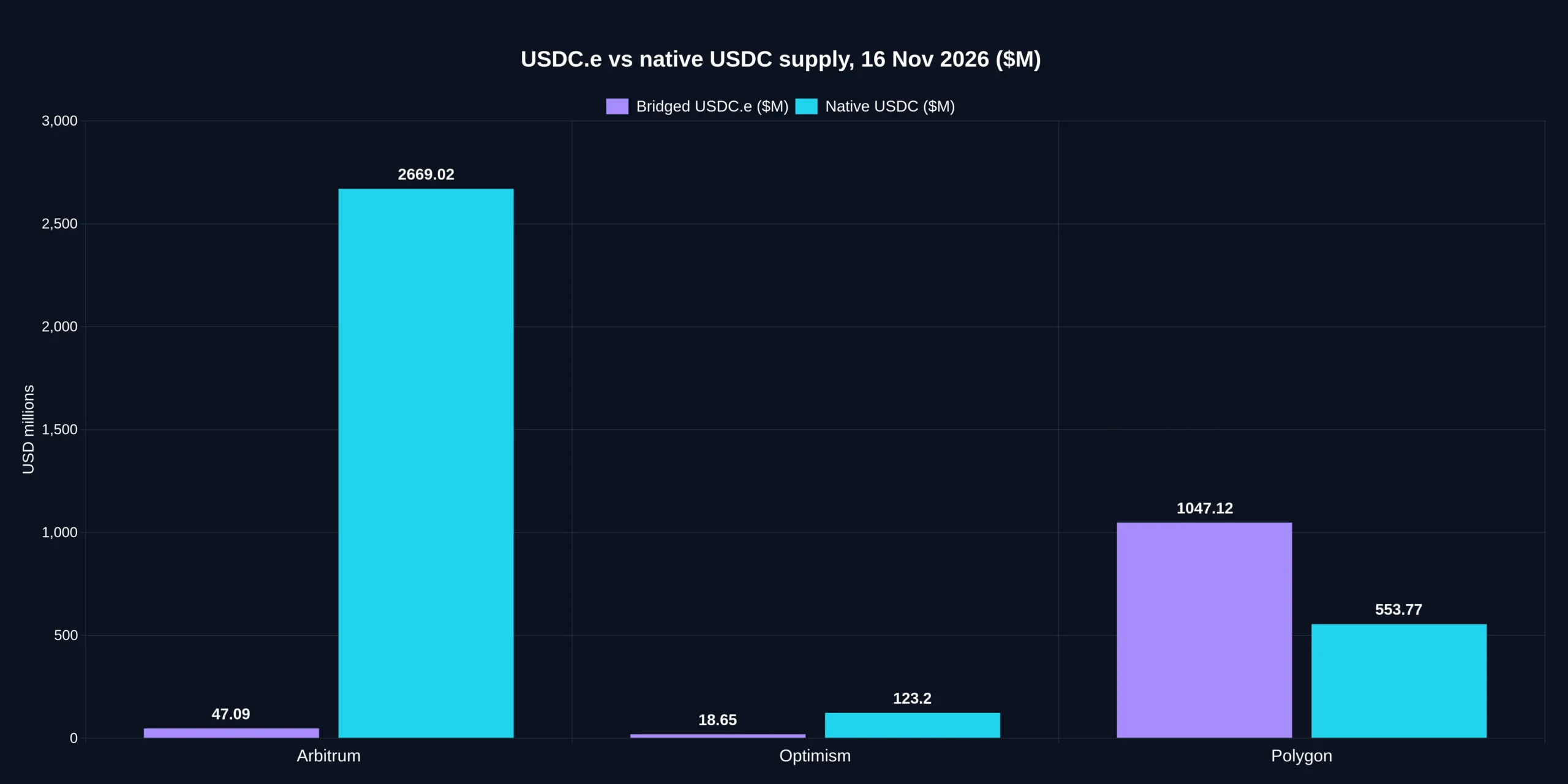
Arbitrum holds 47.09 million USDC.e against 2,669.02 million native, so the bridged token is 1.73 percent of the USDC float there. Optimism carries 18.65 million against 123.20 million, or 13.15 percent.
Polygon is the outlier and the reason the headline number is not trivial. It holds 1,047.12 million USDC.e against 553.77 million native, which makes the bridged token 65.41 percent of the USDC on that network and about 1.89 times the size of the version Circle issues directly.
Aggregate the three and the arithmetic is easy to check. Total USDC.e across the contracts Kraken names comes to about 1.11 billion dollars. Native USDC across the same chains comes to about 3.35 billion. The bridged share of the combined 4.46 billion is just under 25 percent, and almost 94 percent of that bridged total sits on Polygon alone.
Beside the broader stablecoin picture, this is a small line item in a shrinking pool. BlockchainReporter reported on 8 November that total stablecoin supply fell 6.7 billion dollars in a week, the steepest drop of 2026. A venue changing its deposit default does not move that number. It decides which contract address a dollar arrives in when it does arrive.
Why the Issuer’s Own Contract Gets the Default Slot
For an exchange, the two tokens create different operational jobs. Native USDC is minted and redeemed by Circle, so a venue that banks on native has one issuer counterparty and one redemption path.
USDC.e is a claim produced by a bridge. The tokens exist because an equivalent amount sits locked elsewhere, and the venue’s reconciliation depends on that bridge behaving.
That is the structural reason exchanges have been nudging users toward native versions on chains that support both. It is also why the migration has been uneven: where the bridged token dominates liquidity, as on Polygon, the nudge is a bigger operational ask for the venue and a bigger behavioural change for the user.
Kraken’s schedule reflects that asymmetry. Deposits close first, because the venue controls the intake. Withdrawals close four weeks later, which gives holders a window to route the old token out before the pipe shuts.
The wider context is consolidation of stablecoin rails around issuer-controlled contracts while payment volume moves toward corporate and cross-border use. BlockchainReporter covered PNC taking USDC from corporate clients and converting each payment into dollars on 10 November. The same preference for a contract with a named issuer behind it explains the default slot.
14 December Is the Date With a Cost Attached
Today’s cutoff is friction. December’s can cost money, because after that date the exchange will not move USDC.e out on those networks at all. Kraken’s instruction is unambiguous: “Complete any USDC.e deposits before November 16, 2026, and any withdrawals before December 14, 2026.”
Read that in order of urgency. Anyone holding USDC.e in self-custody on Arbitrum, Optimism or Polygon who still routes it through Kraken should stop treating that route as available, and either withdraw before 14 December or move the token on-chain through a venue that still supports it.
Anyone with USDC inside Kraken has nothing to do. The notice states that balance and trading are unaffected, and it lists no conversion step. Anyone depositing fresh USDC on those networks should use the native contract, which is now the default anyway.
What is not required is a swap. The notice does not ask holders to convert USDC.e into native USDC, and it does not describe a redemption programme. It closes two rails and keeps the third.
What the Notice Does Not Establish
Three limits are worth stating plainly, because each is easy to over-read.
First, this is one exchange’s rule. Kraken’s notice says nothing about other venues, and nothing in it establishes that USDC.e support is ending anywhere else. A reader who takes it as industry-wide is drawing a conclusion the document does not support.
Second, the token is not being shut down. USDC.e remains a live contract on all three networks, its supply is unchanged by an exchange delisting, and Polygon venues that quote it are unaffected by what Kraken does with its own deposit addresses. The bridged Arbitrum contract can be checked directly on Arbiscan , and the Polygon one on PolygonScan .
Third, the notice does not describe what happens to funds sent the wrong way after a cutoff. That silence is not permission. A deposit sent to a disabled route has no documented credit path, and the burden sits with the sender.
Frequently Asked Questions
No. They share a ticker on exchange screens but are separate contracts. Native USDC is issued and redeemed by Circle; USDC.e is a bridged representation, which Circle’s documentation describes as not issued or backed by Circle.
Yes, until 14 December 2026. Kraken disabled USDC.e deposits on 16 November but keeps withdrawals open on Arbitrum, Optimism and Polygon until the December date.
No. Kraken states that the USDC balance and the ability to trade USDC are not affected, and the notice lists no conversion step for balances held on the exchange.
Kraken’s change covers its own deposit and withdrawal routes. The USDC.e contract on Polygon, which holds about 1.05 billion dollars of supply, continues to exist and is not addressed by the notice.
Disclosure: This article does not represent investment advice. The content and materials featured on this page are for educational purposes only.