

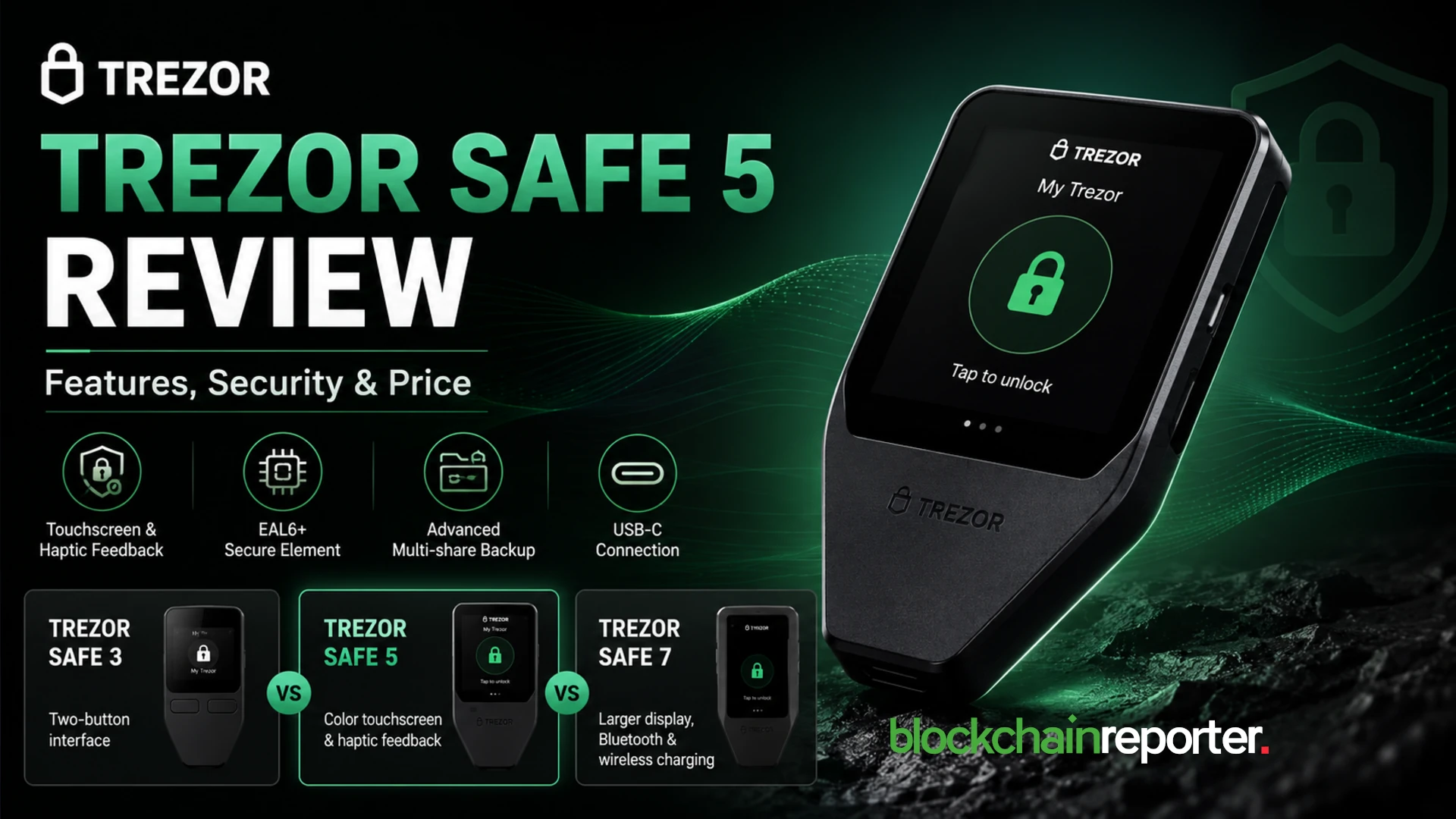
A Trezor Safe 5 bought from the Southeast Asian reseller CryptoBilis carried a hardware implant that copied what appeared on its screen, including the recovery phrase. On 12 November the company said its lab had confirmed the modification and that two more units among 48 customer devices showed the same board. The finding, published in Trezor’s investigation update , turns a single credible report into a confirmed supply-chain compromise and narrows the affected sales to a 34-day window between 20 August and 23 September 2026.
The 48 shapes what the three mean. Trezor reviewed 48 devices after asking CryptoBilis buyers to come forward, and the company’s own wording is careful about what that sample can support: “three Trezor Safe 5s bought from CryptoBilis contain the implant, including the one reported to us in October.” Of those three, only one went through the lab. The other two were identified from photographs of their internals sent by their owners, which is a weaker class of evidence than a teardown and remains the reason the finding should be read as a bounded problem rather than a measured infection rate.
What the teardown found: a board that copies the screen
The implant is an extra circuit board fitted between the Safe 5’s main board and its display. Trezor describes the behaviour in one sentence: “It only listens: it copies everything shown on the screen, including what you type on the device.” That sentence explains why the usual checks failed. The device keeps verifying its own firmware. It keeps showing the legitimate interface. It keeps signing transactions correctly, because nothing in the signing path is altered.
What was added sits outside the software boundary. The board reads the display, recognises the recovery words when they appear, stores them, and relays them over a cellular link to a server controlled by whoever built it. Because the seed is displayed once during setup and again when a backup is verified, a compromised unit needs only a few minutes of a buyer’s attention to lose the one secret that hardware wallets exist to protect. Trezor’s embedded team extracted and analysed the firmware from the reported unit, which is the difference between the October advisory and this month’s update: in October the company had a customer description and a video interview, and it said so.
Three devices, two marketplaces, 34 days
All three affected units were bought between 20 August and 23 September 2026, through CryptoBilis’s Tokopedia and Shopee stores and directly from the reseller. The company states that none of the owners has lost funds, and that its checks on devices from other resellers in the region found no evidence of tampering. “We have no confirmed cases outside CryptoBilis,” the update says.
The purchase window is the most useful constraint in the document. Thirty-four days is short enough to suggest an intervention confined to a shipment or a warehouse rather than a practice running for months, and it gives every buyer a test that requires no technical skill: the channel and the date on the invoice. It also produces the obvious gap. Trezor has not published how many Safe 5 units CryptoBilis sold in that period, so the number of devices that were never submitted for review cannot be estimated from the report, and the 6.25% implied by three cases out of 48 describes a self-selected group of worried customers, not the population of units in circulation.
The 49 to 83 days that firmware 2.13.1 cannot reach
Trezor released firmware 2.13.1 on 11 November. The company says the update stops the implants it has found from capturing anything, making, in its words, the current batch of implants useless. The timing is where the arithmetic matters. A device bought on 20 August ran unpatched for 83 days before that release. A device bought on 23 September ran unpatched for 49 days. Any seed shown on a tampered unit inside that gap has to be treated as copied, and the update does nothing about it.
The company does not soften the conclusion: “If you bought from CryptoBilis, you should still move your funds to a new wallet with a new seed, because the update can’t protect a wallet backup that was captured before it.” Its earlier notice said the same thing in operational terms, warning that reusing the backup generated by a tampered wallet on a different device does not solve the problem.
Moving to a new seed is more than a transfer. A new wallet means new addresses, so any recurring payment, payroll destination or exchange withdrawal whitelist that pointed at the old addresses has to be updated, and token approvals granted from the old address should be revoked rather than left live. The recovery phrase is the only credential in self-custody that a user cannot rotate in place, and that asymmetry is what makes hardware-level capture more damaging than a phishing page.
An 80% cut leaves roughly one reseller in five
Trezor also cut its reseller network by about 80% and imposed stricter rules on the partners that remain, covering how devices are sourced, stored and physically accessed. The company was explicit that the removals were not accusations: “The partners we removed were trustworthy and posed no immediate threat, but they didn’t fit the much stricter processes every remaining reseller will now have to follow to protect the supply chain.”
Read as market structure, the decision moves a control point. A manufacturer can audit its own line and its own firmware, but it cannot audit a warehouse in another country that it does not operate. Removing four of every five intermediaries converts an unverifiable distribution layer into a smaller, contractual one, and the cost lands on buyers in markets where direct shipping is slow, expensive or exposed to customs. Trezor concedes as much: shipping rules mean it cannot deliver every model to every country, and in some cases it will offer a different model with the price difference refunded, delivery to an address in another country, or a refund.
For institutional allocators the lesson is narrower than the headline. The failure was physical, not cryptographic, and it happened after the device left the factory. Custody arrangements that treat hardware as a solved problem, without recording provenance, shipping chain or first-power-on procedure, inherit exactly this exposure. The same reseller sat behind a parallel case: Ledger began investigating fund losses among CryptoBilis customers on 9 October, and Trezor removed the partner the same day , before it had examined a single Trezor unit.
What a CryptoBilis buyer should do
Anyone who bought a Safe 5 from the reseller between 20 August and 23 September should assume the device is compromised, and anyone who bought from CryptoBilis at any point since March 2026 is eligible for a replacement device, which Trezor will ship directly or cover with a voucher. The company’s instructions are specific about sequence. Keep the device. Do not set it up. Never enter an existing recovery phrase into it. Move funds to a newly created wallet with a newly generated seed, and if no second hardware wallet is available, use a software wallet or a familiar exchange as a temporary destination after checking the full receiving address.
Two warnings from the 29 October advisory still apply. Trezor says there is no reliable home test for the implant, so weight, packaging and firmware checksum are not evidence either way. And the incident has already produced impersonation attempts, including fake emails, letters and calls offering replacements: Trezor support never asks for a recovery phrase, and replacements are handled only through its own support channel . The company is coordinating with SEAL 911, the Security Alliance’s incident response service, and says it will not publish technical details that could help an attacker or expose affected customers.
For anyone holding funds on an older device from another channel, the safe-storage routine that matters is unchanged and documented separately: a seed generated offline, stored physically, and never typed into a computer or a browser form. The cold storage setup guide covers the parts of that routine a tampered screen can defeat.
What the report still cannot answer
Three questions remain open, and each one changes how the episode should be read. The first is volume: without the number of units CryptoBilis sold in the window, the size of the exposed pool is unknown, and the review of 48 devices cannot substitute for it. The second is the insertion point. The update describes the artefact and its behaviour, not where in the chain the board was fitted or who had physical access at that moment, which is the fact that would determine whether other sellers and other brands face the same risk.
The third is verification. The teardown was performed by the manufacturer, coordinated with an outside emergency-response group, and no independent audit of the implant has been published. That is a normal arrangement for an active investigation, and it is also why the finding should be treated as well-documented rather than settled. Trezor has committed to dating any change to the post, including a confirmed implant outside CryptoBilis or in a model other than the Safe 5, and to announcing new protections when they ship. Until one of those updates appears, the defensible reading is that the problem is bounded by channel and date, not that it is closed.
Frequently Asked Questions
Three, out of 48 units submitted by CryptoBilis customers. All three were bought between 20 August and 23 September 2026 through CryptoBilis’s Tokopedia and Shopee stores or directly from the reseller. One was disassembled in Trezor’s lab; the other two were identified from photographs of their internals.
No, if the device was used before 11 November. The update stops the implants Trezor has found from capturing anything on devices that run it, but it cannot protect a recovery phrase that was already copied. Trezor’s guidance is to move funds to a new wallet with a new seed.
Trezor says there is no dependable way to inspect a device yourself and that weighing it is not a reliable test. The practical check is the purchase record: a Safe 5 bought from CryptoBilis between 20 August and 23 September 2026 falls inside the confirmed window, and any purchase from that reseller since March 2026 qualifies for a replacement.
Trezor says it found no confirmed implant outside CryptoBilis and no evidence of tampering in devices from its other resellers in the region. It has committed to updating its post if that changes.