



The zero is the story. In the Kraken amendment Nakamoto Inc. disclosed on Nov. 12, no principal on its $164.9 million loan falls due in 2026.
Nakamoto Holdings, the Nashville company’s wholly owned borrowing subsidiary, pushed 60 million USDT of its 165 million USDT facility from Dec. 4, 2026 to Dec. 4, 2027, per the amendment disclosure . The other 105 million USDT still matures June 30, 2027. Both tranches now sit outside the current fiscal year, and the collateral definition widened in the same document.
The borrower needed that. Nakamoto closed Nov. 12 at $5.79, down 7.36% on the day, according to Nasdaq . Multiply the 18,346,473 shares the company reported outstanding as of Nov. 9 in its quarterly filing by that close and the equity is worth $106.2 million. The loan principal is $164.9 million. The market is pricing the company at 64 cents for every dollar Kraken is owed.
That gap is the whole trade. Either Bitcoin recovers enough to make the pledged coins comfortable again, or the lender ends up holding the collateral. The amendment buys twelve months on the smaller tranche without answering which one happens.
The maturity ladder Kraken agreed to
Read the amendment as a schedule, not a rescue. Before Nov. 11, Nakamoto faced a $60 million wall on Dec. 4, 2026 while trading below the value of its own debt. After it, the first date that matters is June 30, 2027, when 105 million USDT comes due, followed by 60 million USDT on Dec. 4, 2027.
The borrowing terms did not get cheaper. The June loan carries a 7.75% annual fee while Nakamoto holds at least 2,000 BTC in the Kraken trading wallet, and 8.00% when it holds less. On $165 million, that is $12.79 million a year at the lower tier and $13.2 million at the higher one, before any price effect on the collateral.
The waiver of 2026 maturities also resets the clock on the collateral test. Nakamoto pledged 3,805 BTC when the June loan was struck; the count stood at 3,030 at Sept. 30 after Kraken released 775 coins, which the company attributed to the rise in Bitcoin’s price during the quarter. That release mechanism is mechanical: more coin value per coin means fewer coins are needed to secure the same principal. It runs in both directions.
4,283 coins, 3,030 of them pledged
Nakamoto held 4,283 BTC at Sept. 30, carried at a fair value of $357.9 million, which works out to $83,565 per coin. Of those, 3,030 were pledged against the Kraken loan with a restricted fair value of $253.2 million. The remaining 1,253 coins, worth $104.7 million at the quarter-end mark, sat unencumbered next to $19.4 million of cash.
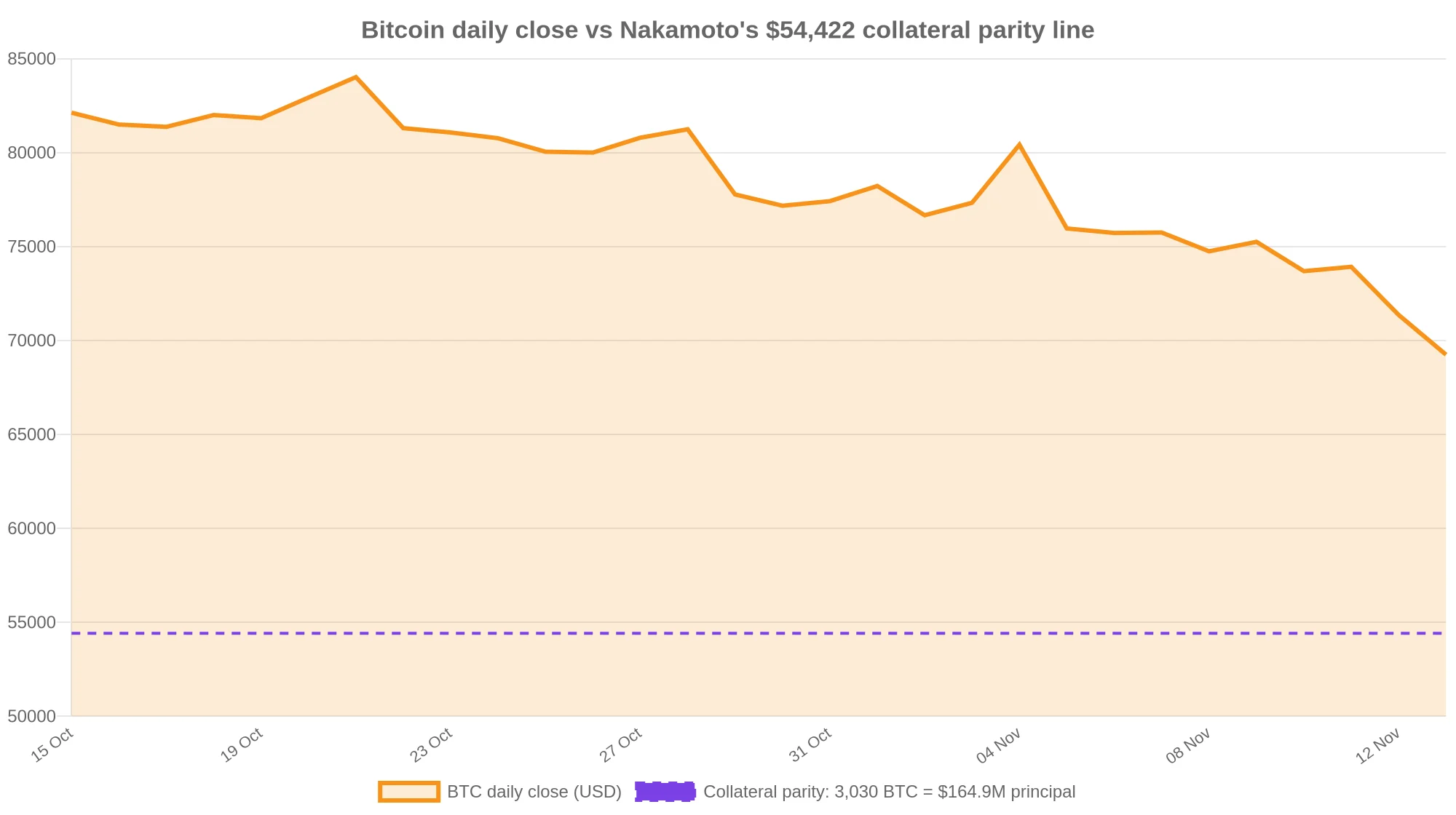
Bitcoin has since fallen. At $69,356 on Coinbase spot on Nov. 13, the pledged stack is worth $210.1 million against $164.9 million of principal, a coverage ratio of 1.27x. It was 1.54x at the Sept. 30 mark. The unencumbered buffer is worth $86.9 million.
| Bitcoin price | Value of 3,030 pledged BTC | Coverage vs $164.9M principal |
|---|---|---|
| $83,565 (Sept. 30 mark) | $253.2M | 1.54x |
| $69,356 (Nov. 13 spot) | $210.1M | 1.27x |
| $60,000 | $181.8M | 1.10x |
| $54,422 | $164.9M | 1.00x |
The last row is the number worth memorizing. At $54,422, the pledged coins equal the principal one for one, with nothing left over for the interest that keeps accruing. Bitcoin would need to fall another 21.5% from the Nov. 13 spot to get there. Each further 10% decline in the price strips roughly $21 million, or 0.13x, off the coverage ratio.
Two caveats keep that from being a liquidation price. First, the maintenance and liquidation thresholds in the master loan agreement are not disclosed as percentages. The filing says only that a breach of the maintenance line obliges Nakamoto to repay part of the loan, pledge more Bitcoin, or both, and that a fall through the lower liquidation line is an event of default Kraken can enforce by selling the coins. Second, Nakamoto has 1,253 free coins it can pledge before any of this becomes a forced sale. The $54,422 line is where the arithmetic gets uncomfortable, not where Kraken’s margin desk acts.
What the new collateral was actually worth
The amendment’s headline change is that the net value of Nakamoto’s Bitcoin derivatives in its pledged Kraken trading account now counts as collateral, floored at zero. On the last balance sheet, that book was a net liability.
The 10-Q shows $2.3 million of derivative assets against $8.7 million of derivative liabilities at Sept. 30, a net position of minus $6.4 million. Nakamoto writes covered calls and call spreads for premium and buys protective puts against drawdowns. The “not less than zero” language in the amendment tells you the lender knows the sign can be negative: a losing options book adds nothing to collateral, but it does not subtract from it either.
So the new collateral class is optionality for Kraken, not a fresh slug of Bitcoin. The substantive relief is the date change, and the company says so in its own words.
“This amendment extends our runway and makes our collateral position more resilient,” Chief Investment Officer Tyler Evans said in the release. “It gives us more flexibility to manage through Bitcoin price volatility so we can put our full attention on what we control: building our operating businesses and managing our Bitcoin holdings so that we can continue to grow through this market cycle.”
Read that as a statement about time, not about solvency. The forward-looking risk section of the same release is blunter than the quote: a decline in Bitcoin’s price could “require the Company to repay outstanding loan amounts or pledge additional collateral, or result in an event of default and the liquidation of collateral at unfavorable prices.”
The $85.5 million quarter was a Bitcoin mark
The results filed Nov. 13 make the same point from the income statement. Nakamoto reported net income of $85.5 million, or $4.07 per diluted share, on total operating revenue of negative $1.9 million. The profit came from a $110.4 million gain on the change in fair value of digital assets, which is 129% of net income. Strip the mark out and the adjusted operating loss was $15.8 million.
Revenue itself was thin where it matters. The operating businesses, Bitcoin Magazine, the conferences and UTXO’s asset management, produced $3.9 million in the quarter. Net derivative revenue was negative $5.8 million, and the company attributed it to the rise in Bitcoin’s price during the period reducing the value of positions it had written. Annualize the $3.9 million of operating revenue and you get $15.6 million against a $12.79 million loan fee, so the financing alone consumes about 82% of the businesses’ annualized top line.
Chairman and CEO David Bailey framed the quarter around that gap. “We are doing this work while Bitcoin trades well below its highs,” he said in the results release . “Markets move in cycles, and we are building Nakamoto to perform through all of them, by extending our debt maturities and building operating businesses that earn revenue beyond our Bitcoin holdings.”
That accounting pattern is not unique to Nakamoto. Trump Media booked a $409.7 million profit on Bitcoin marks in its own third quarter, which is what a treasury company’s income statement looks like when the asset rallies, and what it looks like in reverse when it does not. The Q3 gain was struck at $83,565. At $69,356 the same 4,283 coins are worth $297.1 million, about $60.8 million less, and that swing lands in the fourth quarter.
Why the equity trades at 64% of the loan
Nakamoto’s shares have a second problem that has nothing to do with Kraken. The stock closed at $5.83 on Nov. 9, the filing notes, after a 1-for-40 reverse split on May 22 cured a Nasdaq minimum-bid deficiency that the exchange had flagged on Dec. 10, 2025. Nasdaq closed the matter on June 9, 2026.
The filing spells out what happens if the bid breaks $1 again: because the split falls inside the one-year lookback, Nasdaq’s listing rules would require a staff delisting determination rather than a fresh compliance period, subject to appeal. A second reverse split large enough to fix the price would push the cumulative ratio past the 250-to-1 threshold that also removes the compliance window. Equity that trades below the debt has limited room to raise its way out.
That is why the $106.2 million market value matters more than the 7.36% down day. A company whose shares are worth 64% of its secured debt cannot issue equity at a good price to repay the loan, cannot lean on the $25 million buyback it authorized in June and has not used, and cannot treat the 2027 maturities as a problem it can solve with a secondary offering.
The case that Kraken just voted confidence
The bull read is not stupid. A lender that expected a default would not extend a maturity by a year and widen the collateral definition. Kraken, whose parent Payward has been expanding through acquisitions and exchange partnerships, has every incentive to keep a $165 million Bitcoin-backed credit performing rather than seize coins into a falling market. Forbearance and confidence look identical from the outside until the collateral is tested.
The balance sheet also supports patience. Total Bitcoin plus cash is worth $316.5 million at current prices against $164.9 million of debt, and the company concluded in the 10-Q that its liquidity sources cover its needs for the next twelve months, with an explicit warning that Bitcoin’s price can change that. There is $86.9 million of unencumbered Bitcoin to pledge before anyone talks about liquidation.
Compare that with how the same trade ends when a treasury company decides the collateral is not worth defending. KULR sold its entire 1,099-BTC treasury for $80.1 million and repaid its Coinbase loan rather than carry the position through a drawdown. Nakamoto has chosen the other path twice now, in June and again this month.
Three things that would change the read
The parity line. $54,422 per Bitcoin is where 3,030 pledged coins stop covering principal. A weekly close below $60,000, the 1.10x row in the table, would put the maintenance question on the table for the first time since the June restructuring. The invalidation of the bear case is a reclaim of the Sept. 30 mark near $83,565, which would push coverage back above 1.5x and make the derivatives clause irrelevant.
An 8-K about collateral. Any filing disclosing additional Bitcoin pledged, a partial repayment, or a sale of unencumbered coins is the hard signal that the maintenance threshold was approached. The company has 1,253 coins it can post before that becomes visible, so watch the pledged count in the next quarterly filing as closely as the price.
The June 2027 wall. Extending the $60 million tranche moved one date. It did not touch the $105 million due June 30, 2027, which is still the largest single obligation on the balance sheet and the one that will need either a Bitcoin recovery, a refinancing, or asset sales. That date is about seven and a half months away, and one asset decides whether the company can meet it.
Disclosure: This article does not represent investment advice. The content and materials featured on this page are for educational purposes only.