Yes. MSCI is deleting Strategy from its indexes. The index provider published the final list of securities caught by its non-operating companies screen at 10:23 PM GMT on November 11, and the row for Strategy A reads Deleted. The change takes effect at the close of November 30, 2026, the same date MSCI applies the results of its November 2026 Index Review.
The MSCI announcement runs three paragraphs of procedure. The substance sits in the attached spreadsheet : 25 securities, six marked Deleted, 19 marked on Watchlist, each with an issuer market cap and a float-adjusted market cap dated October 20, 2026.
That file is the end of a process MSCI started on August 3 with a consultation and concluded on October 15 when it adopted the methodology. For anyone holding the stock rather than an index fund, the useful question is not whether Strategy leaves, but how much passive weight goes with it and when the rebalance clears.
Six Deletions, Nineteen Watchlist Names, One Effective Date
The list applies to constituents of the MSCI ACWI All Cap indexes and the MSCI Frontier Markets IMI indexes. MSCI dates the financial information to September 30, 2026 and the market capitalisations to October 20, 2026, which is also the price cutoff for the November review. Every figure below is MSCI’s own, in millions of dollars.
| Security | Country | Segment | Action | Float-adj. cap ($M) |
|---|---|---|---|---|
| Strategy A | USA | Large Cap | Deleted | 37,258.0 |
| Yellow Cake | United Kingdom | Small Cap | Deleted | 1,752.8 |
| Metaplanet | Japan | Small Cap | Deleted | 797.1 |
| Skel Fjarfestingafelag | Iceland | Small Cap | Deleted | 103.0 |
| Agronomics | United Kingdom | Micro Cap | Deleted | 52.6 |
| Upexi | USA | Micro Cap | Deleted | 36.3 |
| Sharplink | USA | Small Cap | Watchlist | 223.6 |
| Urbana Corp NV A | Canada | Micro Cap | Watchlist | 185.4 |
| Stack Capital Group | Canada | Micro Cap | Watchlist | 163.1 |
| BNB Standard | USA | Micro Cap | Watchlist | 153.8 |
| Canton Strategic Hldg | USA | Micro Cap | Watchlist | 116.7 |
| Cipherpunk Technologies | USA | Micro Cap | Watchlist | 111.4 |
| Sui Grp Hldgs | USA | Micro Cap | Watchlist | 84.9 |
| TON Strategy | USA | Micro Cap | Watchlist | 72.2 |
| Capital B | France | Micro Cap | Watchlist | 67.8 |
| Solana Company A (US) | USA | Micro Cap | Watchlist | 61.0 |
| Logistics Dev Group | United Kingdom | Micro Cap | Watchlist | 54.2 |
| Flat Capital B | Sweden | Micro Cap | Watchlist | 48.1 |
| DeFi Dev Corp | USA | Micro Cap | Watchlist | 43.6 |
| Helios Fairfax Partnr Sv | Canada | Micro Cap | Watchlist | 42.7 |
| StreamEX Corp | USA | Micro Cap | Watchlist | 30.3 |
| APG Securities JSC | Vietnam | Micro Cap | Watchlist | 27.2 |
| Trendlines Group | Israel | Micro Cap | Watchlist | 20.9 |
| Quantum Solutions Co | Japan | Micro Cap | Watchlist | 20.4 |
| AI Financial | USA | Micro Cap | Watchlist | 15.1 |
Read the segments and the crypto angle disappears fast. Four of the six deletions are small or micro cap, and the watchlist is almost entirely micro cap. The one name that is not micro cap, not small cap and not a rounding error is the large cap at the top.
The Deletion List Is One Company and Five Rounding Errors
Add up MSCI’s float-adjusted column across the six deletions and the total is $40.00 billion. Strategy alone accounts for $37.26 billion, or 93.15% of it. The other five deletions combine to $2.74 billion. Strategy is 13.6 times the size of everything it is being deleted alongside.
The same arithmetic flattens the watchlist. Its 19 names carry $1.54 billion of float-adjusted market cap in total, about 4.1% of Strategy’s figure. So the final list is not a broad clean-up of small holding companies: one $40 billion company carries 93% of the affected float and the other 24 names share the rest.
MSCI’s own two columns also show how it treats the float. Strategy’s issuer market cap is $40.06 billion and its float-adjusted market cap is $37.26 billion, a float factor of 93.0%. Roughly 7% of the company is treated as non-float for index purposes.
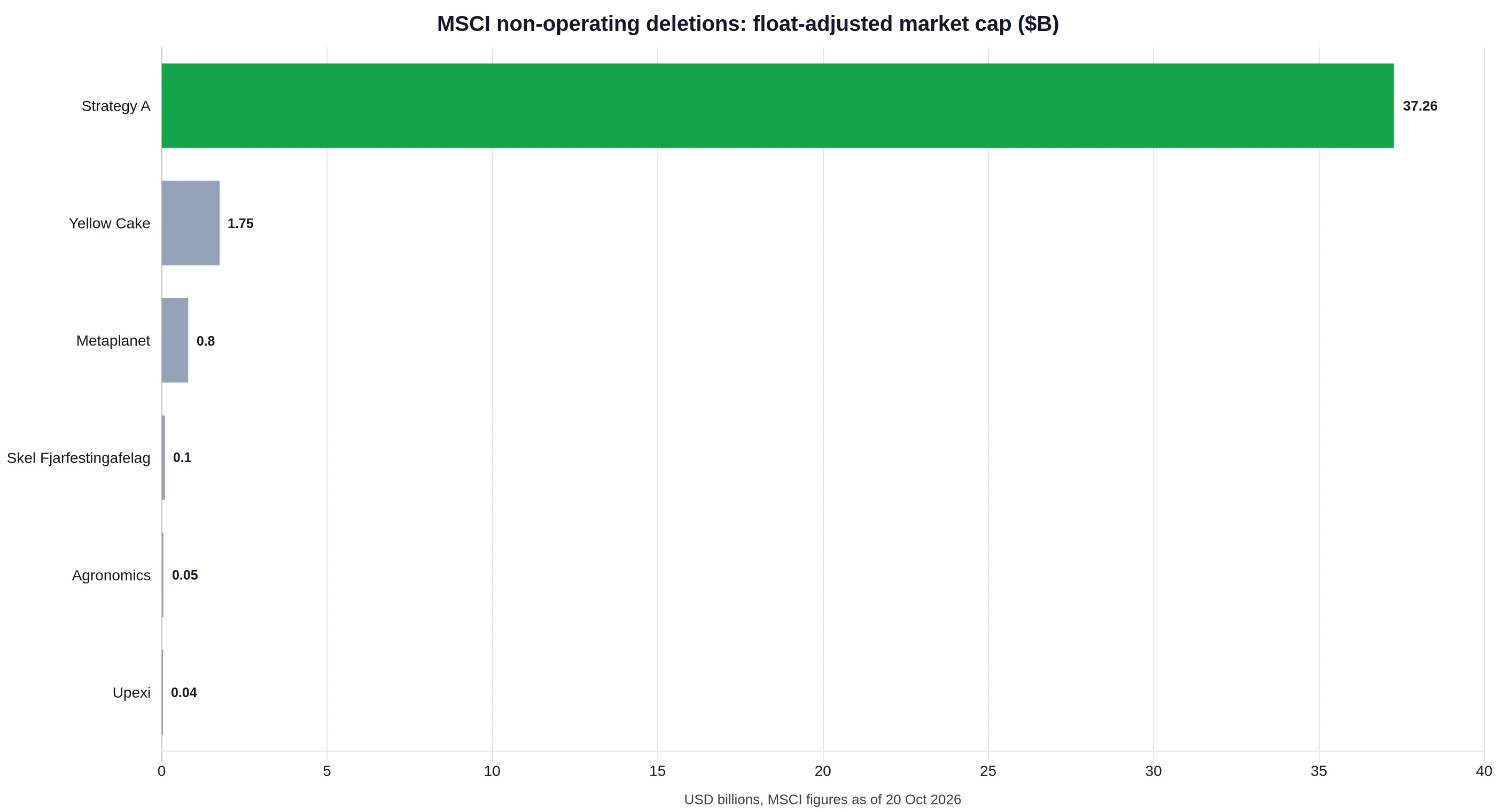
The concentration matters for the rebalance mechanics. An index deletion is a scheduled flow, not an opinion. Funds that track the affected MSCI indexes must hold what the index holds at the close of November 30, which means the selling is dated, mechanical and known in advance to anyone reading this file.
How a Screen Built for Holding Companies Reached a Bitcoin Treasury
MSCI’s methodology runs two stages. The first is a core screen, described in the announcement as “an initial core screen to determine whether an issuer is a company with substantial operating assets.” Issuers that fail it go to a second stage: an exclusion screen scored on five financial ratios that have nothing to do with industry. In MSCI’s words, “a security will be ineligible for index inclusion if it is flagged on four or more of the five ratios.”
The buffer is the part most readers miss. MSCI states that “current constituents will be removed only if they fail the ineligibility screen in each of the two most recent annual filing periods.” A company can fail once and stay. It has to fail twice, in consecutive annual filings, to lose its place. Non-constituents face the mirror rule: they cannot be added if they fail in either of their two most recent annual filing periods.
That timing explains the list’s composition. Eligibility is judged on annual filings, not on a quarter, so the deletions reflect balance sheets that were already public when MSCI ran the screen. It also explains why 19 companies sit on the watchlist rather than in the deletion column: they have failed at least one test, but not yet the two that trigger removal.
The review also retires an earlier patch. MSCI’s October 15 announcement said the interim measures announced on October 10, 2025 for companies whose digital asset holdings represented 50% or more of total assets would be discontinued with the November 2026 review. Those measures included a freeze on number of shares, foreign inclusion factor and domestic inclusion factor increases, and a deferral of additions and size-segment migrations. From December, the general screen does the work instead.
What Changed Between the August List and the Final One
The consultation document published in August carried 22 names: five deletions and 17 on watch. The final list carries 25: six deletions and 19 on watch. Three names moved, and the direction of each move is informative.
Agronomics was not on the August list at all and arrives as a deletion. Enlivex and GD Culture dropped off the watchlist entirely. Four names entered it: BNB Standard, StreamEX Corp, APG Securities and Quantum Solutions. None of the four is large, and the largest of them, BNB Standard, carries $153.8 million of float-adjusted value.
So the screen is alive between consultations. A company’s position on it can change in either direction inside a single review cycle, and the difference between the preliminary and final lists is three names on a list of 25. Treating either list as permanent would be a mistake; treating the effective date as firm would not.
Strategy Also Appears in the MSCI USA Deletion Column
The non-operating file is not the only document published on November 11. The standard index additions and deletions file lists Strategy A among 24 deletions from the MSCI USA Index. The full deletion list is Annaly Capital Management, AST SpaceMobile A, Carlyle Group, Charter Communications A (new), Cooper Companies, Corteva, Deckers Outdoor, Dicks Sporting Goods, Fabrinet, Flutter Entertainment (US), FNF Group, Gen Digital, IREN, Lennox International, McCormick, Mid-America Apartment Communities, Neurocrine Biosciences, Pinnacle Financial Partners, Regency Centers, Strategy A, Sun Communities, Textron, Watsco and Weyerhaeuser. Moderna is the single addition.
MSCI USA supplies the American sleeve of MSCI World and MSCI ACWI, so a deletion there reaches further than one country index. The review press release puts the wider turnover at 13 additions and 100 deletions for MSCI ACWI, 113 additions and 272 deletions for MSCI ACWI IMI, and 171 additions against 243 deletions for the ACWI Small Cap index.
One caution on attribution. MSCI does not attach a reason to each line in the standard file. Strategy appears in both documents, which is consistent with a removal driven by the non-operating methodology, but the provider does not say so line by line, and IREN’s deletion in the same column may have an entirely different cause. Read the overlap as corroboration, not as a stated cause.
What the Deletion Does Not Do
Three things are absent from the file. There is no index weight for any security, no estimate of assets tracking each index, and no flow forecast. The passive selling that follows cannot be sized from MSCI’s spreadsheet, and anyone quoting a dollar figure for it is supplying their own assumption.
Nothing is sold today. Index funds rebalance at the close of November 30. Active managers, discretionary holders and funds benchmarked to S&P, FTSE Russell or CRSP products are unaffected by this decision. The watchlist is not a deletion either: those 19 companies keep their places unless they fail the screen twice.
MSCI also keeps its own escape hatch. The review file notes that results may be updated for corporate events, ineligible alert board treatments and other adjustments between the October 20 price cutoff and the November 30 effective date. A merger, a spin-off or a restatement between now and then could change an individual line.
The Countercase: The Premium Was Already Thin
The bearish read is straightforward. Index inclusion gave Strategy a permanent, price-insensitive buyer, and losing it removes a structural bid. That argument carried more weight when the stock traded at a large multiple to the bitcoin it holds. It carries less now.
Strategy’s own metrics page , updated after the November 11 close, reports 850,364 bitcoin, equal to 4.05% of total supply, and a bitcoin reserve of $62,625 million at a spot price of $73,644. The same page shows MSTR at $122.35, a market value to net asset value of 1.08x, net bitcoin of 650,136 coins, $6,714 million of debt and $12,946 million of preferred stock.
Run the numbers both ways. Gross holdings of 850,364 coins at $73,644 are worth $62.6 billion, and the equity’s market capitalisation of $51,622 million sits at 0.82 times that gross reserve. Net of debt and preferred, 650,136 coins are worth $47.9 billion and the equity trades at 1.08 times, which matches the published mNAV. The premium over net asset value is single digit, not double digit. A structural bid that has already compressed to 1.08x has less to lose than the phrase index inclusion suggests.
There is a second reason for caution on the bear case. MSCI’s numbers are three weeks stale relative to Strategy’s own. The index provider’s issuer market cap of $40.06 billion is dated October 20; Strategy reported a market capitalisation of $51,622 million on November 11, 28.9% higher. The gap reflects different dates and different methodologies rather than a sudden re-rating, but it means the file’s weights are a snapshot, not a live measurement.
On scale, Strategy reported average 30-day trading volume of $2,676 million in the same update, against a float-adjusted market cap of $37.26 billion in MSCI’s file. Passive funds do not have to sell the whole float, only their pro-rata share of it, and the provider has not disclosed what that share is. The flow is dated and mechanical; its size is unknown, and that unknown is doing most of the work in both the bull and bear versions of this trade.
What to Watch Before November 30
The first observable signal is the rebalance itself. Watch MSTR’s premium to net asset value into the November 30 close and in the sessions after it: if index demand was a real part of the premium, mNAV should compress toward parity on the flow. If it holds near 1.08x, the index bid was a smaller factor than the liquidation story assumes.
The second is the February 2027 review, when MSCI revisits the watchlist. Watch which of the 19 names fail a second annual filing and move from watchlist to deletion. That transition, not the 25-name list, is the repeatable part of this methodology.
The third is Strategy’s own disclosure. The company reported 177,864 bitcoin acquired year to date with a bitcoin yield of negative 4.2%, and its buying has been the other half of the treasury trade. A company that keeps accumulating while its index weight disappears is telling you which of the two it thinks matters more. For readers tracking the treasury complex beyond this one name, our 2026 record of public company bitcoin sales and the cost basis arithmetic behind Strategy’s position set the base rates.
Frequently Asked Questions
Yes. MSCI’s November 11 final non-operating list marks Strategy A as Deleted, and the same company appears among the 24 deletions from the MSCI USA Index, which supplies the US portion of MSCI World and MSCI ACWI. The removal takes effect at the close of November 30, 2026.
At the close of business on November 30, 2026. MSCI applies all November 2026 Index Review changes on that date, using a price cutoff of October 20, 2026 for the underlying market data.
MSCI’s methodology asks first whether an issuer holds substantial operating assets, then applies an exclusion screen built on five industry-neutral financial ratios, with ineligibility triggered by four or more flags. MSCI does not publish a reason for individual names, so the specific ratios that caught Strategy are not disclosed in the final list.
They keep their index membership for now. Current constituents are removed only if they fail the ineligibility screen in each of their two most recent annual filing periods, and non-constituents cannot be added if they fail in either period. The watchlist therefore marks companies that have failed at least one test but not yet the two that force a deletion.
No. The decision affects which stocks index funds hold, not the company’s balance sheet. Strategy’s 850,364 bitcoin remain on its books; what changes is that funds tracking the affected MSCI indexes no longer need to own the equity after November 30.
This article is based on MSCI’s published index announcements and Strategy’s own investor metrics. It is not investment advice.