Türkiye’s authorities report 7.1 million crypto-asset accounts, 5.3 million account holders and roughly $200 billion in annual transactions in 2025. On 11 November the Financial Stability Board published its second peer review of Türkiye , and the gap it identifies is narrow and specific: “Stablecoins are not subject to comprehensive regulation, supervision and oversight.”
The report credits real progress. The Capital Markets Board licenses crypto-asset service providers. Client assets sit mostly with authorised depositories. Crypto payments are banned domestically. What the review does not find is any regime for the companies that issue the dollar tokens Turkish users hold as savings.
The FSB’s own framing is blunt about why that matters in this market. “In an EMDE setting, the absence of a comprehensive regulatory regime for stablecoins is more consequential given higher retail use, stronger FX-linked channels and the potential for digital dollarisation, making clarity on issuance safeguards a core financial-stability concern.”
The review reflects information as of August 2026 and was discussed by the FSB’s Standing Committee on Standards Implementation in September. It is not a rule-making document.
As the FSB put it in its announcement , the review “finds Turkish authorities have made meaningful progress”. The recommendations are addressed to Turkish authorities within their existing mandates, and nothing in the report changes Turkish law by itself.
What the FSB Listed, in Full
The report makes five recommendations. Each maps to specific FSB principles, and none is a single-line request.
Recommendation 1 asks authorities to keep full implementation of the crypto-asset (CA) and global stablecoin (GSC) recommendations as a priority. That is the umbrella item, and the four that follow specify where the distance remains.
Recommendation 2 targets CA recommendation 8, financial stability monitoring. Authorities should assess interconnections inside the crypto ecosystem and between it and the wider financial system, then identify key risk indicators and build collection systems that combine off-chain and on-chain data.
Recommendation 3 covers the provider framework, mapped to CA recommendations 1, 6, 7, 8 and 9. The FSB asks for “completing the transition from interim registration to licensing on a defined schedule, communicating expected timeframes for each stage of the process”.
It adds three more items. Authorities should engage audit firms on common findings and clear the review pipeline. They should standardise proof-of-reserve presentation and incident reporting, and improve how completely and quickly providers file to the central registry.
A fourth item asks them to assess how bank crypto exposures are treated, including possible future alignment with the Basel Committee’s SCO60 standard.
Recommendation 4 is the stablecoin block, mapped to GSC recommendations 1, 2, 3, 8 and 9. The FSB asks for issuer requirements “including redemption rights, effective stabilisation mechanisms and prudential requirements”, plus clarity on how stablecoins interact with payments and e-money law, while keeping safeguards against foreign-currency stablecoins in domestic payments.
The second limb covers distribution: targeted expectations on stabilisation mechanisms, reserve composition and transparency for foreign-issued, foreign-currency tokens circulating through domestic providers, with better cooperation with the issuer’s home supervisor.
Recommendation 5 asks for periodic review of cooperation and information-sharing arrangements, domestically and internationally, as oversight needs change.
Read together, the list is less about new prohibitions than about converting a licensing regime into a supervisory one, and extending it to an asset class the current perimeter only touches at the point of sale. The full report runs to 31 pages, with annexes on Türkiye’s implementation of G20 reforms.
A Licensing Queue Longer Than the Law
The legal foundation is recent. Amendments adopted in July 2024 brought crypto-asset services into the Capital Markets Law and gave the CMB its remit. A three-month application window opened in March 2025, with an “Actively Operating” list published so platforms could keep running during transition.
KuCoin TR filed its own SPK licence application that year, joining a queue the CMB is still working through.
First on-site inspections followed in the third quarter of 2025, covering governance, trading, custody, registry integration, outsourcing, proof of reserve and business continuity.
Then the schedule slipped. Authorisation deadlines were extended at the end of March 2026, with authorities citing custodian availability and audit bottlenecks, and exiting firms were required to file weekly wind-down returns.
Six banks had Banking Regulation and Supervision Agency preliminary approvals by late June 2026 and the CMB had deemed three “suitable”. Three banks had received custody licences in the preceding weeks, and none had begun serving clients.
The report names the constraints plainly. Technical reviews by TÜBİTAK carry no statutory time limit. Independent ICT audit capacity is thin, with firms accepting clients selectively. Data and private-key localisation rules, plus prescriptive custody controls, add cost and time for smaller custodians.
The custody rules themselves are demanding. A platform may hold no more than 5% of client crypto-assets in its own wallets, with the rest at an authorised depository institution. Hot wallets at depositories are capped at 5% of customer assets in normal conditions, with flexibility to 10% based on daily volumes, and at least 95% must be back at the depository by daily settlement.
Those are stronger structural safeguards than several larger markets require, and they are also part of why onboarding has been slow.
Banks face a separate sequence: preliminary BRSA approval, then a CMB licence backed by technical assessment and independent audits, then a BRSA authorisation to expand activity. The report puts the practical timeline at 12 to 18 months. Banks cannot hold crypto-assets on their own balance sheets, and crypto work must sit in ring-fenced subsidiaries.
The Two Market-Share Tables That Disagree
The report contains two pictures of who holds the Turkish market, and they do not match. Supervisory data puts BTC Turk at 29% and Midas and Binance TR at 19% each, which is 67% of the domestic market across three licensed venues. Blockchain data for the first quarter of 2026, cited from CoinDesk, puts Binance Global at roughly 70% and BTC Turk at 18%.
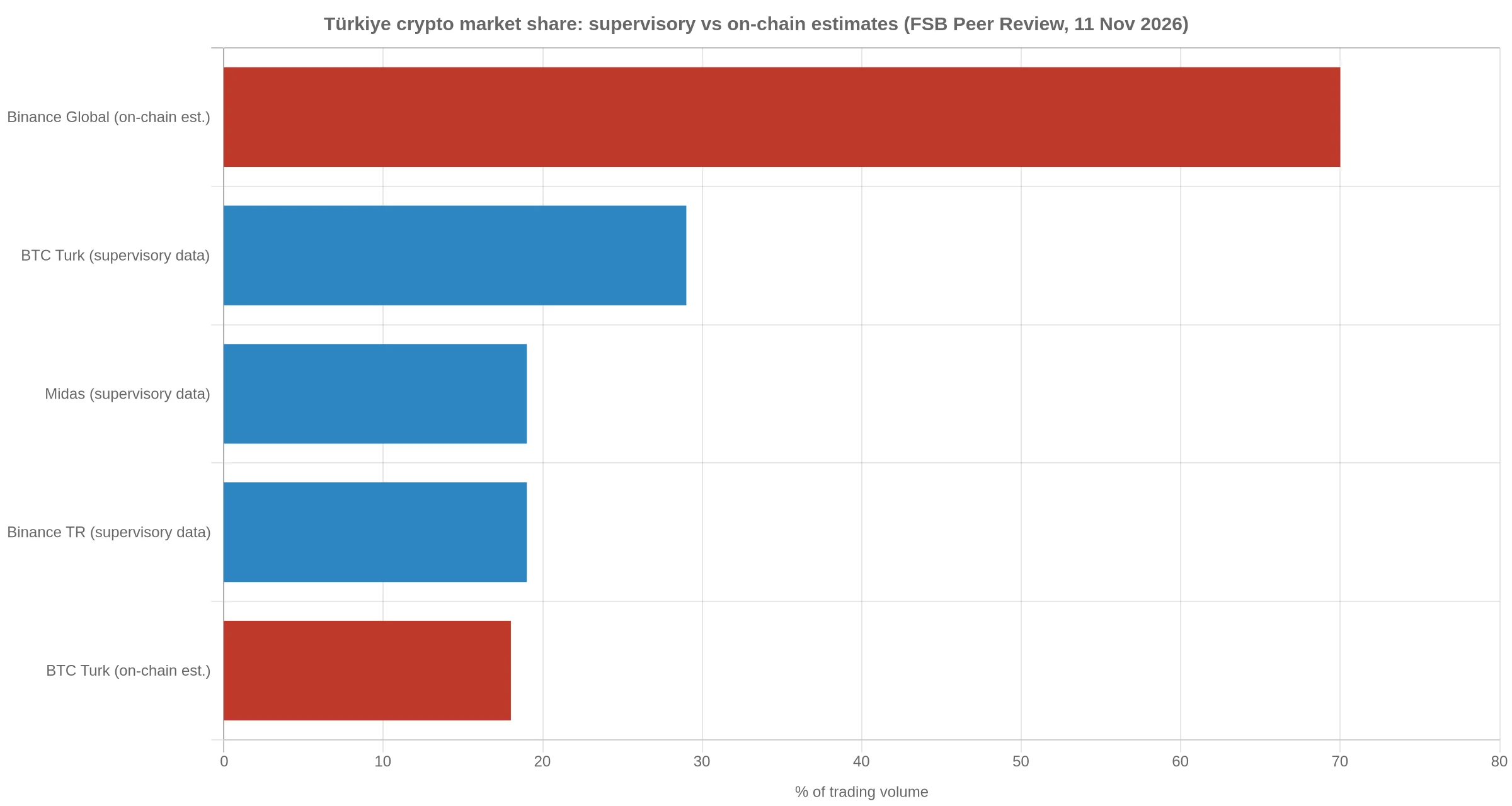
Both can be true. The supervisory figure measures what the CMB can see: platforms licensed in Türkiye. The on-chain figure measures where the wallets are. Turkish users seeking margin trading or derivatives, which domestic platforms cannot offer, onboard with foreign venues at their own discretion and outside Turkish protections, as the report itself notes.
That divergence is the operational core of the FSB’s concern. A regime that supervises 67% of visible volume but sees a market where most activity sits offshore has limited reach over the channels that transmit stress, including stablecoin flows that move value across borders in minutes.
The concentration inside the domestic market is also unusual. Four assets account for more than 45% of holdings: Bitcoin at 18%, Ether at 11%, XRP at 9% and USDT at 7%. Those four add to exactly 45%, which is the arithmetic the report’s “more than 45%” implies and a useful check that the figures come from one consistent dataset.
A Payment Ban With an E-Money Door Ajar
Türkiye has banned crypto for domestic payments since the central bank’s 2021 regulation. That rule works through two prohibitions: payment service providers cannot build crypto into payment services or e-money issuance, and licensed payment and e-money institutions cannot process transfers to or from crypto trading, custody or transfer platforms. Crypto on- and off-ramping stays with banks.
The FSB had already flagged cross-border stablecoin risks in its October thematic work. This review applies that framework to one country.
Yet an amendment to the Central Bank’s Regulation No. 31676 on payment services and e-money now allows certain currency-pegged stablecoins to be treated as equivalent to e-money. The ban does not apply to e-money, so the amendment opens a pathway to payments for stablecoins that qualify. Implementation is left to future central bank regulations that have not been issued.
That leaves issuers in an unusual position. They face no dedicated issuance framework, no reserve eligibility rules and no redemption standards, but they may soon face an e-money regime whose details are unwritten.
The FSB’s wording captures the interim state: “Setting these expectations would promote consistent oversight, improve transparency and reduce uncertainty, while work to clarify the e-money pathway continues.”
The supervisory tools that do exist are narrow. Crypto-to-crypto transfers are limited to $3,000 a day and $50,000 a month, with time-bound exceptions for corporate clients approved by a platform’s management board under enhanced due diligence.
The daily cap reaches the monthly ceiling in 17 days, so the monthly limit is the binding constraint, and the annual ceiling works out to about $600,000 per user.
Domestic stablecoin issuance is almost nonexistent. BiLira (TRYB) is the only stablecoin issued by a domestic entity, with a market capitalisation of about $5.9 million. Against $200 billion of annual crypto transactions, that is roughly 0.003% of the flow. The dollar tokens Turks hold are overwhelmingly issued abroad.
Why $3 Billion Is the Countercase
The authorities’ own view, as recorded in the report, is that exposures are modest. Crypto-asset holdings registered with Turkish providers came to about $3 billion in 2026, equal to roughly 0.3% of total banking-sector assets.
That is one dollar of registered crypto for every 333 dollars of bank assets, which is why the BRSA has been able to rely on supervisory expectations rather than formal prudential rules.
Measured against the equity market, the picture is different in one respect and similar in another. Borsa Istanbul’s market capitalisation was $406.9 billion in 2025, and registered crypto holdings equal about 0.74% of it.
But daily crypto trading volume of roughly $0.5 billion is about 12.8% of Borsa Istanbul’s $3.9 billion average daily turnover. Turks trade crypto at roughly one-eighth the intensity of their stock trading, on an asset base less than 1% the size.
That ratio explains the FSB’s emphasis on monitoring over prohibition. A market this small relative to banking assets can still generate outsized retail flow and cross-border movement, and the report notes that activity rises around periods of market or political uncertainty.
The countercase has limits of its own. The central registry, KVMKS, does not cover self-custodial wallets or service providers outside the reporting perimeter. Its weekly feeds have shown transmission delays, incomplete fields and limited reconciliation with custodian records, and proof-of-reserve attestations are point-in-time, missing intraday balances and encumbrances.
The 0.3% figure is a measurement of what is registered, not of what Turks hold.
On the prudential side, Türkiye has not implemented the Basel Committee’s SCO60 standard on bank crypto exposures. The BRSA’s position is that ring-fencing and a no-proprietary-trading expectation mitigate the risk, and the report accepts that this may need revisiting if permissible bank activity broadens.
What Would Show the Gap Closing
Four observable items would show whether the recommendations change anything.
The first is the central bank’s implementing regulations under the e-money amendment. Until they exist, the treatment of a fully reserved lira- or dollar-pegged token is an open question, and issuers cannot build to a rule that has not been written.
The second is a licensing schedule. The FSB asks for published timeframes at each stage and for audit capacity to be addressed. Watch whether the transitional arrangements are extended again, and whether the three banks holding custody licences actually begin serving clients.
The third is registry quality. Weekly KVMKS submissions are the only domestic dataset that can distinguish routine activity from concentration or cross-border stress, and the report’s complaint is about completeness and timeliness rather than design.
The fourth is cross-border reach. The CMB can use the IOSCO memorandum of understanding but has made limited use of it for crypto matters, and there is no stablecoin-specific cooperation arrangement. The report also notes that MASAK has a direct channel with Tether for AML/CFT information sharing and asset freezing, which is an enforcement tool rather than a supervisory one.
For readers holding dollar stablecoins through a Turkish platform, nothing changes this week. The licensing regime continues, the payment ban continues, and the transfer limits continue. What the review adds is a dated benchmark: a market with 7.1 million accounts, $200 billion of annual flow and no issuance rules for the instrument most of those users rely on to hold value.
Disclosure: This article does not represent investment advice. The content and materials featured on this page are for educational purposes only.