

Two governance votes opened at 09:22 UTC on 9 November 2026, and between them they ask the holders of Acala and Karura to approve the end of both networks. The Acala referendum, indexed on-chain as proposal 195 , keeps withdrawals and cross-chain transfers open until 10 February 2027, when the chain stops producing blocks. The matching Karura vote sets the same deadline for the Kusama-side network that served as Acala’s proving ground.
Karura’s proposal records that it was the first parachain on Kusama and the proving ground for Acala; between them the two networks shipped an EVM-compatible execution layer, a native DEX, liquid staking through LDOT and LKSM, and a stablecoin. Seven years of work now ends in a wind-down schedule, and the documents are explicit that the native tokens do not travel: “ACA cannot be withdrawn. As the native token, it stays on Acala,” the Acala proposal states, with the Karura text saying the same of KAR.
Both are signalling referenda. They grant a mandate, and the on-chain steps that carry it out follow through each network’s own governance. At the opening block the recorded tally on both chains stood at zero Aye and zero Nay, with the proposal ledger listing an electorate of 1,319,127,120 ACA, about 82% of the 1.6 billion maximum supply, and 130,189,450 KAR, roughly 81% of Karura’s 160 million.
Why Acala Says the Chain No Longer Pays for Itself
The motivation section of the Acala proposal is a short account of a liquidity thesis that failed on its own terms. Acala was designed as the DeFi hub of Polkadot, and the hub needed depth that never arrived. “DeFi depends on deep liquidity, and the liquidity Acala needed never arrived,” the document says, before naming the structural cause: Polkadot’s multi-chain design “split liquidity, users and attention across many parachains, and wallet infrastructure never made moving between them seamless.”
The conclusion is a cost statement rather than a market call. “Usage no longer covers the cost of running a dedicated chain,” the Acala proposal states. The Karura document reaches the same verdict in nearly the same words, noting that “the liquidity Karura needed never built up.”
That framing matters for how the decision should be read. This is not a protocol declaring that its product failed. It is a team concluding that a standalone chain, with collators, RPC infrastructure, coretime and governance overhead, is the wrong container for the activity that remains. Running a parachain is a fixed cost; DeFi liquidity is a variable revenue base, and the gap between them has been widening across the ecosystem for more than two years.
What Is Left to Wind Down: $252,065 Across Two Chains
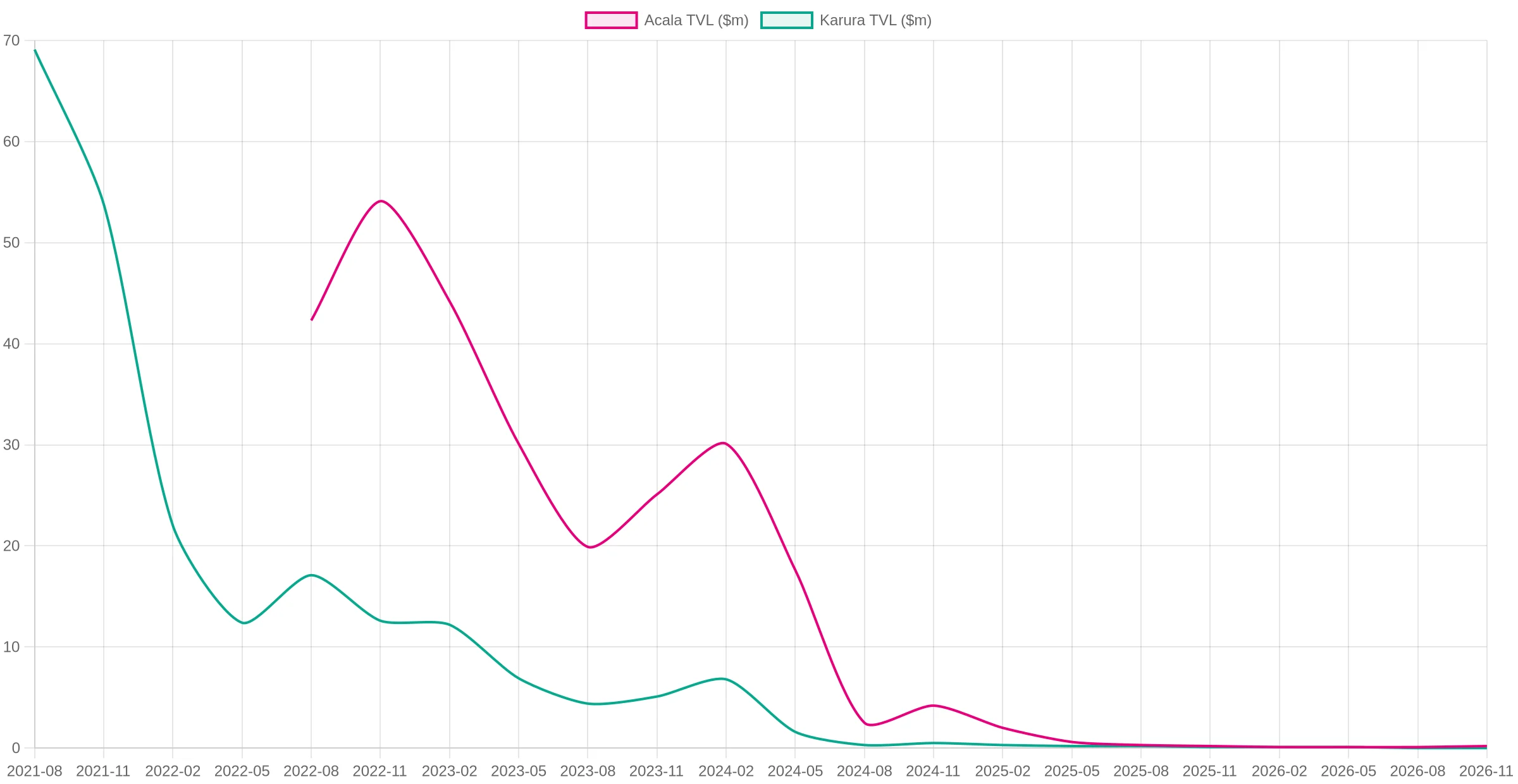
DefiLlama’s chain-level series puts the scale of the remaining business in plain numbers. Acala’s DeFi TVL stood at $224,838 on 9 November 2026 against a peak reading of $113.9 million, a decline of 99.80%. Karura’s stood at $27,227 against a peak of $79.65 million, down 99.97%. Combined, the two chains hold $252,065 of deposits.
The peak dates are worth reading carefully. DefiLlama dates Acala’s high to 14 August 2022, the date this publication reported the aUSD stablecoin exploit . A single-day reading from an incident window is a poor benchmark for organic demand, which makes the long decline after it, rather than the peak itself, the more useful measure. Monthly readings fell below $5 million in November 2024 and have not exceeded $1 million since May 2025.
The token market has priced that trajectory more aggressively than the deposit base. ACA trades at $0.00022758 with a market capitalisation of $265,508 and a fully diluted value of $364,125, down 99.99% from its January 2022 high of $2.79. KAR trades at $0.00022623 for a market capitalisation of $26,394 and a fully diluted value of $36,197, down 99.998% from $13.20 in September 2021.
One comparison frames the end state. KAR’s entire market capitalisation of $26,394 is now slightly smaller than the $27,227 of value still locked on Karura, a ratio of 0.97 to 1. The chain’s deposits are worth more than the token that governs them. On Acala the ratio runs the other way at 1.18 to 1. Neither multiple leaves room for a chain that must pay for blocks, nodes and governance out of the same pool.
Four Dates, Two Unbonding Periods, One Hard Stop
The exit is not a single deadline. The Acala text sets out a ladder that begins well before the chain stops, because Polkadot’s DOT takes 28 days to unbond. Holders of LDOT, Acala’s liquid staking token, must unbond by 12 January 2027 to have DOT in hand by the deadline. Those who locked LDOT to specific validators need to unbond by 16 December 2026, since that lock adds a further 28-day unlock to the queue.
On Karura the arithmetic is shorter. KSM unbonds in 7 days, so LKSM holders must unbond by 2 February 2027 to be clear of the stop date. Counting from 9 November 2026, that gives validators-locked LDOT holders 37 days, ordinary LDOT holders 64 days, LKSM holders 85 days, and everyone else 93 days until the chain halts.
The votes themselves have a shorter clock. Acala’s referendum opens at block 12,394,137 and closes at block 12,430,137; Karura’s runs from block 12,821,838 to 12,857,838. Both windows are 36,000 blocks. Acala’s proposal metadata timestamps block 12,394,006 at 08:56:36 UTC and the opening block at 09:22:48 UTC, which is 131 blocks in 1,572 seconds, or 12.0 seconds per block. At that rate a 36,000-block window runs five days and closes around 14 November 2026. Any holder who intends to vote has less time than the exit window suggests.
The Restart Argument: Why a Dead Chain Is a Live Liability
The most unusual part of both proposals is the case for spending money after the shutdown. A stopped chain does not disappear: its code and final state remain public, and anyone can restart it. With the original team gone, a governance flaw in the preserved state becomes an unguarded door. “A stopped chain can be restarted by anyone, and with no one maintaining or watching it, a governance flaw could be exploited to take whatever was left behind,” the Acala document warns, adding that better tooling, including AI, makes that prospect easier each year.
That reasoning explains two commitments that would otherwise look like unnecessary generosity. Both teams say they will do their best to return external assets stranded on the chains to their owners’ accounts on Polkadot Asset Hub and Kusama Asset Hub respectively, and both will donate the external assets held by their treasuries to the Polkadot and Kusama treasuries. The Acala text is careful about the limits: “Not every asset can be returned.”
The proposals also commit to keeping the lights on until the deadline. “Until 10 February 2027, we will keep collators and RPC nodes running and make sure Acala holds valid coretime, so the chain keeps producing blocks and every exit route stays open,” the Acala document states. That is a promise about infrastructure, not about price, liquidity or exit routes on the far side of a bridge.
Parachain Economics After the Auction Cycle
Acala’s diagnosis implicates Polkadot’s own architecture, and the market has already marked that architecture down. DOT trades at $0.878449 for a market capitalisation of $1.503 billion, a fraction of the valuation the network carried when parachain slots were auctioned at scale. The multi-chain model that was supposed to let specialised chains compete produced fragmentation instead, and the wallet layer never closed the gap.
The pattern is not unique to Polkadot. In September 2026 Harmony proposed shutting down its layer-1 and migrating the ONE token to Ethereum, a decision that followed the same logic: the cost of a dedicated chain outlasted the demand for one. What distinguishes the Acala and Karura votes is coordination. Two networks on two relay chains, with shared code and a shared team, are unwinding on a single date rather than drifting into dormancy separately.
That coordination has a practical benefit for users and a strategic cost for the ecosystem. Users get one clear deadline and infrastructure that keeps working until it. Polkadot and Kusama lose a visible DeFi venue each, and the deeper question, whether parachains can support standalone DeFi economies at all, is left open by two documents that describe the failure without proposing a replacement model.
What the Votes Do Not Settle
Neither referendum has passed. Both sit in the Started state with the full voting window ahead, and a signalling mandate is not the same as enacted code. The on-chain steps that follow, including treasury transfers and the final coretime commitment, still have to move through governance, and each is a separate opportunity for the schedule to slip.
The asset-return commitment is explicitly best-efforts. Holders who leave DOT, USDC or bridged assets on either chain past 10 February 2027 have a promise and a preserved state, not a guarantee, and the documents say so without naming which assets cannot be returned. Exchange and custodian support for the exit is also unaddressed: no announcement covers whether venues holding LDOT or LKSM will process unbonding on behalf of customers, and the 28-day DOT queue leaves little room for a late decision.
Price direction is the least informative variable. ACA’s 24-hour move of about 7.6% lower occurred on roughly $3,421 of recorded daily volume, a market too thin to read as a verdict on the referendum. The vote is a schedule, not a signal, and the schedule is the part holders can act on.
Frequently Asked Questions
Acala has put a sunset plan to a token-holder referendum that opened on 9 November 2026 at 09:22 UTC. If it passes, the chain stops producing blocks on 10 February 2027. The vote was still open at the time of writing.
ACA cannot be withdrawn from Acala. The proposal states the native token stays on the chain, whose final state is preserved. Only external assets such as DOT and bridged stablecoins are covered by the withdrawal window and the best-efforts return to Polkadot Asset Hub.
LDOT holders should unbond by 12 January 2027, because DOT unbonding takes 28 days. Holders who locked LDOT to specific validators must unbond by 16 December 2026, since that lock adds another 28-day unlock period.
Yes. Karura would also stop producing blocks on 10 February 2027 under referendum 137. LKSM holders have a later unbonding deadline of 2 February 2027 because KSM unbonds in 7 days, while KAR, like ACA, stays on its chain.
External assets held by the Acala and Karura treasuries are to be donated to the Polkadot Treasury and the Kusama Treasury respectively before each chain stops. The proposals do not state a dollar value for either transfer.
Data: DefiLlama , CoinGecko . Prices and TVL as of 13:35 UTC on 9 November 2026.