



The Office of the Comptroller of the Currency granted Coinbase final approval to charter Coinbase National Trust Company, the company said on Nov. 9, 218 days after the agency’s conditional sign-off. The charter covers fiduciary custody for institutional clients. It does not cover deposit-taking, lending, or stablecoin issuance.
The final step turns a spring promise into an operating federal license. In its announcement , Coinbase dates the decision to the previous Friday, which places it on Nov. 6, three days before the post went live. The conditional letter behind it — OCC Corporate Decision #1370 , signed April 2 by Senior Deputy Comptroller Stephen A. Lybarger — is the most detailed public description of the bank that now exists, and it is narrower than much of the coverage that followed.
What the OCC Put in Writing
The two-step is not unique to Coinbase. The agency points every applicant to its Charters licensing manual , and the April letter repeats the sequence: a de novo bank may organize once its articles are accepted, but “may not begin the business of banking until it fulfills all requirements for a bank in organization and the OCC grants final approval.”
The April decision describes a single-purpose institution. Coinbase National Trust Company is a wholly owned subsidiary of Coinbase Global with a main office in New York, in space leased from its parent. Its core activity is custody performed as a fiduciary: the bank “plans to provide digital asset custody services as a fiduciary, primarily for institutional clients.”
Two adjacent activities sit around that core. The first is transactional service inside a custodial account, letting custody customers accept, hold and transfer custodied fiat currency and digital assets. Cash held that way sits in “for benefit of” accounts at third-party banks rather than on the trust company’s own balance sheet, which keeps client money outside the bank’s estate. The second is finder work: the bank may introduce custody clients to staking, prime trading and prime financing run by Coinbase affiliates, under the finder authority in 12 CFR 7.1002, on the explicit condition that “the Bank will not be providing the underlying Staking, Prime Trading, and Prime Financing services itself.”
Fiduciary custody, transfers within custodied accounts and referrals to affiliates are the whole of the approved business. The decision contains no deposit franchise and no lending authority. The OCC grounded the charter in the 1978 amendment to the National Bank Act that confirmed its power to charter banks limited to trust-company operations, and concluded that custody and safekeeping sit inside what a trust company has always done.
| Owner | Wholly owned subsidiary of Coinbase Global, Inc. |
| Main office | New York, New York, leased from Coinbase |
| Core activity | Digital asset custody as a fiduciary, primarily institutional clients |
| Transactional services | Accept, hold and transfer custodied fiat and digital assets inside custodial accounts |
| Affiliate products | Finder only: staking, prime trading, prime financing |
| Customer cash | Held in “for benefit of” accounts at third-party banks |
| Deposits and lending | Not described in the decision |
| Stablecoin issuance | “The Bank does not propose to issue stablecoins” |
| Federal Reserve | Must apply for Reserve Bank stock under 12 USC 222 |
Five Commenters and the Stablecoin Sentence the Coverage Dropped
The decision also records what happened during the comment period, which is where the public argument over the charter can be read in full. The OCC received five comments: two from trade groups representing banks and three from community groups. Four of them addressed the OCC’s authority to charter the bank, arguing the proposed activities do not align with its precedent on fiduciary activities at national trust banks. Three said the public had too little information and too little time, a complaint the agency dismissed on the record, noting that those same commenters “were nonetheless able to provide voluminous comments on the Application.”
One commenter raised stablecoin issuance as a reason to refuse the application. The agency’s reply is a single sentence that has been largely lost in the summaries that followed: “However, the Bank does not propose to issue stablecoins, so the issues and argument are irrelevant to the Application.”
That sentence matters because it separates two things that are easy to merge. A national trust charter is a fiduciary license; it is not a payment stablecoin authorization, and the April record says plainly that this bank is not seeking one. Anyone reading the final approval as a stablecoin license is reading a different document from the one the OCC signed. If Coinbase later wants to issue a token through a federally chartered entity, that would be a separate application, a separate review and a separate public file.
Why Coinbase Traded a New York Charter for a Federal One
Coinbase has not been unsupervised. It has held a New York BitLicense since 2017, and its custody arm, Coinbase Custody Trust Company, has operated under a New York limited purpose trust charter since 2018. The federal step does not replace that history so much as move its center of gravity: the custody entity’s primary examiner changes from a state regulator to the OCC.
Coinbase frames the change in terms of consistency: “This charter allows us to bring clear and consistent federal uniformity to our industry-leading custody capabilities, and strengthens the regulatory framework under which we serve customers.” The company also leans on tenure as an argument for competence, writing that “For over 14 years, Coinbase has safeguarded digital assets at scale.”
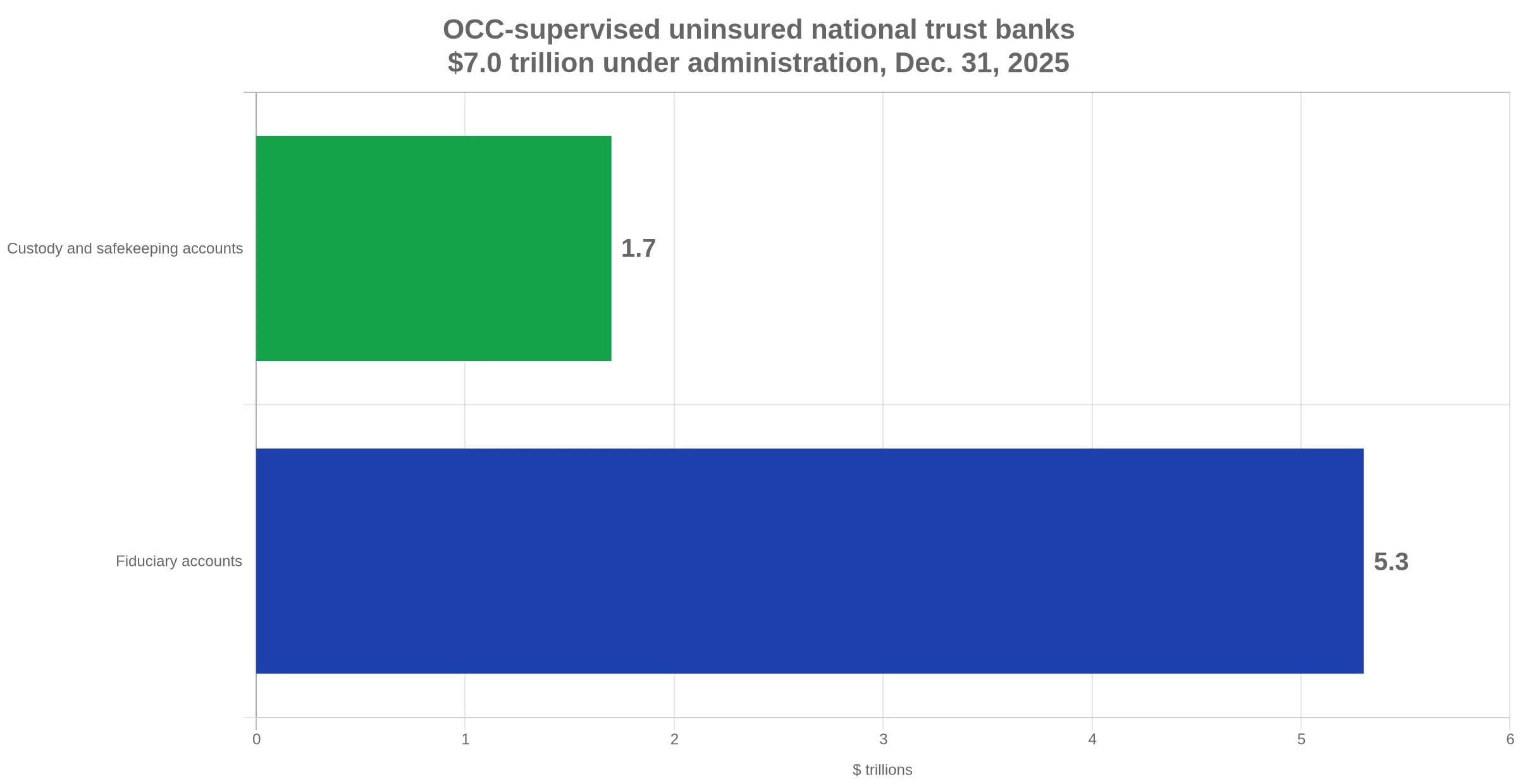
The decision gives a sense of the segment the bank is entering. As of Dec. 31, 2025, OCC-supervised uninsured national trust banks reported $7.0 trillion in assets under administration, split between $1.7 trillion in custody and safekeeping accounts and $5.3 trillion in fiduciary accounts. Custody and safekeeping is therefore about a quarter of the total, 24.3% by simple division, and the rest is fiduciary work of other kinds. A custody-only charter enters the smaller half of that pool, which is also the half most exposed to digital-asset growth.
One condition stays structural after the final approval. The OCC granted it “with the understanding that the Bank will apply for stock in a Federal Reserve Bank in accordance with 12 USC 222.” Reserve Bank stock is a membership requirement, not a master account, and the decision does not describe payments access of the kind a commercial bank would hold.
The Three-Year Move Out of Coinbase Custody Trust Company
The migration is the part of the decision with a clock on it. The OCC writes that “Coinbase will migrate the entirety of this custody business from CCTC to the Bank over the three-year de novo period.” Everything the New York trust company holds today is meant to end up inside the national trust company.
If the clock started with the April approval, complete migration falls due around April 2029. The decision does not publish a per-client timetable, does not describe how customer consent is handled when assets move between two Coinbase-controlled entities, and does not say what happens to a client who prefers the New York charter. Those are operational questions the bank answers privately, not conditions the OCC wrote into the order.
The governance is settled, at least on paper. Rick Schonberg is director and chief executive officer, Alesia Haas is director and chief financial officer, and Gregory Tusar and Paul Grewal sit as directors. Dana Wagner, Brian Dong and Robert Easton are the independent directors. The OCC waived the residency requirement in 12 USC 72 for Haas, Dong, Wagner and Grewal, an administrative detail that shows how quickly the board was assembled relative to the statutory requirement that directors live in the bank’s state.
The Lawsuit That Has Not Been Decided
None of this settles the legal question hanging over the trust-charter pipeline. In October, the Independent Community Bankers of America sued the OCC over the framework, in a case that challenges the agency’s reading of its own chartering authority and, by extension, the approvals granted under it, as covered in the ICBA’s October filing against the OCC .
Coinbase’s charter was granted under the same reading. The OCC addressed the authority argument directly in the decision, citing the 1978 statutory amendment and its precedent on trust company operations, and it concluded that the proposed activities are permissible for a national trust bank. It also reserved its own escape hatch: the agency “may modify, suspend, or rescind this approval if a material change in the information on which the OCC relied occurs.”
What a court would do with a charter already granted is a question the litigation has not reached. The honest reading is that the legal basis is contested while the license is live, and that a ruling against the agency would raise questions about the footing of every charter issued on the same reasoning, not that it would switch off an operating bank the following morning.
What Actually Changes for a Custody Client
For an institutional client, the practical change is the identity of the regulated counterparty rather than the menu of services. The custody work, the affiliate staking and financing referrals, and the transfer mechanics inside a custodial account all continue under a charter that describes the same activities. What changes is who examines the entity, which statute it is chartered under, and which supervisory escalation path applies when something goes wrong.
The decision does not announce new products. There is no new asset eligibility list, no change to fee schedules and no retail offering in the order. Coinbase’s own framing is institutional custody under a federal framework, which is a narrower claim than a consumer banking launch and closer to what the document actually authorizes.
The precedent is the more interesting read. Circle went through the same two-step earlier this year, converting a conditional trust charter into final approval in July, as Circle’s national trust bank approval showed. Coinbase now sits in the same category: a crypto company with a federal fiduciary charter, a state-licensed predecessor entity winding down into it, and a custody business that has to be re-papered inside three years.
The next observable dates are the bank’s Federal Reserve stock application under 12 USC 222 and the first migration tranche out of Coinbase Custody Trust Company. Neither has a published deadline, and the OCC’s order does not create one. Until those appear, the verifiable facts are the charter, the scope, and the three-year window.
Frequently Asked Questions
Coinbase now owns a federally chartered national trust bank, Coinbase National Trust Company. That is a trust company license for fiduciary custody, not a commercial bank license: the OCC decision describes custody, transfers inside custodial accounts and finder referrals, and does not describe deposit-taking or lending.
The OCC’s April decision does not authorize either activity. Customer fiat is held in “for benefit of” accounts at third-party banks, and the approved business is fiduciary custody plus related transactional and finder services.
No. The OCC decision states that “the Bank does not propose to issue stablecoins” and calls a commenter’s stablecoin objection irrelevant to the application. Stablecoin issuance would require a separate authorization.
The OCC granted preliminary conditional approval on April 2, 2026, in Corporate Decision #1370. Coinbase said final approval came on Friday, Nov. 6, 2026, and announced it on Nov. 9 — 218 days after the conditional decision.
Its custody business moves into the national trust company over the three-year de novo period, according to the OCC decision, which states that Coinbase “will migrate the entirety of this custody business from CCTC to the Bank.”
This article is not intended as financial advice. Educational purposes only.