



Stablecoin supply fell $6.66 billion in the seven days to 7 November, to $292.31 billion, the steepest weekly contraction of 2026 and the deepest since the week Terra’s UST collapsed in May 2022, according to DefiLlama’s daily stablecoin series . Tether and Circle accounted for $4.40 billion of the fall, 66% of the total. Neither token broke its peg: USDT traded at $0.99892 and USDC at $0.99945 on CoinGecko at 01:03 UTC on 8 November. The dollars left through redemptions, not through a discount.
The series has now declined for ten consecutive days, starting 29 October, and the rolling seven-day change has been negative on 29 straight days. Over 30 days, supply is down $15.03 billion from $307.33 billion on 8 October. Friday’s reading of $292.31 billion is the lowest since 24 September 2025, when the total stood at $291.68 billion. Measured from the 17 May peak of $315.54 billion, the market has shed $23.23 billion, or 7.36%, in 174 days.
For scale, $6.66 billion is 2.28% of the outstanding stablecoin base and 0.44% of bitcoin’s $1.52 trillion market value at the same moment. It is equal to 8.2% of the $81.07 billion of deposits that DefiLlama counts across its 421 supported chains. A contraction of that size does not empty lending markets. It removes a layer of the dollar liquidity those markets sit on.
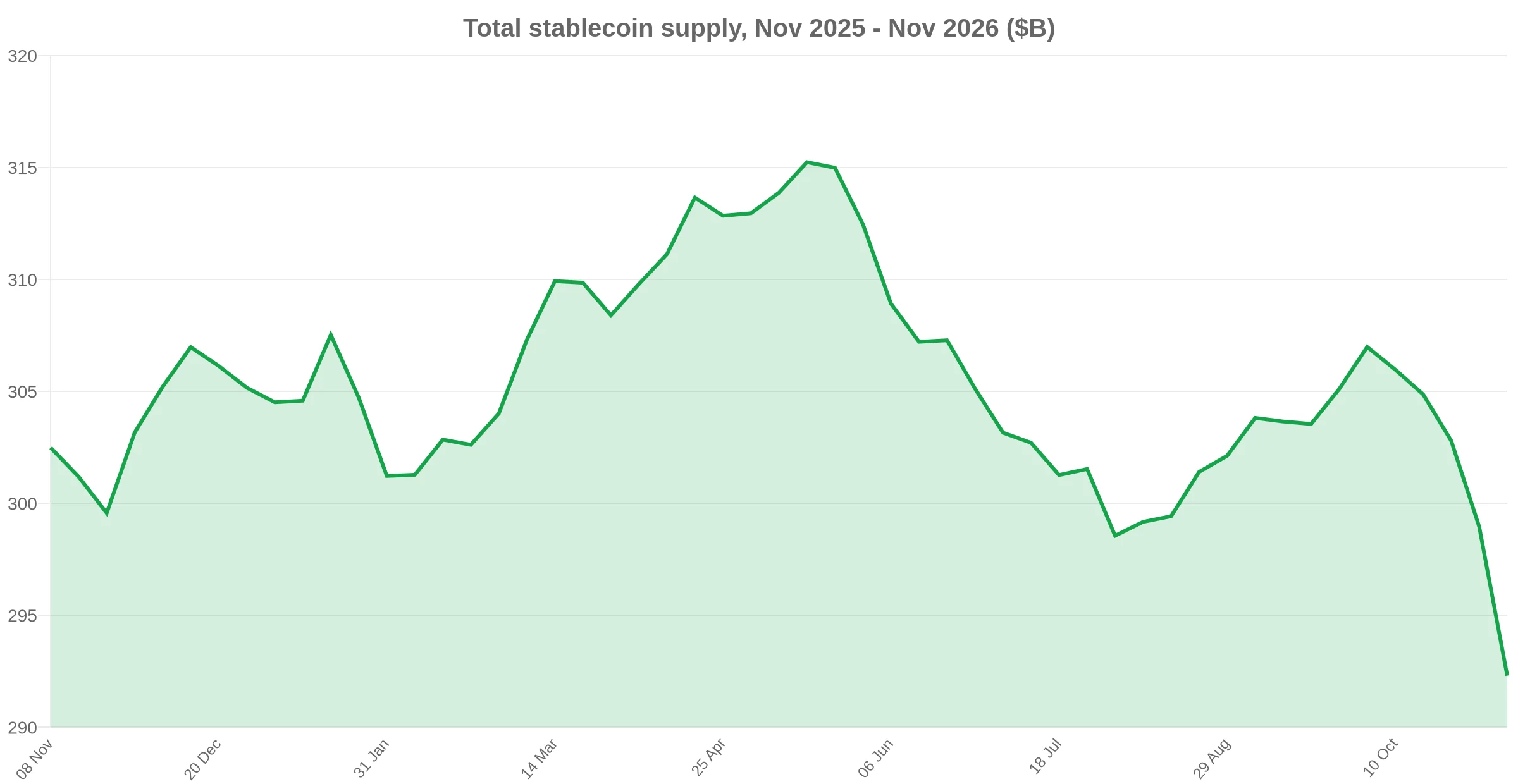
Ten Straight Down Days and the Steepest Week of the Year
The daily series makes the run legible. Supply stood at $303.25 billion on 23 October and held above $300 billion through 29 October, when the reading was $300.11 billion. It crossed below the next day at $299.70 billion, then slid to $298.96 billion, $298.36 billion, $297.62 billion, $296.01 billion, $295.13 billion, $294.55 billion, $293.73 billion and finally $292.31 billion. The three largest single-day drops came on 29 October (−$1.49 billion), 3 November (−$1.60 billion) and 7 November (−$1.42 billion).
Among the 311 rolling seven-day readings recorded in 2026, the one for 7 November is the most negative of the year, and the seven worst readings of 2026 all fall inside the current run. Before this stretch, the sharpest weeks were 1 February at −$4.08 billion and 7 June at −$3.81 billion.
Proportionally the comparison with 2022 is less alarming than the headline suggests. In the week to 15 May 2022, supply fell $27.4 billion against a $158.01 billion base, a 17.36% contraction. Last week’s $6.66 billion equals 2.28% of the base, 7.6 times smaller in percentage terms. The 2022 event was a run on issuers whose collateral was in question. This one is a steady withdrawal from the two largest issuers, both of which are still redeeming at par.
Two Issuers Account for Two-Thirds of the Drop
| Token | 31 October | 7 November | Change |
|---|---|---|---|
| USDT (Tether) | $180.09B | $177.00B | −$3.10B |
| USDC (Circle) | $71.90B | $70.60B | −$1.31B |
| USDS (Sky) | $6.45B | $5.59B | −$0.86B |
| USDe (Ethena) | $4.52B | $4.92B | +$0.40B |
| DAI (Sky) | $4.72B | $4.67B | −$0.05B |
| USD1 (World Liberty) | $3.89B | $3.54B | −$0.36B |
| PYUSD (PayPal) | $2.83B | $2.76B | −$0.07B |
| USDG (Global Dollar) | $2.94B | $2.72B | −$0.22B |
| RLUSD (Ripple) | $2.42B | $2.69B | +$0.27B |
| BUIDL (BlackRock) | $2.01B | $1.76B | −$0.25B |
USDT’s $3.10 billion decline is 46.5% of the total and USDC’s $1.31 billion is 19.6%. Sky’s USDS lost $864 million, World Liberty’s USD1 $357 million, BlackRock’s BUIDL $249 million and Global Dollar $217 million. Eight of the ten largest stablecoins shrank over the week, and exactly two grew.
The concentration shapes how the contraction transmits. Tether and Circle are the two largest issuers, and their tokens are the default quote asset on most spot and derivative venues. When their supply falls, the effect lands on the shared order-book base rather than on a single platform losing deposits.
Tether’s Own Attestation Points the Same Way
Tether’s third-quarter attestation, prepared by BDO and dated 30 September, described USD₮ issuance as “broadly steady at $184 billion” across the first three quarters. DefiLlama’s series for the same date shows $183.84 billion, a $160 million gap that sits inside the normal difference between issuer reporting and on-chain aggregation. Against Friday’s $176.997 billion, USD₮ is down $6.84 billion, or 3.87%, in the 38 days since that report.
The issuer’s own numbers explain why the redemptions have not produced a discount. The attestation put the reserve buffer at $7.95 billion, up from $4.1 billion at the end of the second quarter, with total reserve assets of $191.5 billion and $132.4 billion in direct and indirect Treasury bill holdings. Against the $6.84 billion five-week drawdown, the buffer covers 1.16 times. Against the $176.997 billion of USD₮ outstanding, reserves cover 108.2%.
Paolo Ardoino, Tether’s chief executive, framed the buffer as a redemption tool rather than a profit line in the attestation release . “ Our responsibility is to make sure USD₮ remains dependable when people need it most, including when markets and financial systems come under pressure ,” he said. “ Generating $1.5 billion in net operating profit while maintaining nearly $8.0 billion in excess reserves gives us a strong foundation for that work. ” Tether reported $4.5 billion in net operating profit across the first three quarters, $1.5 billion of it in the third.
Circle’s quarter shows a steeper slope on a smaller base. USDC stood at $74.58 billion on 30 September and $70.60 billion on 7 November, a decline of $3.99 billion, or 5.35%, in five weeks. Its third-quarter results reported revenue up 17% to $865 million while reserve income fell 8%. Chief executive Jeremy Allaire pointed to distribution rather than balances in the company’s release : “ In Q3, we saw continued proof that institutions are building and expanding on USDC. ” The same release disclosed a $100 million equity investment from Binance alongside a renewed partnership, and the Arc mainnet launch on 16 September.
Neither quarter is a distress signal, which is the point. The two largest issuers lost $4.40 billion of tokens in a week, and neither reported a reserve shortfall. Supply can fall because holders redeem, and that is a different event from supply falling because holders cannot.
The Long Tail Grew While the Leaders Shrank
USDe’s $404 million gain and RLUSD’s $270 million gain together offset 10.1% of the total contraction. Both differ structurally from the tokens that shrank. USDe is a synthetic dollar backed by hedged derivative positions rather than bank deposits, and RLUSD is issued by a company that also runs a payments network and settles on XRP Ledger as well as Ethereum.
Two tokens gaining is not proof of a rotation. Total supply still fell, which means most of the dollars that left the two largest issuers did not reappear elsewhere in the same quantity. What the split does show is where marginal demand went: toward instruments that pay a yield on the dollar rather than a token whose only promise is a peg.
What a $6.7 Billion Hole Does to Onchain Credit
A stablecoin is the unit in which onchain credit is denominated. Lending markets quote borrow rates in USDT and USDC, perpetual futures settle in them, and treasuries hold them as the cash leg. When the supply of those tokens falls 2.28% in a week, three things follow mechanically, without any change in borrower behaviour.
First, USD-denominated TVL falls at the same rate. A protocol holding $1 billion of USDC shows $977 million after a 2.28% contraction even if no contract changed hands. Second, the lendable float shrinks, so utilization rises for a given level of borrowing, and variable borrow rates follow utilization. Third, the same dollars are asked to do more work across venues, which is why a 2.28% supply move can register as a larger move in funding rates than its size suggests.
The run began on 29 October, the same day as the Binance breach that the exchange later said it had 98% replenished. The timing is worth naming and not overreading. A theft does not shrink stablecoin supply unless the stolen tokens are redeemed or burned, and neither issuer has linked the two events. The daily series also shows the decline accelerating after 4 November, with drops of $580 million, $822 million and $1.42 billion on consecutive days.
What the record supports is a demand story. Supply has fallen in every rolling seven-day window for 29 days, with bitcoin at $75,709 and ether at $2,233.87 on CoinGecko at the time of writing. Stablecoins are the cash leg of crypto positions; when the cash leg shrinks, gross exposure is usually shrinking too.
The Levels That Break or Confirm the Trend
Two readings matter for the next week, and both come from the same daily series rather than from a chart pattern. A close back above $300 billion, the level the total held on 29 October, would be the first sign that the run has stalled. A print below $291.68 billion, the 24 September 2025 reading, would be a new 2026 low and the weakest level since at least September 2025, extending the drawdown past the range that has held all year.
Pace matters more than the level. Five consecutive seven-day readings have landed between −$3.5 billion and −$6.7 billion. A week that closes with a decline under $1 billion would be the first deceleration since 29 October, and would mean new issuance is absorbing redemptions. The data does not yet support a stronger claim than that.
For DeFi, the number to watch is the ratio between stablecoin supply and total value locked. At $292.31 billion of stablecoins against $81.07 billion of TVL, that ratio is 3.6 to 1. Watching it separates a dollar exit from a risk exit: if TVL stabilises while supply keeps falling, the money is leaving crypto entirely; if supply stabilises first, the withdrawal was a rotation out of risk within crypto.
Data: DefiLlama , Tether Q3 attestation , Circle Q3 results , CoinGecko .
This article is for information only and is not investment advice. Stablecoin supply figures are DefiLlama’s daily series through 7 November 2026 and may be revised.