


On the morning of 4 November, TeraWulf told the market it had moved the credit risk of its largest customer onto Alphabet’s balance sheet. Google LLC signed credit support agreements covering roughly $19 billion of lease commitments that Anthropic owes the company’s Raylan Data subsidiary at the Justified campus in Hawesville, Kentucky. The same morning, TeraWulf announced a definitive engineering, procurement and construction contract with Fluor for the three buildings that will hold the tenant.
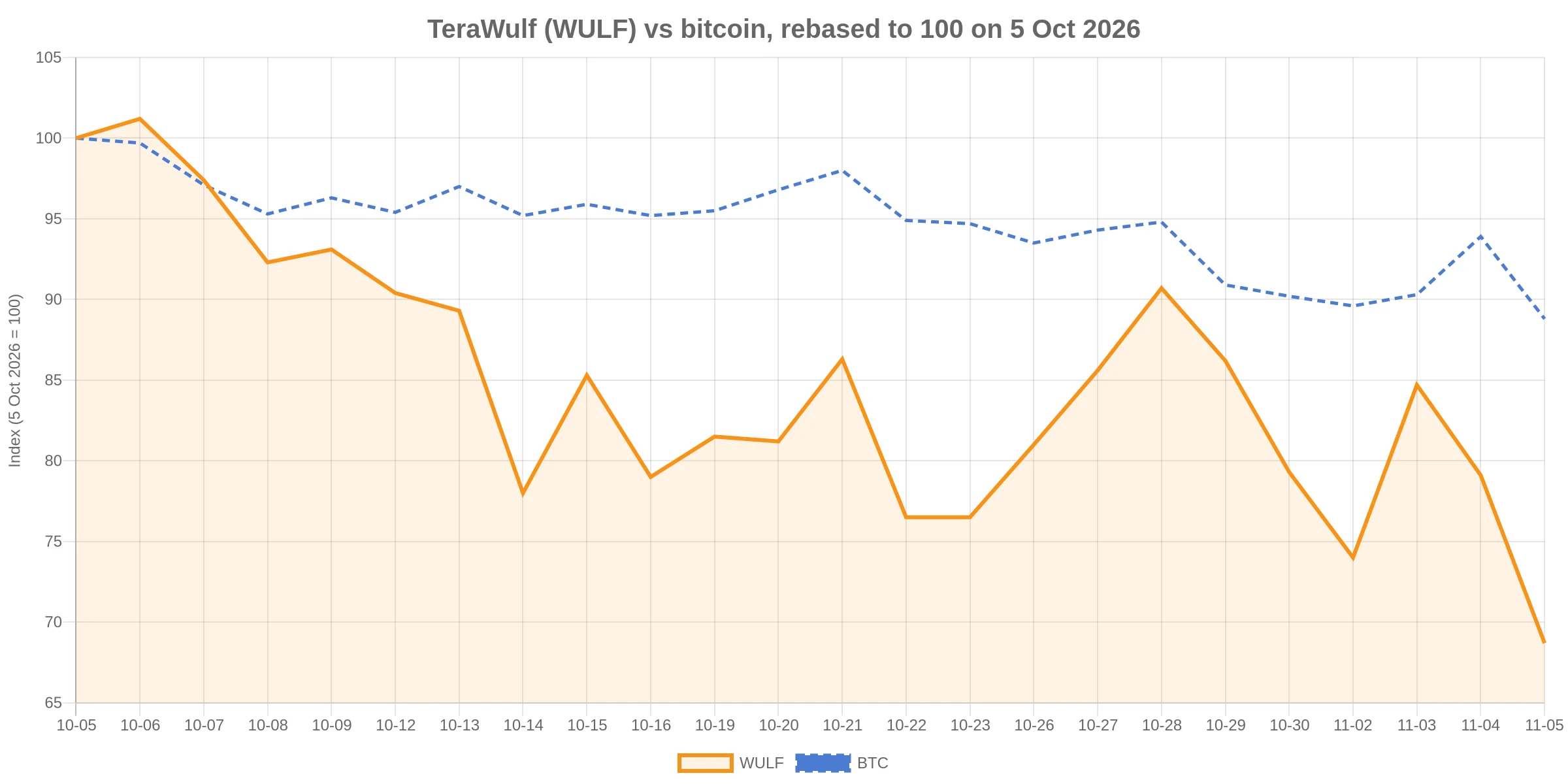
WULF closed that session at $11.70, down 6.6% from $12.53 the day before. On 5 November the selling continued. The stock closed at $10.08, down 13.8% on the day, after touching $9.51, which is also the low end of its 52-week range on a band that tops out at $29.84. Measured from the $14.79 close on 5 October, TeraWulf has lost 31.8% in a month in which it announced the two agreements that are supposed to make its largest project financeable.
The convenient reading is that investors misread the filing. The more useful reading is that a credit backstop solves a lender’s problem rather than a shareholder’s, and the two do not get resolved on the same schedule. What TeraWulf bought with Google’s signature is cheaper debt. What it did not buy is rent that starts any earlier, a tenant whose own balance sheet is investment grade today, or a share price that stops tracking the AI trade.
What Google actually signed
The mechanics matter more than the headline, because they determine who is on the hook and when. According to the Form 8-K TeraWulf filed on 4 November , the company’s subsidiary Raylan Data LLC signed a 20-year lease with Anthropic in July 2026 for about 401 megawatts of critical IT load, split across three data halls labelled CB-1, CB-2 and CB-3. Rent begins when each hall is delivered, with the phased handovers running from late 2027 into the second quarter of 2028.
The three credit support agreements, executed on 4 November, sit alongside those leases and involve Raylan, a wholly owned TeraWulf subsidiary called Justified DataPower LLC, Anthropic, and Google. The backstop does not switch on at signature. It becomes effective on the commencement date of the final data hall under each lease, and it terminates once Anthropic, or an affiliate that has guaranteed its obligations, holds investment grade ratings for at least three months. Alphabet’s own senior unsecured debt carries an AA+ grade from S&P Global Ratings and Aa2 from Moody’s, a detail TeraWulf put in the release for a reason.
If Anthropic misses a payment or runs into an insolvency event, the filing gives Google two paths. It can pay the rent then due and step into the lease as the tenant itself, or, under certain circumstances, pay a termination fee, after which it would be entitled to acquire an equity interest in Raylan. Google can also defer the choice for a set period, provided it keeps paying the rent that falls due while it decides. The termination fee amortises over a defined term, which is the filing’s way of saying the protection is worth most early in the lease and less later.
Read plainly, TeraWulf has converted a single-tenant credit exposure into an Alphabet exposure, with a path by which Google ends up holding part of the landlord if the tenant fails. That is a strong structure for a project finance lender. It is not a payment.
The $19 billion line, divided by 401 megawatts
TeraWulf describes the leases as roughly $19 billion of contracted commitments. Spread over the 401 MW of contracted IT load, that works out to about $47.4 million per megawatt across the 20-year term, or $2.37 million per megawatt per year. On a monthly basis the average works out to roughly $197 per kilowatt, a rate that sits inside the range large AI campuses have been signing at, and one that has to carry a 20-year escalation schedule rather than a flat price.
The same arithmetic explains why the campus is built the way it is. TeraWulf’s August release on the Kentucky Public Service Commission approval covered a retail electric service agreement for up to 482 MW at Justified. The Anthropic lease covers 401 MW of IT load, which is 83.2% of the approved power. The remaining capacity is the difference between a single-customer campus and a platform that can add a second tenant without going back to the commission.
Those figures also frame the risk the backstop does not remove. A 20-year lease signed in 2026 against capacity that will not be fully delivered until mid-2028 means TeraWulf carries construction, supply chain and power interconnection exposure for roughly six quarters before the first full rent cheque clears. Google’s support helps the company borrow against that gap. It does nothing about the gap itself.
Credit support is not revenue
Paul Prager, TeraWulf’s chairman and chief executive, framed the structure in the language of cost of capital. “We structured our Anthropic leases from the outset to address counterparty credit, financing costs and capital requirements,” he said in the release. “Google’s credit support strengthens our ability to secure competitive project financing, while Fluor’s engineering and construction capabilities expand our capacity to execute at scale.”
Chief financial officer Patrick Fleury put the same point more directly. “Cost of capital is fundamental to infrastructure development,” he said. “Strong investment-grade credit support strengthens the project’s financing profile and our ability to pursue competitive long-term debt, reinforcing our focus on disciplined capital allocation and attractive risk-adjusted returns.”
Both statements are about the debt TeraWulf has not yet raised. Neither says anything about when cash arrives. That gap between a better financing profile and a cash flow statement is where the 5 November selling happened, and the tape gives the argument its evidence. Bitcoin traded at $76,013 at 21:50 UTC, down 5.2% in 24 hours, and Nvidia closed at $181.60, down 9.3%, on the same Nasdaq feed that priced WULF. TeraWulf is now a stock that trades with both the AI complex and the bitcoin complex, and the available evidence does not establish the backstop announcement as the cause of either decline.
The company’s own chief executive made the shareholder-value argument before the market did. “Ultimately, megawatts alone do not create shareholder value,” Prager said. “What gives us confidence is what we have in the ground, what we have under contract, the investment-grade credit supporting those commitments and a team with decades of experience delivering large-scale infrastructure.”
That sentence is the honest summary of the position. The contracts exist, the tenant exists, the credit support exists, and the rent does not start until the buildings do. WULF has fallen 66.2% from its 52-week high, and bitcoin has fallen 11.4% over the same month in which the stock lost 31.8%, so the shares are discounting something beyond the price of the asset on the balance sheet.
Riot Platforms ran a version of the same experiment three weeks earlier. Its $28 billion Corsicana lease is also a long-dated contract with a single large tenant, and the same distinction applied there: contracted revenue against compute that still has to be delivered. TeraWulf’s version comes with something Riot’s did not, a named investment grade guarantor behind the rent.
Fluor signs, and a date in late 2027
The second half of the 4 November announcement got less attention than the Google clause and may matter as much to the schedule. TeraWulf executed a definitive EPC agreement with Fluor covering engineering, procurement, construction, testing and commissioning for the three data centre buildings at Justified, building on a limited notice to proceed first announced in March 2026. The contract is on a guaranteed maximum price basis, with the GMP being established as engineering and procurement progress, and it includes open-book cost reporting, procurement oversight and delivery milestones.
Prager described the logic of outsourcing that function. “Fluor gives us the ability to scale execution without building a global engineering and construction organization internally,” he said. “Their engineering depth, procurement capabilities and access to skilled labor complement our team’s decades of experience developing energy infrastructure.”
Labor is the constraint the market has started to price into every AI campus. The release leans on Fluor’s century of infrastructure delivery as the answer, and the milestone schedule puts phased ready-for-service completions between late 2027 and the second quarter of 2028. Every quarter of slippage in that window moves the first full rent payment, the debt service and the revenue line together. This is why the same filing that strengthened the credit story left the equity exposed: the credit support is dated to the commencement of the final hall, which is precisely the event a construction schedule controls.
The blank spaces in the 8-K
Three things a reader might want are not in the filing. The termination fee is described as amortising over a defined term but no dollar amount appears. The equity interest Google could acquire in Raylan is not quantified. And the debt financing the support is meant to enable has not been announced, so the cost of capital improvement Fleury described is still an expectation rather than a number.
There is also the question of the tenant’s own rating path. The backstop terminates once Anthropic or a guaranteeing affiliate holds investment grade ratings for three months. Until then, the credit support is the thing standing between the lease and TeraWulf’s own balance sheet, and the market has no way to model Anthropic’s trajectory from this filing alone. The questions hanging over Anthropic’s S-1 disclosures are the same ones sitting under TeraWulf’s tenant. Anyone who says the structure removes counterparty risk entirely has read the press release and not the exhibit.
Against that, the disclosures are unusually complete for a single material agreement. The company attached the form of the credit support agreement as Exhibit 10.1, named the entities, dated the effectiveness trigger and described the default paths in plain language. That is more than most project financings get at signing, and it is why the structure can be evaluated at all before the debt is priced.
Tomorrow morning, the numbers arrive
TeraWulf reports third quarter results and holds its call at 8:00 a.m. Eastern on Friday, 6 November, according to the scheduling release from October. That timing puts the balance sheet, the capital expenditure plan and any commentary on financing terms less than 24 hours after the market marked the stock down 13.8%.
Three things are worth watching in that call. First, whether management puts a number on the debt it expects to raise and at what spread, which is the only test of the cost of capital claim. Second, whether the construction schedule at Justified has moved, because the backstop’s effectiveness and the first rent payment both hang on hall delivery. Third, whether TeraWulf says anything about the remaining 81 MW of approved power at the campus, since a second tenant would change the concentration math that the Google structure was built to solve.
The wider story is that the miner-to-AI conversion trade has entered its credit phase. The first leg was announcements and megawatts. The second leg is financing, where the question is not whether a tenant signed but what a lender will charge against that signature. TeraWulf has answered the counterparty half of that question with the strongest balance sheet in the industry. The other half gets tested when the debt is priced.
One number to keep alongside all of this: the approved power agreement at Justified covers 482 MW and the Anthropic lease takes 401 of them. If a second tenant signs for the remaining 81 MW, the campus stops being a single-credit story and the Google structure starts looking like a bridge rather than the whole architecture.
Data: Nasdaq quote data for WULF and NVDA, Binance BTC/USDT, and Yahoo Finance daily closes.
This article is for information only and is not investment advice. Prices, levels and market data are a point-in-time snapshot and can change quickly. Always do your own research.