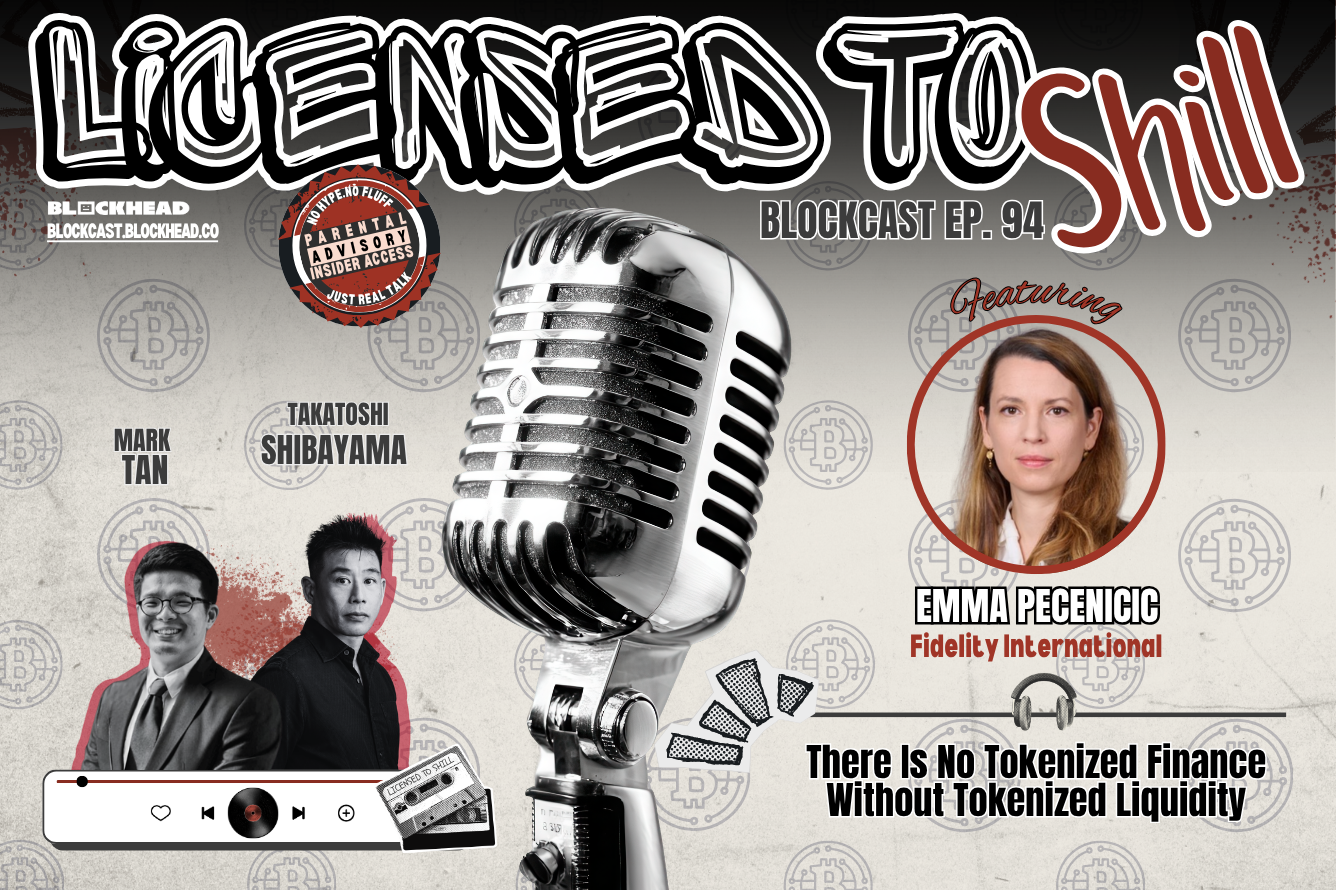
Emma Pecenicic, Head of Digital Assets Distribution at Fidelity International, argues that tokenized money market funds are the foundation every other on-chain capital market will be built on. "There is no tokenized finance without tokenized liquidity," she said on the latest episode of Licensed to Shill.
Pecenicic leads digital assets for Fidelity's offshore business across Europe and Asia, covering crypto ETP distribution and tokenization. Her team recently launched FILQ, a tokenized liquidity fund she describes as one of the first products to be both available 24/7 and rated AAA-mf by Moody's. That gives her a direct commercial stake in the thesis.
Her sequencing starts with cash. Stablecoins, bank tokenized deposits, CBDCs and tokenized liquidity funds form the settlement layer, with tokenized equities, bonds and ETFs to follow. "We're building the cash layer first," she said. She put tokenized US dollar liquidity and treasury funds at about US$1.5 billion in 2024 and US$16 billion by mid-2026, and cited PwC estimates placing the combined crypto-native, retail and institutional collateral opportunity at roughly US$8–9 trillion by 2035.
The gaps she identified are secondary market liquidity, connections between market makers and both TradFi and crypto venues, and regulatory acceptance of 24/7 peer-to-peer trading. She credited crypto ETF launches with drawing traditional market makers into the space, and said the US holds a head start because the DTCC now lets issuers connect directly to the book of records.
She was candid that automation only covers routine operations. Because the fund's underlying assets do not trade around the clock, 24/7 redemptions lean on credit facilities, liquidity lines and repo agreements. "The worst-case scenario has nothing to do with technology," she said, adding that Fidelity had to design processes for convening a board meeting on a Sunday night.
Current demand comes from crypto hedge funds and traders using the fund as yield-bearing collateral, stablecoin issuers managing reserves, and foundations investing treasury cash. DeFi vaults proved harder than expected because of KYC requirements. "Fully compliant DeFi is still a fraction of DeFi, which is itself a fraction of crypto markets," she said.
On product design, she highlighted a digital-native structure in which holding the token means holding the shares, a 24/7 operating model on the primary side, and separate accumulation and distribution tokens. "It's like share classes; now we have token classes," she said.
The larger obstacle remains regulation. The US has clarified that tokenized liquidity funds are eligible as collateral, but Pecenicic said most other jurisdictions have yet to follow.
If you enjoyed this episode, please like and subscribe to Blockcast on your favorite podcast platforms like Spotify and Apple .
Blockcast is hosted by Head of APAC at Ledger, Takatoshi Shibayama . Previous episodes of Blockcast can be found here , with guests like Daren Guo (Reap), Yat Siu (Animoca Brands), Kean Gilbert (Lido), Joey Isaacson (Nook), Kapil Dhiman (Quranium) Eric van Miltenburg (Ripple), Davide Menegaldo (Neon EVM), Anastasia Plotnikova (Fideum), Jeremy Tan (Singapore parliament candidate), Hassan Ahmed (Coinbase) and more on our recent shows.