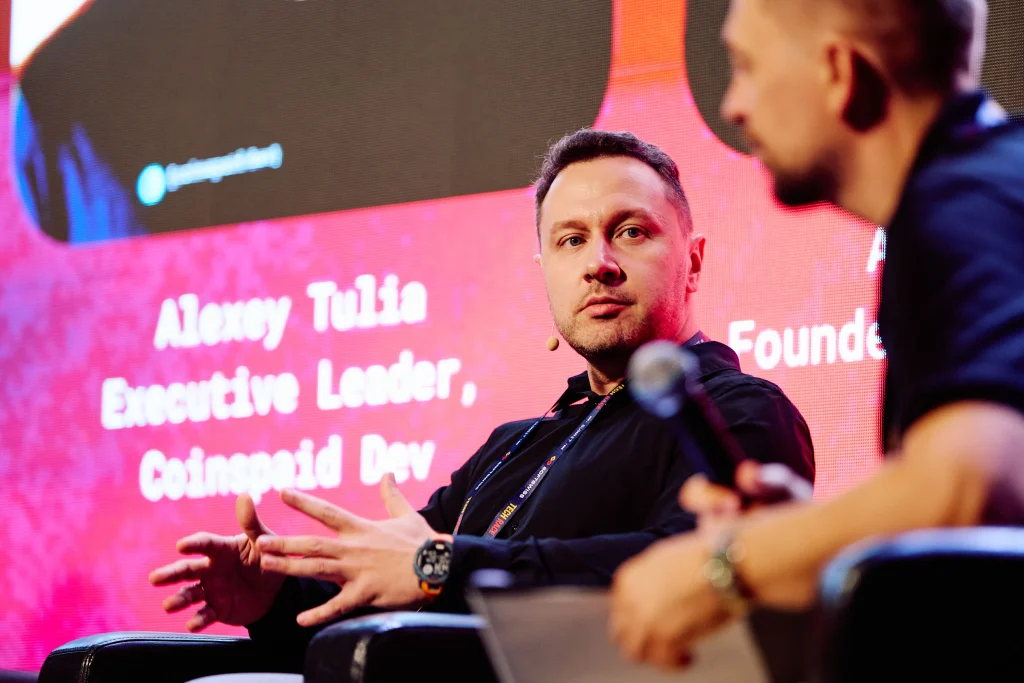
Alexey Tulia, Executive Leader at Coinspaid Dev , discussed the changing role of engineers and CTOs during the AI Impact in Engineering panel at Tech Race Summit 2026 in Warsaw. His remarks centred on the transition towards AI systems that can act through company infrastructure.
Companies already use AI to help with drafting and analysis. The next stage will connect agents to live systems, from sensitive data to deployment pipelines, allowing them to act. That access raises questions about permissions and who is responsible for each decision.
When AI can act in production
“The more authority we give machines, the more important accountability becomes,” Tulia said.
Consider an AI agent that can prepare and deploy a change to production. Should it be allowed to do so without human approval? Who is responsible if the deployment fails?
Before granting that access, the organisation needs permission controls and audit logs. It must also be able to stop the agent and recover from a failed deployment. Together, these requirements reflect Tulia’s broader argument: greater autonomy in production requires clearly defined authority and human responsibility.
Investing in the ability to change
Tulia encouraged CTOs to tie AI spending to a specific organisational need. His priorities included strong APIs and reliable data. Automated testing, observability, security and flexible architecture give companies room to introduce new technology safely.
Engineering teams also need capacity for experimentation. A roadmap that consumes all available resources leaves little room to test an emerging tool or respond when priorities shift.
Architecture and reduced vendor lock-in may generate little immediate revenue. They make it easier to replace a provider or revise a system when assumptions change.
“I don’t need to predict the future perfectly. I need to make being wrong cheap,” Tulia said.
Engineers take responsibility for outcomes
AI is speeding up coding and prototyping. Tulia said this should give engineers more room to understand the business problem and follow the result into production.
Leaders can support that shift by giving teams the business context and a clear expected outcome. Productivity can then be assessed through correctness, maintainability, security and operational performance rather than code volume.
Looking towards 2029
Tulia expects smaller engineering teams to manage larger areas of responsibility by 2029. He also expects AI to generate a majority of production code, increasing the importance of verification and technical judgment.
The CTO role will continue to require deep technical expertise alongside business understanding. Easier technology creation will bring more vendors and AI-generated systems into the organisation.
“I think technical judgment becomes even more important,” Tulia said.
For engineering leaders, the immediate task is to define safeguards and ownership before AI agents receive access to critical production systems.
About Coinspaid Dev
Coinspaid Dev is an independently owned and operated software engineering company specialising in blockchain infrastructure development. With more than 120 engineers and over 11 years of industry experience, Coinspaid Dev brings together software engineering, infrastructure, security and R&D teams with experience building distributed systems and blockchain infrastructure operating across more than 20 blockchain networks.