Pick one reputable tracker, aggregator, or exchange app, then build a short watchlist and set one or two alerts that actually matter. Start with a market-data aggregator like CoinGecko for broad prices and rankings, add your exchange app for executable quotes, and if you hold coins, connect wallets and exchanges through a read-only API key or log them manually. That covers most of what casual and active traders actually need day to day.
TL;DR:
- Use a trusted aggregator like CoinGecko for research and comparison, but rely on exchange apps for actual trade prices and liquidity.
- Keep your watchlist limited to five to ten assets relevant to your trading goals to avoid ignoring important alerts.
- Connect your portfolios via read-only API keys or manually track holdings to ensure security and accurate tax reporting.
- Be aware that aggregated prices differ slightly from exchange spot prices due to weighting, liquidity, and regional demand factors.
- Always verify the actual executable price on your exchange before trading, especially during high volatility or when prices seem inconsistent.
Table of Contents
- How Do You Track Crypto Prices Across Different Platforms?
- How Do You Build a Watchlist That Doesn’t Overwhelm You?
- Should You Sync Your Portfolio or Track It Manually?
- Why Does the Same Coin Show Different Prices on Different Sites?
- How Do You Spot a Fake Crypto Tracker or App?
- Why Trust Blockchainreporter’s Price Coverage?
- What Makes Real-Time Price Feeds Actually “Real Time”?
- Spot Price vs. Aggregated Price: What’s the Difference?
- How Much Do News Events Actually Move Crypto Prices?
- Can You Build Your Own Price Tracker Using an API?
- Does Time Zone Affect When Crypto Prices Update?
- Key Steps for Reliable Crypto Price Tracking
- Where to Check Crypto Prices and Methodology
- What the Conventional Advice on Price Tracking Gets Wrong
- Get Live Prices and Market Context in One Place
- Sources
How Do You Track Crypto Prices Across Different Platforms?
Not every tool answers the same question, and confusing them is where most tracking mistakes start. Aggregators, exchange apps, charting platforms, and portfolio trackers each show you a different slice of the market, and knowing which one to open for which question saves time and prevents bad trade decisions.
Market-data aggregators like CoinGecko and CoinMarketCap pull quotes from hundreds of exchanges and roll them into a single reference price, market cap ranking, and historical chart for thousands of coins. They’re the best starting point for research and comparison, but the number you see there isn’t necessarily the number you’ll get when you hit “buy.”
Exchange apps show a different thing entirely: the actual executable price on that specific order book, along with the liquidity and spread context that determines your real fill price. Charting platforms layer on technical indicators, custom timeframes, and drawing tools for anyone doing pattern-based analysis rather than just checking a number.
Portfolio trackers solve a separate problem. They consolidate holdings across multiple wallets and exchanges, calculate realized and unrealized profit and loss, and often export tax-ready records. Mobile apps and home-screen widgets tie all of this together for people who want a glance-and-go update without opening a browser.
- Aggregators : best for research, rankings, and market-wide context
- Exchange apps : best for the price you’ll actually pay or receive
- Charting tools : best for technical analysis across timeframes
- Portfolio trackers : best for consolidated P&L and record-keeping
- Mobile widgets : best for quick, passive monitoring throughout the day
How Do You Build a Watchlist That Doesn’t Overwhelm You?
Most people make the same mistake on day one: they add forty coins to a watchlist and end up ignoring all of it within a week. A tighter list built around actual exposure or trading intent works far better, and it’s the approach most practical guides recommend for beginners setting up alerts.
Here’s a workable sequence for setting one up:
- List what you actually hold or plan to trade. Five to ten assets is plenty for most people; anything more turns into noise.
- Choose your alert triggers. Set a fixed price level for entries and exits, a percentage move for volatility spikes, and a volume trigger if you care about breakouts.
- Pick your notification channel. Push notifications work for immediate reaction, email suits end-of-day review, and webhooks make sense if you’re feeding alerts into a custom script or bot.
A reasonable starting point: set a percentage alert at 5% for a coin you hold long-term, and a tighter 2% to 3% alert for anything you’re actively trading. Mobile apps like CoinMarketCap’s tracker build push alerts and watchlists directly into the app, so you don’t need a separate notification tool.
Pro Tip: Turn off alerts for coins you’re not actively trading. A watchlist buzzing every ten minutes trains your brain to ignore it entirely, which defeats the purpose of having alerts in the first place.
Should You Sync Your Portfolio or Track It Manually?
Connecting your accounts gives you a live, consolidated view of every holding in one place, but it isn’t the right move for everyone. The choice comes down to how many accounts you juggle and how comfortable you are granting any level of access to a third-party app.
Three connection methods cover most situations. Read-only API keys let a tracker pull your balances and trade history without touching your funds. Public wallet addresses work for on-chain holdings and require no API at all. CSV import or manual entry works for anyone who’d rather not connect anything and is willing to update numbers by hand.
Platforms like Kryptos and CoinStats advertise integrations across hundreds of exchanges and wallets, pulling live balances, allocation breakdowns, and both realized and unrealized gains into a single dashboard.
- Never generate an API key with withdrawal permissions enabled, even if the option is offered
- Rotate keys periodically, especially after connecting a new tracker
- Enable two-factor authentication on the exchange account itself, not just the tracker
- For small portfolios or privacy-focused holders, manual spreadsheet tracking still works fine
Pro Tip: If a portfolio app asks for withdrawal access “for convenience,” that’s a hard no. Koinly and similar tools work perfectly well with read-only permissions, and that’s the only permission level you should ever grant.
Synced portfolios also make tax season considerably less painful, since most tools export cost-basis and gain/loss records you’d otherwise have to reconstruct by hand.
Why Does the Same Coin Show Different Prices on Different Sites?
A coin trading at $43,210 on one aggregator and $43,180 on your exchange isn’t a glitch. It’s a byproduct of how prices actually get calculated.
Aggregators like CoinMarketCap compute a representative price using weighted averages across many exchanges, filtering out anomalous or illiquid tickers that would otherwise skew the number. That’s an index-like blended figure, not a price you can actually trade at anywhere specific.
Real gaps between that blended number and your exchange’s order book come down to a few factors:
- Spread and order-book depth : thinner liquidity means a wider gap between bid and ask
- Quote currency : a price quoted in USDT can drift slightly from one quoted in USD or a local fiat currency
- Exchange-specific supply/demand : regional demand spikes can push one venue’s price ahead of the pack briefly
Before placing a trade, pull up your exchange’s own order book and compare it against the aggregator figure you started from. If the two are more than a fraction of a percent apart on a liquid asset, something’s off, whether that’s a stale tracker feed or unusually thin liquidity on that specific venue.
How Do You Spot a Fake Crypto Tracker or App?
Fake or cloned tracking apps are common enough that a quick verification habit is worth building into your routine every time you install something new.
- Check the publisher name in the app store listing , not just the app icon or name, and confirm it matches the official company.
- Scan review patterns rather than star ratings alone. A flood of generic five-star reviews posted in a short window is a common sign of a fake listing padding its numbers.
- Never enter a private key or seed phrase into a tracking app. Legitimate portfolio tools only ever need a read-only API key or a public wallet address.
- Watch for lookalike domains and unsolicited messages claiming to be from a tracker’s support team asking you to “verify” your account.
- Keep transaction records exported regularly , both for tax filing and as a paper trail if a dispute with an exchange or app ever comes up.
Why Trust Blockchainreporter’s Price Coverage?
Blockchainreporter tracks real-time price movement alongside expert market commentary, so readers get context, not just a number on a screen. Coverage draws on exchange feeds, market aggregator data, and on-chain metrics to build a fuller picture of what’s actually moving a coin.
- Real-time price data paired with analysis on regulatory shifts and technical developments
- Coverage spanning Bitcoin, Ethereum, and a wide range of altcoins
- Continuously updated market pages for ongoing price and news tracking
Readers can follow ongoing coverage on the crypto market today page for ongoing price and trend updates.
What Makes Real-Time Price Feeds Actually “Real Time”?
“Real-time” gets thrown around loosely, but there’s a real technical difference between tick-level feeds and the near-real-time updates most retail tools deliver. Tick-level data updates with every single trade executed on an exchange, which is what professional trading terminals and exchange order books use natively.
Most consumer-facing trackers and aggregator apps update on a short interval instead, often refreshing every few seconds rather than on every trade. For casual monitoring, that gap is meaningless. For anyone trading on tight margins or reacting to fast-moving news, though, a few seconds of lag can matter, especially during high-volatility windows when prices move several percentage points in minutes.
Exchange apps generally offer the tightest feeds because they’re pulling directly from their own order book rather than aggregating across venues first. Aggregators introduce a small amount of inherent lag simply because they’re collecting, weighting, and republishing data from dozens of sources rather than showing you one venue’s live tape.
If your trading style depends on split-second execution, use your exchange’s own interface for the actual trade and treat aggregator prices as a research layer sitting alongside it, not a replacement for it. If you’re checking prices a few times a day to see how your holdings are doing, the difference between tick-level and near-real-time is not something you’ll ever notice.
Spot Price vs. Aggregated Price: What’s the Difference?
A spot price is the price of an asset for immediate delivery on one specific exchange right now. An aggregated price, the kind you see on CoinGecko or CoinMarketCap, is a computed blend across many exchanges designed to represent the broader market rather than any single venue.
This distinction matters more than most people realize. If you’re checking a price purely for informational purposes, an aggregated figure is genuinely more useful; it smooths out one exchange’s temporary quirk or thin liquidity moment. But if you’re about to place an order, the aggregated number is not the number you’ll actually receive. Your fill price depends entirely on the spot price and order-book depth on the specific exchange you’re using.
This is also where the difference between centralized and decentralized exchange prices becomes relevant. Centralized exchange prices reflect an order book matching buyers and sellers directly. Decentralized exchange prices come from automated market maker pools, where the price is a function of the ratio of assets in a liquidity pool, and can diverge meaningfully from centralized prices during periods of low liquidity or high trading volume on one side. Large trades on a thin DEX pool can move the price significantly more than the same trade would on a deep centralized order book, a phenomenon usually called slippage.
Aggregators try to account for this by weighting toward higher-liquidity venues and filtering out anomalous quotes, but the underlying reality remains: the “price” you see on a research page is a snapshot of a moving target, assembled from many moving targets underneath it.
How Much Do News Events Actually Move Crypto Prices?
Crypto markets react to news faster and more violently than most traditional asset classes, largely because the market trades continuously with no closing bell and no cooling-off period overnight.
Regulatory announcements are a recurring trigger. A country restricting exchange access, or a securities regulator taking action against a major platform, can move prices within minutes of the headline hitting. Macro data releases matter too. Broad economic indicators have shown a measurable ability to move Bitcoin and altcoin prices in step with traditional markets, a pattern that’s become more pronounced as institutional capital has entered the space.
Exchange-specific events carry outsized weight as well. News of a hack, an insolvency, or a sudden halt in withdrawals at a major exchange tends to trigger a market-wide selloff, even for coins with no direct connection to the affected platform, simply because it shakes confidence in the infrastructure itself.
On the other side, presale hype and speculative rushes into new projects can create sharp, short-lived price action in adjacent tokens as capital rotates. Reading price movement in isolation, without checking what news is driving it, is one of the most common ways traders misjudge whether a move is the start of a trend or a one-off reaction that will fade within hours. Pairing a price tracker with a live news feed, rather than treating them as separate tools, closes that gap.
Can You Build Your Own Price Tracker Using an API?
If the built-in dashboards on aggregators and portfolio apps don’t fit your workflow, most major data providers offer developer API access for pulling price data directly into a custom tool, spreadsheet, or trading bot. Aggregators like CoinGecko and CoinMarketCap both publish public APIs with tiered access, free for light use and paid for higher call volumes or additional endpoints.
A basic custom setup usually pulls three things: current price, 24-hour volume, and market cap, refreshed on whatever interval your use case needs. More advanced setups pull historical OHLC (open, high, low, close) data for backtesting or feed live prices into a webhook that triggers a notification when a condition is met, like a coin crossing a specific threshold.
The appeal of building your own feed is control. You decide exactly which metrics matter, how often they refresh, and how alerts fire, rather than working within whatever a pre-built app offers. The tradeoff is maintenance. API rate limits, occasional downtime, and formatting changes on the provider’s end mean a self-built tracker needs occasional upkeep that a polished consumer app handles for you automatically.
For most individual traders, a hybrid approach works best: use a consumer app for daily monitoring and alerts, and reserve API access for the specific custom calculations or automations that off-the-shelf tools don’t offer.
Does Time Zone Affect When Crypto Prices Update?
Crypto markets never close, which is a genuinely different structure from stock exchanges that shut down every evening and over weekends. That means there’s no “opening price” or “closing price” in the traditional sense, and no time zone in which the market is simply offline.
That said, trading volume isn’t evenly distributed across the clock. Activity tends to cluster around when major regional markets are active, Asian trading hours, European hours, and US hours each bring distinct waves of volume, and price volatility often ticks up during the overlap windows between them. A quiet 3 AM Eastern time can mean thinner order books and wider spreads, even though the exchange itself never stops running.
Delay in price updates is a separate issue from time zone, but the two often get confused. Most retail tracking apps and aggregator sites refresh on a short polling interval rather than instantaneously, so the price on your screen might lag the true current price by anywhere from a few seconds to under a minute, depending on the platform. During high-volatility events, that small delay can matter more than usual since prices are moving faster than the refresh cycle can keep up with.
If you’re tracking prices for general awareness, this lag is irrelevant. If you’re executing trades based on the number displayed, always cross-check against your exchange’s live order book rather than trusting a tracker app’s timestamp completely.
Key Steps for Reliable Crypto Price Tracking
Reliable tracking comes down to a handful of habits repeated consistently, not a single perfect tool.
- Use a reputable aggregator or exchange app, and verify the publisher before installing anything
- Keep your watchlist short and your alerts meaningful, not constant
- Sync portfolios through read-only connections, or track manually if you prefer full control
- Always compare a tracker’s displayed price against your exchange’s executable price before trading
| Step | Why it matters |
|---|---|
| Pick a verified tracker | Avoids fake apps and inaccurate data |
| Build a focused watchlist | Reduces noise, keeps alerts meaningful |
| Sync securely or track manually | Protects funds while giving visibility |
| Verify price before trading | Prevents slippage surprises |
Where to Check Crypto Prices and Methodology
- CoinGecko for live prices, market cap, and coverage methodology
- CoinMarketCap for pricing methodology and rankings
- Blockchainreporter’s crypto market page for ongoing live coverage
What the Conventional Advice on Price Tracking Gets Wrong
Most guides treat price tracking as a solved problem: download an app, add some coins, done. That undersells how much the quality of the underlying data source shapes every decision you make from there. A cheap or unverified tracker feeding you a stale or manipulated price isn’t a minor inconvenience; it’s the difference between a good entry and a bad one.
The bigger blind spot is treating price as a number in isolation. A coin jumping 8% means very little without checking volume and liquidity alongside it, since a low-liquidity token can be moved 8% by a handful of trades. I’d argue market cap and 24-hour volume deserve equal screen time to price on any dashboard you build, not a secondary tab you check occasionally.
Security gets treated as an afterthought too, usually addressed with a single line about “using strong passwords.” Read-only API permissions and two-factor authentication aren’t optional extras; they’re the baseline for connecting any account to a third-party tracker. Get the data source right and the security setup right, and the rest of tracking is mostly a matter of habit.
— Name
Get Live Prices and Market Context in One Place
Blockchainreporter gives you real-time price coverage without forcing you to piece together data from five different apps. Instead of hopping between an aggregator for prices, a separate app for news, and another tab for market analysis, you get all three together, updated continuously.
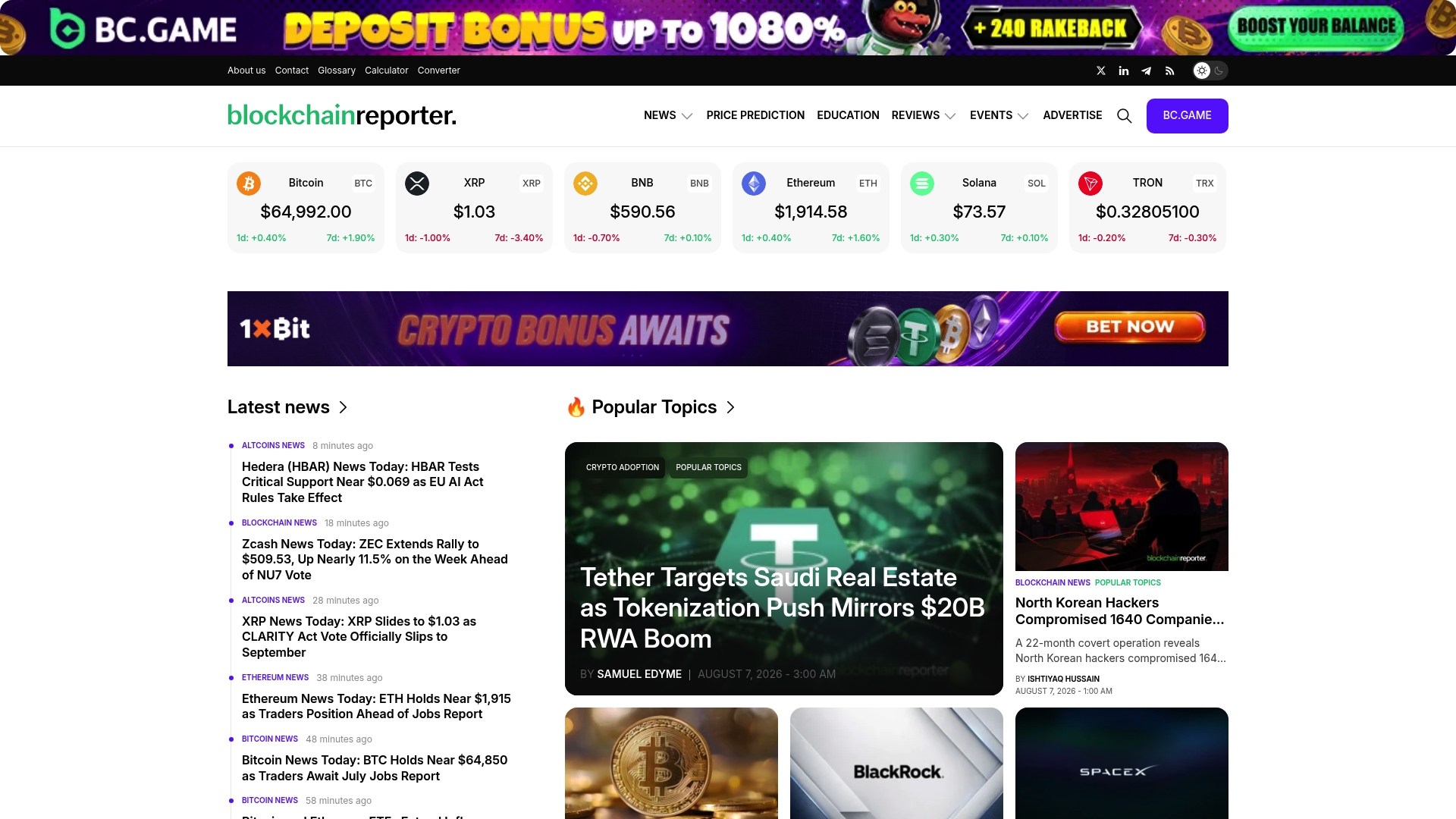
That matters because price alone rarely tells the full story. A sudden move usually has a cause, whether it’s a regulatory headline, an exchange event, or a broader macro shift, and Blockchainreporter pairs the number with the reporting behind it. Recent coverage on Bitcoin’s price action near key support and resistance zones shows exactly this kind of context in practice: not just where the price sits, but why it’s sitting there and what traders are watching next.
Visit Blockchainreporter for continually updated Bitcoin, Ethereum, and altcoin coverage, and bookmark the Bitcoin news page if BTC price action is your primary focus.
This article is general information, not a substitute for advice from a qualified financial advisor. Consult a qualified financial professional about your own circumstances before acting on anything here.
Sources
- Cryptocurrency Prices, Charts, and Crypto Market Cap | CoinGecko
Recommended
- Crypto Market Today | Prices, Trends & Analysis
- Bitcoin Holds Above $64K As Traders Eye $100B SpaceX Share Unlock
- Bitcoin’s Low Volatility Doesn’t Mean Low Risk