



Nigeria’s payments market is evolving quickly, but one thing hasn’t changed: customers don’t all pay the same way. Card-only checkouts still miss a significant share of the market because they ignore how people actually move money every day . For digital merchants, supporting the alternative payment methods Nigerian customers already use is often the difference between a completed purchase and an abandoned one.
That shift has made financial inclusion in Nigeria much more than a public policy goal. It has become a commercial advantage. When businesses accept payment methods customers already know — bank transfers, mobile wallets, USSD, or agent-assisted payments — they remove friction from checkout. Higher approval rates, broader market reach, and stronger customer retention tend to follow.
As a result, Nigerian e-commerce payment solutions are becoming increasingly local. Instead of building checkout experiences around global card habits, successful merchants adapt to the payment behaviour that already exists inside the market. In Nigeria, the payment strategy has become part of the growth strategy.
The evolution of Nigeria’s payment landscape

Over the last decade, Nigeria has built one of Africa’s most dynamic payment ecosystems. Cash is still widely used, but it now exists alongside instant bank transfers, mobile wallets, USSD payments, agency banking, and traditional Card networks. Consumers switch between these methods depending on convenience, internet access, and the type of purchase they’re making.
The Central Bank of Nigeria’s Payment System Vision 2028 reflects this direction. The regulator is investing in stronger payment infrastructure, wider financial inclusion, better interoperability between providers and tighter cybersecurity standards. Rather than promoting one dominant payment method, the framework encourages an ecosystem where different rails work together.
That approach mirrors how Nigerians already pay. Someone may receive a salary through a bank account, transfer money using online banking, withdraw cash through an agent and make another purchase via a mobile wallet — all within the same week. For merchants, supporting only one payment route means serving only part of the market.
The country’s expanding network of licensed mobile money providers and banking agents reinforces the same trend. Banking services are no longer limited to physical branches, while digital financial services are reaching communities that traditional banking has historically struggled to serve. The result is a payments environment shaped by local behaviour rather than imported checkout models.
For businesses entering Nigeria, this changes the way payment infrastructure should be planned.
How APMs are unlocking the underbanked market
Millions of Nigerians remain underbanked or only partially connected to traditional banking services. That doesn’t mean they are excluded from digital commerce. It simply means they pay differently.
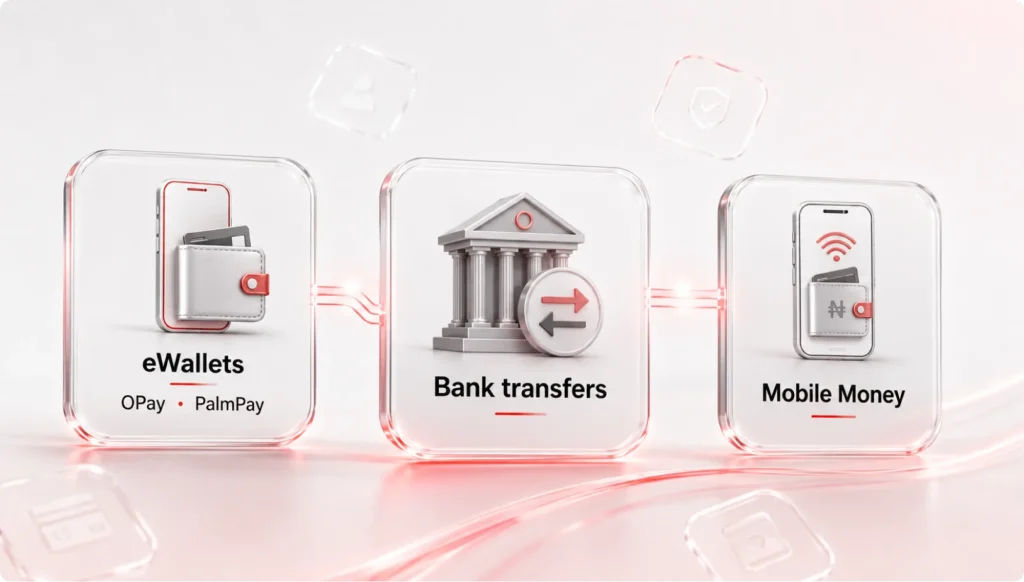
This is exactly where alternative payment methods become essential for Nigerian merchants. Instead of forcing customers into card payments, businesses can accept the methods people already know and trust. For someone with a feature phone, that may be USSD. For another customer, it could be an instant bank transfer. Others may depend on a nearby banking agent or one of the country’s growing mobile money wallets.
These payment options remove barriers that often prevent transactions from reaching completion. Limited internet access, inconsistent card acceptance, expensive mobile data or lack of a Credit Card become much less of an obstacle when customers are given familiar alternatives.
For merchants, the impact appears in measurable business metrics rather than abstract inclusion goals. Better checkout conversion. Higher transaction success rates. A larger addressable customer base. Fewer failed payment attempts.
The same approach also supports broader financial inclusion Nigerian businesses are increasingly helping to expand. Instead of changing customer behaviour, merchants work with it. Users continue paying through channels they already understand, while businesses gain access to customers who might otherwise leave before completing a purchase.
That practical approach usually delivers better commercial results than trying to educate customers into adopting unfamiliar payment habits.
The power of USSD and bank transfers over Cards
Cards remain part of Nigeria’s payment ecosystem, but they are far from being the default choice for everyone. In many everyday situations, bank transfers and USSD payments are simply more practical.
A USSD payment gateway allows customers to complete transactions directly from feature phones without downloading an app or relying on a stable internet connection. That makes it particularly valuable in areas where smartphones are less common or mobile connectivity is inconsistent.
Bank transfers have become equally important. Nigerians increasingly use Account-to-Account (A2A) transfers for everything from retail purchases to bill payments. The process is familiar, widely trusted, and often faster than repeated card authorisation attempts.
For digital merchants, this changes checkout priorities. Offering transfer-based payments alongside cards reduces failed transactions while matching the way customers already prefer to pay. In many sectors, transfer options now deliver higher completion rates than traditional Card payments.
Checkout design plays a significant role here. If a customer encounters a failed Card payment but immediately sees a bank transfer alternative, the purchase can often still be completed within minutes. Without that option, many users simply abandon the transaction.
This is why Nigerian e-commerce payment solutions increasingly place local payment rails at the centre of the checkout experience rather than treating them as secondary options. Instead of asking whether cards should remain available, merchants should ask a different question: which payment methods are most likely to help customers complete the purchase on the first attempt?
Mobile money operators and agency banking networks
The growth of mobile money wallets and agency banking has fundamentally expanded access to financial services across Nigeria. Customers no longer need to live near a traditional bank branch to send money, receive payments or manage basic financial transactions.
Licensed mobile money providers now operate alongside thousands of banking agents distributed across urban centres and rural communities. Together, these banking networks extend financial services well beyond the reach of conventional banking infrastructure.
For merchants, this matters because these channels support much more than deposits and withdrawals. Customers use them for transfers, everyday purchases, account services, and digital payments. In many communities, banking agents have become the primary point of access to the wider financial system.
Supporting these local payment ecosystems allows businesses to reach customers who would otherwise experience unnecessary payment friction. Someone may prefer making purchases through a wallet instead of using a Card. Another customer may rely on nearby banking agents to access their money. Both represent legitimate customer journeys that merchants should accommodate rather than replace.
There are operational advantages as well. Businesses handling frequent settlements, merchant payouts or commission payments benefit from providers that already understand local payment infrastructure. Working with existing banking networks generally creates smoother operations than attempting to build workarounds for them.
This is one of the reasons platforms such as SPAYZ.io focus on integrating local payment methods directly into merchant operations. The closer the payment infrastructure reflects how people actually move money, the more reliable the overall payment experience becomes.
Why digital merchants must adapt to local APMs
For digital businesses in Nigeria, checkout has become a competitive advantage. Customers compare prices and products, but they also judge how easy it is to pay. If the payment flow feels unfamiliar or unnecessarily complicated, many simply leave before the transaction is complete.
That’s why local payment methods have moved far beyond being an optional feature. They directly influence conversion, repeat purchases and customer loyalty. A checkout that reflects local payment habits removes uncertainty and helps users complete purchases with less hesitation.
This is particularly relevant for businesses targeting mobile-first customers or operating in industries where customers expect instant transactions. Whether it’s e-commerce, subscriptions, digital services, or high-frequency platforms, payment reliability affects revenue every single day.
When merchants insist on Card-only checkout, they create friction that doesn’t need to exist. Customers who prefer transfers or wallets shouldn’t have to change their habits just to complete a purchase. The easier it is to pay the way they already do, the more likely they are to come back .
Adapting to local payment behaviour isn’t about offering more payment buttons. It’s about understanding which options customers naturally choose and making those options immediately available.
Boosting transaction success rates and revenue
Improving transaction success rates (SRs) often starts with a simple question: which payment method is most likely to work for this customer?
The answer isn’t always the same. Some users trust instant bank transfers because they’re already part of their daily banking routine. Others reach for mobile money wallets because they’re faster and don’t require entering card details. In areas where smartphones or mobile internet is less reliable, a USSD payment gateway may still be the easiest way to complete a purchase.
When merchants support those preferences, fewer payments fail. That has a direct financial impact.
Every unsuccessful payment creates additional costs. A customer may abandon the purchase entirely. Some contact support. Others decide to buy from a competitor instead. What starts as a payment failure quickly becomes lost revenue, higher acquisition costs and lower customer lifetime value.
Businesses operating in e-commerce, subscriptions, SaaS, Forex, or iGaming feel this especially strongly because customers complete transactions repeatedly. Even a small increase in successful payments each day compounds into meaningful revenue growth over weeks and months.
Payment infrastructure also becomes easier to manage when providers understand local market conditions. Settlement timelines, routing logic, bank availability, and customer behaviour differ from one country to another. Providers familiar with Nigerian payment rails can optimise payment routing and reduce unnecessary failures without merchants constantly adjusting their own systems.
This is where FinTech innovation becomes genuinely valuable. It’s less about introducing another payment product and more about making existing payment journeys work better.
Faster routing. Better visibility. Fewer failed transactions. Those improvements are measurable and immediately visible in performance data.
Reducing cart abandonment for local consumers
Many abandoned carts have nothing to do with pricing or product quality. The customer reaches checkout, doesn’t see a familiar payment option or encounters unnecessary friction, and leaves.
In Nigeria, this often happens when businesses build checkout experiences around assumptions borrowed from other markets. A payment flow that works well in Europe or North America may feel awkward for customers who are used to transfers, USSD, or wallet-based payments.
Reducing abandonment usually doesn’t require redesigning the whole checkout. Small changes often produce the biggest improvements.
Merchants can start by making local payment methods easier to find rather than hiding them under Card payments. If bank transfers are already a preferred payment method, they should appear early in the checkout flow rather than behind several additional clicks.
Instructions matter too. Customers shouldn’t have to interpret technical language or guess what happens after initiating a transfer. Clear confirmation messages and visible payment status updates reduce uncertainty, especially during manual or bank-based payment flows.
The overall experience becomes smoother when businesses:
- Display bank transfers and USSD payment gateway options prominently
- Keep mobile money wallets available for returning customers
- Use short, plain-language payment instructions
- Show payment confirmation immediately after completion
- Allow customers to retry failed payments without restarting the checkout process
Individually, these are relatively small UX decisions.
Together, they can significantly reduce cart abandonment because they match how customers already expect digital payments to work. Better checkout design also encourages digital wallet adoption, as customers are more likely to reuse payment methods that consistently deliver a fast and predictable experience.
Regulatory shifts: what merchants need to know about CBN frameworks
Nigeria’s payment ecosystem isn’t evolving only because of consumer behaviour. Regulation is changing alongside it.
The Central Bank of Nigeria continues to strengthen the country’s payment infrastructure through initiatives such as the Payment System Vision 2028, while more recent updates to agency banking regulation place greater emphasis on transparency, interoperability and operational oversight. For merchants, these developments have practical consequences.
Compliance can no longer be treated as a separate function from payments. Businesses relying on local collections, payouts or Agent-based infrastructure need providers that understand KYC and KYB requirements, settlement processes, reporting obligations, and local operational standards from the outset.
Recent agency banking reforms illustrate that direction clearly. Requirements covering transaction limits, geo-tagging, dedicated agent accounts and stronger supervision all point toward a more structured payment ecosystem. The goal is greater trust and accountability across the market, but it also raises expectations for payment providers operating within it.
Choosing a payment partner, therefore, involves more than comparing transaction fees.
Merchants should ask questions such as:
- Does the provider support alternative payment methods that customers in Nigeria actually use?
- Can it improve transaction success rates across local payment rails?
- Does it understand Nigerian banking networks, settlement processes and regulatory expectations?
- Can it support broader financial inclusion across Nigeria without adding unnecessary operational complexity?
Those answers become increasingly important as businesses scale. A payment setup that works for a small operation may become a bottleneck once transaction volumes begin to grow.
Conclusion
Nigeria’s payment ecosystem is becoming broader, more connected and increasingly shaped by local payment behaviour rather than traditional Card infrastructure. Merchants that recognise this shift are in a stronger position to reach more customers and complete more transactions.
Supporting the payment methods Nigerian consumers already know and trust isn’t simply about expanding payment choice. It’s about matching real-world payment habits. Bank transfers, mobile money wallets, USSD payment gateway solutions, and established banking networks all play a role in how people pay every day.
That directly supports financial inclusion in Nigeria while producing measurable commercial results. Better checkout experiences lead to higher transaction success rates, lower cart abandonment and stronger customer retention. Over time, those improvements contribute to sustainable revenue growth.
The same principle applies to digital payments in Nigeria as a whole. Merchants don’t need to persuade customers to adopt unfamiliar payment methods. They need payment infrastructure that fits existing behaviour and removes friction wherever possible.
As the Nigerian payment ecosystem continues to evolve, businesses that prioritise local payment acceptance will be better positioned to compete in Africa’s largest digital economy. For companies expanding into Nigeria or optimising existing operations, payment localisation is no longer an enhancement — it has become a core part of sustainable growth.
This article is not intended as financial advice. Educational purposes only.