

To what extent does your yield come from genuine economic activity, including actual business paying actual interest on an actual loan?
I worked on that question longer than my expectation. I got the information about the total APR on each of the positions in my wallet. I was also informed about the pool recompensing in emissions as well as the one rewarding in fees. However, I couldn’t always find the information about the actual activity of my capital.
This included questions like: what was my capital funding? What occurred while it was earning? And who was on the opposite side? A large amount of DeFi yield, when traced back, turns out to be circular. It includes capital enabling additional capital to deal with more DeFi activities.
Though it is not bad, I didn’t think I was joining such a setup when I began investing in this sector. That was the reason I came across crowdlending, and at last 8lends. At first, crowdlending appeared to be a niche Web2 market. I thought it was a legacy class that was not related to crypto. Then, I focused on the actual participants behind it, finding out that the assumption was not correct.
What Crowdlending Actually Is
Exactly as the title implies, crowdlending includes a group of investors who pool capital for funding loans, rather than a banking entity performing it solely. The role of the investor is straightforward, as you’re not making an equity buyout, lending money straight to a borrower pool or a single borrower for interest, or staking any of the governance tokens.
On the other hand, the most suitable analogy for those knowing about DeFi is that it is like a bond. However, the issuer is a small business rather than a corporation or a government. Additionally, yield is recompensed because someone is really utilizing your capital to carry out their operations, and not because some protocol is releasing tokens to get liquidity.
Particularly, there are a couple of wider categories of this, with one being peer-to-peer (P2P) crowdlending. It funds personal loans and individuals, typically without any collateral, with 10% to 14% yields and significantly limited recovery in the case of something going wrong. However, peer-to-business (P2B) crowdlending funds medium- and small-sized businesses.
It seems structurally different, as loans get support from real assets such as real estate, vehicles, or equipment. Additionally, this category has annual 19-25% yields in $USDC. Apart from that, the P2B model has the least connection to crypto cycles. So, this warehouse of equipment does not care about the performance of Bitcoin ($BTC).
8lends runs a P2B model, which I want to explore here. The most surprising thing about this model was not its mechanics but the scale. The crowdlending market has been operating since the year 2005, working wholly autonomously of the crypto sector for nearly 20 years. One of the biggest platforms in this landscape is Mintos, which has facilitated over €12.8 billion in loans since 2015 across hundreds of thousands of investors
Since the month of November 2023, the ECSPR model of the EU has required mandatory and unified regulation across all crowdlending entities working in the bloc. For context, most of today’s DeFi lending infrastructure was built in roughly that same window. Nonetheless, crowdlending enjoys a 20-year head start in the case of solving many of the issues that DeFi is currently working through, including collateral, borrower verification, and credit risk.
So, the actual question, once one knows that, is not about the legitimacy of crowdlending, but what happens after its merger with seamless crypto rails. 8lend is the platform that tries to answer the respective question.
Introduction to 8lends: A Popular Crowdlending Platform
The reason I started using 8lends is not a crypto-based team that experiments with lending services for the first time. Rather, it is a developed lending business that brings an already-proven mechanism on-chain.
8lends works as a blockchain-powered investment entity that permits people to invest in medium- and small-sized businesses across the globe. Maclear AG and the team backing it built 8lends, which went live in 2025. Additionally, Maclear had reportedly processed over $89M in terms of investments across over 32,000 investors in more than 5 years even before 8lends.
Additionally, Maclear operated as and is still operating in the form of a Web2 business. The euro-denominated project moved money through SEPA transfers, open only to investors in Europe. It operated, but it was organically shut off from a worldwide crypto audience.
Keeping this in view, 8lends follows the same lending framework as well as redevelops the distribution area to deal with Web3. For this purpose, it focuses on $USDC in comparison with euros. Additionally, it settles on an open network — Base, Coinbase’s L2 — rather than a closed system or a bank’s internal ledger you have to take on trust.
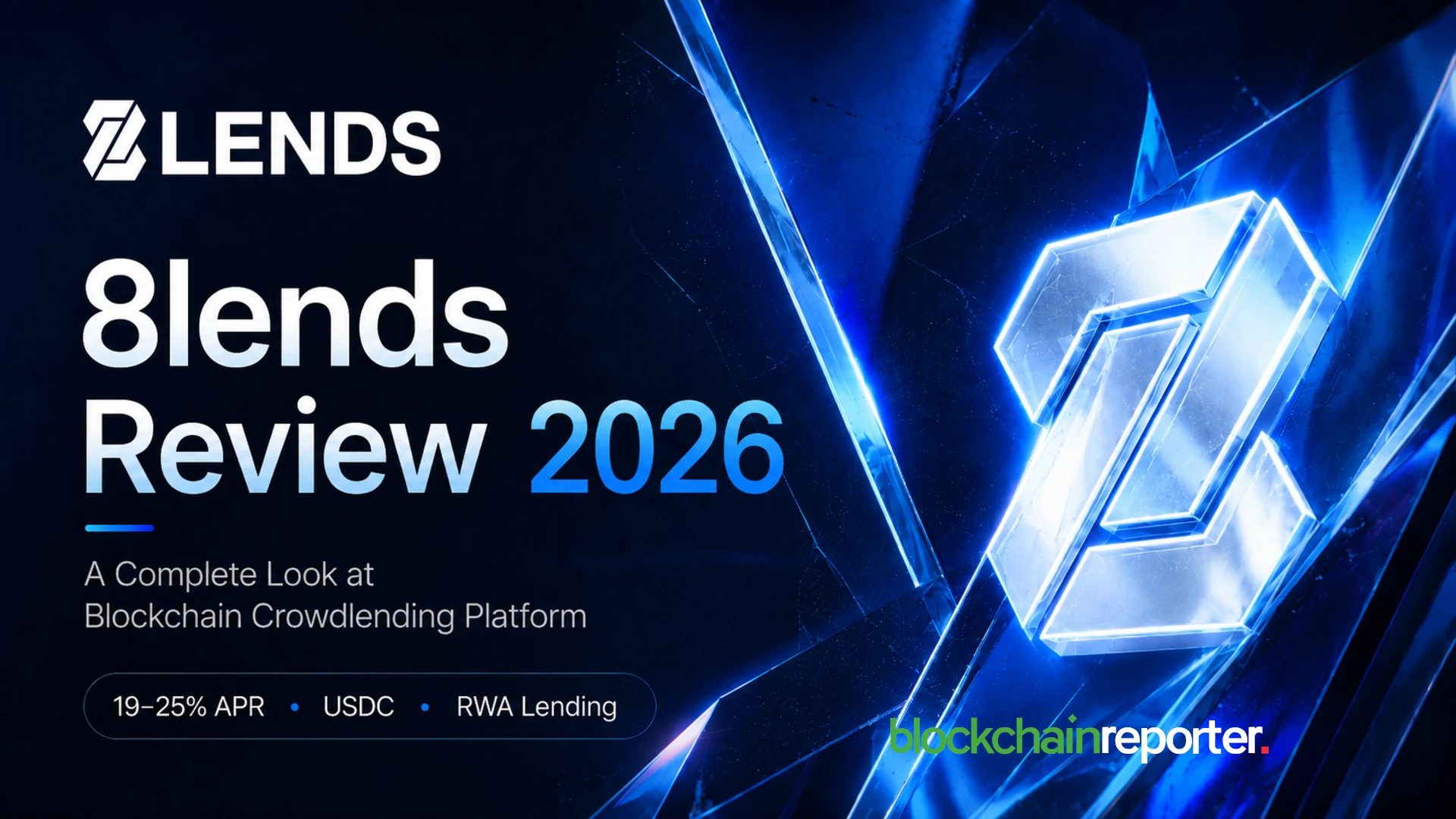
After delving into the tagline “real lending, rebuilt for Web3,” I think it is the real description instead of marketing copy. Simultaneously, 8lends has collected over $10M across over 1,600 investors following its launch. The average yearly returns of the project stand between 19 and 25% in terms of $USDC, while the minimum investment amount accounts for 100 $USDC.
Additionally, it operates on Base, with $USDC being used for the denomination of everything. Along with that, Cyberscope and Certik provide services to audit smart contracts. Moving on, Maclear AG keeps offering services in the form of a Swiss legal platform and a Collateral Agent.
Actual Working of the Model
At the start, you invest, beginning at the $100 USDC spot, into a particular business operating within a validated collateral backing it. The smart contract is then locked in for the duration, collateral terms, and rate, while none of the respective factors can be changed in the mid-term. Additionally, the business recompenses interest in $USDC on a monthly basis at the fixed rate at the time of investment.
The agreement deals with what is revealed, not a company’s token, $USDC, or a variable rate. Following that, your principal amount, at maturity, returns in a complete one-bullet repayment. My loan term ran for 4-16 months in total. Below that, the part in which I spent significant time was the validation of investor funds within a smart contract that does not have any direct access to the platform.
The Base blockchain records every single payment, letting you pull up a block explorer while also seeing the transfer yourself. For this purpose, there is no requirement for login or trust on the dashboard. Additionally, the code is open, and Cyberscope and Certik have audited it, and you can read their reports.
I myself did a 10-minute version by opening the explorer and found a transfer. Then, it validated that it matched what was said by the dashboard. So, that is a notably different experience in comparison with most of the DeFi products, where the purpose of “verified” focuses on the trust in the UI.
Where Your Capital Goes?
This is the section that differentiates 8lends from the majority of the operations I came across before. In the majority of cases, in a staking position or a liquidity pool, I really couldn’t figure out the productive operation my funds were backing. However, on 8lends, each of the project cards presents a certain story, a named entity, an industry, a country. It also includes what the purpose of the loan is, the pledging of physical assets in the form of collateral, the autonomous credit assessment, and the core financial metrics. Thus, you are clearly funding a firm rather than a protocol.
A thing that led me to a halt included the interest rates as the 19-25% APR in USDC rate felt notably high to be counted as a red flag, but that wasn’t the case. In Western Europe, the usual bank rates regarding SMBs run between 4% and 6% annually, and there is fierce competition for valuable clients. At the same time, loans are severely made against capital flow instead of hard collateral. Authorization can take 2-4 weeks for crowdlending, while a bank requires 2-6 months.
On the other hand, in Eastern Europe, the area accounting for several 8lends borrowers, bank rates work between 7% and 10% while credit access remains restricted by a few dominant banks. Additionally, there is a need for hard collateral such as real estate, and authorization timelines expand even longer. The increased rate does not indicate desperation, as it underscores the market price of more accessible and faster capital for diverse businesses. These businesses possess real revenue and real assets but cannot afford to wait for months for the bank’s decision.
Each of the projects also displays a risk-scoring block, while I’ve begun dealing with it in the way I would deal with a credit memo. So, loan-to-value (LTV) underscores the loan amount that is divided by the value of the collateral. A lower amount highlights more buffer in case more liquidation is ever needed. In this respect, my filter includes anything lower than 70%. Debt-to-equity divides total debt by owner equity; below 2 is comfortable, and 2–2.5 is acceptable depending on the sector.
Along with that, credit history focuses on the evaluation of the repayment portfolio of the borrower by the compliance team. Additionally, Total Risk Score is responsible for the aggregation of all this via a AAA-through-D rating. It is mostly leveraged for the diversification across risk tiers in comparison with picking individual contracts.
And, at the back of all this is Maclear AG in the form of Collateral Agent, which is a Swiss-based legal platform that holds the collateral of every borrower on behalf of the investors. It also initiates foreclosure in the case of a default occurrence, with the proportional distribution of the proceeds. That serves as a legally binding operation within Swiss financial law rather than a platform promise.
How Are Earnings Made?
The center of the return takes into account fixed interest that is recompensed between 19% and 25% on an annual basis in $USDC. It is fixed within the smart contract when you invest. Then it is recompensed on a monthly basis, with zero entry, holding, or exit fees. Therefore, it is worth noting what I was engaged in ahead of finding 8lends. Specifically, staking yield is generated from protocol or token emissions, usually between 3 and 12% APR. It is then recompensed via a protocol token without any impermanent loss.
However, it has straight correlation to the wider market and usually has low rate predictability. Emissions and fees generate LP pool yield that ranges between 5% and 80% APY. It carries real, usually noteworthy impermanent loss on the market correlation’s top. DeFi lending yield, coming from different crypto-collateralized borrowers, normally runs 2-10% APY, with increased market correlation and medium predictability.
The P2B model of 8lends gains yield from substantial interest that a real business pays, providing a 19-25% APR via $USDC. It does not have any impermanent loss, with high predictability and the least market correlation, as the rate remains fixed since the time you invest. Honestly, in my opinion, the comparison of 19-25% APR through $USDC with strict and fixed terms appears structurally distinct. Hence, it is dissimilar to the identical headline figure tied to a token that could possibly be worth 50% as much when you intend to exit.
It doesn’t mean that one is comparatively better; rather, they are not the same instruments and carry distinct risks. When it comes to my active position, a P2B loan is given to a logistics firm with a 21% APR. Up till now, each of the monthly payments has landed on time in $USDC, as mentioned in the contract. That is the detail that I would intend to see ahead of trusting any platform with additional capital. Normally, such details are missing from most of the reviews.
Additionally, each investment earns a 6% bonus in $8LNDS via the Proof of Loan mechanic. The reward contract buys $8LNDS on the open market, burns the tokens, and mints an equivalent amount to the investor, keeping circulating supply stable rather than inflationary.
The respective 6% rate is reportedly fixed at the moment of launch and may lower gradually parallel to the platform’s scaling. It also rests at up to 2.5% each week over up to ten months without requiring any claiming. Nonetheless, as campaign terms may change over time, you should check the present status if reading at a time well after this publication.
What Safeguards Your Funds
In my opinion, “regulated” and “audited” are not the magic words after which a conversation concerning risk ends. Therefore, here is the solid version of the actual funds protection that an investor is provided with on 8lends.
The 1st layer is a smart-contract custody where your capital stands in a contract that cannot be accessed by the platform. Its code is public and audited by Cyberscope and Certik. Each of the payments is autonomously verifiable through Base without the platform login. Following that, the 2nd layer includes the role of Maclear AG in the form of a Collateral Agent. It is a Swiss legal platform that holds borrower collateral within a legally binding setup.
When it comes to a borrower default, in one scenario, an autonomous partner purchases back the position for the total principal amount and interest. In the other case, the collateral faces liquidation. There is one written default in the history of Maclear, and the complete principal was finally recovered for each investor in that certain project. The legal procedure took time as such procedures do, but the outcome took place. That is governed under Swiss financial regulation, not a whitepaper.
Subsequently, the 3rd layer includes the borrower screening, taking into account a 40-point validation procedure. Nearly ninety percent of applications are rejected following this compliance review. Specifically, financial statements undergo analysis, and collateral experiences autonomous valuation. Particularly, one can see all this on the project card ahead of committing a dollar.
As a result, this is a clear difference to remember if you have a DeFi background. On Compound or Aave, collateral denotes a crypto asset with auto-liquidation at the time its price slumps below a threshold. Nevertheless, here, collateral works as a physical business asset, including vehicle fleet, real estate, or equipment. Its value is not influenced by Bitcoin’s ($BTC) performance.
Taking the First Step
Signing up was more rapid than I anticipated. The 8lends.io registration includes just an email and password. KYC operates via Sumsub, which is a verification platform utilized broadly across compliant financial products. For me, it took just 12 minutes with document uploading and a selfie. From that point, you link a Web3 wallet. I connected MetaMask, although Coinbase Wallet and several other compatible options are also working. There is no point where the platform requires a seed phrase.
The marketplace is just like a financial terminal instead of a usual DeFi dashboard. It presents the firm name, industry, country, credit rating, which ranges between AAA and D, term for the project, and APR. Every card expands into collateral valuation, borrower documents, risk-scoring block, and financial metrics. Thus, the information revealed about an 8lends borrower surpasses what the majority of DeFi protocols display about their internal mechanics.
My Honest Opinion on the Token
In my straightforward opinion, I think readers can clearly identify when a writer endeavors to hype a token that they don’t trust. $8LNDS is an incentive and marketing asset operating within the 8lends network. It does not act as a governance token or a revenue-share tool, or even an equity. The purpose that it serves is just to facilitate active investors with rewards. Its distribution is wholly on-chain via smart contract encoding.
My approach is to assess 8lends in line with the $USDC yield coming from the core loans first. Then, I’ll separately focus on the $8LNDS component, with different conservative assumptions. Any increase denotes an added benefit. But if it is not the case, the core investment still makes complete sense on its own. Thus, $8LNDS works as an incentive layer, with its future value being genuinely uncertain. Nobody, even the team, actually knows about its future worth.
A Brief Description of the Bonus Program
A real bonus structure works on the top, as is the case with every promotional program. As the eligibility and terms can change, you should confirm the exclusive status ahead of depending on any of this. Latest investors receive a welcome bonus of $30 on an initial investment of up to $ 100 USDC at minimum. Proof of Loan, mentioned above, adds nearly 6% in $8LNDS tokens to each investment.
Additionally, a time-limited RetroDrop pays 0.001 $USD in $8LNDS for each of the invested $USDC. The distribution occurs automatically every week. At the same time, the referral program project pays six percent of investments carried out via your link, through $USDC. Moreover, when Galxe or Zealy community programs are active, the top ten participants get 5,000 $8LNDS, and each of the next hundred earns 2,222 $8LNDS.
Strengths and Weaknesses
Strengths
· High fixed returns: Earn up to 25% APR in USDC, with rates locked in at the time of investment.
· Real-world asset backing: Loans are secured by physical assets rather than crypto collateral.
· Regulated framework: Operates under Maclear AG, a Swiss-regulated collateral agent with AML, GDPR, and KYC compliance.
· Strong track record: One recorded default in five years, with full principal recovered for every investor.
· Independent security audits: Smart contracts have been audited by Cyberscope and CertiK.
· Low entry requirement: Start investing with as little as 100 USDC.
· No investor fees: No entry, holding, or exit fees are charged.
· On-chain transparency: Every payment can be independently verified on the blockchain.
· Bonus incentives: New users receive a $30 welcome bonus, while the referral program offers 6% USDC rewards.
Weaknesses
· Limited platform history: Although backed by Maclear’s experience, 8lends itself launched in 2025, giving it a relatively short operating history.
· Capital lock-up: Investments remained locked for the full loan term, typically 4–16 months.
· Requires Web3 knowledge: Users need a compatible crypto wallet and a basic understanding of DeFi.
· USDC only: No direct fiat deposits or bank transfer support.
· Uncertain token value: The long-term value of the $8LNDS reward token is not guaranteed.
· Lengthy default resolution: If collateral liquidation becomes necessary, recovering funds may take several months depending on the legal process.
Risks Involved
In my opinion, no review earns credibility if its risk section includes just 3 lines at the end. Thus, here is a complete version as any investment includes a list of risks related to capital loss. 8lends provides instruments to adequately manage that risk.
Credit risk includes the possibility that a particular borrower just doesn’t repay. The respective risk is linked to an individual borrower rather than market-wide volatility. Though a 40-point screening procedure triggered the bar notably, it does not make any defaults impractical. The one written default in the history of Maclear is where the complete principal was ultimately recovered. It is a positive point but not a guarantee of the same resolution next time.
Collateral realization pattern matters if a default surges to liquidation. That leads to a legal process, and can take months to more than a year based on the asset type and jurisdiction. Capital may return, but it won’t return rapidly.
Liquidity risk comes after the lock-up. Mine funds were committed between 4 and 16 months. This is not a spot for capital you might require on short notice.
Smart contract risk remains real irrespective of the Cyberscope and Certik audits, as no auditing amount can guarantee that a Web3 contract has become completely exploit-proof.
Collateral market valuation keeps changing according to schedule. Real estate markets shift, and equipment depreciates. That is the reason behind LTV’s importance. A decreased LTV provides more space for a price drop ahead of an actual loss.
Concentration Risk is structural rather than being optional. You should spread funds across geographies, industries, and borrowers and deal with crowdlending allocation just like a bond portfolio, without any position above almost 10-15% of the cumulative.
The protection structure, including the borrower screening, the smart-contract custody, and the Collateral Agent, minimizes the above-mentioned scenario to a notable extent. Nonetheless, it does not eliminate the risk by 100%, so knowing about the actual working of the mechanism carries more weight in comparison with a single number that a project card carries.
My Final Take
APR was not what attracted me, as I’ve witnessed higher numbers several times, normally associated to something that cannot be explained. I could really trace each dollar to a certain business, or a particular asset. Furthermore, I could trace a particular legal structure standing behind the respective projects and validate the majority of that without depending on a dashboard.
What I would still want to see developing is a longer autonomous track record covering 8lends, particularly distinct from Maclear’s. Additionally, there should be more transparency concerning the sustainability of the potential value of $8LNDS parallel to the advancement of the incentive program.
In my portfolio, I’m not using this as an alternative to DeFi positions. I treat it as a separate type of exposure. It is adequate for a person who seeks real-world-backed yield. Additionally, it is also suitable for the one who is comfortable locking funds for months, while also willing to utilize time actually examining project cards rather than chasing the top number. Nevertheless, it is not adequate for the one who requires liquidity at any time, or anyone who is not ready to accept that “regulated” and “audited” decrease risk without eliminating it.
Keeping this in view, if you are willing to delve into it, begin with a small amount, carefully examine the project cards, and categorize it as a distinct sleeve within your portfolio. Sign up via this referral link to get a welcome bonus of $30 on your initial investment.
Not investment advice. The $8LNDS token works as an incentive layer in the network rather than a guaranteed return or an equity. Just like any investment, a capital loss risk remains. So, make your decisions autonomously in line with your risk tolerance and analysis.
My Rating: 4.6 / 5
Returns: 4.7/5. (19-25%) APR through $USDC and static at entry is actually differentiated. It is not 5 just because the own history of the platform is short.
Security: 5/5. A Swiss-regulated Collateral Agent that has a clear track record, dual audits, and smart-contract custody.
Transparency: 5/5. Public audit reports, transparent borrower documentation, and on-chain verification raise the bar.
Ease of Use: 4.6/5. KYC, investing, and registration were all smooth; the wallet/DeFi prerequisites are the things that lower it from a perfect rating in the case of less experienced consumers.