



XRP traded at $1.11 and Solana at $87.71 at 03:30 UTC on Nov. 9, and both had printed their lowest prices of the past 30 days hours earlier, according to CoinGecko price data . Over that 30-day window the two tokens fell almost the same amount: XRP 20.8%, Solana 19.9%. The useful comparison is therefore not which one fell less, but what each price now represents. One dollar of XRP buys exposure to 63.5 billion circulating tokens. One dollar of SOL buys exposure to 591 million.
That difference drives everything below. XRP’s $70.5 billion market cap sits against a $110.9 billion fully diluted valuation, so 36.5% of its eventual supply is not yet circulating. Solana’s $51.8 billion market cap sits against $55.9 billion fully diluted, so 7.2% of its fully diluted value is not circulating. The drawdowns look identical on a chart. The structures behind them do not.
The Two Lows, Measured
XRP’s 30-day range runs from a high of $1.4090 on Oct. 12 to a low of $1.1084 on Nov. 9, a 21.3% spread, on CoinGecko daily closes. Solana’s runs from $111.25 on Oct. 12 to $86.41 on Nov. 9, with an intraday print of $85.54, a 22.3% spread. Both lows were set in the same session, which is what a market-wide move looks like rather than two separate company stories.
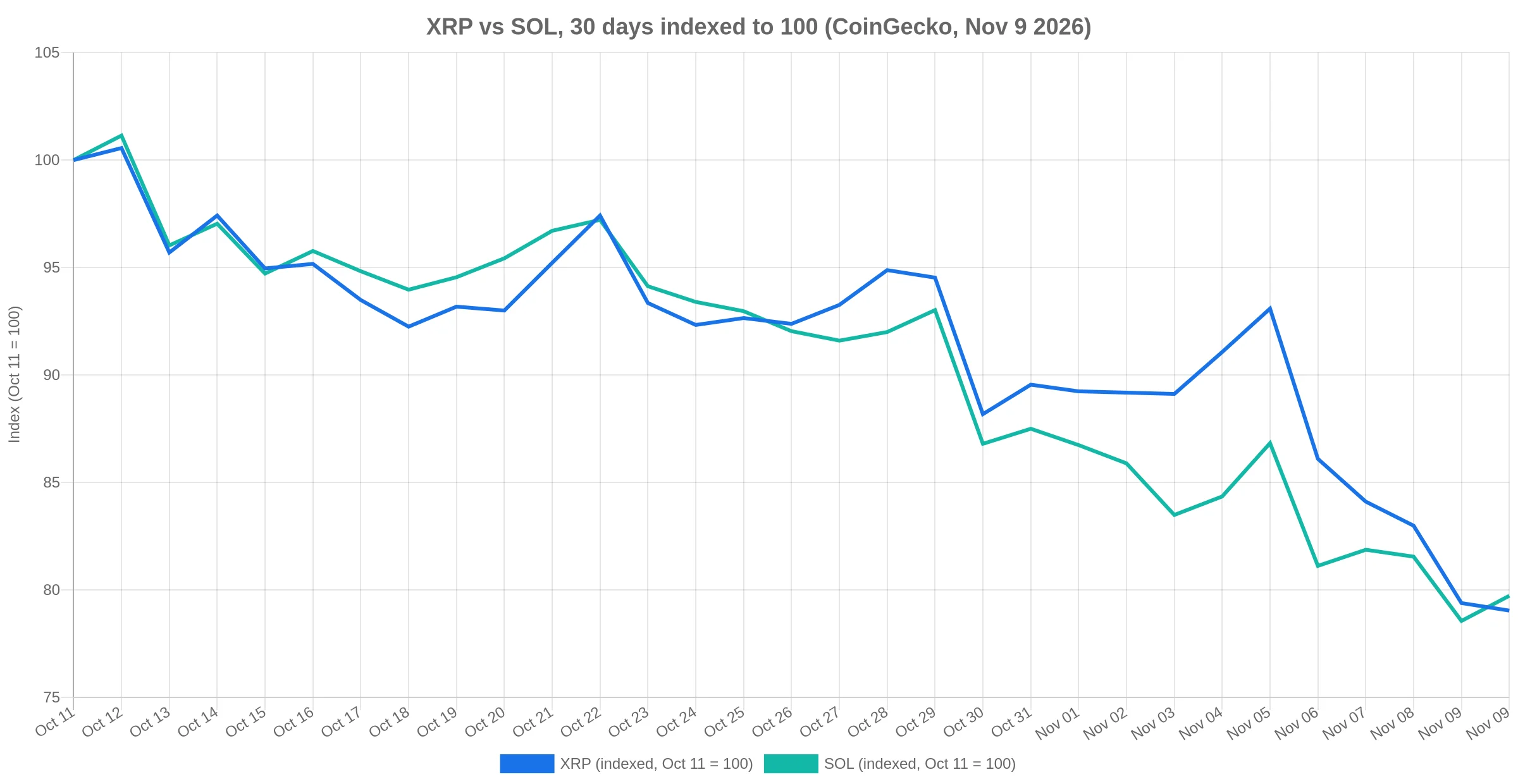
The indexed chart above, both tokens rebased to 100 on Oct. 11, shows the two lines crossing repeatedly and finishing within 0.7 index points of each other: XRP at 79.0, Solana at 79.7. For a reader weighing the two, that is a useful starting point because it removes the price-per-coin illusion. It does not tell you which asset is cheaper. Supply does.
Turnover adds a second measurement. XRP’s $1.84 billion of 24-hour volume equals 2.6% of its $70.5 billion market cap. Solana’s $2.15 billion equals 4.1% of $51.8 billion. Relative to its size, SOL is changing hands roughly 1.6 times faster than XRP, which is what a market with more active short-term positioning looks like.
Why the Supply Gap Changes the Math
Market-cap arithmetic is the part of a coin comparison that most price charts hide. XRP has 63.52 billion tokens circulating out of a 99.99 billion total supply, with a 100 billion maximum. Solana has 591.1 million circulating out of 637.3 million, with no fixed maximum.
Run the doubling test. XRP at $2.22 would carry a $140.9 billion market cap. Solana at $175.41 would carry $103.7 billion. Both are large numbers; the second is smaller than several existing top-ten assets, while the first would put XRP within reach of the largest non-BTC networks. Extend it to ten times: XRP at $11.08 implies $704.6 billion, roughly 2.7 times Ethereum’s current $261.7 billion market cap. Solana at $877 implies $518 billion. Neither outcome is a forecast. The point is that XRP needs a larger pool of new capital to produce the same percentage gain, because there are 107 times more tokens in circulation.
A $1,000 position at these prices buys 902.9 XRP or 11.4 SOL. The first is a claim on a network with a third of its supply still to be released; the second is a claim on one that is almost fully floated and inflates on a published schedule.
The Last Seven Days Split the Two
The 30-day numbers match to within 0.9 percentage points. The last week does not: XRP is down 11.2% over seven days against 7.3% for Solana, a 3.96-point gap. In other words, most of the relative divergence between the two happened in the most recent five sessions, not across the month.
The broader market moved with them. Bitcoin traded at $75,017, down about 1% over 24 hours, with BTC dominance at 60.2% of a $2.49 trillion total market cap, per CoinGecko’s global data. A 60% dominance reading means capital is not rotating out of bitcoin into altcoins; it is sitting in the largest asset while the rest deflates. That is the environment in which both XRP and SOL are trading, and it is the reason a single asset’s announcement has had limited traction on price.
XRP’s Case Rests on RLUSD Distribution
The most concrete XRP development of the past two weeks is not a price event. It is distribution for Ripple’s dollar stablecoin. Ripple said on Oct. 28 that RLUSD had gone live across Coinbase Prime, Coinbase Exchange and the Coinbase retail app, with 1:1 conversion from dollars and other supported stablecoins and support on the XRP Ledger, Base and Ethereum, in the company’s announcement . A day earlier it announced a Robinhood partnership covering RLUSD, treasury and prime brokerage in a separate release .
Jack McDonald, Ripple’s senior vice president of stablecoins, framed the Coinbase deal around access rather than speculation: “Institutional appetite for compliant, high-quality stablecoins is clear. The challenge is making them readily available through the platforms institutions already trust and use.” Brett Tejpaul, co-chief executive of Coinbase Institutional, described the addition as “another step toward the everything exchange.” BlockchainReporter covered the Coinbase listing when it was announced .
What that does for XRP holders is indirect and slow. RLUSD settles on the XRP Ledger, so more stablecoin volume means more ledger activity and more fee demand, but the token’s price is not mechanically tied to stablecoin issuance. The XRP Ledger’s fee is burned in tiny amounts, and the supply overhang described above remains the dominant variable in any valuation model that starts from fully diluted value.
Solana’s Case Rests on Applications
Solana’s most recent shipped product came from Solana Labs itself. On Nov. 5 the company announced the beta launch of Leap, a mobile trading app for tokenized stocks, ETFs, metals, currencies and crypto, built with Jupiter for routing, Helius for infrastructure and Birdeye for market data, per the launch release . The release states that future fees will be used to buy and burn SOL.
Anatoly Yakovenko, Solana Labs’ co-founder and chief executive, described the bet in product terms: “The network is ready for every kind of market. What matters now are the products that help people use it well and keep them coming back.” That is a demand-side argument, and it is the one Solana’s price has depended on through this cycle: applications and tokenized assets rather than a single settlement corridor.
There is a second, quieter data point. ZetaChain’s governance is voting to retire its own layer 1 and move ZETA to Solana on Dec. 9, a migration BlockchainReporter detailed here , with the proposal published at ZetaChain’s blog . A chain choosing to become an application on Solana rather than compete with it is a modest endorsement of the network’s execution layer, and it adds a dated event to the calendar.
What Would Change the Picture
For XRP, the reference level is $1.1084, the 30-day closing low set on Nov. 9. A daily close below it would put the token beneath every close in the observed window, and the next reference would have to come from a longer lookback. The Oct. 12 high at $1.4090 sits 27% above spot and is the level that would signal the drawdown has reversed rather than paused. Both numbers come from CoinGecko daily data and neither is a prediction.
For Solana, the equivalent levels are $86.41 on a closing basis and $85.54 intraday, with $111.25 the 30-day high. The dated catalyst is Dec. 9, when the ZetaChain migration is scheduled to execute, and the ongoing one is whether Leap’s fee-funded buy-and-burn produces measurable demand once the app leaves beta.
The variable that sits above both is bitcoin dominance. At 60.2%, it is near the top of its recent range, and altcoin pairs typically stop underperforming only when that reading falls. Until then, the more useful question for a reader is not which token is cheaper but which supply structure they are willing to own through another leg lower.
Frequently Asked Questions
XRP traded at $1.11 at 03:30 UTC on Nov. 9, 2026, down 4.4% over 24 hours and 20.8% over 30 days, with a $70.5 billion market cap according to CoinGecko.
Solana traded at $87.71 at the same time, down 1.7% over 24 hours and 19.9% over 30 days, with a $51.8 billion market cap and a $55.9 billion fully diluted valuation.
Both moved with a broader market decline in which bitcoin held 60.2% dominance of a $2.49 trillion market, so capital concentrated in BTC rather than rotating into altcoins. Neither token’s company-specific news reversed that flow.
XRP. Its $110.9 billion fully diluted valuation is 57% above its $70.5 billion market cap, meaning 36.5% of eventual supply is not circulating. Solana’s fully diluted value is 7.8% above its market cap, so 7.2% of it is not circulating.
Dec. 9, 2026, when ZetaChain’s governance plan would retire its layer 1 and move ZETA to Solana. XRP’s nearest dated items are the RLUSD distribution rollouts announced on Oct. 27 and Oct. 28, which are already live on Robinhood and Coinbase.
Data: CoinGecko , CoinGlass .
This article is not intended as financial advice. Educational purposes only.