Introduction
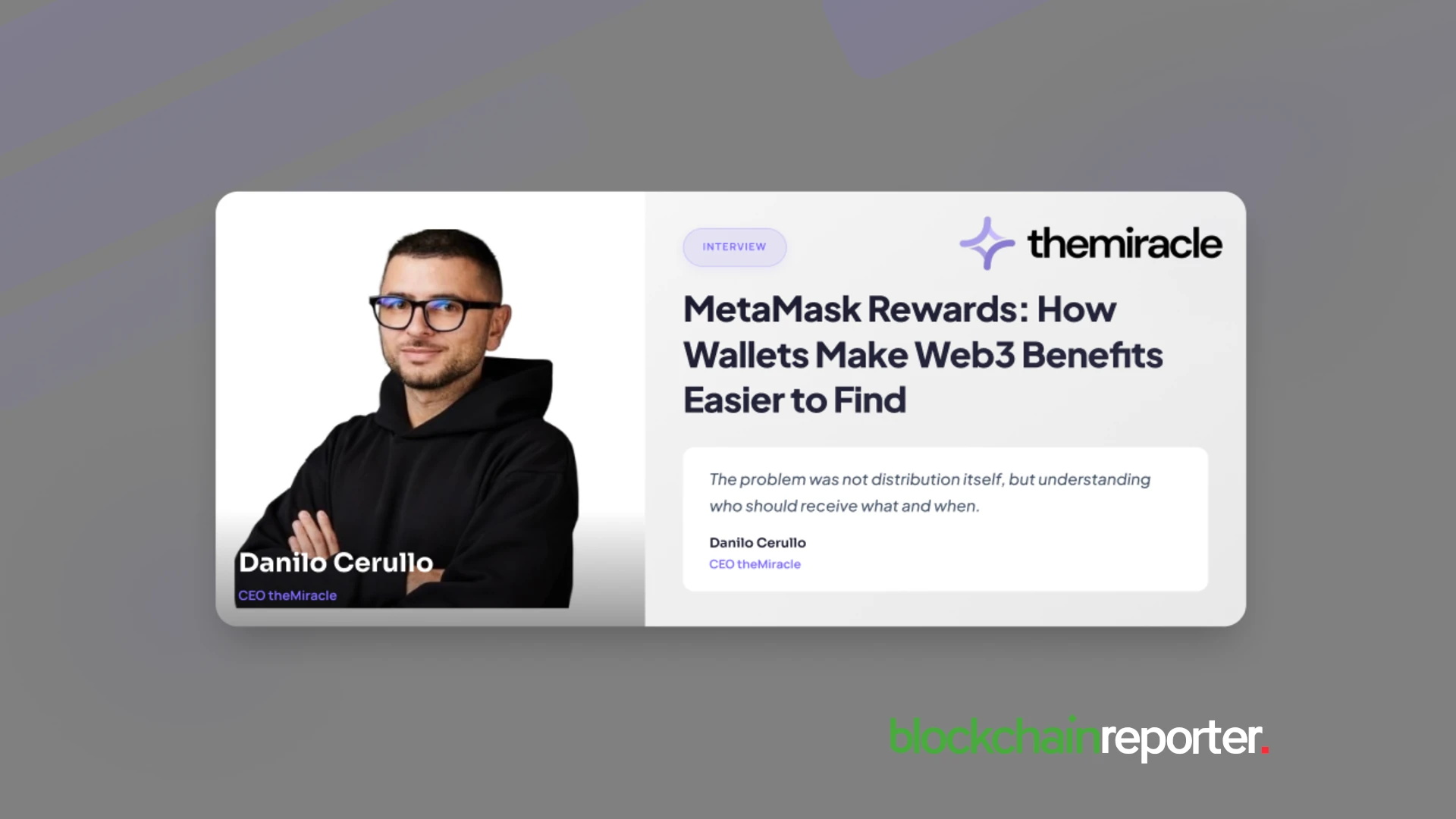
In an exclusive interview with BlockchainReporter, Danilo Cerullo, CEO of theMiracle , talks about one of Web3’s most persistent but unaddressed problems, getting the right benefits to the right users at the right time. With integrations now live inside MetaMask’s redesigned Rewards tab and Solflare, theMiracle has become a part of a broader shift in how wallets surface rewards and benefits.
In this interactive session, Danilo Cerullo breaks down why current incentive frameworks fail committed users, how wallet-native context can reduce reliance on identity-based systems, and what the behavior-led distribution means for the future of Web3 growth strategies.
Interview Session
You have said the real gap in Web3 was understanding, not only distribution. What structural issues created that gap?
Web3 has created a lot of real value. Users can earn access, rewards, airdrops, event benefits, fee discounts, loyalty perks, and ecosystem-specific opportunities. The issue is that much of this value still depends on broad announcements and fragmented claim flows.
For users, that means searching across X, Discord, Telegram, partner blogs, quest pages, and claim links. Even when someone is eligible, the benefit may arrive late.
The problem was not simply that projects could not distribute – they could. The problem was understanding who should receive what and when. Without that understanding, value gets pushed into the market and lands with whoever sees it first.
Our recent partnerships with Solflare and MetaMask matter a lot here. Solflare showed the model working inside a live wallet environment. MetaMask now brings the same model into one of the largest self-custodial wallet experiences, with theMiracle powering the Benefits section inside its redesigned Rewards tab. There, users see brand activations and loyalty rewards shaped by what they hold, own, and engage.
What happens when users only find out about relevant benefits after a campaign is already live?
When users discover relevant benefits only after a campaign is already public, the experience turns into a chase. They watch too many channels, click too many links, join communities they may not care about, and only then learn whether the reward applies to them.
This can look like engagement on a dashboard. But much of that activity is shaped by the reward mechanics, not by real product or ecosystem fit.
It also makes campaign data harder to read. If a brand reaches everyone first and works out relevance later, the signal is already mixed. Wallets connect, channels grow, claims come in, but it becomes harder to understand who engaged because the benefit truly mattered to them. For brands, that means less budget spent on broad reach and cleaner data on who actually cares.
The better model is to understand relevance before distribution begins. If the system can read wallet context earlier, the benefit can reach people with a clearer reason to care.
Why do current incentive frameworks often reward low-intent users before committed community members?
Many incentive systems reward discovery skill before genuine fit. The people who benefit most are often those with the best alert setup, the most time, and the most automation.
A committed user behaves differently. They may hold an asset, return to the same protocol, participate in one ecosystem, or use a product consistently. But they are not necessarily watching every announcement channel.
There’s a strange outcome: the strongest ecosystem users can miss the value meant for them, as short-term users capture it first.
Web3 already has enough behavioral data to improve that. Wallet context already shows what users hold, what they do, and what kind of value fits them. The work is turning that signal into claimable benefits.
What are the resulting challenges from the current framework for claiming rewards?
The current framework puts too much work on the user. If I am eligible, I may still need to find the claim, verify that it is real, connect a wallet , sign, switch tabs, and repeat the process across different ecosystems. That creates friction and a trust problem.
Reward links often travel through noisy channels. Users have to decide what is legitimate and what is dangerous. Fake airdrops and phishing flows can sit close to real opportunities, so people become suspicious.
Adoption slows if claiming value feels risky or confusing. Some users become more cautious, delay action, or avoid claim flows unless the source feels trusted. The better experience is real, claimable benefits appearing inside an interface people already trust, with fewer external links and unnecessary steps.
How does behavior-led distribution change user acquisition for projects and brands?
The change is that distribution can begin closer to the place where users already act. A wallet can show useful context before a campaign goes live, including assets, activity, recurring ecosystems, and relevant benefit categories.
Projects can surface tailored benefits to users already showing relevant behavior, then measure claims, completed actions, return activity, and behavior changes after the benefit appears.
For brands, this can mean less wasted spend and a cleaner path to acquisition. The goal is to bring the right benefit into a trusted wallet environment, where a user can understand it and act.
Across campaigns, we are already seeing projects onboard a significant number of new users through this model. The bigger story is that benefits become a path into deeper participation. Eligible wallet users can become customers, community members, or repeat participants because the first interaction begins with value.
What on-chain and off-chain signals are most useful for understanding whether a benefit is relevant?
I see the most useful signals as the ones that show real participation. That can include assets held, time active, protocol categories used, repeat interactions, claim history, or whether someone returns to similar activity over time.
A single transaction doesn’t tell the whole story. A pattern says more. If someone deposits, interacts, holds, returns, and keeps using a category, that’s more meaningful than a one-time action. Off-chain context can sharpen that picture.
Eligibility alone is not enough. Someone may technically qualify for a benefit, but their broader behavior can show whether the benefit is likely to feel useful, timely, or relevant to them.
Each benefit then carries a clearer reason to be there.
How does better benefit delivery support community development and retention?
Delivery shapes how a user feels about the ecosystem. If a benefit arrives at the right moment, it feels like recognition. The user doesn’t have to hunt for it or wonder whether they missed something.
MetaMask is the clearest example of this working in practice. Its redesigned Rewards tab introduces new ways for users to earn and discover value, and theMiracle powers the Benefits section within that experience. There, users can see brand activations and loyalty rewards shaped by their wallet context, including what they own, do, and engage with, directly inside the wallet.
The user doesn’t experience the benefit as another campaign to chase. They experience it as something their wallet helps them understand and access. As for brands, better benefit delivery turns a one-off campaign into a relationship moment, because the user receives value in a place they already trust.
That can support retention and loyalty for communities. People return when an ecosystem keeps showing them value that feels earned, relevant, and easy to claim.
What role does UX play in making incentives actionable?
UX is often the difference between being eligible and actually claiming. A user can qualify for a benefit and still never claim it if the path feels confusing, unfamiliar, or unsafe.
Every extra step adds drop-off: leaving the wallet, opening a browser, connecting again, reading a claim page, signing on an unknown site, and wondering whether the link is real.
Wallet-native delivery reduces that pressure. Discovery, context, and trust sit closer together, so the user can understand what may be relevant without leaving the interface.
Can better distribution reduce Sybil activity and airdrop farming, or will those actors adapt?
They will adapt. Any incentive system attracts people who try to optimize it, and that’s not unique to Web3.
But better distribution can still change the economics. Sybil farming works best with broad campaigns, simple rules, and eligibility that’s easy to copy across many wallets.
Behavior-led delivery makes that harder. Not every wallet needs to see every opportunity. Campaigns can rely on stronger indicators of real participation, time, usage patterns, and previous behavior.
None of this removes Sybils completely. It reduces easy wins and helps brands focus more attention on users whose behavior shows real fit.
What role will behavior-led distribution play in changing Web3 growth plans and marketing budgets over time?
It will move growth teams toward better use of the budget. Instead of spending first and learning only after distribution begins, brands can understand where relevance already exists before a campaign goes live. More budget can go toward showing the right benefits to the right people.
From the user’s perspective, wallets are the place to trade, claim, discover, spend, and return. When benefits match the user’s context, they feel native because they are shaped by what users hold and do. For wallets, relevant benefits can deepen trust when what shows up feels useful, earned, and native to the wallet experience.
Over time, Web3 growth moves from broadcasting incentives to understanding intent, matching value. This helps brands turn relevant wallet users into customers, community members, and repeat participants.
Conclusion
Danilo Cerullo has made it clear that Web3’s incentive problem is less about what projects offer and more about how, when, and to whom those offers arrive. theMiracle is powering the Benefits section inside MetaMask’s Rewards tab, which means that the approach is now live inside one of the world’s most widely used self-custodial wallets.
If behavior-led distribution becomes the new standard, the Web3 growth would be very different in the coming couple of years; less noise, less farming, and clearer paths to relevant benefits.