


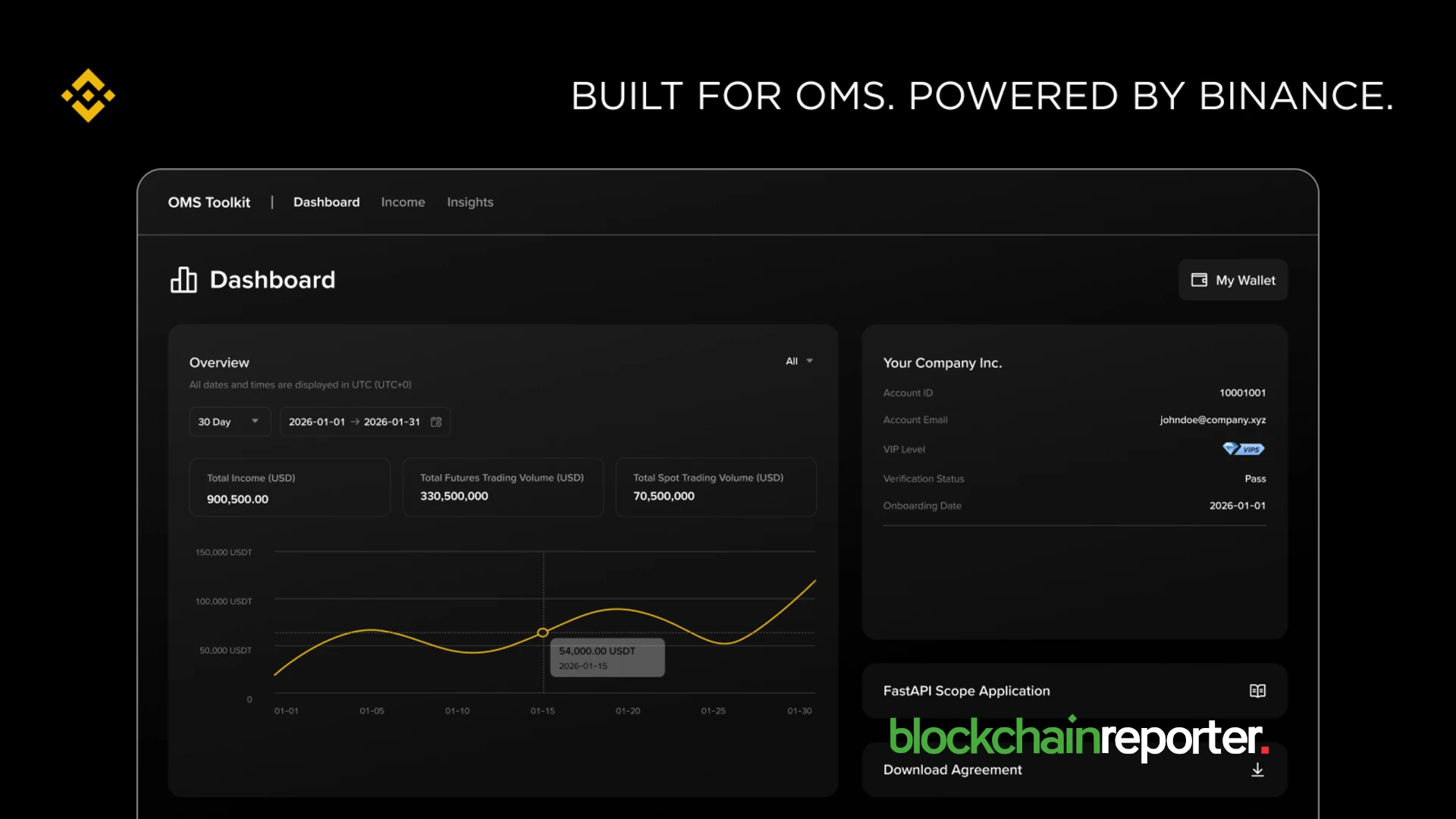
Binance has unveiled the OMS Toolkit, a new institutional exchange solution designed for Order Management Systems, Order and Execution Management Systems, and the trading technology providers that serve both crypto-native and traditional finance clients. The company says the product is meant to do more than simply connect firms to Binance’s venue: it is intended to give them deeper exchange-level visibility, better tooling and a smoother way to support professional clients as institutional activity in digital assets continues to grow. Binance announced the launch on May 25, 2026, describing it as the first institutional exchange solution of its kind in this segment.
At the center of the new toolkit is a streamlined integration layer paired with analytics designed to show providers more clearly how end clients are trading on Binance. According to Binance, the toolkit surfaces order flow, trading activity and engagement patterns in a way that can help OMS providers understand client behavior more precisely, improve workflows and strengthen client support. The company also says the system gives providers a fuller view of integrated API trading activity, which should make it easier to handle servicing and retention across fragmented markets where institutions often rely on several systems at once.
Binance is also leaning heavily into self-service features. The company says custom user tags will allow providers to segment and manage client accounts directly within the platform without having to rely on Binance support for routine changes. That is a meaningful detail for firms that want faster operational control and less back-and-forth when dealing with account structures, access settings, or client grouping. On top of that, the toolkit includes white-glove onboarding and ongoing support from Binance’s VIP and Institutional team, plus access to Binance Spot and Futures through the provider’s own system.
In a statement accompanying the launch, Catherine Chen, Binance’s Head of VIP and Institutional , framed the product as part of a broader push to treat technology partners less like passive order-flow conduits and more like ecosystem participants with room to grow. “Binance OMS Toolkit gives technology solution providers greater visibility into client activity,” she said, adding that the company wants to give key players “a stake in the ecosystem.” Binance said the new tool builds on Link and Trade, its earlier spot and futures API trade-tracking system for crypto technology providers, but expands it into a wider commercial and analytics offering.
Broader Institutional Strategy
The timing of the launch also fits into Binance’s broader institutional pitch. In a CoinDesk interview published May 30, Chen said the firm is building through the current market slowdown and aiming for a much larger role in global finance over the next several years. She said Binance is targeting 3 billion verified active users by 2030, up from about 310 million today, and argued that the company sees a major spending gap between traditional finance and crypto infrastructure that tools like the OMS Toolkit can help narrow. CoinDesk reported that Chen pointed to TradFi spending of more than $2 billion annually on advanced OMS infrastructure, compared with roughly $185 million in crypto infrastructure spending.
Chen’s comments underline the strategy behind the product: Binance is trying to position itself not just as a trading venue, but as a core part of the plumbing that institutions use to access digital assets. The company said the OMS Toolkit is available now to crypto-native and traditional market OMS providers, and that other non-custodial crypto businesses, including algorithmic and automated trading platforms that route trade flow through Binance, are also eligible. Interested providers can apply through their Binance Institutional representative or through Binance’s OMS Toolkit page.
Taken together, the launch suggests Binance is pushing deeper into the infrastructure layer at a time when competition for institutional clients is becoming more about data, integration and service than simple execution. Rather than just offering access to markets, the exchange is trying to make its platform stickier for technology providers that sit between Binance and the end client. That approach, if it gains traction, could help Binance strengthen its institutional relationships while giving OMS and trading tech firms a more detailed picture of how their clients interact with crypto markets.