



International shipping is absurdly expensive. Send a small package from Dubai to London through FedEx or DHL, and you’ll pay $30-$150 for something that weighs less than a kilogram. Meanwhile, hundreds of travelers fly that exact route daily with empty luggage space, earning nothing from their unused capacity.
Traditional logistics companies have built monopolies on cross-border delivery, charging premium prices while an entire parallel infrastructure—millions of international travelers—moves through the same channels unused. The inefficiency is staggering, yet most people accept it as unavoidable. But what if this broken model could be disrupted?
MVON, a utility token powering MovitOn’s peer-to-peer delivery platform, aims to bridge this gap. By connecting people who need items shipped with travelers heading to those destinations, the platform transforms waste into value. The MVON token presale offers early investors access to this logistics disruption before it reaches mainstream crypto markets.
The MovitOn Vision: Turning Travelers Into Couriers
MovitOn isn’t just another blockchain project searching for a use case. The platform addresses a genuine market inefficiency by connecting people who need items delivered with travelers already heading to those destinations. Think of it as Uber for package delivery, except the “drivers” are international travelers monetizing their unused luggage capacity.
Through the MovitOn application, a business person in Dubai can send contracts to London for a fraction of FedEx’s cost. A parent can ship homemade food to their studying child abroad. Travelers earn money simply by carrying items they would have space for anyway. The model works because it transforms a waste—empty suitcase space—into an asset.
This is where the MVON token enters the equation. Built as an EVM-compatible ERC20 token with a maximum supply of 650 million, MVON serves as the ecosystem’s lifeblood. Shippers pay in MVON. Travelers earn in MVON. Security deposits, commission fees, and platform services all run on MVON. Unlike speculative tokens trading on hype alone, MVON’s utility creates organic demand as the platform scales.
Crypto Presale 2025: Three Entry Points for Different Risk Appetites
The token distribution strategy reveals careful planning rather than a quick cash grab. Rather than dumping all 650 million tokens on the market at once, the team is releasing just 31.54%—205 million tokens—through three presale phases, each targeting different investor profiles.
| Phase | Private Sales | Presale Event | Public Sale (TGE) |
| % of Total Supply | 3.85% | 9.23% | 18.46% |
| Allocated Tokens | 25,000,000 MVON | 60,000,000 MVON | 120,000,000 MVON |
| Token Price | $0.02 USD | $0.034 USD | $0.042 – $0.05 USD |
| Minimum Entry | $2,000 USD | $500 USD | $100 USD |
| Maximum Hardcap | $500,000 USD | $2,000,000 USD | $6,000,000 USD |
| Duration | 1 Month | 2 Months | 4 Months |
| Special Benefits | Lowest entry price for strategic partners | Beta app access on iOS/Android | Large-scale promotional support |
The pricing structure tells an interesting story. Private sale participants—likely strategic partners and early believers—lock in tokens at $0.02, a 70% discount compared to the highest public sale price. That’s not unusual for crypto presales, but what matters is whether the discount reflects genuine early risk or simply rewards insiders.
The presale round at $0.034 opens doors wider while offering something tangible: beta access to the actual MovitOn application. This isn’t vaporware—presale participants can test the platform firsthand, evaluate its functionality, and make informed decisions before the public crowd arrives. For investors burned by projects that never delivered working products, this hands-on access provides valuable validation.
By the time the Token Generation Event rolls around at $0.042-$0.05, MVON becomes accessible to retail crypto investors with just $100 minimum entry. The four-month window and large promotional campaigns suggest the team expects significant public interest, but it also means later participants pay 150% more than private sale buyers for the same token.
Here’s where the opportunity narrative becomes relevant: the project targets an initial exchange listing price of at least $0.10. If achieved, private sale participants would see 400% returns before the token even begins trading publicly. Presale buyers would nearly triple their investment, while public sale participants might see 100% gains. These aren’t guarantees—crypto markets are notoriously volatile—but the structured pricing creates clear incentive tiers rewarding early risk-taking.
Tokens With Real Use: Beyond Speculation
What separates MVON from countless failed ICOs is its utility framework. The token isn’t a governance token without governance, or a “platform token” for a platform that doesn’t exist. MVON has specific, necessary functions within the MovitOn ecosystem that create sustainable demand.
Every shipment through MovitOn requires MVON tokens. Shippers can’t pay in dollars or euros—they need MVON to access the platform. This creates baseline buying pressure proportional to platform usage. As MovitOn scales from its 2026 target of 40,000 users to its 2027 goal of 100,000+ users, transaction volume should drive corresponding token demand.
The security deposit mechanism adds another layer. Both shippers and delivery agents must stake MVON as collateral, ensuring accountability on both sides. Smart contracts automatically hold these deposits and release them upon successful delivery. This temporarily removes tokens from circulation with each active shipment, reducing available supply during periods of high platform activity.
Staking rewards offer long-term holders additional incentives. By locking tokens in smart contracts for extended periods, users earn percentage returns—32.5 million MVON (5% of total supply) is allocated specifically for staking rewards. This mechanism encourages holding rather than dumping, stabilizing price action while rewarding patient investors.
Future features like MovitBox smart terminals and MovitAds viewing rewards will create additional token utility. MovitBox functions as physical pickup/dropoff locations, expanding MovitOn beyond pure peer-to-peer into semi-automated logistics. MovitAds allows users to earn MVON by viewing advertisements, creating a closed-loop economy where platform engagement itself generates tokens users can then spend on shipping.
The Tokenomics Blueprint: Designed for Scarcity
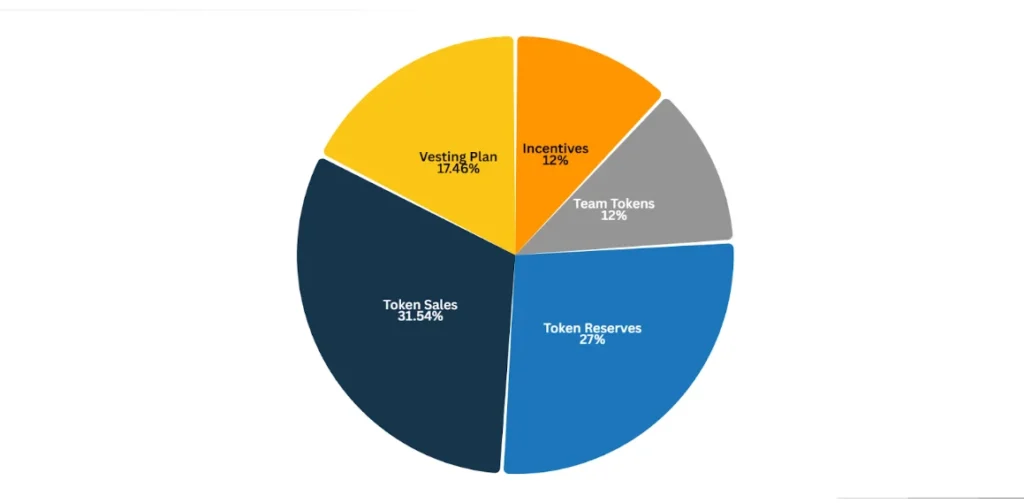
MovitOn’s token distribution reveals strategic thinking about long-term value preservation. Only 31.54% enters circulation through presales. Another 12% rewards the team, but these tokens remain locked until 2027 or until the token price increases 500% from listing—whichever comes first. This aligns team incentives with token holder interests; the founders profit only if everyone else profits first.
Community incentives account for another 12%: advisors, ambassadors, staking rewards, and airdrops that build grassroots support. These tokens distribute gradually rather than all at once, preventing supply shocks.
The most intriguing allocation is the 27% reserve fund—175.5 million tokens locked until 2030. These release only if MovitOn experiences acute token shortage combined with price increases exceeding 10,000%. This massive reserve ensures the project can operate for years even if early token sales underperform, but the extreme unlock conditions mean these tokens likely remain off the market indefinitely, effectively reducing real circulating supply.
Perhaps most importantly, the project implements a deflationary burning mechanism. Starting after the 2026 commercial launch, MovitOn will permanently destroy up to 5% of total supply annually using platform-generated profits. Fewer tokens plus growing demand equals upward price pressure—basic economics applied to crypto tokenomics.
The team projects less than 50% circulation by end of 2025, positioning MVON favorably for exchange listings. With limited supply available and (theoretically) growing demand from platform usage, the initial listing target of $0.10 per token seems plausible if the platform gains traction. That’s a significant premium over presale prices, but reaching it requires actual user adoption, not just speculation.
From Blueprint to Reality: The Development Journey
Roadmaps in crypto often read like science fiction—grand visions that never materialize beyond flashy websites. MovitOn’s timeline is aggressive but grounded in achievable milestones rather than revolutionary promises.
| Period | Phase | Key Milestones |
| 2024 | Foundation |
• Technical architecture design
• Development infrastructure deployment • Proof of Concept (PoC) prototype |
| 2025 Q1 | Build Phase | • MVP DEMO App development and testing |
| 2025 Q2 | Token Launch |
• MVON Presale PHASE 1 (Private)
• App BETA version release |
| 2025 Q3 | Network Testing |
• MVON Presale PHASE 2
• MovitOn TestNet Launch |
| 2025 Q4 | Mainnet |
• MVON TGE (Public Sale)
• MovitOn Mainnet Launch |
| 2026 Q1 | Market Entry |
• Go-to-Market strategy execution
• CEX and DEX listings • Travelers P2P Marketplace launch |
| 2026 Q2-Q4 | Platform Rollout |
• Launch in first 10 countries
• Target: 40,000+ users • MovitBox terminals deployment • MovitAds monetization program |
| 2027 | Global Expansion |
• Expansion to 30+ countries
• API integration for business partners • User base growth to 100,000+ • P2P marketplace affiliate program |
The beta access for presale participants in mid-2025 is crucial—investors can actually use the platform they’re funding before the public sale. This transparency dramatically reduces vaporware risk.
2026 becomes the make-or-break year. Q1 exchange listings will reveal whether early bets pay off. The Q2-Q4 expansion to 10 countries and 40,000+ users will determine whether MovitOn has genuine market fit. User acquisition at scale is brutally difficult—MovitOn must overcome trust barriers, regulatory hurdles, and network effects simultaneously.
If MovitOn survives 2026, the 2027 expansion to 30+ countries and API integrations with local businesses could transform it from consumer app to B2B logistics solution, dramatically expanding both addressable market and token utility.
The Deflationary Advantage: Token Burning Mechanism
Traditional currencies inflate—governments print money, diluting existing holders’ value. Most cryptocurrencies accidentally inflate too—founders mint tokens whenever convenient, or staking rewards flood the market with new supply. MVON’s deflationary model intentionally does the opposite.
The burning mechanism activates post-commercial launch in 2026. As MovitOn generates revenue from platform fees and services, up to 5% of total supply gets permanently destroyed each year. These tokens don’t go to a reserve or team wallet—they’re sent to burn addresses, gone forever.
Why does this matter? Supply and demand. If MovitOn achieves its user growth targets, demand for MVON increases as more people need tokens for shipping. Simultaneously, supply decreases through burning. The combination creates scarcity pressure that should support price appreciation, assuming demand remains constant or grows.
This is where the long-term investment thesis emerges. Early presale participants buying at $0.02-$0.034 aren’t just betting on a $0.10 listing price. They’re betting that by 2027-2028, after multiple burn cycles and user base expansion, MVON might trade significantly higher as a mature utility token with proven demand and diminishing supply.
Of course, this assumes the platform succeeds. Token burning means nothing if nobody uses MovitOn. But if the project gains traction, the deflationary model amplifies value for holders who weather the early volatility.
Investment Calculus: Risk vs. Opportunity
Every crypto investment involves calculated gambling. The question isn’t whether risk exists—it always does—but whether potential rewards justify those risks.
MVON’s risk factors are substantial. The peer-to-peer delivery model is unproven at scale. Regulatory challenges around cross-border transport could complicate expansion. User trust in strangers carrying valuable items may prove difficult to build. The team operates from Dubai under VAERTECH Solution FZCO, which raises questions about oversight compared to US or EU-based projects.
Against these risks, consider the opportunity. The global logistics market exceeds $10 trillion annually. Even capturing 0.1% would represent $10 billion in transaction volume. The structured presale pricing creates clear upside tiers: private sale buyers at $0.02 get 5x returns at the targeted $0.10 listing, while presale participants at $0.034 still nearly triple their investment.
More importantly, MVON represents tokens with real use—projects solving actual problems rather than existing solely for speculation. The utility token model with deflationary burning presents a more compelling investment thesis than most meme coins or unclear DeFi protocols.
For investors seeking crypto presale 2025 opportunities with substance, MVON deserves consideration. The project must prove itself through execution, but it offers serious evaluation as a utility token with genuine potential.
Getting Positioned: Practical Participation Guide
For those interested in participating in the MVON token presale, the process typically involves:
- Reviewing the project documentation thoroughly
- Following MovitOn on social platforms (Twitter/X: @MovitOn_P2P)
- Joining the community to stay updated on presale announcements
- Preparing necessary KYC documentation if required
- Having cryptocurrency ready for purchase (typically USDT, ETH, or BNB)
- Following official presale participation instructions when rounds open
Always verify you’re interacting with official MovitOn channels to avoid scams. Never send funds to unverified addresses or respond to unsolicited direct messages claiming to represent the project.
Final Assessment: Evaluating the MVON Opportunity
The MVON token presale represents an opportunity to invest early in a utility token addressing real logistics inefficiencies. The structured presale phases, deflationary tokenomics, and clear development roadmap suggest serious planning rather than a quick cash grab. Beta access for presale participants provides unusual transparency for crypto projects.
Risks remain substantial—unproven business model, regulatory uncertainties, execution challenges, market volatility. The peer-to-peer delivery concept must overcome significant adoption barriers and trust issues. Traditional logistics companies won’t surrender market share without fighting back.
Yet for investors seeking tokens with real use in the crypto presale 2025 landscape, MVON deserves consideration. The global logistics market offers enormous addressable opportunity. The token’s utility creates organic demand drivers beyond pure speculation. The deflationary model and strategic supply management could support value appreciation if the platform gains traction.
Early presale participants get the best entry prices but assume the highest risk. Later participants pay premiums but invest with more visible product validation. The choice depends on individual risk tolerance and belief in the MovitOn vision.
One thing seems certain: crypto is moving beyond pure speculation toward utility and real-world application. Projects like MovitOn—with clear problems to solve, working products to launch, and tokens that serve necessary functions—represent this evolution. Whether MVON specifically succeeds depends on execution, but the category of utility tokens addressing logistics, commerce, and real economic activity appears increasingly relevant.
For those who see potential in blockchain-powered logistics and trust the team’s ability to execute, the MVON token presale offers early access to what could become a significant player in decentralized delivery networks. For skeptics, it’s another untested project in an industry littered with failures. Time will reveal which assessment proves correct.
This article is not intended as financial advice. Educational purposes only.