



WLFI printed an all-time low of $0.0156 in the 18:00 UTC hour on Binance spot, 58.3% below the same hour a day earlier and the weakest level since the token began trading on the exchange in September 2025. The pair was changing hands at $0.0169 at 20:45 UTC, down 53.4% over 24 hours. The 04:00 candle cleared the previous floor of $0.0356, set on 27 November, within its first hour and the pair has not reclaimed it since, according to Binance’s own WLFI/USDT market data .
What happened underneath the candle is the more useful number. Open interest in Binance’s WLFI perpetual futures fell from $136.9 million at 04:00 UTC to $24.3 million four hours later, a decline of 82.3%. In token terms it went from 3.98 billion to 1.25 billion. The spot price lost 40% across those same four hours and 54% from the 04:00 open to the 05:00 low; the leverage lost four-fifths of itself.
At 12:37 UTC, World Liberty Financial published its account of the night. “We are aware that overnight, Binance automatically closed WLFI perpetual futures positions on both the long and short sides,” the project wrote on X . It added that “WLFI had no involvement in these actions and has no control over how these positions are managed, closed, or settled.”
We are aware that overnight, Binance automatically closed WLFI perpetual futures positions on both the long and short sides. WLFI had no involvement in these actions and has no control over how these positions are managed, closed, or settled.
— WLFI (@worldlibertyfi) November 28, 2026
The statement names a mechanism that Binance documents in public, not a cause. The venue’s own definition of that mechanism is checkable, and it points somewhere other than the project’s account.
Four hours, and the number that explains them
The collapse was not gradual. Between 03:00 and 04:00 UTC, WLFI traded 4,471 times for $1.09 million. Between 05:00 and 06:00, the pair printed 176,204 trades for $32.46 million, roughly 39 times the earlier trade count on 30 times the notional.
| Hour (UTC) | Open | Low | Close | Quote volume | Trades | Futures OI at hour start |
|---|---|---|---|---|---|---|
| 03:00 | $0.0350 | $0.0338 | $0.0344 | $1.09M | 4,471 | $140.1M |
| 04:00 | $0.0344 | $0.0211 | $0.0256 | $27.34M | 137,696 | $136.9M |
| 05:00 | $0.0256 | $0.0158 | $0.0188 | $32.46M | 176,204 | $66.9M |
| 06:00 | $0.0188 | $0.0166 | $0.0184 | $17.61M | 70,856 | $32.2M |
| 07:00 | $0.0184 | $0.0178 | $0.0193 | $20.29M | 117,694 | $26.6M |
| 08:00 | $0.0193 | $0.0184 | $0.0206 | $12.54M | 56,317 | $24.3M |
| 12:00 | $0.0196 | $0.0191 | $0.0194 | $2.06M | 5,582 | $25.1M |
| 16:00 | $0.0177 | $0.0168 | $0.0176 | $3.84M | 25,867 | $22.2M |
Data: hourly candles for WLFI/USDT spot and the WLFIUSDT perpetual , pulled from Binance’s public market endpoints at 18:40 UTC on 28 November 2026. Open interest is shown at the start of each hour, so the 05:00 row already reflects the liquidation burst inside the 04:00 candle.
Two things stand out in that table. First, open interest in dollars fell harder than open interest in tokens, by 82.3% against 68.5%. A book that had only been repriced would have shrunk on both measures by the same percentage; the gap is what a forced deleveraging looks like, because positions were closed and the tokens behind them left the venue.
Second, the cash that changed hands was smaller than the notional that disappeared. Spot turnover across those four hours was $97.7 million, summing the quote volumes in the table from 04:00 to 07:00, while open interest in dollars shrank by $112.6 million over the same window. Leverage unwinding explains the shape of the candle; it does not explain how far the price fell relative to the cash that traded.
What auto-deleveraging is, according to Binance’s rulebook
Binance’s support documentation is unusually clear about where ADL sits in the chain. “Auto-Deleveraging (ADL) is the final step in the liquidation process and occurs only if the Futures Insurance Funds are unable to accept a bankrupt futures position,” the exchange’s FAQ states. It adds that “positions that are more profitable and more highly leveraged will be queued for ADL liquidation first, ahead of positions that are less profitable and less leveraged.”
Read that literally and the sequence runs the other way round from the way it is being told. ADL is the last resort after a position has gone bankrupt and the insurance fund has declined to absorb it. It closes the winning side at the bankrupt trader’s price. It does not choose a price for the asset, and it cannot push spot down 54% in two hours by itself, because the spot market is a separate book.
If World Liberty’s description is accurate, then two things must also be true: losses on WLFI futures were large enough to exhaust the pair’s insurance fund, and the resulting forced closes hit traders on both sides. The project itself reports having seen “reports from users whose positions were profitable prior to closure but resulted in losses upon settlement.” Both points are checkable, and only Binance can confirm them. The exchange had published nothing about WLFI or USD1 on its announcement feed as of 20:45 UTC.
That leaves a narrower reading of the project’s statement. It describes what affected users experienced; it does not establish why the spot market fell. Binance’s own rulebook puts ADL at the end of a liquidation chain, which means forced closes in the perp book follow a price move rather than set one. What started the move is still unattributed.
USD1 traded at 94 cents while WLFI was writing its statement
The stablecoin is the harder fact of the day.
USD1, World Liberty’s dollar token , traded down to $0.9400 in the 07:00 UTC hour on Binance’s USD1/USDT pair, a 6% discount to par. It closed that hour at $0.9955 and was back at $0.99897 by 18:35 UTC, ten basis points below the dollar it tracks. The dip lasted about two hours.
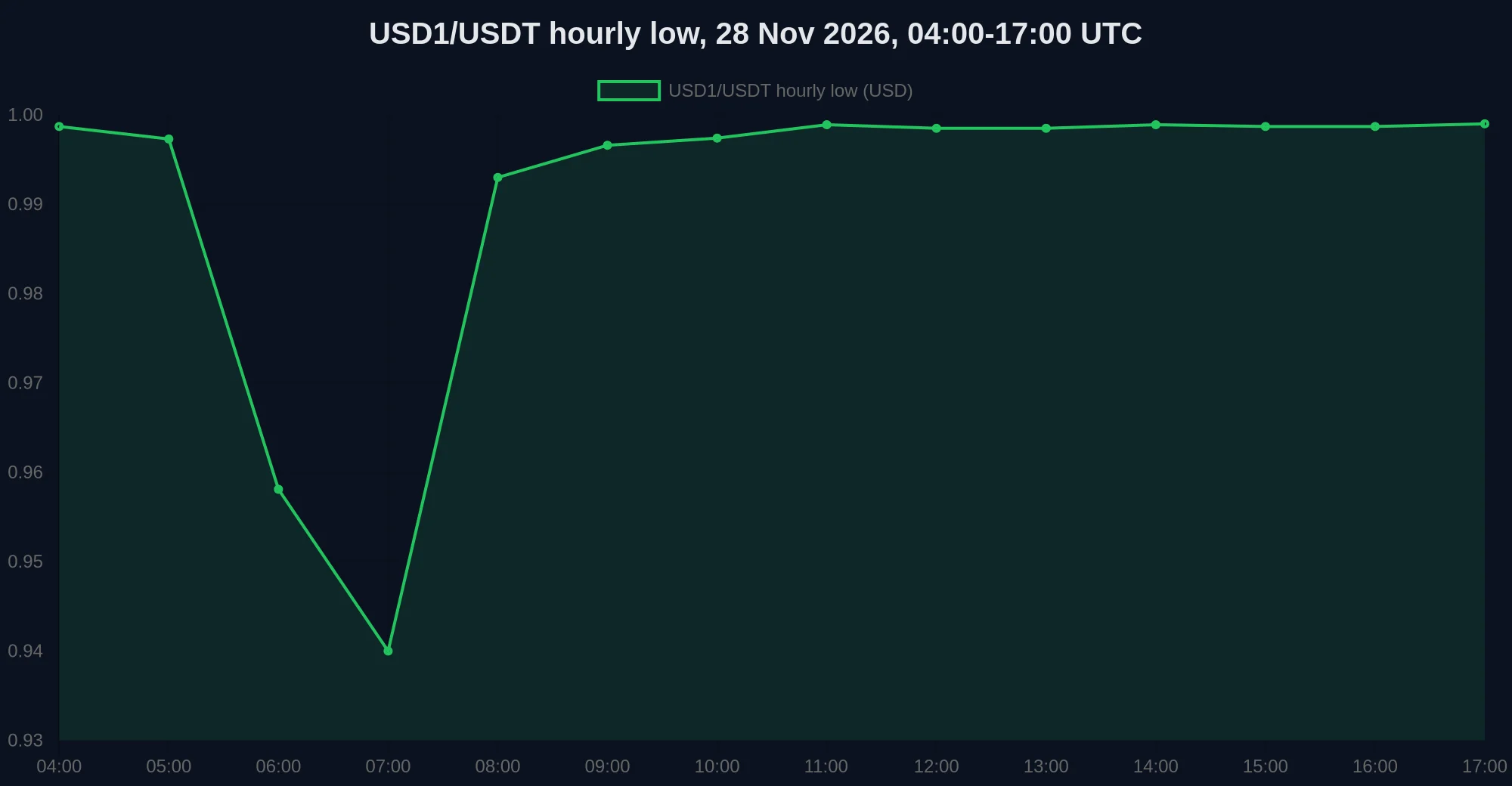
Volume tells you who was panicking. The pair turned over $479.9 million in the 24 hours to 18:35 UTC, and $291.9 million of that, 61%, came in the four hours from 04:00 to 08:00. The 07:00 hour alone carried $119.0 million across 151,848 trades, on a pair that had been doing $1 million to $5 million an hour before the break.
The recovery matters as much as the dip. A genuine redemption run does not retrace from 94 cents to 99.7 cents inside two hours. A thin order book meeting forced sellers does, which is consistent with a collateral event rather than a solvency event. That reading is an inference from prices and volumes, not something either company has confirmed.
Anyone holding WLFI as collateral, or USD1 as a settlement asset, now has a reason to check the terms. A token that gives up more than half its value in two hours is a holder’s problem. A dollar token at 94 cents is a venue’s problem, because platforms that post it as margin have to decide what to mark it at when the next squeeze arrives.
Sun wants a delisting, and he is also the plaintiff
Justin Sun, an early WLFI investor who is litigating against the project, used the crash to escalate. “Today’s WLFI episode is just another rerun of insider circular lending to cash out, unauthorized insider selling, the illegal freezing of investor assets, and investor fraud,” he wrote at 07:23 UTC , before the project’s own statement. He called on “major exchanges, regulators, judicial authorities, and the courts to take prompt action against WLFI and USD1, including but not limited to issuing warning lists, immediate delisting, restricting deposits, and requiring disclosure of where the illicit funds have gone.”
Those are allegations from a party with a live financial and legal interest in the outcome. No court has ruled on them, and the freeze at the centre of his complaint is the subject of a dispute the project has already answered in public . Treat the delisting call as a demand, not a decision: no major venue had announced a WLFI or USD1 delisting as of Saturday afternoon.
The practical version of his request is narrower than it sounds. Exchanges that quote USD1 or accept it as collateral would have to revalue it and notify users. No major venue has signalled such a review, and Binance’s announcement feed carried no rule change on either token as of 20:45 UTC.
Funding flipped to minus 0.64%, and that is the honest footprint
One more data point separates the story from the usual leverage-blame template. The WLFI perpetual settled at a funding rate of +0.005% at 04:00 UTC, an annualised 11%. There was no long-side premium in the hours before the break, which undercuts the standard explanation that a crowd of overleveraged longs simply got what was coming.
After the crash, the sign flipped hard. The 08:00 UTC settlement printed -0.6356%, which annualises to -1,392% if it persisted, and the 16:00 print was still negative at -0.0114%. Shorts were paying longs to stay in the trade. That is the footprint of a book that had been cleaned out on one side, not a market that was crowded the wrong way before the fall. Annualising a single funding interval is arithmetic, not a forecast, and one print says more about the four hours around it than about the next four.
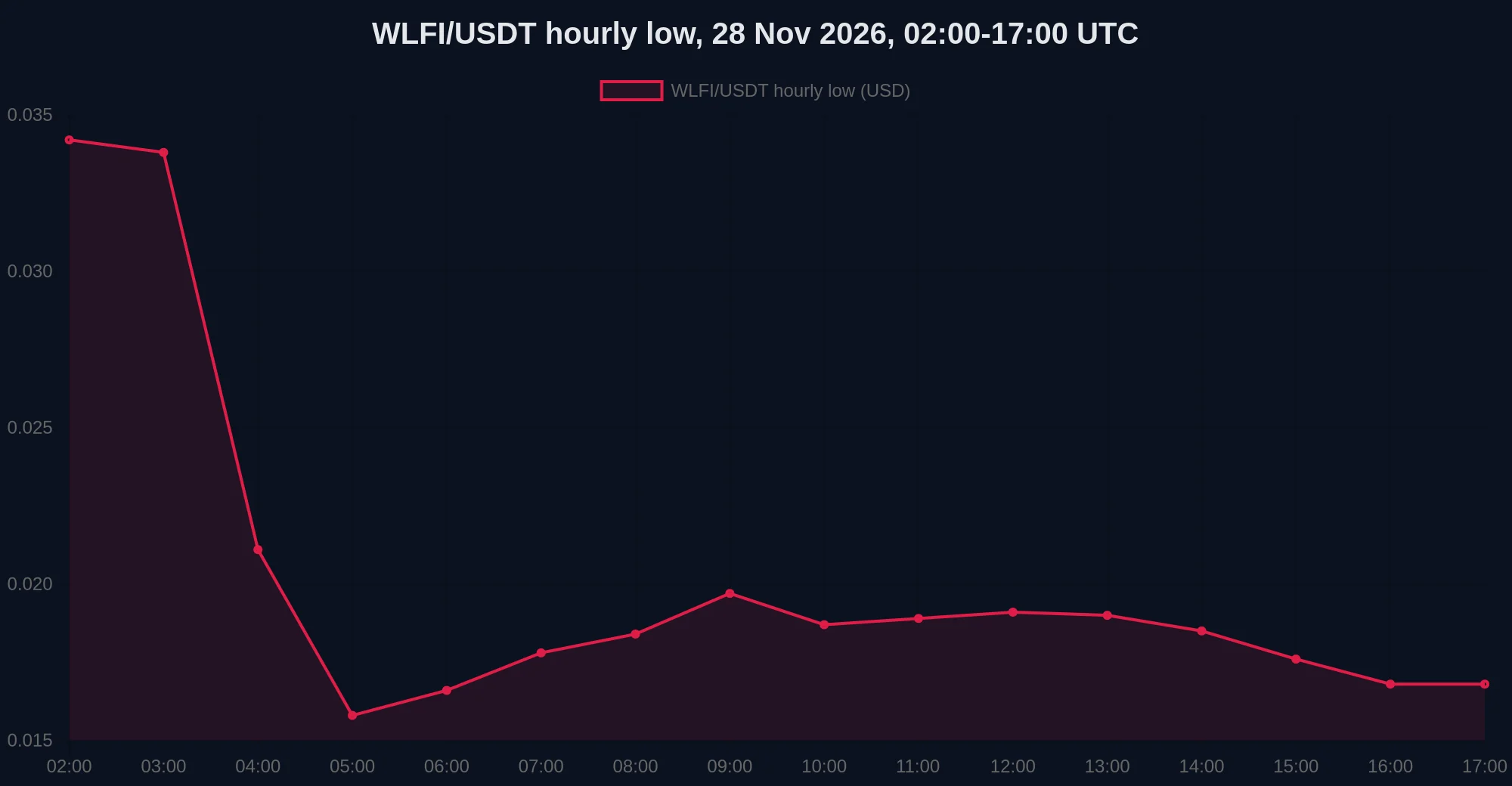
For a trader, the levels are simple and they come from the same table. $0.0156, the all-time low set in the 18:00 hour, is the level that has to hold; a close back above $0.0206, the 08:00 hourly close, would break the base that has capped every bounce since. Between those two numbers there is no edge in either direction while liquidity stays this thin, and the invalidation is a close, not a wick.
What would turn blame into evidence
Three disclosures would settle this, and none of them requires a press release.
First, Binance’s account of the WLFI insurance fund. If the exchange confirms that the fund could not absorb the bankrupt positions, World Liberty’s account is mechanically correct and the cascade started inside the perp book. If Binance says the fund held, the ADL claim does not survive contact with its own rulebook, and the selling that started the move came from somewhere else: a collateral liquidation, a treasury sale, or a large holder exiting into a Saturday book.
Second, the collateral question. On-chain analysts spent Saturday circulating an unverified claim that a World Liberty-linked position sold ETH at a loss to avoid a liquidation on the Dolomite lending market. Neither company has confirmed it, and ether itself fell only 1.3% on the day, which argues against a market-wide event and for a single seller. Until a wallet, a filing or a statement puts that sale on the record, it belongs in the hypothesis column.
Third, the flows. USD1’s premium or discount on Binance over the next few sessions is the cleanest read on whether the stablecoin’s backers are redeeming or defending. A return to par with shrinking volume is a system that absorbed the shock. A persistent discount with rising volume is a system that did not.
What the record already shows is narrower than either side wants. A token that had never closed below $0.0356 lost 54% of its value in two hours on 39 times its normal hourly trade count, an entire tier of leveraged positions disappeared, and its sister stablecoin briefly traded at 94 cents. The project has explained how positions were closed. It has not explained what sold first.
The post WLFI Fell 54% in Two Hours as Binance Open Interest Dropped 82%. World Liberty Blames Auto-Deleveraging appeared first on Blockchainreporter .