



The instruction reached Solana validators at 23:31 UTC on Friday in 32 words and one alarm emoji: upgrade to Agave v4.4.2, do not wait, and the scope is every Agave-based node, staked or unstaked. The notice went further than most patch announcements, because it did not limit itself to the machines that vote on blocks, and it carried a reassurance line in the same breath.
? Mainnet validators: URGENT Agave v4.4.2 release is out. Don’t wait, upgrade now.
Applies to all Agave-based nodes, staked or unstaked. Clusters are safe and running normally.
Testnet and devnet upgrade to v4.5.0-rc.1. ?
— Anza (@anza_xyz) November 27, 2026
The release itself had shipped four hours and 26 minutes earlier. Anza’s GitHub page for v4.4.2 timestamps it at 19:04:56 UTC and labels it “This is stable release recommended for general adoption,” the same wording the project uses for routine patches. Nothing in the public record explains why a stable patch turned into an urgent alert, and that gap is the part validators have to work with.
A Patch Note That Reads Like Routine Maintenance
The release lists eight changes. Three are suppressions of RustSec advisories in dependencies (quinn, libz-sys and url). One bumps the vendored anza-quinn crates that ship with the client. One disables unused TLS early data in tpu-client-next, the transaction forwarding path. One puts the
/v0/circulating-supply
RPC endpoint behind the
--full-rpc-api
flag. One adjusts a CI job for XDP tests, and the last is the version bump itself.
Of those eight, only the RPC change appears in the
4.4 changelog
as notable, and it lands under “Breaking”: “The
/v0/circulating-supply
endpoint now requires
--full-rpc-api
.” The networking and dependency work sits in the release notes without a CVE, a vulnerability summary or an exploit scenario. The repository’s advisory list carries nothing for this version, and no post-mortem has been published.
Read plainly, the changes harden the client’s QUIC and TLS surface and clear three audit flags that had been sitting in the dependency tree. Read against the word “URGENT,” they suggest something in that surface mattered enough to interrupt operators, and Anza has not said what it was. Both readings are supportable from the same eight lines, which is why the notice matters more than the changelog.
Four Hours Between the Release and the Alarm
The timing is easy to check. v4.4.2 was published at 19:04:56 UTC. Jito-Solana, the client that builds on top of Agave, published a matching v4.4.2-jito build at 20:14:41 UTC, 70 minutes later, with release notes that say only: “Pull in changes from upstream agave v4.4.2.” The urgent post came at 23:31:20 UTC, more than four hours after the upstream tag existed and roughly three hours and 17 minutes after the downstream client build.
Anza also published v4.5.0-rc.1 eight minutes before v4.4.2, at 18:56:05 UTC, and pointed testnet and devnet operators at that candidate instead. The two tracks moving within nine minutes of each other is the normal shape of Anza’s release flow, not evidence of two separate problems: the 4.4 line carries stable mainnet patches while the 4.5 line carries the next upgrade candidate.
The patch cadence behind the release is short. Agave 4.4.0 shipped on 28 October at 20:35 UTC, 4.4.1 followed on 5 November at 18:33 UTC, and 4.4.2 arrived on 27 November, 22 days after its predecessor. Two stable patches in a month on the same minor line fits a client that ships continuously, but both were tagged for general adoption and one of them was followed by an urgent validator notice. Feature work moves on a different track: the Alpenglow consensus upgrade was scheduled for 21 October with its own activation date and a finality target, while a patch like v4.4.2 asks operators for nothing beyond a version bump and a restart.
What the Chain Looked Like While the Alert Went Out
Solana’s own RPC endpoints, sampled at 06:40 UTC on 28 November, showed epoch 1099 with 86,115 of 432,000 slots elapsed, or 19.9% of the epoch. The absolute slot was 474,854,115. The cluster reported 655 current validators and 10 delinquent ones, with 423,439,967 SOL of activated stake behind the active set.
Two-thirds of that stake comes to 282,293,311 SOL. Anza set no stake target for this upgrade and the notice names none, but two-thirds is the stake weight Solana’s consensus needs to finalize a block, so it is the number to watch if a client split ever shows up in the delinquency count. Ten delinquent validators out of 665 tracked is 1.5% of the set, far below the third of stake that would put finality at risk.
The Solana status page listed no incident for 27 or 28 November at the time of writing; its most recent entries date back to 2024. Anza’s own line, “Clusters are safe and running normally,” is consistent with that record rather than a substitute for it.
Why the Scope Line Names Nodes, Not Holders
Agave is the client Anza maintains, and an operator running it is responsible for the version on their machine. That is why the notice says “staked or unstaked”: a non-voting RPC node running Agave still needs the patch if the change touches request handling, and an unstaked node cannot vote its way out of a code path it still executes. Jito-Solana inherits the upstream changes, which is why it needed a release of its own within the hour.
Nothing in the notice, the release notes or the changelog asks token holders to move funds, redelegate stake or change wallet software. There is no governance vote attached, no activation height published and no instruction to restart at a particular slot. The whole ask is a version change on the operator side, and the notice does not say what happens if an operator waits.
The Price Layer: SOL at $71.45
SOL traded at $71.45 at 06:38 UTC, down 2.11% over 24 hours, with a market capitalisation of $42.32 billion against a fully diluted value of $45.60 billion on 592.43 million circulating tokens out of 638.35 million total. That leaves 45.92 million SOL, about 7.2% of total supply, outside the circulating count. The token sits 75.6% below its January 2025 high of $293.31.
The 30-day close series shows where the alert landed. SOL closed at $102.32 on 29 October, fell to $68.76 on 21 November and has spent the last week between roughly $69 and $75. The urgent upgrade notice arrived inside that range, not at a break of it.
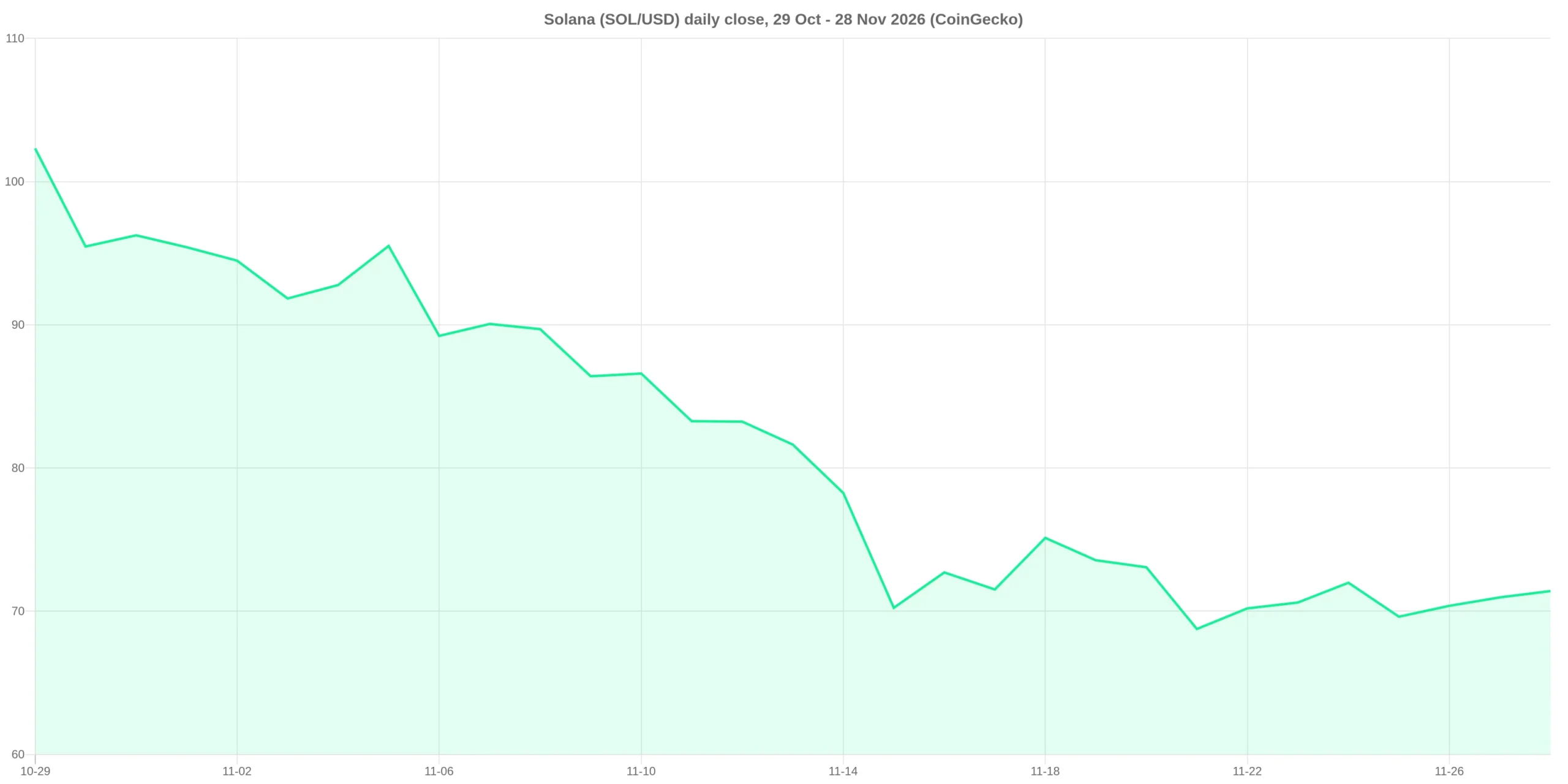
Available evidence does not establish that the upgrade notice moved the price. SOL has traded with the wider market through November, and the $70 line has been the reference point for two weeks of coverage here, long before this release existed. A client patch with no disclosed defect is not a catalyst a market can price.
Three Signals That Would Change the Picture
First, the delinquency count. Ten out of 665 is quiet. A jump into the dozens, especially clustered around one client version, would mean operators are restarting into a problem rather than out of one.
Second, a public advisory. If Anza or a downstream client publishes a vulnerability write-up for the QUIC or TLS changes, the urgency stops being a judgment call and becomes a documented incident with a timeline.
Third, the next release. The 4.4 line has shipped twice in 30 days. A 4.4.3 inside a week would suggest the hardening in this patch was incomplete. Until one of those three moves, the accurate description of 28 November is a client team telling its operators to patch fast and a network that kept producing blocks while they did.
Frequently Asked Questions
It is a stable release of Anza’s Solana validator client, published on 27 November 2026 at 19:04 UTC. The release notes list eight changes covering QUIC and TLS handling in the transaction forwarding path, three dependency advisories, an RPC endpoint restriction and a version bump.
No holder action has been announced. Anza’s notice is addressed to mainnet validators and node operators running Agave-based software, staked or unstaked. It does not ask token holders to move funds, redelegate stake or change wallets.
Anza said clusters were safe and running normally in the same notice that called the upgrade urgent. The Solana status page showed no open incident on 27 or 28 November, and the cluster was 19.9% through epoch 1099 when the network was sampled at 06:40 UTC.
Neither the notice nor the release notes set a deadline or an activation slot. Anza asked operators to upgrade immediately and gave no cut-off, which means the practical deadline is whatever exposure an unpatched node carries.
The
/v0/circulating-supply
endpoint now requires the
--full-rpc-api
flag, per the 4.4 changelog. Nodes exposing that endpoint without the flag will stop serving it after the upgrade.
Disclosure: This article does not represent investment advice. The content and materials featured on this page are for educational purposes only.
The post Anza Tells Every Solana Agave Node to Upgrade Now to v4.4.2 appeared first on BlockchainReporter .