


The best crypto to buy now, judged only on evidence dated 26 November 2026, is the asset with a live regulatory catalyst and a price still below its long-run averages: Chainlink’s LINK at $9.24, where $1,000 buys 108.2 tokens. Fidelity filed an S-1 for a spot LINK fund on 25 November, and the document itself is unusually generous with the details a buyer needs. It also removes two things that marketing copy tends to assume.
The filing runs to 830,557 bytes and carries four square brackets in the places where money and identity usually go. The sponsor fee reads “[ ]%”. The ticker reads “[FLNK]”. The creation basket reads “[25,000]” shares. The date of the prospectus reads “[ ], [2026]”. Everything else is specific enough to price: a Delaware trust, three named custodians, a Nasdaq listing, and an index calculated every fifteen seconds.
What follows separates the parts of the S-1 that are facts from the parts that are intentions, then puts the number that matters next to the price a reader would pay today. The two existing spot LINK funds make that comparison possible, because they already publish what a share holds and what the wrapper costs.
Four brackets Fidelity left in its own prospectus
The cover page of the preliminary prospectus states the limit plainly: “The information in this Preliminary Prospectus is not complete and may be changed. We may not sell these securities until the registration statement filed with the Securities and Exchange Commission is effective.” A filing date of 25 November is a filing date. It is not an approval, and the document says so on the page a reader sees first.
The structure behind the brackets is fully specified. FD Funds Management LLC is the sponsor. CSC Delaware Trust Company is the trustee. The custodian sentence names three institutions and assigns all of the trust’s holdings to them jointly: “Anchorage Digital Bank NA, BitGo Bank & Trust, N.A. and Coinbase Custody Trust Company, LLC (each, a “Custodian” and collectively, the “Custodians”) are the custodians for the Trust, and will together hold all of the Trust’s LINK on the Trust’s behalf.”
That is the most consequential operational difference between this filing and the funds already trading. A single-custodian product concentrates key management and legal risk in one counterparty. Three custodians split it, at the cost of more transfer friction when baskets are created and redeemed.
The fee sentence is the one that decides whether the fund competes. The trust “will pay the Sponsor an annual unified fee of [ ]% of the Trust’s LINK Holdings (the “Sponsor Fee”).” Until that bracket is filled by amendment, no reader can say whether Fidelity intends to undercut the two funds already in the market, match them, or price above them. A blank fee in a first filing is normal. It is also the single number that determines the fund’s long-run cost to a holder, because the fee is paid in LINK, which shrinks the amount of the token each share represents over time.
The index construction is specified: LINK price feeds from eligible spot markets, a volume-weighted median price, “calculated every 15 seconds based on VWMP spot market data over rolling sixty-minute increments”, with Coin Metrics, Inc. as the independent calculation agent. The benchmark name still carries brackets as well, listed as the “[Fidelity Chainlink Reference Rate]”.
Two funds already hold this exposure, and their combined size is the story
Grayscale’s Chainlink Trust ETF trades as GLNK on NYSE Arca. Its issuer page, updated 25 November, shows GAAP assets under management of $115,711,668, a management fee of 0.35%, 14,352,010 shares outstanding, a GAAP net asset value of $8.06 per share against a market price of $8.08, and a 30-day median bid/ask spread of 0.27%. The trust itself dates from February 2021; the exchange-traded listing dates from 2 December 2025.
Bitwise’s Chainlink ETF trades as CLNK, also on NYSE Arca, and launched on 13 January 2026. The issuer’s page, updated 24 November, reports $41.63 million in net assets, a sponsor fee of 0.34% with no other expenses, a net asset value of $16.01 against a market price of $16.02, a 30-day median spread of 0.60%, and 4,725,453.72 LINK held for 1.82 LINK per share. Coinbase Custody Trust Company is its digital asset custodian.
| Product | Listing | Fee | Assets | Custody | Status |
|---|---|---|---|---|---|
| Grayscale GLNK | NYSE Arca, listed 2 Dec 2025 | 0.35% | $115.7 million (25 Nov) | Single third-party custodian | Trading |
| Bitwise CLNK | NYSE Arca, launched 13 Jan 2026 | 0.34% | $41.6 million (24 Nov) | Coinbase Custody | Trading |
| Fidelity [FLNK] | Nasdaq, proposed | [ ]% | None | Anchorage, BitGo, Coinbase Custody | S-1 filed 25 Nov, not effective |
Add the two live funds together and the total is $157.3 million. LINK’s market capitalisation at 12:02 UTC on 26 November was $7.09 billion across 766.8 million circulating tokens. The entire American spot LINK complex therefore holds 2.2% of the asset’s market value, and Bitwise’s 4.73 million tokens represent 0.62% of circulating supply.
That ratio reframes what a Fidelity listing would accomplish. A third fund at a lower fee mostly moves existing exposure between wrappers and captures fee revenue from the two incumbents. It does not, by itself, remove tokens from the market at a scale that changes the price. The demand argument for this filing is real but smaller than the headline suggests, and the fee bracket is where the competitive fight actually sits.
Why the trust will pay nothing for staking, and where that yield goes
The prospectus is explicit about the choice, and states it twice. “The Trust will not stake its LINK, and Shareholders will not receive staking rewards through the Trust.” It then sets the scale of what is being forgone: “Chainlink Staking is limited and is currently capped at approximately 4% of total supply.”
Four percent of the fixed 1,000,000,000 LINK supply is 40 million tokens by the document’s own arithmetic, and the same section elsewhere cites a staking capacity of 45 million LINK under the current v0.2 framework. Measured against the 766.8 million tokens actually circulating, that 45 million cap equals 5.9% of the float. The population of tokens eligible for staking rewards is therefore small in absolute terms, and a fund that refuses to stake gives up a share of a modest pool rather than a large one.
Where those economics do land is the part most ETF coverage skips. The S-1 describes Payment Abstraction, under which users pay for Chainlink services in other assets or fiat and those payments are “programmatically converted into LINK”, and it describes the Chainlink Reserve, introduced in August 2025 to accumulate LINK using ecosystem revenue, including a portion of fees from staking-secured services. Reserve purchases are retained rather than burned.
So the mechanism that ties network usage to token demand runs through the reserve and through payments to node operators. An exchange-traded wrapper sits outside both. A shareholder owns a passive claim on a fixed number of tokens that generates no yield, while the staking and reserve machinery continues to work for holders who custody LINK directly. That is not a reason to reject the fund. It is a reason to compare it against holding the token, and to understand that the wrapper’s convenience is paid for twice: once in the fee, and once in forfeited staking participation.
A $9.24 token below every average that matters
LINK traded at $9.24 at 12:02 UTC on 26 November, up 7.44% in twenty-four hours, up 0.48% over seven days, and down 18.65% over thirty. Its twenty-four-hour range was $8.47 to $9.26. Against a 52-week high of $15.44 it is 40.2% lower, and against its all-time high of $52.70 it is 82.5% lower.
The moving averages are the honest part of the picture. The 20-day average sits at $9.55, the 200-day at $10.07, the 50-day at $11.01 and the 100-day at $11.67. Price is below all four, which means the move this week is a bounce inside a downtrend rather than a trend change. The 14-day relative strength index, calculated from daily closes, reads 41.5: recovered from oversold, still short of neutral.
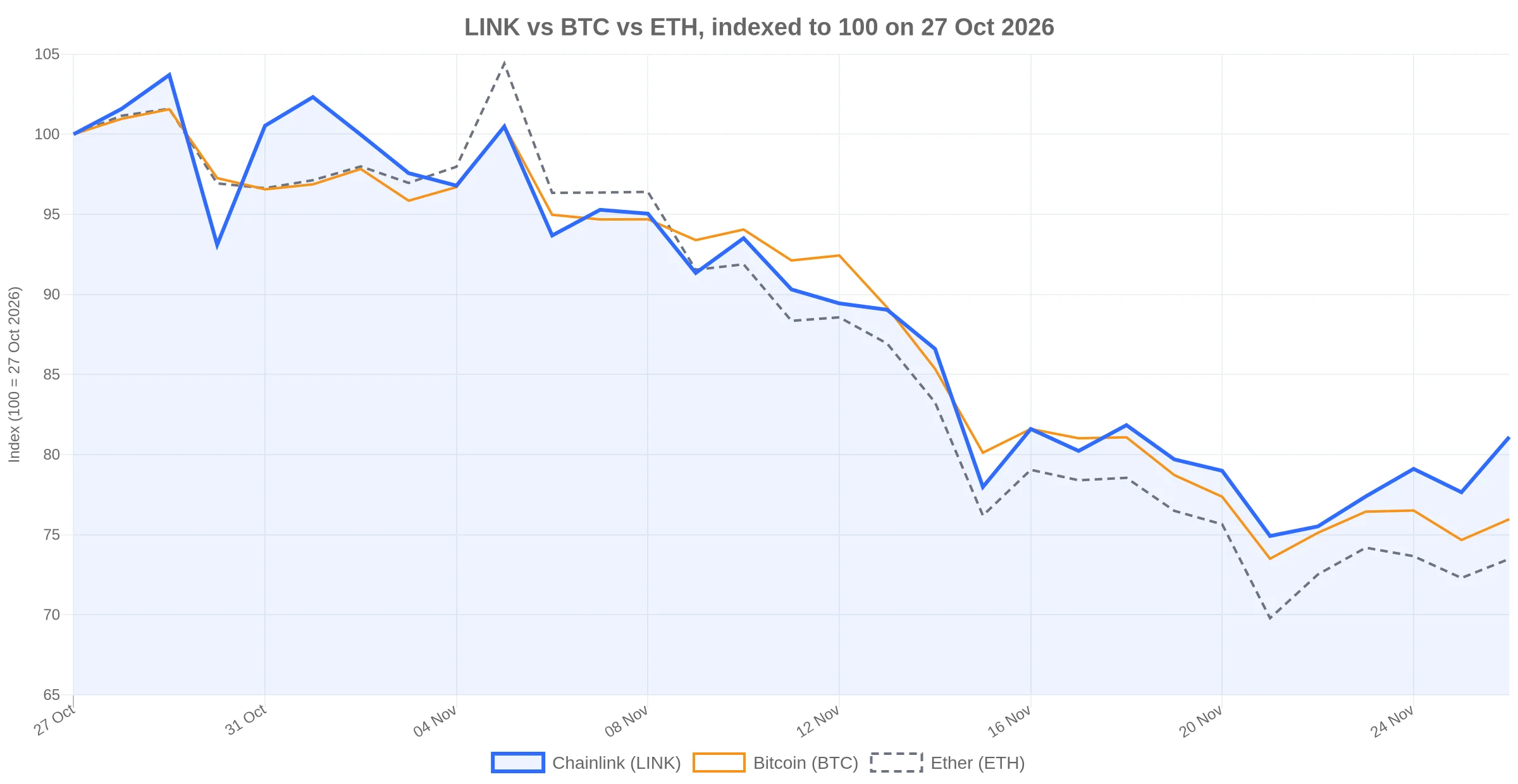
Set against the two largest assets, LINK has lost less. Indexed to 100 on 27 October, LINK sits at 81.1 while Bitcoin sits at 76.0 and Ether at 73.5. The seven-day columns tell the same story: LINK plus 0.48% against Bitcoin minus 4.84% and Ether minus 5.72%, in a week when Solana fell 4.80% and Hyperliquid fell 11.24%.
For a buyer sizing a position rather than calling a bottom, the arithmetic from $9.24 is straightforward and unflattering to anyone expecting a fast recovery. A $1,000 purchase buys 108.2 LINK. At the 200-day average of $10.07 that position is worth $1,089. At the 50-day of $11.01 it is worth $1,191. At the 52-week high of $15.44 it is worth $1,670. At the 52-week low of $7.19 it is worth $778.
Every one of those levels is a measurement, not a target. The 50-day average is falling, which means the $11.01 figure will be lower in a week if price stays here, and the recovery math improves for the wrong reason. The level that matters for the downside case is the 52-week low at $7.19, roughly 22% below spot.
The strongest case against buying this filing
LINK’s 7.44% gain arrived in the same twenty-four hours as the S-1, and it would be comfortable to connect the two. The evidence does not support that connection. Bitcoin rose 3.79% and Ether 3.98% over the same window, Solana added 5.36% and XRP 5.27%, so a broad rebound explains most of the move. Attributing a 7% advance to a registration statement that cannot yet sell a single share is a story, not a measurement.
The second objection is the wrapper itself. Bitwise’s fund charges 0.34% and shows a 30-day median bid/ask spread of 0.60%; Grayscale’s charges 0.35% and shows 0.27%. A half-point spread paid on entry and exit exceeds a year of management fee for a short holding period. The cheapest wrapper is not automatically the best one, and Fidelity’s blank fee leaves the decisive comparison unavailable.
Third, the filing has procedural steps left. Registration must become effective, the shares must be listed, and the Nasdaq listing arrives “subject to notice of issuance”. The same prospectus lists the ways the structure can disappoint: the trust’s net return will not match its index because of expenses, and the number of tokens each share represents declines over the fund’s life as LINK is sold to pay the sponsor.
Fourth, the asset’s own record argues for patience. LINK is down 82.5% from its all-time high and 19.2% over ninety days. A filing does not change the demand for oracle queries, and the reserve mechanism that does respond to demand responds slowly, through revenue rather than through announcements.
The four numbers that would change the answer
The first observable signal is an amendment that fills the fee bracket. A number below 0.34% would put Fidelity at the bottom of the market on cost and force a response from two incumbents that have already published their pricing. A number above 0.35% would make the fund a distribution play rather than a price play, relying on Fidelity’s brokerage base instead of its expense ratio.
The second is effectiveness. The S-1 is the beginning of a review, not the end of one, and the difference between a filed registration and an effective one is the difference between a plan and a product. Watch for a 424B filing and an effective date rather than a press release.
The third is fund-level flow. Both incumbents publish assets and shares outstanding, and those two numbers move only when authorised participants create or redeem. An increase in CLNK’s 4.73 million tokens held, or in GLNK’s $115.7 million, would be the first hard evidence that American wrapper demand exists at scale rather than in theory.
The fourth is technical, and it is the one a holder can check without reading a prospectus. LINK has not closed above its own 50-day average since 14 October 2026, a run of 43 consecutive sessions, and it has not closed above its 200-day average since 13 November, a run of 13. A weekly close above the 50-day, after reclaiming the 200-day at $10.07 first, would end that stretch and mark the first time since October that the short and long averages agree with the price. Until then, the bounce is a bounce.
Frequently Asked Questions
Not yet. Fidelity filed an S-1 for the Fidelity Chainlink Fund on 25 November 2026, and the shares cannot be sold until the SEC declares that registration effective. Two other spot LINK funds, Grayscale’s GLNK and Bitwise’s CLNK, already trade on NYSE Arca.
The prospectus lists Nasdaq ticker “[FLNK]” in brackets, which marks it as provisional. The same document leaves the sponsor fee, the transfer agent, the prospectus date and the creation basket size in brackets, so none of those details should be treated as final.
No. The prospectus states that “the Trust will not stake its LINK, and Shareholders will not receive staking rewards through the Trust.” Holders of the token directly can stake through Chainlink Staking, which is capped at 45 million LINK under the current framework.
That depends on the holding period and the price paid, and the record supports two readings. LINK has outperformed Bitcoin and Ether over thirty days and holds a live catalyst in the Fidelity filing, while trading below its 20, 50, 100 and 200-day averages with a 14-day RSI of 41.5. The downside reference is the 52-week low of $7.19; the recovery references are the averages above spot.
Data: CoinGecko , SEC S-1 , Bitwise CLNK , Grayscale GLNK . Prices are the 12:02 UTC snapshot on 26 November 2026.
The fund-level context is not abstract for readers who already hold the token through a broker: Schwab added Chainlink to its retail crypto lineup in November , which means the same exposure is now reachable without an exchange account. What the Fidelity filing would add is a regulated wrapper with a share price, a custodian and a fee, and the three documents in this article are the only reliable way to compare them. The second internal reference worth keeping is the earlier work on how Chainlink’s data feeds price markets outside crypto , because that usage is what the reserve mechanism responds to over time.
Disclosure: This article does not represent investment advice. The content and materials featured on this page are for educational purposes only.
The post Best Crypto to Buy Now: Fidelity’s Chainlink ETF Filing Has a Blank Fee and No Staking appeared first on BlockchainReporter .