
Binance’s stock trading page gets a new price list at 08:00 UTC on 25 November. The flat platform fee falls from 0.35 USD to 0.17 USD, and the spread is split into three VIP tiers between 0.01% and 0.05%. For every order, Binance charges whichever of the two is higher, so the 17-cent number only reaches traders who keep their orders small.
The change was published in Binance’s announcement feed on 24 November at 21:00 UTC, roughly eleven hours before it takes effect. That short gap matters for anyone who routes equity orders through the exchange’s app or API: the new rate needs app version 3.21.0 or above on iOS and Android, and the notice says fees are rounded up to two decimal places.
The announcement is short, and the arithmetic behind it is not spelled out. Doing that arithmetic changes the story. For a regular user, the 0.05% spread overtakes the 17-cent platform fee at $340 of notional. Above that level, the fee cut is irrelevant and the spread sets the bill. Below it, the platform fee dominates, and a $100 order pays 17 basis points rather than the 5 basis points the spread table implies.
What Changes at 08:00 UTC
The notice replaces the previous single platform fee with a three-row schedule. The spread is now grouped by VIP level, and the platform fee is fixed at 0.17 USD across all three tiers.
| VIP level | Spread | Platform fee (USD) |
|---|---|---|
| Regular user to VIP 3 | 0.05% | 0.17 |
| VIP 4 to VIP 7 | 0.04% | 0.17 |
| VIP 8 to VIP 9 | 0.01% | 0.17 |
The rule that ties the table together is one sentence: “For each order, either the applicable Platform Fee or Spread Fee will be charged, whichever is higher.” The notice also states: “The Spread will be categorized into three tiers ranging from 0.01% to 0.05%, depending on the user’s VIP level,” and: “The Platform Fee will be reduced from 0.35 USD to 0.17 USD.”
Binance’s own examples show how the two charges interact. A regular user trading 1,000 USDC pays 1,000 × 0.05% = 0.50 USDC, because the spread is higher than the platform fee. The same user trading 200 USDC pays 0.17 USDC, because 0.10 USDC of spread is lower than the flat fee.
Read together, the schedule describes a fee floor: no order, however small, pays less than 17 cents in total. The old floor was 35 cents. That is the entire scope of the cut for small accounts, and it is also why the reduction looks larger in a press line than it does in a monthly statement.
The $340 Line
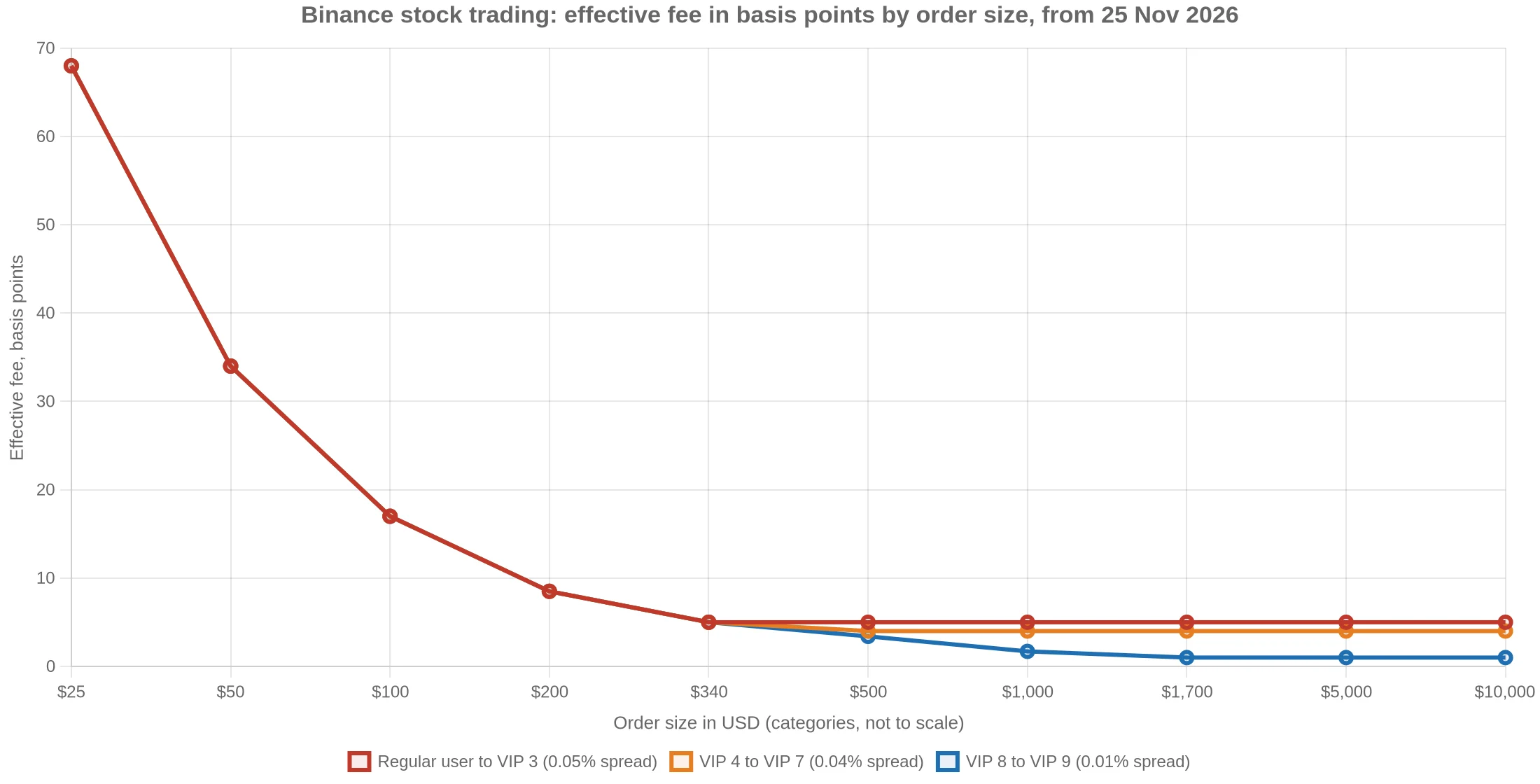
The crossover point is easy to calculate because both charges are known. The platform fee equals the regular-tier spread when the order size is 0.17 ÷ 0.0005, which is $340. Below $340, a regular user pays the flat fee. Above $340, the spread governs and the platform fee never binds again.
Higher tiers push the crossover further out, because their spread is thinner. For VIP 4 to VIP 7, the break-even is 0.17 ÷ 0.0004 = $425. For VIP 8 to VIP 9, it is 0.17 ÷ 0.0001 = $1,700. A VIP 8 trader buying $1,000 of stock pays 10 cents of spread, which is below the platform fee, so the flat 17 cents applies and the effective rate lands at 1.7 basis points.
The notice does not publish the previous spread schedule, so the size of the change depends on what a given user paid before. If the regular-tier spread was already 0.05%, the point where the flat fee stopped binding has moved from $700 to $340. That would mean the cut mainly helps orders between $340 and $700, plus every order below $340. If the spread tiers themselves are new, part of the change is a repricing of large orders rather than a discount.
Why a 17-Cent Fee Is Not a 17-Cent Trade
The floor changes the effective rate on small orders far more than the headline suggests. On a $100 order, the regular user pays 0.17 USD against a spread of 0.05 USD, which works out to 17 basis points. On a $50 order, 17 cents is 34 basis points. On a $25 order, it is 68 basis points, or 0.68% of the amount traded.
Those numbers matter for the kind of order flow Binance’s app is built to attract. A user buying two shares of a $50 stock, or adding a small position to an existing one, is paying a rate that is 3 to 13 times higher than the spread table suggests. The platform fee is not a rounding error at that size; it is the fee.
The rounding rule adds a second, smaller effect. Fees are rounded up to two decimals, so a $60 order at a 0.05% spread produces 0.03 USD of spread, still below the 0.17 USD platform fee, and the flat charge applies anyway. Only orders above $340 see spread figures that clear the floor without rounding.
For a trader moving $500 a few times a month, none of this changes. The spread is 0.25 USD per trade, comfortably above the platform fee, and the new 17-cent number is decoration. The cut is real, but it is concentrated at the bottom of the size distribution, which is exactly where retail order flow sits.
Zero Commission Was Never the Price
Binance’s stock product is not a brokerage account, and the notice is explicit about the plumbing: “Nest Trading Limited acts as your introducing broker and routes your orders for Securities to its clearing broker partner, Alpaca Securities LLC, for execution, clearing, settlement and custody. Binance does not handle or custody your Securities.”
The same disclaimer adds that “Binance may receive payment for order flow remuneration for directing your orders.” That single line puts the exchange in the same revenue model as the zero-commission US brokers it is competing with, where the visible commission is zero and the economics sit in routing and spread instead.
This is the right frame for comparing the new schedule to a US brokerage. A zero-commission equity app charges nothing visible per order and earns from order flow, net interest and spreads. Binance charges a visible floor plus a percentage, and discloses that it may also earn from order flow. Comparing 17 cents with zero is therefore not a comparison of costs; the comparable number is the all-in rate per dollar traded, which is 17 basis points at $100, 5 basis points at $340 and 1.7 basis points at $1,000 for a VIP 8 user.
The notice also flags that securities are subject to liquidity risk and price volatility “particularly outside traditional market hours.” That is the trade-off of 24-hour equity access: the spread widens when the underlying market is closed, and the 0.05% figure is a schedule rate rather than a guarantee of the price a user gets.
Where This Sits in Binance’s Equities Build-Out
The fee change is one line in a longer build-out that has accelerated since September. On 22 September the exchange added 25 stocks to its stock trading platform , widening the ticker list beyond the first batch of large-cap names. On 11 November it opened stock purchases through 49 fiat currencies, removing the crypto leg from the process for many users. A day later it opened 24/7 perpetual trading on Nubank and Freedom Holding stock.
On 24 November, the same day as the fee notice, Binance said it had integrated the Cboe Global Indices Feed for the S&P 500, Dow Jones Industrial Average and Nasdaq-100 into its app, its platform and Binance AI. And at 12:00 UTC on 25 November, five more tokenized bStocks become eligible collateral across Cross Margin, Portfolio Margin and Portfolio Margin Pro.
Rivals have moved in the same direction. HTX turned negative fees on TradFi assets into a marketing weapon . Fee schedules are now the cheapest part of that competition to change.
What the Notice Does Not Say
Several things a trader would want to know are absent. The announcement does not say how stock trading volume counts toward VIP level, which decides whether a user sits in the 0.05% or the 0.01% spread tier. It does not describe maker rebates, volume thresholds or promotional waivers for the new schedule. It does not mention any change to crypto spot or futures fees.
It also does not say which jurisdictions gain access, only that “products and services referred to here may not be available in your region.” The securities disclaimer states that the underlying instruments are not offered to US persons, and the stock option product routes through Nest Trading and Alpaca rather than Binance’s own custody. Users outside those permitted markets are reading a schedule they cannot use.
The fee page linked from the notice is the place Binance says the “latest applicable fee display” lives, which suggests the schedule can still be adjusted. The notice itself reserves that right: Binance “reserves the right in its sole discretion to amend or cancel this announcement at any time and for any reasons without prior notice.”
For most readers the practical takeaway is narrow. If you trade less than $340 per stock order, your bill just fell from 35 cents to 17 cents, and the percentage in the table is not the rate you pay. If you trade more, the spread you were already paying is unchanged by this notice, and the 17-cent headline does not apply to you at all.
Frequently Asked Questions
From 08:00 UTC on 25 November 2026, Binance charges either a 0.17 USD platform fee or a spread fee of 0.05%, 0.04% or 0.01% depending on VIP level, whichever is higher for the order. The platform fee was previously 0.35 USD.
At 08:00 UTC on 25 November 2026. The new rate is shown on app versions 3.21.0 and above for iOS and Android, and fees are rounded up to two decimal places.
For a regular user to VIP 3 the crossover is $340, calculated as 0.17 USD divided by 0.05%. For VIP 4 to VIP 7 it is $425, and for VIP 8 to VIP 9 it is $1,700. Below those levels the flat 17-cent fee applies.
The announcement states that the securities products are not offered in the United States or to US persons, and that availability depends on country of residence and account eligibility. Orders route through Nest Trading Limited as introducing broker to Alpaca Securities LLC, and Binance does not custody the securities.
This article reports an exchange fee announcement and does not constitute investment advice. Fee terms can be amended by Binance, so eligible users should confirm the applicable rate on the exchange’s own fee page before trading.
The post Binance Cuts Its Stock Platform Fee to 17 Cents. The Spread Still Sets the Bill appeared first on BlockchainReporter .