



Binance has engaged three outside security firms to review its defences. The exchange said in a release dated 23 November 2026 that Mandiant, SlowMist and Verichains will conduct “comprehensive, independent reviews” of its security procedures, and that the work will “validate Binance’s current security infrastructure and assess its security posture going forward.”
The timing is the part that carries information. Twenty-five days earlier, on or about 29 October, more than $6 billion in crypto was taken from the exchange in an intrusion the U.S. Justice Department attributes to North Korean actors. Binance’s announcement does not say whether the reviews were prompted by that theft. It does not mention the theft at all.
What the release does contain is a list of firms, a description of each one’s credentials, and four quotations from executives. What it does not contain is a scope, a deadline, a budget, a reporting line, or any commitment to publish what the reviews conclude. For the institutions that decide how much counterparty exposure they will carry to a venue of Binance’s size, those absences are the story inside the story.
The three firms, and the different jobs they imply
Mandiant is described in the release as “part of Google Cloud” and “one of the world’s foremost incident response and threat intelligence firms, with more than two decades of frontline experience investigating nation-state and advanced cyber attacks.” That is the profile of a firm brought in to reconstruct an intrusion and attribute it, not to run a compliance checklist.
SlowMist is presented as “a threat intelligence firm specialising in blockchain ecosystem security, established in 2018 and built on more than a decade of network security experience.” Its work sits on-chain: tracking the movement of stolen assets, mapping wallet clusters and identifying the laundering routes that follow a breach.
Verichains is described as combining “advanced research and deep offensive insight” with “a track record of investigating and mitigating some of the largest incidents in Web3.” That framing points at code and infrastructure review rather than fund tracing.
Read together, the three engagements cover three different questions: how the intrusion happened, where the money went, and whether the systems that failed can be rebuilt to resist a repeat. Binance does not say in the release which firm is answering which question, or whether any of them is empowered to look at the others’ findings.
Binance has engaged leading security firms Mandiant, SlowMist and Verichains for independent reviews of our security procedures.
The security of our users’ assets is our first responsibility. We’re committed to acting on what they find. These reviews will validate our current security infrastructure, assess our security posture going forward, and help strengthen the protections people expect from our platform.
— Binance (@binance) 23 November 2026
What the executives said, and what they left open
Jimmy Su, Binance’s chief security officer, framed the engagement in terms of external validation. “We have engaged three of the most respected firms in the field to independently review our security procedures,” he said. “They will review our systems and tell us where we can be stronger. We are committed to acting on what they find.”
Richard Teng, identified in the release as co-CEO of Binance, put the reviews in the language of institutional obligation. “The security of our users’ assets is our first responsibility,” he said. “Independent review by world-class experts is how we hold ourselves to the highest standard. We take that responsibility seriously.”
Both statements describe a process that will produce findings. Neither describes what happens to them afterwards. There is no reference to a written report, a board or committee that will receive it, a regulator that will be shown it, or a date on which customers will learn anything. “Committed to acting on what they find” is a promise about conduct, not a disclosure obligation.
The two outside executives quoted are more specific about method. 23pds, partner and chief information security officer at SlowMist, said: “Security is an ongoing effort. Independent reviews can help organizations test their controls, identify gaps and strengthen resilience.” Thanh Nguyen, chief executive of Verichains, argued the threat model itself has moved: “You cannot out-patch AI-powered attackers, so the industry must shift from patching vulnerabilities faster to designing systems where attacks fail.”
Twenty-five days in which $2.9 billion was traced
The gap between the theft and the review is not idle time, and the record of what happened during it comes from the government rather than from the exchange. In a separate release the same day , the Justice Department said it had moved to forfeit over $1.1 billion in USDC tied to the intrusion, and that the United States had “assisted in the freezing, seizing, and/or the return of over $2.9 billion worth of cryptocurrency from multiple sources since the theft from Binance on or about Oct. 29.”
The operational detail in that release is worth pausing on. Brett Leatherman, operations director of the FBI’s Cyber Branch, said the bureau and its partners “moved quickly to trace and freeze stolen assets and share critical information with virtual asset service providers.” Todd Bratz, special agent in charge at the Secret Service’s criminal investigations division, went further: “Secret Service investigators worked with precision to identify and freeze stolen funds within minutes of the hack.”
The fastest effective response to the breach, in other words, was external tracing and freezing, executed by agencies working with issuers and exchanges. The reviews Binance has now commissioned are prospective: they are about the controls that failed before the theft, not the recovery that followed it. Both matter, but they answer different questions, and only one of them has produced a public accounting so far.
The exchange has spent the same period rebuilding in public. It restored withdrawals in stages and published a proof-of-reserves disclosure covering the assets it holds, the sequence that followed the breach in early November . Those disclosures show balances. They do not show whether the intrusion path has been closed, which is the gap the new reviews are meant to fill.
The arithmetic the announcement leaves to the reader
Binance’s release supplies no figures, so the only numbers available are the government’s, and they are enough to size the problem. If more than $6 billion was taken and more than $2.9 billion has been frozen, seized or returned, then roughly $3.1 billion, or about 52% of the loss, has not been accounted for publicly. The $1.1 billion forfeiture action covers roughly 18% of the total.
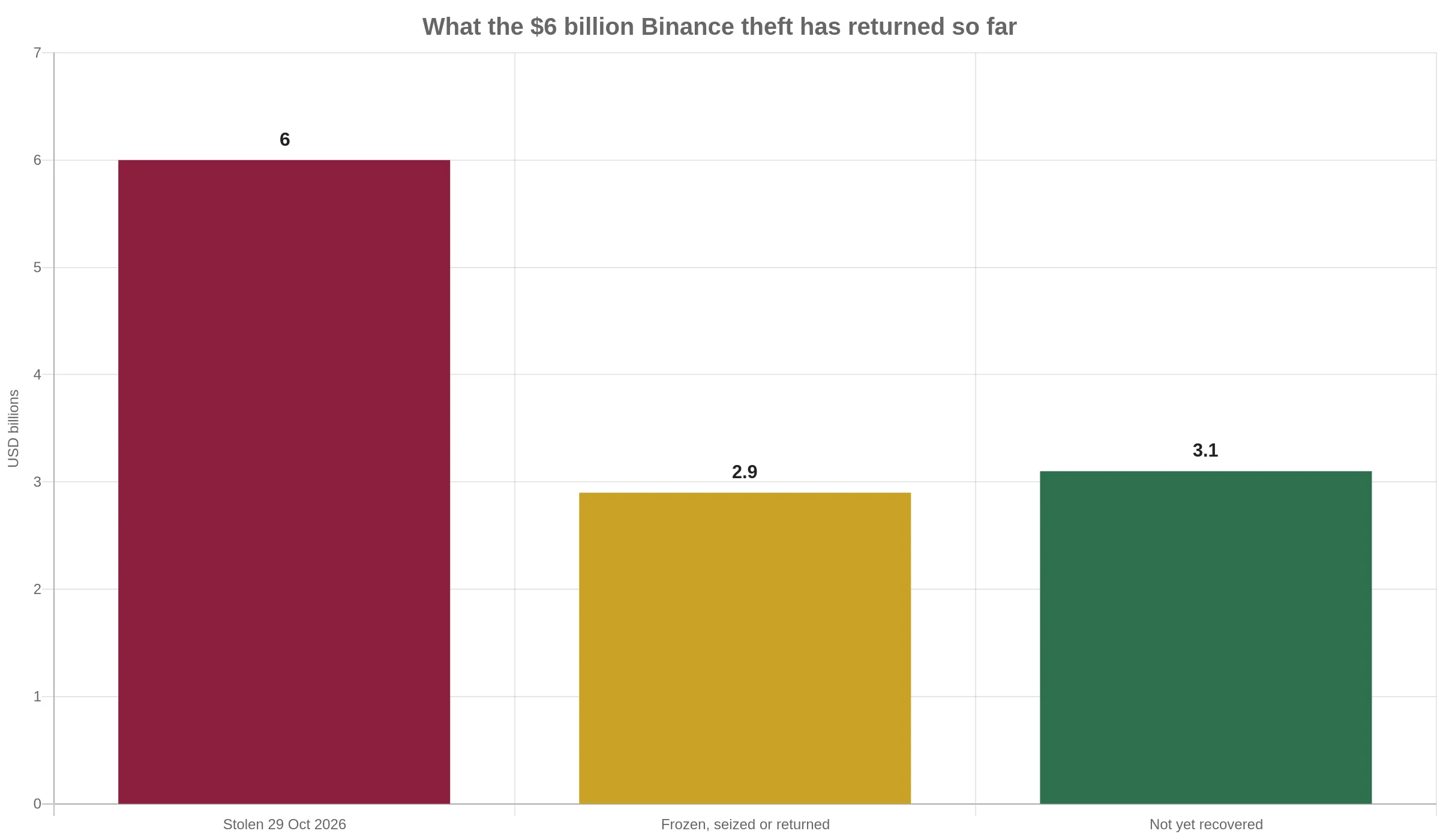
Those figures describe assets, not customer outcomes. The Justice Department’s language is about assisting recovery; it does not state that any user has been made whole, and the forfeiture action is a claim on property that a court has yet to grant. The forfeiture complaint filed the same day asks a judge to take ownership of the stablecoins themselves, which is a separate process from compensating account holders.
Market pricing has not treated the announcement as a solvency event. BNB traded at $557.02 at 00:55 UTC on 24 November, down 0.3% over 24 hours, against a market capitalisation of $73.25 billion, according to CoinGecko. The outstanding $3.1 billion is equivalent to roughly 4.2% of that valuation. A single day’s price change does not establish what traders think of a security review; it does show that the disclosure did not move the token’s value in any measurable way.
What institutional counterparties will ask for next
For funds that custody at, clear through or lend against a venue, an independent review is only useful if it produces something they can read and audit. The usual chain runs from engagement letter to scope document to findings to a remediation plan with dates. Binance’s announcement supplies the first element and gestures at the third: the reviews “will validate” the infrastructure and the company is “committed to acting” on the results.
The missing middle is where diligence teams will push. A review commissioned by the company being reviewed, scoped by that company, and reported to that company is an internal control exercise with external labour. It can still be rigorous. It becomes an assurance product only when the scope is defined in advance, the findings are summarised for third parties, and someone outside the company attests that the remediation happened.
Nothing in the release suggests Binance has ruled that out. It simply does not say. For a business that says it serves more than 330 million users across 100-plus countries, and that has spent the past three weeks publishing reserve data to steady confidence, the omission is a choice about sequencing rather than an oversight of drafting.
Where the review stops and the court case begins
The reviews will not resolve the legal exposure. The forfeiture action is a civil proceeding against assets, investigated by the FBI, the Secret Service and IRS Criminal Investigation, with Circle Internet Financial providing assistance. It will proceed on its own calendar, and its findings will be filings, not press releases.
Nor do the reviews settle the question of how much of the loss the exchange’s own controls should have prevented. That question will be tested in filings and in policy argument, not inside a security audit, and an external review that stays private does not shorten it. It gives the company a defensible internal account, which is worth something in a negotiation and very little in a hearing.
What would count as a result
Three things would move this from announcement to evidence. A published scope, naming the systems under review and the period covered. A date, even an approximate one, for completion. And a form of output that a third party can inspect, whether that is a summary report, an attestation from one of the three firms, or a description of remediated controls specific enough to be checked.
Absent those, the meaningful benchmark is time. The firms were engaged on 23 November. If the reviews conclude without a public trace, the market will be left with the same information it had on 29 October: a very large loss, a partial recovery led by law enforcement, and an exchange asking to be trusted on the strength of the firms it hired rather than the findings they produced.
Frequently Asked Questions
Mandiant, which the release describes as part of Google Cloud; SlowMist, a blockchain threat-intelligence firm established in 2018; and Verichains, a Web3 security firm. Binance said all three will conduct independent reviews of its security procedures.
No. The release does not mention the theft. It was issued 25 days after the intrusion of 29 October that the Justice Department says took more than $6 billion, but it gives no reason for the timing and no link between the two events.
No deadline, budget or scope document appears in the announcement. Binance said the reviews will validate its infrastructure and assess its security posture, and that it is committed to acting on what the firms find. It made no commitment to publish the findings.
The Justice Department said the United States had helped freeze, seize or return more than $2.9 billion since the theft of more than $6 billion, and that it had moved to forfeit over $1.1 billion in USDC. That leaves roughly $3.1 billion not publicly accounted for.
Not directly. The reviews examine controls and procedures. Refunds depend on the exchange’s own policy and on the outcome of the forfeiture action, which is a civil claim against the assets themselves rather than a compensation process for account holders.
Data: CoinGecko (BNB price and market capitalisation, 24 November 2026, 00:55 UTC). Primary sources: Binance release via PR Newswire, 23 November 2026 , the exchange’s own post , and the Department of Justice release of 23 November 2026 .
The post Binance Hires Mandiant, SlowMist and Verichains 25 Days After the $6 Billion Breach appeared first on BlockchainReporter .