


On Saturday, Bitcoin traded as low as $58,779. By Monday morning, American Bitcoin Corp. had filed a document telling investors it could borrow as much as $150 million against the coins it has spent two quarters accumulating.
The document is a Form 8-K, filed on November 23, three days after the company’s subsidiary signed the credit agreement on November 18. The borrower is American Bitcoin Operating LLC, a wholly owned subsidiary of the Nasdaq-listed miner. The lender is FalconX Charlie, Inc., a Delaware corporation whose address in the contract is a suite in Dallas. The facility is committed and revolving, secured by Bitcoin held at Anchorage Digital Bank, and matures on November 18, 2028. Drawn amounts carry a 5.95% annual loan fee, plus a commitment fee on undrawn capacity.
Read past the headline number and the filing turns into a lesson in how secured crypto lending gets priced. It fixes how much Bitcoin has to sit behind every dollar borrowed, and it names the levels at which the lender can demand more or take the coins. Those levels can be priced against Monday’s market, and the result says more about the risk than the interest rate does.
The terms in the filing
The 8-K summarises a contract most readers will never see, and one sentence does most of the work: “The Credit Agreement provides for a committed revolving credit facility of $150.0 million.” Amounts can be drawn, repaid and redrawn before maturity. The borrower may prepay “in whole or in part, at any time without premium or penalty.” The lender can extend the term by three years, but only with the borrower’s acceptance, which puts that option on the lender’s side of the table.
Two clauses carry more weight than the rate. The first limits the lender’s claim: “Lender’s recourse under the Credit Agreement is limited to the Collateral, subject to customary exceptions for fraud and willful malfeasance of the Borrower.” A default ends with pledged Bitcoin sold. It does not become a general claim on American Bitcoin’s rigs, its other assets or its parent.
The second is about custody: “Neither the Lender nor the Custodian has any right to lend, pledge, hypothecate or re-hypothecate the posted Collateral.” Coins posted as collateral are not lent out or reused against another position. In a market where rehypothecation is the quiet source of trouble when a lender fails, that sentence is the one a treasury desk reads first.
| Term | Detail from the 8-K and Exhibit 10.1 |
|---|---|
| Commitment | $150.0 million, committed revolving |
| Borrower | American Bitcoin Operating LLC, wholly owned subsidiary |
| Lender | FalconX Charlie, Inc. |
| Loan fee | 5.95% a year on amounts drawn |
| Commitment fee | On undrawn capacity; rate redacted in the term sheet |
| Maturity | November 18, 2028, with a three-year extension at the lender’s election and the borrower’s acceptance |
| Collateral | Bitcoin held at Anchorage Digital Bank, N.A. |
| Reference exchange | Coinbase Pro |
| Initial collateral ratio | 143% |
| Margin call | Below 130%; cure back to 143% |
| Default limit | 105%, the liquidation threshold |
| Refund limit | Above 163% for 30 consecutive days; release back to 143% |
| Drawn at filing | None |
The 143% posting and the three lines beneath it
The schedule sits in the term sheet filed as Exhibit 10.1 , and it is unusually explicit: “Initial Collateral Ratio: 143% … Margin Call Limit: 130% … Default Limit: 105% (Liquidation Threshold/Default Limit) … Refund Limit: 163%.” Collateral is measured against Coinbase Pro as the reference exchange and tested on an aggregate basis across the facility.
Four numbers, one ladder. At 143% the borrower posts $1.43 of Bitcoin for each dollar drawn. Below 130%, the lender can demand a top-up that restores the ratio to 143%. Below 105%, it may declare an event of default and liquidate. Above 163% for thirty consecutive days, the borrower can ask for collateral back, again down to 143%.
At a full $150 million draw, the initial posting would be $214.5 million of Bitcoin. At $61,220 a coin, the CoinGecko rate at 13:30 UTC on November 23, that is 3,504 BTC, or 41% of the 8,500 BTC reserve the company says it holds.
In prices, the ladder reads $55,655 at the margin call, $44,952 at the default line and $69,782 at the release level. Against $61,220, that is 9.1% down to the first call, 26.6% down to default, and 14% up to the point where coins can come out.
Only the dollar levels depend on the quote, not the gaps. A draw priced at $63,873 rather than $61,220 would post 3,358 BTC instead of 3,504 and lift all three lines by the same 4.3%: $58,066 for the margin call, $46,900 for default, $72,806 for the release. The percentages would not move, because 130%, 105% and 163% are ratios written into the exhibit and 143% is the denominator.
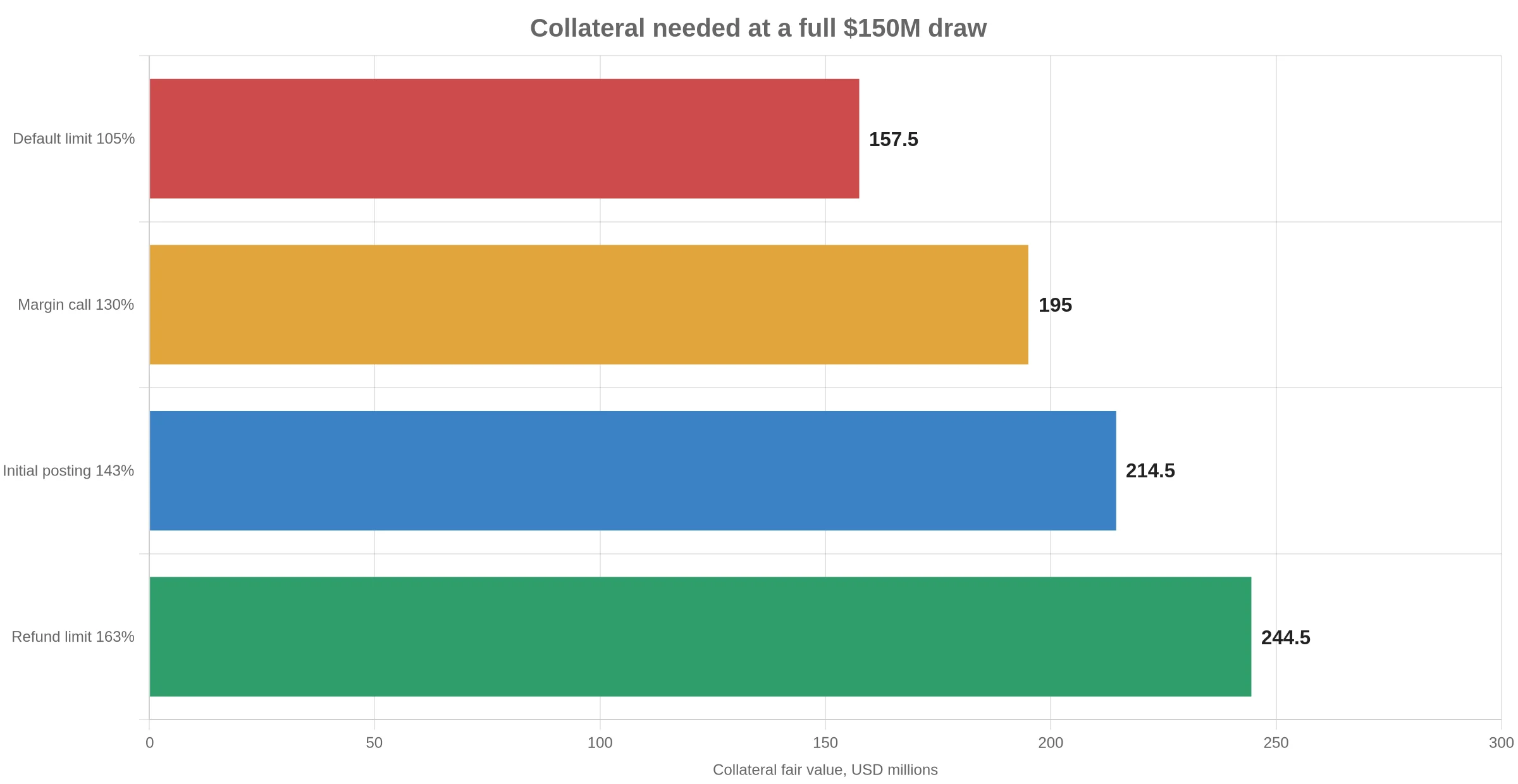
Everything scales with the draw. Half the facility drawn means half the collateral and the same percentage moves, so the figures above describe the maximum case rather than a position the company has taken.
The 105% line deserves one qualifier. The master agreement gives the lender the option rather than a mandate: “If the value of the Collateral drops below the Default Limit, Lender shall have the right, but not the obligation, to declare an Event of Default.” A breach hands the lender the choice. It does not execute the sale.
How close those lines sat to the weekend’s low
Bitcoin’s lowest print on CoinGecko in the past 48 hours was $58,779, on November 21. A fully drawn facility posted at 143% would have been about 5.6% above its margin call line that day, not through it. The default line at $44,952 sits 23.5% below that low.
That distance is the purpose of the 143% posting. A borrower who posts to the initial ratio buys roughly 9% of downside before the phone rings, which for Bitcoin is a normal week. The buffer is not a view on volatility. It is sized to the asset.
For the company’s own reserve, the pledge matters more than the facility. Pledging 3,504 BTC at a full draw would encumber 41% of the 8,500 coins the company says it holds, leaving the rest unencumbered unless it chooses to post more. For scale, the largest Bitcoin treasuries among public companies run to six figures of coins; American Bitcoin sits far below that group. The alternative to that pledge was selling coins, and American Bitcoin has spent two quarters telling investors it does not want to do that.
The parent already owes FalconX $200 million
American Bitcoin is a majority-owned subsidiary of Hut 8, and Hut 8’s September 30 quarterly report shows the group has borrowed from the same lender before. “On May 1, 2026, the Company entered into a $200.0 million Bitcoin-collateralized term loan with FalconX Charlie, Inc.” That loan bears 7.0%, matures on April 30, 2027, and its proceeds repaid a Coinbase credit facility that carried 9.0%.
Two facts follow. The subsidiary is borrowing 105 basis points cheaper than its parent did six months earlier, on a revolving structure with a two-year term. And FalconX has replaced Coinbase as the group’s secured Bitcoin lender: the May refinancing retired the Coinbase facility, and the November agreement adds capacity at the subsidiary.
Combined, the group now has $350 million of committed, FalconX-secured capacity. At full draw that is $22.9 million of annual interest at the stated rates, more than a third of American Bitcoin’s $63.4 million of third-quarter revenue. Neither line is drawn in full today. Hut 8’s $200 million appears as outstanding non-recourse debt on its September 30 balance sheet; the subsidiary’s $150 million was untouched at filing.
The maturities differ in a way worth noting. Hut 8’s term loan comes due in April 2027, about five months after the American Bitcoin signing, while the subsidiary’s revolver runs to November 2028. The shorter-dated obligation sits at the parent, which is also the entity that guarantees nothing on the new facility.
Why pledge the coins instead of selling them
American Bitcoin spent the third quarter mining and keeping. It mined about 891 BTC, grew its reserve from roughly 8,002 to 8,427 coins , and sold part of production to cover costs. Revenue per coin was about $71,100 against a cost of about $42,100, a 41% gross margin on $63.4 million of revenue. Roughly 48% of what it mined stayed on the balance sheet.
The company did not issue shares through its at-the-market programme that quarter, which is why “non-dilutive” is the word its chief executive chose. “This $150 million facility provides American Bitcoin with non-dilutive capital to support our continued operations and growth initiatives,” Mike Ho said in the release. Oliver Sitt, a director of sales at FalconX, framed the product the same way: “Collateralized lending gives American Bitcoin a way to access liquidity while it continues to grow its Bitcoin reserve and scale its business.”
The economics are a comparison, not a verdict. Borrowing at 5.95% against coins the company would otherwise hold costs less than selling them if Bitcoin returns more than the fee over the draw period, and more if it does not. Pledging also keeps the reserve intact for the metric management watches, satoshis per share, which rose 5.3% in the third quarter.
The equity has been repriced hard in the meantime. ABTC closed at $6.24 on November 4 and $3.50 on November 20, a 44% decline across twelve trading sessions. The filing does not connect the facility to the share price, and the company presents it as growth capital rather than a rescue. But a borrower that arranges secured liquidity after a 44% drawdown is a borrower whose cost of equity has risen, and 5.95% secured debt is the cheaper marginal dollar.
What the 8-K does not say
No amount has been drawn, and the filing does not say how much the company intends to draw, when, or how many coins it will post. “Certain Bitcoin” is the only description of the collateral.
The commitment fee is redacted in two tranches, one for the first $50 million of the commitment and one for the remaining $100 million. The summary calls the fee customary and stops there. Portions of Exhibit 10.1 are withheld as information that is “not material and … the type that the Registrant treats as private or confidential,” so the full covenant package is not public.
The term sheet also lists “Call Option: N/A” and “Prepayment Option: N/A” while the 8-K describes a right to prepay without penalty. The two are not necessarily inconsistent, since those fields appear to describe negotiated optionality rather than voluntary repayment, which the master agreement covers separately. It is still a reminder that the 8-K is a summary written by the borrower’s lawyers, not the contract itself.
What the money is for stays general: “strategic growth opportunities and general corporate purposes.” There is no disclosure of an acquisition, a rig order or a specific capital project attached to the facility. On the record available today, this is balance-sheet capacity rather than committed spending.
The next filing, and the parent’s April 2027 maturity
The next quarterly report is the disclosure that matters. It should show whether the facility is drawn, how many coins are pledged, and the fair value of collateral at period end. Until then, the $150 million is capacity, not cash.
The 130% line is the one to watch in price terms. A full draw at $61,220 leaves 9.1% of room before a top-up is due, and a cure at that point would mean adding about $19.5 million of Bitcoin, or repaying part of the loan. That is the mechanism that turns a price decline into a balance-sheet event for a borrower of this size.
The parent’s April 2027 maturity is the second. If Hut 8 refinances with FalconX again, one lender will hold secured claims on both the parent’s and the subsidiary’s Bitcoin. If it goes elsewhere, the concentration stops growing at two facilities.
What is verifiable today is narrow. A Nasdaq-listed miner has committed two-year financing at 5.95% with recourse limited to coins it mined, a 143% posting requirement, a 130% call and a 105% liquidation line, and has not drawn a dollar. The schedule is public. The use is not.
Data: SEC EDGAR , CoinGecko , PR Newswire , Yahoo Finance .
The post American Bitcoin’s $150M FalconX Facility Is Undrawn. The 105% Clause Is Where Liquidation Starts appeared first on BlockchainReporter .