


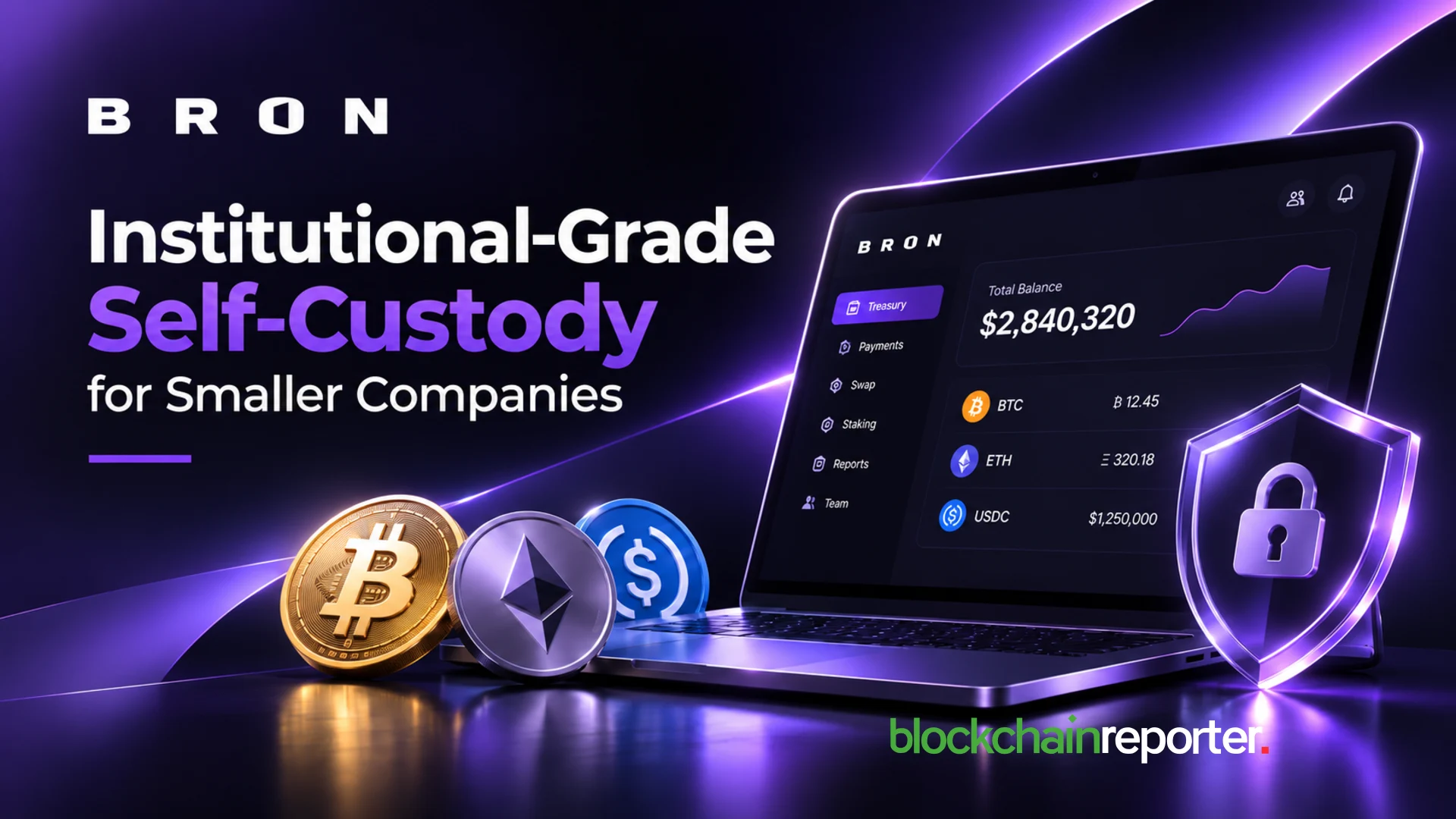
The MPC wallet from the founder of Copper.co combines approval controls, cross-chain swaps and bank rails at a published price of $250 a month. Here is what it offers businesses, and where it falls short.
Companies that hold stablecoins have more to think about than keeping them safe. A business that pays suppliers in USDT on Tron, receives customer payments in USDC on Ethereum and keeps part of its reserves in Bitcoin needs a wallet that several people can control, that a bookkeeper can see into without being able to move funds, and that keeps working when an employee leaves or the vendor goes out of business. Much of that functionality has been sold by enterprise custody platforms priced for exchanges and banks.
Bron , a non-custodial wallet co-founded by Dmitry Tokarev, the founder and former chief executive of institutional custodian Copper.co, is aiming at the market below them. Its Business plan is listed at $250 a month and can be bought without a sales call. Behind it sits multi-party computation (MPC), the approach to key management widely used by institutional custodians, together with approval policies, bank transfers through a regulated partner and reporting designed for accountants. Bron also serves individuals and families on balance-based tiers. This article looks at what it offers companies.
No seed phrase, and no single point of failure
Bron does not use seed phrases. When a company creates an account, three encrypted key shards are generated. One is stored on the user’s device, protected by its secure hardware and biometrics; one is held by Bron; and one is held by Qrypt, an independent company that acts as a trusted third party for the customer. Any two shards are needed to sign, and the full key is never assembled in normal use. Day to day, the device shard and Bron’s shard sign together in a joint computation, so Bron cannot move funds on its own, and neither can someone who steals a single device.
The design also answers a question that auditors and boards tend to ask: what happens if the vendor disappears. According to Bron’s documentation, if the app cannot reach Bron’s services, a customer can combine the shard on a trusted device with the one held by Qrypt to rebuild its private keys offline, without Bron’s servers or any action from Bron, and move the assets elsewhere. The option is available on every plan. While Bron is operating, a company can withdraw its assets to any other wallet at any time.
Bron says its software has been audited by Trail of Bits, Cure53 and CertiK, and the MPC library it uses, bron-crypto, is open source.
Who can do what
For a business, the harder question is often not how keys are stored but who is allowed to use them. Bron workspaces are built to be shared. People join as Owners, who have full control; Members, who can send, swap and stake but cannot manage users or security settings; or Viewers, who can see balances and activity and generate reports but cannot initiate transactions. Approval rights are assigned per policy rather than per role, so a finance controller with a Viewer seat can still be required to sign off on payments.
Rules sit on top of the roles. Transaction limits can hold any transfer above a set amount, per transaction or over a day or month, either for a delay of one hour to a year or until a set number of colleagues approve it, and advanced rules can target specific accounts, destinations or users. An address-book lock restricts payments to saved addresses, and a first-time recipient rule holds the first transfer to any new destination. Changes to users, owners, limits and the address book can themselves be placed behind a 48-hour delay or a team approval, with at least two approvals required and no one allowed to approve their own request; a separate rule protects the policies themselves. After a sign-in from a new device or browser, sensitive settings are frozen for up to 48 hours, so a stolen login cannot be used to switch the safeguards off.
A workspace can have several Owners, and changes to the owner group are approved by the Owners rather than through a support ticket to the vendor. Bron says its policies apply in the same way across all 26 networks it supports, including Bitcoin, Ethereum, Solana and Tron, rather than being configured chain by chain.
Running the treasury
Payments go to saved addresses, external addresses or other Bron users’ short “tags”, and a note can be attached to each transaction for the books. For payroll or supplier runs, a team can upload an Excel template listing many transfers; Bron checks each entry and flags invalid addresses before the batch goes for approval. Staff can prepare these batches, while only people holding a trusted device for the account can sign them.
Moving money between blockchains is a recurring headache for companies whose counterparties use different networks. Bron’s built-in swaps run on what it calls Bron Intents: a swap request is posted on-chain, independent market makers known as solvers respond with firm quotes, and an accepted quote settles on-chain directly between the company’s wallet and the solver. Bron says the quoted price is the price paid and that it does not route or execute orders itself. The routes cover the stablecoin moves a treasury typically needs, such as USDT between Ethereum and Tron or USDT on Tron into USDC on Solana, as well as purchases of Bitcoin, Ether and Solana that are held natively. Pairs that Bron Intents does not cover, usually smaller tokens, are routed to LI.FI, a third-party aggregator. The company cites historical solver liquidity of up to $1 million per trade and spreads as low as 0.05%, while noting that neither is guaranteed.
For idle balances, Bron offers staking on major networks, mTBILL, a tokenized US Treasury bill product issued by Midas, and tokenized stocks and ETFs issued by Ondo. The last two carry eligibility restrictions: neither is available to US persons, and the tokenized stocks are also unavailable in the UK and several other jurisdictions.
Bank rails with no need for a crypto-friendly bank
Bron does not handle fiat itself. Bank transfers run through Noah, a regulated third-party provider, once the business has passed a KYB check, which Bron says usually takes 48 to 96 hours after documents are submitted. Noah then opens a virtual account in the company’s name. Dollars or euros wired to it from the company’s bank arrive in the wallet as USDC, and USDC sent the other way is paid out by SEPA, ACH, Fedwire or SWIFT, either to the company’s own bank account or to a supplier against an invoice. Because the money moves between accounts in the company’s own name, Bron says the company’s bank sees an ordinary transfer between its accounts rather than a payment to a crypto platform.
Limits for businesses are agreed with Noah during onboarding. The service covers USD and EUR, and USDC on Ethereum and Base; other assets are swapped into USDC first. Identity checks apply only to the fiat service: using the wallet itself requires no identity verification.
Books, audits and automation
Bron’s reporting is aimed at the finance function. Any workspace member, Viewers included, can export transactions or daily balance snapshots for any period to Excel, with transaction notes included, and the reference rate where each transaction is priced in dollars at the moment it happens. An activity log records which member did what and when. A group with several legal entities can give each one its own account within a single workspace, with separate addresses, balances and history.
For teams with developers, Bron offers an API, SDKs and a command-line tool. Its desktop app also includes a built-in server for the Model Context Protocol, which lets AI assistants such as Claude, ChatGPT and Cursor read balances and prepare transactions for approval, under the same policies that apply to staff. Companies that need fully automated payments can run an MPC Hot Signer on their own infrastructure, which signs through the API without a person in the loop and so trades manual approval for speed.
Screening and privacy
Before a transaction is signed, Bron checks the recipient address, and any address being granted spending permissions, against the US OFAC SDN and UK sanctions lists, and blocks a match. Incoming funds from a listed address are flagged. The check matches addresses directly and does not assess indirect exposure, and Bron yet has no built-in anti-money-laundering risk scoring of counterparties or incoming funds. Requests from decentralized applications are simulated before signing, with warnings for unverified domains.
Bron also supports confidential token balances on Ethereum using fully homomorphic encryption from Zama. In January 2026, the two companies ran what Zama described as the first confidential payroll on Ethereum mainnet, paying salaries in a confidential version of USDT whose amounts were hidden on-chain while the transactions stayed verifiable. For a business, the appeal is that salaries and supplier payments need not be visible to anyone reading the blockchain.
Lost phones and departing staff
A user who still has another trusted device, such as a laptop, can approve a replacement phone from it without delay. If every device is lost, signing can be restored with a face scan run by iProov or with codes from two pre-chosen Guardians, each followed by a 48-hour security delay, or through self-recovery after 30 days. New recovery methods become usable only 30 days after they are set up, to stop an intruder from adding their own, and the company’s crypto addresses stay the same after recovery. Owner-managed firms can also name beneficiaries under Bron’s inheritance feature, which hands over the workspace after a waiting period of six to 12 months that any participant can cancel. Bron describes it as a technical mechanism that does not replace a will.
What it costs
Bron’s Business plan costs $250 a month, or $2,500 a year if billed annually, and includes five team members, with extra seats at $50 a month each, and up to 10 accounts (meaning up to 10 multi-chain wallets managed from one single interface). There is no platform fee on transfers and no cap on volume. Bron charges a platform fee of 0.15% on crypto swaps and on fiat purchases and sales, and 0.025% on swaps between stablecoins, shown as a separate line before each transaction is confirmed. An Enterprise plan is priced individually. A company can sign up and start using the wallet straight away; KYB is needed only for the bank rails.
That is low for the category. According to the vendors’ published price lists, Fireblocks’ entry-level Essentials plan costs $999 a month for five users and $1 million of quarterly outbound volume, plus 0.20% above that, and runs for up to six months before customers move to custom plans that start at $36,000 a year. Utila’s Starter plan costs $799 a month on a 12-month term for three users, MPC Vault’s Growth plan $500 a month billed annually, and Safe’s Pro Business plan for its smart-contract multisig starts at €669 a month. The products differ in features as well as price: Fireblocks and Utila, for example, offer per-customer deposit addresses at scale, and Fireblocks includes single sign-on on its custom plans.
Where it falls short
Bron’s documentation, and a comparison with competing platforms, point to gaps that matter for some businesses:
- No per-customer deposit addresses at scale or automatic sweeping. That makes it less suited to exchanges, payment processors and marketplaces that collect from many customers. The Business plan includes 10 accounts, with more available on request.
- No batch signing or scheduled payments. Bulk transfers are prepared from a file, but each transaction is confirmed with biometrics, and there is no recurring-payment feature.
- No single sign-on yet, which larger organizations with central identity management may require.
- Sanctions screening, but yet no built-in AML risk scoring of counterparties and incoming funds.
- Fiat limited to USD and EUR through USDC, on Ethereum and Base.
- Recovery is deliberately slow, from 48 hours with a face scan or Guardians to 30 days without them, and some products, including tokenized stocks and mTBILL, are restricted by jurisdiction.
Who it suits
The best fit for Bron is a company that runs a stablecoin treasury with a relatively small finance team: one that holds USDT and USDC across several networks, keeps some Bitcoin or Ether on its balance sheet, pays suppliers and staff, and moves money to and from a bank account, while wanting several people to sign off on large payments and an accountant to see everything. For that kind of business, Bron bundles controls and services that have usually come with enterprise contracts, at a hefty monthly price tag.
Companies that collect from thousands of customers, rely on single sign-on or need deeper compliance tooling may find platforms such as Fireblocks or Utila a better fit, though at a higher cost. Whichever provider a business chooses, it should test the setup before moving significant funds, including the approval rules and the recovery process, and confirm that the fiat partner serves its jurisdiction.
The post Bron as Institutional-Grade Self-Custody to Smaller Companies appeared first on BlockchainReporter .