


27,000 orders. 91 days of purchases. Seven fields of personal data per order. Trezor disclosed on November 16, 2026 that a breach at Skladon, one of its shipping partners, exposed customer names, phone numbers, delivery addresses, email addresses, order dates, product names and prices for orders placed between August 9 and November 7.
The wallet maker’s own account is unusually specific about two things most breach notices blur. The first is the boundary: the exposed records stop at shipping data, and “neither Trezor nor Skladon ever holds” wallet backups, PINs or passphrases, according to the company’s incident post . The second is the gap at the start of the window. A slice of customers who ordered between August 9 and August 14 cannot be emailed at all, because Trezor’s 90-day retention policy had already anonymised their details.
That contradiction, a company that both retains order data and cannot reach part of the cohort it retained, is the most useful thing in the disclosure. It defines what this incident is: not a crypto theft, but a mailing list of people who own hardware wallets, with addresses attached.
The eight days between the breach and the notice
Trezor dates the intrusion to November 7. Skladon notified the company on November 15, eight days later. Trezor then emailed affected customers and says it has informed the data protection authority. For orders placed in the middle of the window, the lag is bounded and documented; for the earliest orders it is not, because there is no address left to send a warning to.
“We believe the attacker exported data for approximately 27,000 orders placed between 9 August and 7 November 2026. An investigation is ongoing,” the post states. The word “approximately” is doing real work: Trezor is describing what it believes was exported, not a confirmed row count from Skladon’s systems, and the number may move as the investigation completes.
Divided across the window, 27,000 orders works out to about 297 orders a day for 91 consecutive days. Nothing in the disclosure suggests every order in that period was captured, and nothing suggests the attacker took only a subset.
How the incident unfolded, in the company’s own dates
| Date (2026) | What happened | Basis |
|---|---|---|
| 9 August | First order inside the exposed range | Trezor incident post |
| 7 November | Unauthorised access to Skladon systems holding Trezor shipping data | Trezor incident post |
| 15 November | Skladon notifies Trezor, eight days after the intrusion | Trezor incident post |
| 16 November | Trezor publishes the disclosure and emails the customers it can still reach | Trezor incident post |
| 9-14 August orders | Cohort that cannot be emailed: details already anonymised under the 90-day policy | Trezor incident FAQ |
The six days Trezor cannot email
The retention arithmetic explains the hole at the front of the affected range. Trezor keeps order data for 90 days. An order placed on August 9 was exactly 90 days old on November 7, the point at which a 90-day retention window closes. Trezor says a “small number of customers who ordered between 9 and 14 August may also be affected, but we can’t email them: their details had already been anonymized in our systems.”
Those customers are being told through the blog and through Trezor’s X account instead. It is a narrow failure mode and a predictable one: the anonymisation that limits how much data a breach can expose also removes the channel for warning the people it exposed. Retention limits cut both ways.
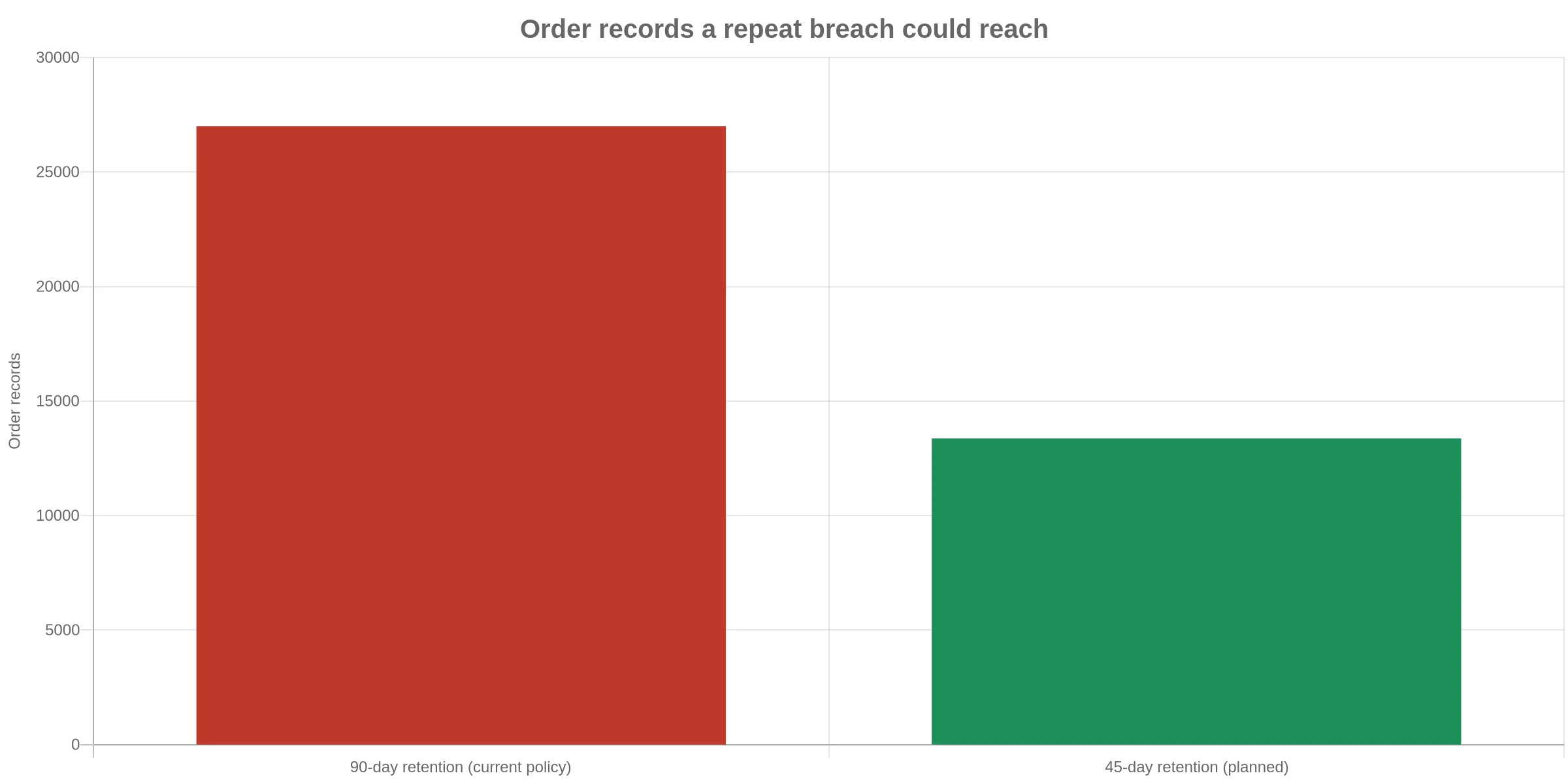
The company is now shortening the window rather than extending the warning reach. It plans to cut order data retention from 90 days to 45. At the order rate implied by this incident, a 45-day window would hold roughly 13,400 orders instead of 27,000, which halves the number of records a future breach of the same kind could reach.
What the exposed fields make possible
The list matters more than the count. Names, phone numbers, postal addresses, email addresses, order dates, product names and prices are enough to run a convincing call. A caller who knows a customer bought a Safe 5 in September and paid a specific amount does not need technical access to anything to sound internal.
Trezor states the risk in plain terms: “If your data was affected by this breach, scammers may use these details in calls, texts, emails or letters. Please be alert to potential risks to your physical security.” Its guidance is blunt about the boundary of what support will ever ask for: “Trezor will never call you or ask for your wallet backup.”
The physical-security advice is the part that differs from a typical account breach. “Because the data includes your address and what you bought, be careful about who knows you own crypto,” the post reads, adding that anyone who receives a threat should “contact your local police first.” Some customers have already reported scam calls, according to the company.
Anonymous pickup, and where it does not reach yet
Trezor’s structural response is to stop holding the address in the first place. Its Anonymous Pickup option, which sends an order to a parcel locker or pickup point instead of a home address, is now available in most European countries. The company says customers in 18 European countries can use it from today, with a US launch planned.
That leaves the largest hardware-wallet market outside the fix for now. It also leaves a structural exposure that no retention change removes: the shipping partner still receives the address, the phone number and the product, because a parcel has to be delivered to somebody. Trezor says it is reviewing its relationships with third-party partners and the security requirements it places on them.
The company is direct about the pattern. “We know this is not the first time customer contact details and addresses have been exposed in an incident involving one of our partners,” the post says, adding an apology to customers affected again.
Where this sits against the earlier incidents
BlockchainReporter reported in September that Trezor said a breach at logistics partner ShipMonk exposed 67,000 more US customers , a larger count concentrated in one market. Skladon’s exposure is smaller in number and wider in geography: the company says the partner delivers to many countries, so the incident is not limited to one region.
The two incidents differ in kind from the hardware tampering Trezor confirmed this month, when it said it had found implants in three Safe 5 devices out of 48 inspected and cut roughly 80% of its resellers. That case was about the integrity of the device in a customer’s hand. This one is about the list of who holds one, and the list is the cheaper target.
What the disclosure still leaves open
Three questions are unanswered in the post. Whether Skladon has established how the attacker obtained access, beyond the fact of unauthorised access to systems holding Trezor shipping data. Whether any other merchant using Skladon was affected in the same intrusion, which would change the incident from a Trezor problem to a vendor problem. And what contractual or audit standard Trezor will now require of partners, beyond the statement that it is reviewing them.
For customers inside the window, the actionable items are narrow and all come from the company: treat unexpected contact about an order as hostile, verify through Trezor’s own support channel rather than any link in a message, and never enter a wallet backup anywhere except on the device itself. Trezor says it will update the post as the investigation develops, which is the only place the count, the cause and the scope are likely to be corrected.
The post Trezor’s Skladon Breach Exposed 27,000 Orders, and Some Buyers Can’t Be Warned appeared first on BlockchainReporter .