
The Commodity Futures Trading Commission’s clearinghouse register changed on 13 November. A new line appeared: TLD Clearing, Inc., doing business as Backpack Clearing, registered by commission order and “permitted to clear margined futures, and fully collateralized futures, options on futures, and swaps.”
Three days later the exchange side of the same group, TLD Markets, Inc., was designated a contract market. Backpack confirmed both approvals on 16 November and said U.S. users will be able to trade crypto perpetual futures with borrowed exposure around the clock, post fiat or crypto as collateral, and offset positions across one global order book.
The clearing line is the part worth rereading. On the CFTC’s current list of 30 registered derivatives clearing organizations, only one other entry carries the same margined-futures wording: NADEX, the Crypto.com-owned venue registered in 2004. Every other registered clearer, including Coinbase Clearing and tZERO’s clearing arm, is limited to fully collateralized contracts.
What the two filings actually say
The corporate names in the CFTC’s Industry Filings database do not match the consumer brand. The designated contract market is TLD Markets, Inc. , dated 16 November 2026. The clearing entity is TLD Clearing, Inc. (d/b/a Backpack Clearing) , registered 13 November 2026. Backpack’s press release uses neither name; it describes “approval from the U.S. Commodity Futures Trading Commission for its U.S. derivatives exchange and clearing operations.”
The regulator’s own account is narrower than the company’s headline. Chairman Michael Selig’s statement , published the same day, never names Backpack. It describes “the applications for designation as a designated contract market and registration as a derivatives clearing organization for a firm utilizing blockchain-based architecture for execution and settlement of derivatives contracts.”
Selig framed the decision as a procedural result rather than a special exemption: “firms employing novel technologies must satisfy the same regulatory standards as those who utilize traditional market infrastructure.” The statement also argues the approvals show “there is a regulated pathway for a new generation of market infrastructure built using blockchain technology.”
That distinction matters for anyone reading the announcement as a green light for on-chain margin engines. The commission did not publish a bespoke framework for blockchain settlement. It applied the existing core principles to a firm whose settlement layer happens to be a chain.
Margined futures, and why the phrase is rare
A fully collateralized clearinghouse requires the full contract value to be posted before a position exists. A margined clearinghouse accepts a fraction of that value and collects variation margin as the position moves. The second model is what makes perpetual futures feel like perpetual futures: borrowed exposure, liquidation thresholds, funding payments.
The CFTC’s DCO table summarizes each registration in one remark line. For Coinbase Clearing, registered 28 September 2026, the line reads “permitted to clear fully collateralized futures, options on futures, and swaps.” For tZERO DCO, registered 16 October, the wording is identical. XV Clearing, registered 29 October, carries the same limit. Backpack Clearing’s line adds margined futures at the front.
That single phrase is the difference between a venue where a trader must fund the whole contract and a venue where a trader can be liquidated. It is also the reason the approval is more consequential than another crypto listing announcement: the clearing layer is where U.S. regulators have historically been slowest to accommodate leveraged digital-asset products.
Two of thirty registered clearers carry that permission
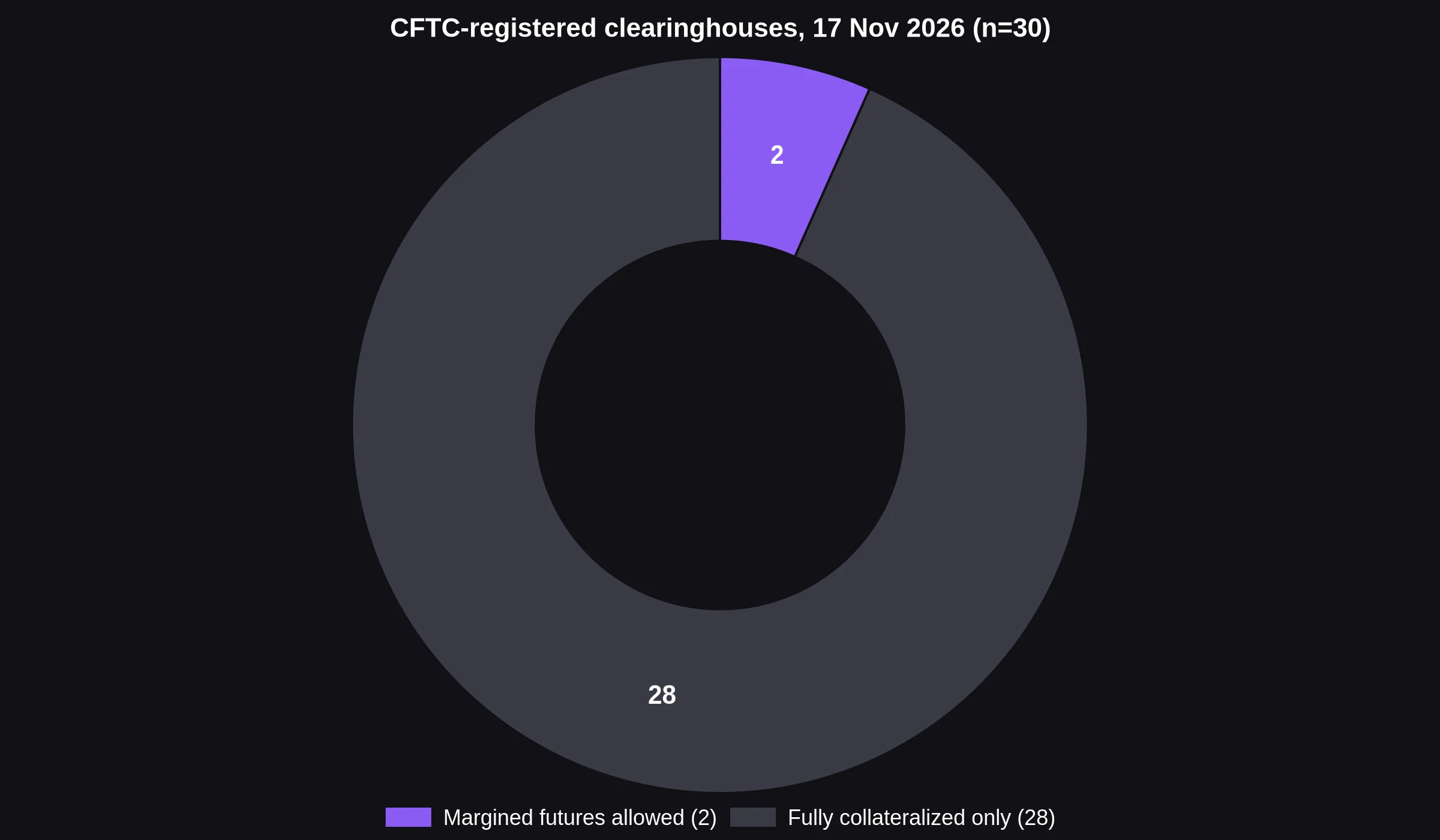
The tally comes from the commission’s own filings page, read on 17 November. The page lists 59 organizations; 30 hold registered status. Two of those 30 include margined futures in the remark field. That is 6.7% of the registered population.
Two caveats belong next to that number. First, the remark column is a summary written by staff, not the full text of each commission order, so a missing phrase is not proof that a clearer cannot take margin under some other authority. Second, NADEX has held its permission since 2004, which means the CFTC has added exactly one new margined-futures clearer in more than two decades of that register’s current format.
The comparison to tZERO is the useful one for readers tracking the onshore derivatives build-out. tZERO DCM was designated on 10 November, six days before Backpack’s exchange entity, and its clearing arm registered on 16 October. On paper, tZERO therefore arrived first at the exchange layer. What it did not receive, according to the filings, was a clearer authorized for margined contracts.
Backpack’s scale numbers, and what they do not measure
Backpack’s release attributes more than $450 billion in trading volume and users in over 150 countries to the group. Those are cumulative figures across a business that includes a self-custodial wallet, a global spot exchange and a brokerage that tokenizes public equity.
The group’s token, BP, traded at $1.07 at 10:51 UTC on 17 November, up 27.3% over 24 hours, with a market capitalization of $267.5 million and $36.6 million of turnover in the same window, according to CoinGecko. Bitcoin was down 0.4% and ether down 0.75% over the same period, so the move was specific to the token rather than a market-wide bid.
Divide $450 billion of cumulative volume by a $267.5 million market capitalization and you get roughly 1,682 times. That ratio describes how much trading the brand has processed relative to what the market values the token at. It says nothing about revenue per trade, because Backpack has not published fee schedules for the U.S. venue, and nothing about how much of the $450 billion came from the exchange versus the wallet or the securities business.
The price reaction is best treated as coincidence with the announcement rather than proof of it. A 27% move over 24 hours can reflect positioning, float size or an unrelated listing. Nothing in the filings ties the token to the clearing approval.
What Backpack has not published
The release lists capabilities, not a launch plan. There is no first-trade date, no fee schedule, no list of contracts, no initial-margin percentages, no liquidation methodology and no statement on how U.S. customer collateral will be segregated from the global order book the company describes.
Those gaps are normal at the approval stage, and they are the difference between a licence and a working venue. A designated contract market must still submit product filings and rule amendments before contracts trade. A new clearinghouse must have its margin model and risk committee arrangements accepted. Neither step is described in the 16 November announcement.
The company’s own framing sets the expectations to test: “U.S. users will be able to trade crypto perpetual futures on a leveraged basis 24/7, use both fiat and crypto assets as collateral, enjoy cross-margin across their various positions, and access Backpack’s global liquidity in one unified order book.” Each clause is a promise about a product that, as of 17 November, has a regulator’s stamp and no published start date.
The state fights underneath the approval
Federal designation does not settle the jurisdictional argument that has consumed the CFTC’s enforcement docket this month. The agency is litigating against Louisiana and Arkansas over state attempts to restrain federally regulated venues, and it is defending its authority over single-stock perpetuals against a court that has signalled doubt, as BlockchainReporter covered in its report on the SEC’s amicus support for the CFTC on single-stock perpetuals .
Backpack’s approval sits inside that fight rather than above it. A crypto perpetual on a DCM is a regulated commodity product, and the CFTC’s position is that states cannot bar it. Several states disagree, and the disagreement is being resolved case by case.
Where this fits in the onshore push
Backpack is one of several venues trying to move perpetual futures into U.S. jurisdiction rather than routing around it. In October, ICE said it would bring Hyperliquid-linked perpetual futures onshore through its Trade[XYZ] unit, a structure BlockchainReporter examined in its report on ICE’s plan to bring Hyperliquid perpetual futures onshore . Binance opened 24/7 trading on tokenized equity perpetuals this month. Kraken has been pushing its derivatives book into new structures.
The difference in Backpack’s case is vertical integration. The same group holds the exchange designation and the clearing registration, which means it controls execution and settlement rather than renting one of them. That is a common structure in offshore crypto and an unusual one among CFTC registrants, where clearing has tended to sit with separate, often bank-owned entities.
Selig’s statement gestures at that: “Today’s approvals reinforce that the United States is open for business and that responsible innovation has a home in our regulated markets.” The test of the claim will be the first margin call processed by a U.S.-regulated, blockchain-settled clearer, not the press release announcing the licence.
Frequently Asked Questions
Yes. The CFTC registered TLD Clearing, Inc. (d/b/a Backpack Clearing) as a derivatives clearing organization on 13 November 2026 and designated TLD Markets, Inc. as a contract market on 16 November 2026, according to the agency’s Industry Filings database.
Not established. Backpack has not published a launch date, a contract list or margin parameters. The clearing registration permits margined futures, but a permission is not a live market, and product filings still have to clear before contracts trade.
The claim needs narrowing. tZERO DCM, LLC was designated on 10 November 2026, six days earlier, and its clearing arm registered on 16 October. Backpack’s distinction is holding both designations at once with a clearer expressly permitted to handle margined futures.
Data: CFTC derivatives clearing organizations , CFTC designated contract markets , CoinGecko .
This article is not investment advice. Derivatives trading involves the risk of losing more than the collateral posted. Figures cited are as reported by the named sources on 17 November 2026.
The post CFTC Clears Backpack to Clear Margined Crypto Perpetuals in the United States appeared first on BlockchainReporter .