



A scored assessment of eight self-custody platforms for companies that run a stablecoin treasury. Data as of November 2026.
A business that holds digital assets needs more than a safe place to keep them. For a business that pays suppliers and receives customer payments in stablecoins, the wallet also has to move money between networks when a counterparty uses a different one, hold part of the treasury in assets such as Bitcoin, let several people approve a payment, give a bookkeeper access to see everything and move nothing, and offer a way out if the wallet provider ever stops operating. Several of the platforms assessed here offer most of this, but some are priced and sold for exchanges and banks rather than for smaller businesses.
This report scores eight non-custodial platforms that a business can use without handing its keys to a custodian: Bron , Fireblocks , Fordefi , Ledger Enterprise Multisig , MPC Vault , Safe{Wallet} , Utila and Zengo Business . We score functionality first, out of 100 points, and then add price separately, so that you know what it costs. The full methodology, including the reference company we priced every product for, is set out below so that a reader who weighs the criteria differently can recompute the totals. The scores describe one reference company: a later section shows how the picture changes for other kinds of business, and a checklist helps any business assess its shortlist.
Results snapshot
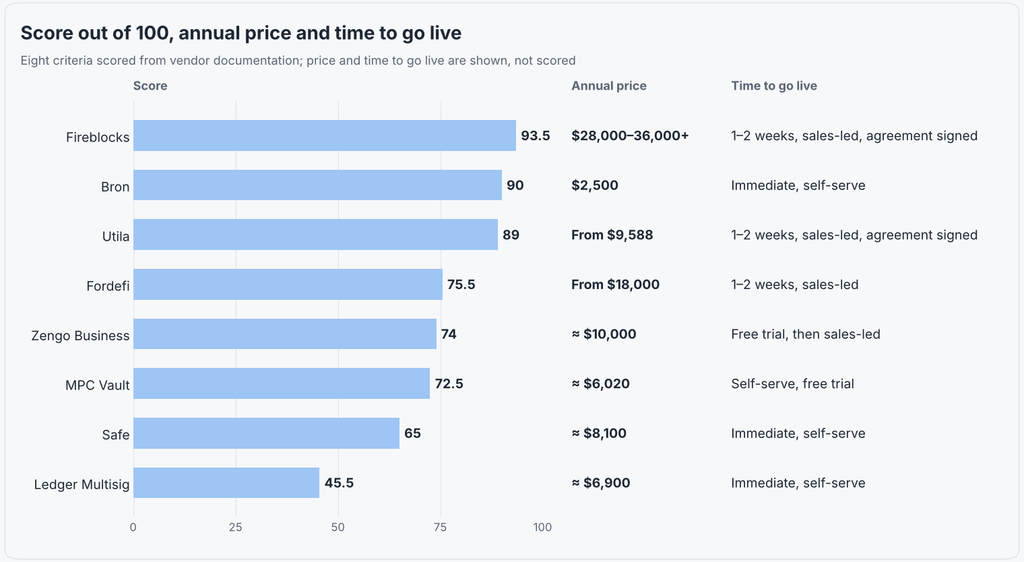
Figure 1 — score out of 100, annual price and time to go live
Scores by criterion (maximum points in brackets)
| Wallet | Security of 15 | Governance of 15 | Treasury of 15 | Continuity of 15 | Fiat of 10 | Integrations of 10 | Screening of 10 | Support of 10 | Total of 100 |
|---|---|---|---|---|---|---|---|---|---|
| 1. Fireblocks | 15 | 15 | 12.5 | 13 | 10 | 10 | 8 | 10 | 93.5 |
| 2. Bron | 15 | 15 | 9 | 15 | 10 | 8 | 8 | 10 | 90 |
| 3. Utila | 15 | 15 | 12 | 15 | 10 | 8 | 8 | 6 | 89 |
| 4. Fordefi | 15 | 15 | 6.5 | 15 | 0 | 10 | 8 | 6 | 75.5 |
| 5. Zengo Business | 15 | 10 | 9 | 13 | 10 | 9 | 2 | 6 | 74 |
| 6. MPC Vault | 14 | 15 | 11 | 7.5 | 10 | 8 | 5 | 2 | 72.5 |
| 7. Safe | 15 | 11 | 5 | 15 | 0 | 5 | 8 | 6 | 65 |
| 8. Ledger Multisig | 15 | 8 | 2.5 | 15 | 0 | 3 | 2 | 0 | 45.5 |
Price and time to go live
| Wallet | Total of 100 | Annual price | Time to go live |
|---|---|---|---|
| 1. Fireblocks | 93.5 | $28,000–36,000+ | 1–2 weeks, sales-led, agreement signed |
| 2. Bron | 90 | $2,500 if billed annually | Immediate, self-serve; KYB needed for fiat transactions only |
| 3. Utila | 89 | From $9,588 | 1–2 weeks, sales-led, agreement signed |
| 4. Fordefi | 75.5 | From $18,000 | 1–2 weeks, sales-led |
| 5. Zengo Business | 74 | ≈ $10,000 | Free trial, then sales-led |
| 6. MPC Vault | 72.5 | ≈ $6,020 | Self-serve, free trial |
| 7. Safe | 65 | ≈ $8,100 | Immediate, self-serve |
| 8. Ledger Multisig | 45.5 | ≈ $6,900 | Immediate, self-serve |
Maximum points per criterion in brackets. The annual price and time to go live are shown for information and are not scored. Each criterion is explained in its own section below.
What each platform offers
Fireblocks (93.5)
Suited to: Businesses that run payment flows at scale, with many customer accounts and automated transfers through the API, and that can work with a sales-led, annual contract.
Strengths: A policy engine with approval groups and an Admin Quorum; built-in blocking of payments to OFAC-sanctioned addresses; an open-source recovery utility that rebuilds keys offline; unlimited vault accounts per customer; SSO, 24/7 support and published response times on Custom plans; all five stablecoin routes through connected CeFi providers.
Limitations: A workspace has one Owner, and replacing the Owner goes through Fireblocks Support. Sweeping and scheduled payments need the API or the paid Automation add-on, and AML screening is a paid add-on on the customer’s own provider contract. Swaps through CeFi providers need an account with each provider, which runs its own checks.
Pricing: Fireblocks’ Essentials plan costs $999 a month for five users and $1 million of outbound transfers a quarter, plus 0.20% on volume above that: about $28,000 a year at the reference company’s volume. Essentials can be kept for up to six months; after that, Custom plans are priced individually on annual terms, starting at $36,000 a year. SSO comes with Custom plans, while Automation and AML screening are paid add-ons.
Bron (90)
Suited to: Businesses whose main need is a stablecoin and crypto treasury run by a team: holding funds, swapping between Ethereum, Tron and Solana, paying suppliers and moving money to and from a company bank account and keeping track of all the movements with easy to understand reporting and transaction notes.
Strengths: 2-of-3 MPC with no seed phrase; approval policies, an address-book lock and delays on new addresses; several Owners; an offline recovery path designed to work without Bron’s servers, using a share held by Qrypt, an independent recovery partner; all five stablecoin routes and purchases of BTC, ETH and SOL through Bron Intents; company IBANs and bank transfers through Noah; 24/7 human chat and a personal manager; sanctions screening against OFAC and UK sanctions lists.
Limitations: No per-customer deposit addresses at scale (10 accounts on Business, more on request) or automatic sweeping; no batch signing or scheduled payments; no SSO.
Pricing: Bron’s Business plan costs $250 a month, or $2,500 a year if billed annually, with five members and up to 10 accounts included; each additional member costs $50 a month. Transfer volume is unlimited, with no platform fee on transfers; Bron’s own fees apply to swaps, at 0.025% between stablecoins and 0.15% for other crypto swaps and for buying or selling crypto with fiat.
Utila (89)
Suited to: Businesses that want broad network coverage, approval controls and independent key recovery, and that can commit to a 12-month contract.
Strengths: Utila combines broad network coverage with approval controls and independent key recovery: a policy engine with an admin quorum on its Starter plan, a recovery package that can be turned into full keys without Utila, and swaps and bridges across EVM networks, Tron, Bitcoin and Solana. It also offers per-customer deposit addresses, batch transfers approved in one step, USD bank rails through Bridge and 24/7 chat.
Limitations: Payment recipients are entered by hand rather than from a file; sweeping runs only through an API script; there is no SSO; screening works only through the customer’s own Chainalysis, Elliptic or TRM contract; and the dedicated account team comes with Custom plans.
Pricing: Utila’s Starter plan costs $799 a month on a 12-month term, billed quarterly ($9,588 a year), and covers three users and up to $3 million of transfers a quarter, the reference company’s volume. Additional users and capacity can be bought, but their prices are not published, so a five-person team should expect to pay more than the list price. Custom plans, with a dedicated account team and a priority SLA, are priced individually.
Fordefi (75.5)
Suited to: Teams active in DeFi on EVM networks and Solana that want detailed policy controls and transaction risk screening.
Strengths: Approval policies by initiator, asset and amount, with an Admin Quorum; mandatory backup and an offline recovery tool; built-in blocking of payments to OFAC-sanctioned addresses; a risk engine that simulates and screens every transaction; Chainalysis integration on the customer’s own key; Okta SSO.
Limitations: No fiat rails; cross-chain swaps are limited to EVM networks, so there are no Tron or Solana routes and no BTC purchases; no payment file upload or scheduled payments; no 24/7 support or published response times.
Pricing: Fordefi does not publish prices, the market data suggests $18,000 a year, but should be treated as indicative. Its rewards program can waive the subscription in full for customers holding qualifying balances of the USDG stablecoin, at thresholds that are not published.
Zengo Business (74)
Suited to: Small teams that want a mobile-first wallet with simple approvals.
Strengths: Four roles (Admin, Approver, Controller and Viewer); whitelisted addresses; 24/7 human support; fiat on- and off-ramps through a company IBAN; in-app swaps of supported assets, including USDT between Ethereum and Tron; an independent escrow for key recovery.
Limitations: One or two approvers by amount, with no time delays or velocity limits; a single Admin manages users and policies; no per-customer deposit addresses or sweeping; no sanctions or AML screening; no public API or named account manager.
Pricing: Zengo does not publish a price for Zengo Business: a free trial is followed by a quote from its sales team. The pricing known from other market participants is about $10,000 a year, though should be treated as indicative.
MPC Vault (72.5)
Suited to: Businesses that collect payments from many customers or pay many recipients, and want to do so without building on an API.
Strengths: Payment files with up to 254 recipients, signed as one transaction; per-customer deposit addresses with automatic sweeping; invoicing and payment links on every plan; an off-ramp in six currencies; 3-of-3 MPC with periodic key refresh; a published price of about $6,000 a year on Growth.
Limitations: The organization owner cannot be deactivated and no ownership transfer is documented; key export, the route to recovery without MPC Vault, needs the Scale plan ($2,000 a month) and the vendor’s support contact; there are no Tron swap routes or BTC purchases; support is by email only, and there is no SSO.
Pricing: Growth plan costs $500 a month, billed annually, with five signer seats and $4 million of transfers a quarter included; extra seats cost $50 a month each, and signature and active-wallet fees add a few dollars a month, for about $6,020 a year in total. Key export, the route to recovery without MPC Vault, is available only on the Scale plan ($2,000 a month, billed annually) and on Enterprise.
Safe (65)
Suited to: Treasuries that operate only on EVM networks and want an open, on-chain multisig with no vendor keys.
Strengths: A smart-contract multisig whose owners can be replaced on-chain; contracts that keep working through any interface or the open-source CLI if Safe’s services are unavailable; on Safe Pro Business, proposers, spending limits, a shared address book and priority support; Safe Shield risk checks, including AML and OFAC checks; payment files through a Safe App and batches signed as one transaction.
Limitations: EVM networks only, so no USDT on Tron, USDC on Solana or BTC; no fiat rails; one approval threshold for every payment; no enforced allowlist; support in business hours only.
Pricing: Safe Pro Business costs €669 a month excluding VAT, or €7,190 a year if billed annually (about $8,100 at the ECB rate of 4 November 2026), for five Safe accounts with unlimited members; the plan can be extended to 10 or 20 Safe accounts. 30-day free trial is available.
Ledger Multisig (45.5)
Suited to: Teams on EVM networks that want every approval confirmed on a Ledger hardware device.
Strengths: Safe contracts with no vendor keys; hardware signing with Clear Signing and Transaction Check; owners replaceable on-chain; pay-per-use pricing with no subscription.
Limitations: Five EVM networks only; no address book or allowlist; no rules by amount, asset or destination; no time delays; no payment files; no sanctions screening; no fiat rails.
Pricing: Ledger Multisig has no subscription: it charges 5 basis points on token transfers and $10 for each other transaction, about $6,000 a year at the reference company’s volume. Each signer needs a Ledger device; five Ledger Nano Gen5 cost about $895 once. Because the fee is a share of volume, the cost grows with payment flows.
How the scoring works
The reference company. Every product is scored for the same customer: a business with 5 users , about $1 million a month of outbound transfers (roughly $3 million a quarter), a stablecoin treasury in USDT and USDC on Ethereum, Tron and Solana, some BTC, ETH and SOL on the balance sheet, suppliers to pay, customers to collect from, and no in-house blockchain engineers.
The plan we score. Features are scored on each vendor’s entry plan, so that the comparison is like for like: Bron Business, MPC Vault Growth and Utila Starter. Fireblocks’ entry plan, Essentials, can be kept for at most six months, so we score Fireblocks on its Custom plans, which are more expensive. For Safe we score Safe Pro Business, the plan Safe sells to teams that need proposers and spending limits. Fordefi, Ledger Multisig and Zengo Business have a single offering, so they are scored on it. A feature available only on a more expensive plan, or only as a paid add-on, earns half credit, and a feature available only through the API earns half credit too, because the reference company has no in-house engineers. The tables say where this applies.
Price and time to go live. Neither is scored. The scorecard shows each product’s annual price for the reference company and how quickly a business can start.
Points and deductions. Each criterion carries a fixed number of points; each wallet is scored directly in those points, and every lost point is itemized in the criterion’s table. Half points appear where half credit applies. Tables are sorted by score, ties alphabetically.
| # | Criterion | Points | What we score |
|---|---|---|---|
| 1 | Security and key control | 15 | No single secret whose loss costs the funds; whether the vendor can move funds without customer consent; hardware-backed keys; per-transaction second factor; open-source code with an audit, or SOC 2 / ISO 27001; replacing a lost or compromised device |
| 2 | Governance and approvals | 15 | Roles with separated duties; approval quorums; rules by amount, asset, destination and initiator; allowlists; time delays or velocity limits; multi-party approval of changes to the rules themselves |
| 3 | Treasury operations | 15 | Paying suppliers; getting paid by customers; five swap routes for stablecoins across Ethereum, Tron and Solana as well as the ability to buy BTC, ETH and SOL for corporate treasury operations |
| 4 | Business continuity | 15 | Several owners and owner replacement without the vendor; rebuilding full private keys without the vendor; a self-serve, documented exit on the plan we score |
| 5 | Fiat rails | 10 | Bank on-ramp and off-ramp to the company’s own account |
| 6 | Integrations and reporting | 10 | Accounting export or integration; statements; audit log; SSO; public API; transaction notes |
| 7 | Transaction screening | 10 | Sanctions screening of recipients, built in or through the customer’s own KYT provider; built-in AML and risk screening |
| 8 | Support | 10 | Human live chat; 24/7; published response-time SLA; account manager on the plan we score |
| Total | 100 |
1. Security and key control — 15 points
What we assessed: (a) no single point of failure: no single person holds a single secret whose loss or theft would cost the funds — 4 points; (b) the vendor cannot move funds without the customer’s consent — 3; (c) the customer’s own key share is held in device hardware (Secure Enclave, TEE or a hardware wallet) — 2 (1 if only the vendor’s shares are documented in hardware); (d) a second factor on every signature — 2; (e) open-source code with a published audit, or a SOC 2 or ISO 27001 certification — 2; (f) a lost or compromised device can be replaced without changing addresses or moving funds — 2.
All eight products pass the basic test: losing one phone or one secret does not cost the funds, and no vendor can move funds alone. The trust models differ. Fireblocks and MPC Vault each hold two of three key shares, but all three are needed to sign, so the customer’s share is always required; Fireblocks states that it never holds enough shares to sign on its own. Bron holds one of three and Qrypt, an independent recovery partner, holds another; Bron cannot ask Qrypt for its share, and a replacement share for a lost device is generated only after a recovery that the user starts and proves, with a delay of 48 hours to 30 days that the user or workspace members can cancel. The only deduction is MPC Vault’s: its documentation does not show the phone share in device hardware.
| Wallet | Score (of 15) | Basis and deductions |
|---|---|---|
| Bron | 15 | 2-of-3 MPC across the user’s device, Bron and Qrypt, an independent recovery partner; no seed phrase; device share in Secure Enclave/TPM, Bron’s share protected by an HSM; biometric signing per transaction; open-source MPC library (bron-crypto) audited by Trail of Bits. Bron alone cannot sign; after a lost device, a new share is generated only on a recovery the user starts and proves (FaceScan, two Guardians, or email with a longer delay), with a 48-hour to 30-day delay that the user or workspace members can cancel; the old share stops working and addresses stay the same |
| Fireblocks | 15 | MPC-CMP with three key shares: one on each signing user’s phone (Secure Enclave/TEE) or the customer’s API Co-Signer, two held by Fireblocks in Intel SGX; Fireblocks never holds enough shares to sign on its own; PIN plus biometric or YubiKey before each action; open-source MPC library, SOC 2 Type II and ISO 27001. A lost phone is replaced without new addresses: the Owner restores the share from a passphrase-encrypted backup, and other users receive new shares for the same workspace key once the Owner approves |
| Fordefi | 15 | Two-party MPC: Fordefi’s share in a cloud secure enclave, the customer’s in the phone’s secure enclave behind biometrics; SOC 2 Type II (EY); periodic share refresh keeps addresses unchanged; admins can reset another user’s device |
| Ledger Multisig | 15 | Safe contracts with every approver signing on a Ledger device (required on mainnet), with Clear Signing and Transaction Check on the screen; Ledger never holds keys; audited open-source Safe contracts; a compromised signer is swapped by threshold |
| Safe | 15 | On-chain M-of-N smart-contract multisig; Safe holds no keys; hardware signers (Ledger, Trezor) and Secure Enclave on Safe{Mobile} supported; open-source, repeatedly audited contracts; a compromised signer is swapped by threshold without changing the address |
| Utila | 15 | Two-party MPC (DKLs23): one share on the customer’s phone, bound to that device, and one with Utila; biometric or passkey per signature; SOC 2 Type 2 and ISO 27001, Halborn audit. A new phone receives the existing shares end-to-end encrypted from another device or from a 13-word personal backup, so addresses stay the same; admins can delete a device |
| Zengo Business | 15 | Two-party MPC: one share on the approver’s phone, tied to the device hardware (Secure Enclave or TEE, per Zengo’s white paper), one on Zengo’s server; signing only in the Business mobile app with biometrics; open-source MPC code and published audits, ISO 27001 claimed; a lost phone is replaced by recovering the same wallet from the company’s Google Drive backup, and the Admin decides which devices may sign |
| MPC Vault | 14 | 3-of-3 MPC: the user’s device plus two vendor shares on Google Cloud (AMD SEV) and Azure (Intel SGX); MPC Vault cannot sign alone; periodic key refresh keeps addresses; SOC 2 Type II. −1: the documentation does not say where the phone share is kept, and the personal key certificate can be backed up to iCloud, as a mnemonic or as key files, so only the vendor’s shares are shown in hardware |
2. Governance and approvals — 15 points
What we assessed: (a) distinct roles, including one that can see but not sign — 3; (b) M-of-N approval quorums — 3; (c) rules by amount, asset, destination, initiator or time window — 3; (d) enforced address allowlisting — 2; (e) time delays or velocity limits — 2; (f) multi-party approval of changes to users, roles and policies — 2.
Bron, Fireblocks, Fordefi, MPC Vault and Utila field complete policy engines on their entry plans, and in each, changes to users, roles and policies need approval by other people on a quorum the customer sets; MPC Vault applies it per vault, where members and policies change only with the manager quorum. The smart-contract products score lower because their interfaces offer fewer rules: Safe Pro Business has one threshold for every payment plus spending limits, with its allowlist still to come, and Ledger Multisig has only signers, proposers and a threshold. Zengo Business has approvals by amount and whitelisted addresses, managed by a single Admin.
| Wallet | Score (of 15) | Basis and deductions |
|---|---|---|
| Bron | 15 | Owner / Member / Viewer roles, approver set per policy, nobody approves their own request; N-of-M approvals; rules by amount (single or cumulative up to 336 hours), account, destination type and initiator; Address Book Lock; 48-hour lock on new addresses and security delays; changes to users, owners, limits and the address book can require approval by other members or Owners (configured by the customer, like the admin quorums of other platforms) |
| Fireblocks | 15 | Policy Engine on every plan: nine roles from Owner to Viewer and Security Auditor; approval groups with thresholds; rules by initiator, source, destination, asset and amount with cumulative windows up to 360 hours; whitelisting under Admin Quorum; Admin Quorum for users, policies and whitelists |
| Fordefi | 15 | Admin / Trader / Viewer with approver groups; minimum approvers per rule; conditions by initiator, vault, recipient, asset, USD amount and periodic amount; address-book allowlisting; Admin Quorum covers users, roles, policies and the address book |
| MPC Vault | 15 | Owner, admins, vault managers, members and a read-only accountant role; per-vault quorums; policies by transaction type and amount, with daily-volume rules; recipient and contract allowlists (whitelist-only on EVM, Bitcoin and Tron); vault members and policies change only with the manager quorum |
| Utila | 15 | Policy engine included on Starter: viewer, operator, signer and admin roles; custom quorums; rules by initiator, wallet, destination, chain, token and amount, with hourly to monthly accumulated limits; address-book allowlisting; admin quorum for policies, users, devices and the quorum itself |
| Safe | 11 | Safe Pro Business: owners with an on-chain threshold, proposers who can create but not sign, and Workspace members; spending limits by beneficiary, token, amount and reset period; owner and threshold changes require the threshold. −1: the approval threshold is the same for every payment (no rules by amount or destination); −2: no enforced allowlist; −1: no time delays |
| Zengo Business | 10 | Admin, Approver, Controller and Viewer roles; one or two approvers by amount threshold; whitelisted addresses. −1: only amount thresholds documented; −2: no time delays or velocity limits; −2: a single Admin changes users, roles and policies |
| Ledger Multisig | 8 | Signers and proposers (who can create but not sign), with threshold approvals and signer changes requiring the threshold. −3: no rules by amount, asset or destination; −2: no on-device address book; −2: no time delays or velocity limits |
3. Treasury operations — 15 points
What we assessed: (a) paying out — uploading a payment file (1), signing a batch of payments at once (1), an address book (1), scheduled or recurring payments (1); (b) getting paid — per-customer deposit addresses at scale (2), automatic sweeping, payment links or invoices (2); (c) five stablecoin swap routes inside the product, 1 point each: USDT Ethereum ↔ USDT Tron; USDT Ethereum ↔ USDC Solana; USDT Tron ↔ USDC Solana; USDT ↔ USDC on the same chain; USDC Ethereum ↔ USDC Solana; (d) buying BTC, ETH and SOL with stablecoins inside the product and holding them natively — 2 (1 for one or two of the three). A route counts when the vendor has in-app swaps or bridges between the networks concerned, even if a third-party provider connected inside the product runs the swap. A feature available only through the API earns half credit, because the reference company has no in-house blockchain engineers.
Fireblocks reaches all five routes through third-party CeFi providers connected to the workspace, which require a separate provider account, and KYC checks might be needed to perform swaps. Utila and Zengo Business are credited the same way: Utila has swaps and bridges across EVM networks, Tron, Bitcoin and Solana, and Zengo states that any supported asset can be swapped. Bron has all of these routes through Bron Intents, where solvers fill orders at firm quotes (RFQ), so the quoted price is the price paid, and settlement is on-chain without a separate identity check by a swap provider. The EVM-only products (Safe, Ledger Multisig) can only swap USDT for USDC on the same chain, and Fordefi’s cross-chain swaps are also limited to EVM networks. On payments, MPC Vault is the most complete: payment files, batches signed as one transaction, per-customer deposit addresses with auto-sweep, and invoicing and payment links on every plan. Bron imports payment files but has no batch signing, and it offers no per-customer deposit addresses or sweeping.
| Wallet | Score (of 15) | Basis and deductions |
|---|---|---|
| Fireblocks | 12.5 | Address book (whitelisted wallets); unlimited vault accounts per customer; all five routes in the console through connected CeFi providers, which support Bitcoin, Solana and Tron with a different asset on the receiving side; buys BTC, ETH and SOL. −1: batch payouts (Payout API) and multi-destination transfers are API-only (half credit for file upload and batch signing); −0.5: scheduled payments need the paid Automation add-on (half credit); −1: no payment links or invoices, and sweeping needs the API or the paid Automation add-on (half credit) |
| Utila | 12 | Batch transfer to several recipients, approved and signed once in the console; address book with CSV import; per-customer deposit addresses; swaps and bridges across EVM, Tron, Bitcoin and Solana (Li.Fi, Relay, Symbiosis), so all five routes and BTC, ETH and SOL purchases are credited at network level. −1: recipients are entered by hand (no payment file upload); −1: no scheduled or recurring payments; −1: sweeping only through an API script (half credit), and no payment links or invoices |
| MPC Vault | 11 | Batch payments to up to 254 recipients from a CSV or Excel upload, signed as one transaction; address book; deposit addresses per customer with auto-sweep of USDC/USDT (enabled by an account manager); invoicing and payment links on every plan; cross-chain swaps between EVM and Solana and Circle CCTP; buys ETH and SOL. −1: no scheduled or recurring payments; −2: no Tron routes (USDT Ethereum ↔ USDT Tron, USDT Tron ↔ USDC Solana); −1: no BTC purchases |
| Bron | 9 | Bulk transfer from an Excel template with network in-built checks; address book; all five swap routes through Bron Intents, firm quotes from independent solvers; swaps USDT/USDC across all available chains and buys BTC, ETH and SOL with USDT or USDC and holds them natively. −1: no batch signing; −1: no scheduled or recurring payments; −4: no per-customer deposit addresses at scale (10 accounts on Business, more on request), and no payment links, invoices or sweeping |
| Zengo Business | 9 | Batch uploads for mass payouts and an address book; in-app swaps through Swaps.xyz and Changelly, where any supported asset can be swapped subject to liquidity (USDT Ethereum ↔ USDT Tron shown explicitly) and KYC requests. All five routes are credited at network level; buys and holds BTC, ETH and SOL. −1: batch signing not documented; −1: no scheduled or recurring payments; −4: isolated sub-wallets, but no per-customer deposit addresses at scale, payment links or sweeping |
| Fordefi | 6.5 | Address book with file import; unlimited vaults and deposit addresses; same-chain swaps on EVM networks and Solana (Jupiter); buys ETH and SOL. −1: no payment file upload; −0.5: batch transfers only for Solana and Bitcoin, through the API (half credit); −1: no scheduled or recurring payments; −1: no automatic sweeping, and there are no payment links or invoices; −4: cross-chain swaps are EVM-only, so no Tron or Solana routes; −1: no BTC purchases |
| Safe | 5 | Transaction Builder bundles many transfers into one signed transaction; CSV Airdrop app for payment files; shared address book; same-chain swaps on EVM networks; buys and holds ETH. −1: no scheduled or recurring payments; −4: one address per Safe, no per-customer deposit addresses, payment links, invoices or sweeping; −4: EVM-only swaps (no Tron or Solana routes); −1: no BTC or SOL |
| Ledger Multisig | 2.5 | Batch transactions through the API (MultiSend); same-chain swaps via 1inch on EVM networks; buys and holds ETH. −1: no payment file upload; −0.5: batching is API-only (half credit); −2: no address book and no scheduled payments; −4: no per-customer addresses, payment links or sweeping; −4: five EVM chains only, so no Tron or Solana routes; −1: no BTC or SOL |
4. Business continuity — 15 points
What we assessed: (a) several people hold owner-level authority, and the owner can be replaced by a quorum of the others without a ticket to the vendor — 5 (3 if several people hold admin-level authority but replacing the owner needs the vendor or is not possible); (b) the customer can rebuild full private keys without the vendor — 5; (c) that exit is self-serve and documented on the plan we score — 5 (2 if it is plan-gated or started by the vendor). A key recovery designed for the vendor’s failure counts in full when the customer can also withdraw all assets at any time while the vendor operates.
Smart-contract wallets score full marks by design: the customer holds every key and the contracts outlive the vendor. Among the MPC products, Bron, Fordefi and Utila also score full marks: several owners or admins under a quorum, and an offline recovery that turns into full private keys without the vendor — with Qrypt in Bron’s case, which Bron cannot ask for its share. Fireblocks matches them on key recovery but has a single Owner whose replacement goes through Fireblocks Support. MPC Vault’s owner cannot be deactivated, and its key export needs the Scale plan and its support contact.
| Wallet | Score (of 15) | Basis and deductions |
|---|---|---|
| Bron | 15 | Several Owners, with owner changes approved by a majority of Owners and no vendor ticket; while Bron operates, assets can be withdrawn to any wallet at any time. Should Bron cease operating, offline private-key recovery rebuilds full keys from the user’s share and the share held by Qrypt, without Bron’s servers or any action from Bron, on every plan |
| Fordefi | 15 | Several admins (three or more recommended) managed by quorum; mandatory backup of both shares; an offline recovery tool outputs full private keys independently of Fordefi; self-serve and documented |
| Ledger Multisig | 15 | Several owners, replaceable on-chain by threshold; each signer holds their own keys on a Ledger device; accounts are standard Safe contracts usable through any Safe interface |
| Safe | 15 | Several owners, replaceable on-chain by threshold; Safe holds no keys; contracts work through any interface or the open-source Safe CLI even if Safe’s services are down |
| Utila | 15 | Several admins, with vault ownership reassigned under admin quorum without a support ticket; the recovery package holds both shares and can be decrypted without Utila, then turned into full keys with an offline tool; set up in the console (self-managed, Station70 or CoinCover) |
| Fireblocks | 13 | Mandatory workspace key backup and an open-source Recovery Utility rebuild full private keys offline without Fireblocks; self-serve and documented on every plan. −2: a workspace has one Owner, and transferring that role, or moving it to a new phone when the old one is lost, requires Fireblocks Support and an ID video call |
| Zengo Business | 13 | Admins manage team access and can update or revoke any role without Zengo; Zengo’s independent escrow (‘guaranteed access’) lets users rebuild private keys if Zengo stops operating, and assets can be withdrawn at any time while Zengo operates. −2: the help center refers to ‘the Admin’ and does not say whether several people can hold the role. Zengo does not say whether the escrow covers Business wallets, and there is no self-serve key export for Business, so the exit rests on the same escrow |
| MPC Vault | 7.5 | Several admins; organization key export rebuilds the root key without MPC Vault, covering existing and future addresses. −2: the organization owner cannot be deactivated and no ownership transfer is documented; −2.5: key export is available only on Scale ($2,000 a month, billed annually) and Enterprise (half credit on Growth); −3: the export is requested through the dedicated support contact and costs extra if not set up when the organization is created |
5. Fiat rails — 10 points
What we assessed: (a) bank on-ramp from the company’s own account into the wallet — 5; (b) off-ramp to the company’s own bank account — 5.
Five products connect a business bank account in both directions, all through third-party providers: Bron (Noah), Fireblocks (Bridge, OpenPayd and others), Utila (Bridge), MPC Vault and Zengo Business (a company IBAN; neither names its provider). Fordefi, Safe and Ledger Multisig have no fiat rails.
| Wallet | Score (of 10) | Basis and deductions |
|---|---|---|
| Bron | 10 | Bank transfers (SEPA, SWIFT, ACH, Fedwire) in and out of USDC through Noah, to and from an account in the company’s name; KYB by the provider |
| Fireblocks | 10 | On- and off-ramp orders through connected providers (Bridge, OpenPayd and others), with KYB by the provider |
| MPC Vault | 10 | Off-ramp to bank accounts in six currencies via ACH, SWIFT and wire, on-ramp listed (20 bps on Growth); KYB by the provider |
| Utila | 10 | USD on- and off-ramp by ACH or wire through Bridge, KYB in the console |
| Zengo Business | 10 | Dedicated virtual IBAN for the company, USD and EUR to and from USDT/USDC, with instant off-ramps; a business-only product, although the KYB process is not described |
| Fordefi | 0 | −10: no fiat rails documented |
| Ledger Multisig | 0 | −10: no fiat rails |
| Safe | 0 | −10: no fiat rails in Safe{Wallet} (developer on-ramp SDKs only) |
6. Integrations and reporting — 10 points
What we assessed: an accounting integration or accounting-ready export — 2; statements or balance reports — 2; an audit log — 2; SSO — 2; a public API — 1, because the reference company has no engineers to build on it; and notes on transactions, so a team can record what each payment was for — 1.
Fireblocks and Fordefi score full marks. SSO is the most common gap: Bron, MPC Vault, Safe, Utila and Ledger Multisig do not offer it on the plan we score; Zengo Business signs users in through the company’s Google Workspace. Transaction notes are standard in the MPC products and absent from the Safe and Ledger interfaces.
| Wallet | Score (of 10) | Basis and deductions |
|---|---|---|
| Fireblocks | 10 | Accounting via Cryptio and TRES Finance; exportable audit log; balance reports; SSO (Okta, Entra ID, SAML and others); full API and SDKs; free-text note on every transaction |
| Fordefi | 10 | CSV exports plus Integral accounting; exportable audit log; Okta SSO; balance and transaction reports; public API; the initiator’s note on each transaction |
| Zengo Business | 9 | CSV exports, audit trails and automated reports; sign-in through the company’s Google Workspace; optional note on each transaction. −1: no public API |
| Bron | 8 | XLSX transaction and daily-balance snapshot reports; activity log via API; public REST API with SDKs and CLI; a note on every transaction, exported with it. −2: SSO is not yet available |
| MPC Vault | 8 | CSV exports, audit history (3 months on Growth), PDF account statements, REST and gRPC API, private transaction notes. −2: no SSO available |
| Utila | 8 | CSV export plus Cryptio and Cryptoworth; audit log; balance reports; public API; notes on transfers. −2: no SSO available |
| Safe | 5 | CSV transaction export; activity log; Transaction Service API and SDK. −2: no SSO available; −2: no statements; −1: no transaction notes |
| Ledger Multisig | 3 | Transaction history through the Transaction Service API with CLI. −2: no accounting export; −2: no SSO available; −2: no statements; −1: no transaction notes |
7. Transaction screening — 10 points
What we assessed: (a) sanctions screening of recipients before a payment is signed, either built in or through the customer’s own KYT provider (Chainalysis, Elliptic or TRM) connected inside the product — 6; (b) built-in risk screening without a separate contract — 4: AML scoring of counterparties and incoming funds (address risk, source of funds) earns 4, and simulation or warnings about risky addresses, contracts or dApps before signing earn 2.
No product offers the full set. Bron, Fireblocks and Fordefi block payments to sanctioned addresses out of the box; Fireblocks, Fordefi and Utila connect the customer’s own Chainalysis, Elliptic or TRM account, which then screens incoming funds too (a paid add-on at Fireblocks). None has built-in AML scoring of addresses and incoming funds without a separate provider contract, which is the largest gap. Most products simulate transactions or warn about risky contracts before signing; MPC Vault lists ‘proactive transaction screening’ without describing it. Ledger Multisig and Zengo Business have no sanctions or AML screening.
| Wallet | Score (of 10) | Basis and deductions |
|---|---|---|
| Bron | 8 | Built-in screening of every recipient against the US OFAC SDN and UK sanctions lists before signing; a match blocks the payment; dApp requests are simulated before signing, with an ‘Unknown domain’ warning. −2: no built-in AML risk scoring of addresses or incoming funds |
| Fireblocks | 8 | Built-in OFAC screening blocks outbound transfers to sanctioned addresses; Chainalysis, Elliptic or TRM integration (a paid add-on on the customer’s own contract) blocks outbound and freezes inbound transfers; dApp protection and transaction simulation. −2: no built-in AML risk scoring without a provider contract |
| Fordefi | 8 | Built-in OFAC SDN screening blocks outgoing transfers to sanctioned addresses; native Chainalysis screening of incoming and outgoing transfers on the customer’s own key; every transaction is simulated and screened by Fordefi’s risk engine. −2: no built-in AML risk scoring without a provider contract |
| Safe | 8 | Safe Shield completes anti-money-laundering and OFAC checks, with risk flags and simulation before signing. −2: no in-built AML checks |
| Utila | 8 | Native Chainalysis, Elliptic or TRM screening of outgoing and incoming transfers on the customer’s own API key, with enforcement for Chainalysis and Elliptic; balance changes simulated before signing and a risk view of token approvals. −2: no built-in AML risk scoring |
| MPC Vault | 5 | ‘Proactive transaction screening’ is listed on every plan but not defined (half credit); transaction simulation, malicious-logic detection and address-book risk alerts. −3: sanctions screening is not described; −2: no built-in AML risk scoring |
| Ledger Multisig | 2 | Transaction Check flags malicious contracts and addresses on the device. −6: no sanctions or KYT screening; −2: no AML risk scoring; Ledger’s interface does not include Safe Shield |
| Zengo Business | 2 | ClearSign warns about risky dApps. −6: no sanctions or KYT screening documented for Zengo Business; −2: no AML risk scoring |
8. Support — 10 points
What we assessed: human live chat or a shared support channel — 2; 24/7 availability — 2; a published response-time SLA — 2; a named account manager on the plan we score — 4.
Bron and Fireblocks score full marks: 24/7 human support, published response times and a named manager, on Fireblocks’ Custom plans. Utila’s Starter plan has 24/7 chat, but its account team comes with Custom plans. We do not score a separate security-incident channel: with a named manager and a 24/7 line, a customer can freeze activity through support. Fireblocks and Fordefi also let an admin freeze the workspace from the console.
| Wallet | Score (of 10) | Basis and deductions |
|---|---|---|
| Bron | 10 | 24/7 in-app human chat; a published response-time commitment, weekends included; personal manager included on Business |
| Fireblocks | 10 | Custom plans: Premium or Platinum support, 24/7, with a technical Slack channel, published response times and a technical account manager; any admin can freeze the workspace from the console |
| Fordefi | 6 | Named customer success manager in a shared Slack or Telegram channel; self-serve emergency workspace freeze. −2: no 24/7 coverage; −2: no response time SLA |
| Safe | 6 | Safe Pro Business: priority support in the app and by email, with published first-response targets (P1 within one business day). −2: business hours only (09:00–18:00 CET); −2: a named contact only on plans that include it, such as Enterprise (half credit) |
| Utila | 6 | Starter: 24/7 chat support. −2: a ‘Standard’ SLA is named, but no response times are stipulated in contract; −2: dedicated account team on Custom only (half credit) |
| Zengo Business | 6 | 24/7 human support and live chat; Zengo guarantees a live-chat reply within one hour on Zengo Pro, which we assume Business matches. −4: no named account manager on starter plan |
| MPC Vault | 2 | Email and contact form. −2: no live chat; −2: no 24/7 coverage; −2: no response time SLA; −2: a dedicated support contact is mentioned only for Scale and Enterprise (half credit) |
| Ledger Multisig | 0 | −10: no support channels, hours, SLA or account manager documented for Multisig; Ledger, not Safe, supports this interface |
Annual price and time to go live
Neither is scored. The annual price is for the reference company (5 users, $1 million a month of outbound transfers) on the plan we score, including subscription, seats and platform volume or signature fees. Swap, trading and fiat-conversion fees are not included, because they depend on the pairs, amounts and providers used. Time to go live for sales-led platforms is our estimate, as vendors do not publish onboarding times.
Bron has the lowest listed price for the reference company: $250 a month, or $2,500 a year if billed annually, published and self-serve. MPC Vault, Ledger Multisig and Safe follow at about $6,000 to $8,100 a year. Utila’s Starter plan costs $9,588 a year for three users, and the price of extra users is not published. Fireblocks’ Essentials plan would cost about $28,000 a year at our volume but runs for up to six months, after which Custom plans start at $36,000 a year. Fordefi and Zengo Business do not publish prices on their websites; the figures shown are indicative: from about $18,000 a year for Fordefi and about $10,000 for Zengo Business.
| Wallet | Plan | Calculation | Annual cost | Time to go live |
|---|---|---|---|---|
| Bron | Business | $250 a month, or $2,500 a year if billed annually; 5 members included; unlimited volume, no platform transfer fees | $2,500 | Immediate, self-serve; KYB needed for fiat transactions only |
| MPC Vault | Growth | $500 × 12, billed annually; 5 signer seats and $4M a quarter included; signature ($0.005) and active-wallet ($0.04 a month) fees add a few dollars a month | ≈ $6,020 | Self-serve, free trial |
| Ledger Multisig | Pay per transaction | 5 bps on token transfers × $12M = $6,000, plus $10 per other transaction; 5 Ledger Nano Gen5 at $179 = $895 one-off | ≈ $6,900 | Immediate, self-serve |
| Safe | Safe Pro Business, 5 Safe accounts | €7,190 a year at the ECB rate of 1.1267 (4 November 2026); €669 a month if billed monthly (≈ $9,050 a year); unlimited members; network gas extra | ≈ $8,100 | Immediate, self-serve |
| Utila | Starter | $799 × 12 on a 12-month term, billed quarterly; covers 3 users and up to $3M a quarter; extra users can be bought, but their price is not published | From $9,588 | 1–2 weeks, sales-led, agreement signed |
| Zengo Business | Not published | Free trial; no published price; indicative price about $10,000 a year | ≈ $10,000 | Free trial, then sales-led |
| Fordefi | Quote-based | No published price; indicative price from about $18,000 a year; a USDG rewards program can offset the subscription at undisclosed balances | From $18,000 | 1–2 weeks, sales-led |
| Fireblocks | Essentials, then Custom | Essentials: $999 × 12 = $11,988 plus 0.20% on volume above $1M a quarter ($8M a year) = $16,000, or $27,988; Essentials runs for up to six months, after which Custom starts at $36,000 a year | $28,000–36,000+ | 1–2 weeks, sales-led, agreement signed |
If your business is different
The scores above describe one reference company. A business with other needs should give more weight to the criteria that matter to it. The table suggests where to start for five common profiles, based on the evidence in this report.
| Business profile | What matters most | Where to start | Also consider |
|---|---|---|---|
| Stablecoin treasury: holds stablecoins and some BTC, ETH or SOL, moves funds between Ethereum, Tron and Solana, pays suppliers; small team | Cross-chain swaps, approvals, independent recovery, bank rails, cost | Bron: all five stablecoin routes, bank rails and independent recovery at the lowest listed price | Utila (similar functionality, 12-month term); Fireblocks (more treasury tooling at a higher price) |
| Payment business collecting from many customers: exchange, payment provider, marketplace | Per-customer deposit addresses at scale, automatic sweeping, an API | Fireblocks; Utila | MPC Vault (sweeping, invoices and payment links without coding, with weaker continuity) |
| Payouts to many recipients: contractors, affiliates, payroll | Payment files, batch signing, an address book | Bron, if confirming every transaction with biometrics is fine for you | MPC Vault if batch signing is necessary, Safe if EVM only) is fine |
| Large organization with IT and compliance teams | SSO, 24/7 support with response times, KYT integration, audit logs | Fireblocks | Fordefi; Utila |
| Small team that wants simplicity of operations | Easy approvals, a mobile app, a company IBAN, 24/7 support | Bron | Zengo Business (mobile-first, with simple approvals) |
Checklist: how to choose a business crypto wallet
Use these questions to assess every product on your shortlist. A “no” is not always a reason to reject a product, but each one should be a conscious choice.
Keys and security
☐ Can any single person, device or lost secret cause a loss of funds?
☐ Can the provider move or block our funds without our approval?
☐ Where are our key shares stored, and are they protected by device hardware?
☐ Is there open-source code with a published audit, or a SOC 2 or ISO 27001 certification we can review?
☐ If a device is lost or an employee leaves, can we replace the device without changing addresses?
Approvals and controls
☐ Can we require two or more approvers, with different rules by amount, asset and destination?
☐ Can we restrict payments to an approved address book?
☐ Are new addresses and large payments subject to time delays or daily limits?
☐ Do changes to users, roles and policies need approval from more than one person?
☐ Is there a view-only role for our bookkeeper or auditor?
Treasury operations
☐ Can we upload a payment file and will it create all the transactions automatically? Can we approve the whole batch in one step?
☐ Can we give each customer a deposit address and sweep the funds automatically?
☐ Can we swap between the stablecoins and networks we use inside the product, and who executes the swap?
☐ Can we buy and hold BTC, ETH or SOL natively if our treasury policy allows it?
Continuity and exit
☐ Can more than one person hold owner-level authority, and can the owner be replaced without the provider?
☐ If the provider stops operating, can we rebuild our private keys and move our funds without it?
☐ Is that exit documented, self-serve and available on our plan, and have we tested it?
Fiat and compliance
☐ Can we move money between the wallet and our company bank account, and which provider handles it?
☐ Which jurisdictions and currencies are supported, and how long does business verification (KYB) approximately take?
☐ Are recipients screened against sanctions lists before we sign, and is incoming money screened?
☐ Do we need our own Chainalysis, Elliptic, Hypernative or TRM contract?
Reporting and integrations
☐ Can we export transactions and balances in a format our accountants use?
☐ Is there an audit log, and can we add a note to each transaction?
☐ Do we as a company require SSO, and if so, is it included in our plan?
Support
☐ Is human support available when we operate, including weekends?
☐ Is there a published response time and a named contact?
☐ How do we freeze activity in an emergency?
Cost and contract
☐ What is the total annual cost for our users and volume, including seats, volume fees and add-ons?
☐ Is the price published, and what is the minimum term?
☐ Can we sign up without a sales call, and how long until we can operate?
Conclusion
For the reference company, Bron combines a high functionality score with the lowest listed annual platform cost in this comparison ($2,500 a year if billed annually). Fireblocks offers additional treasury capabilities and SSO at a higher price (about $28,000 a year on Essentials, then from $36,000 on Custom plans), while other platforms may suit businesses with different network or payment requirements.
The scorecard provides a starting point for a shortlist. Before selecting a provider, businesses should confirm total costs, review the supporting security evidence, and establish that the provider’s recovery arrangements and contractual terms meet their needs.
The post The Best Non-Custodial Crypto Wallets for Business: November 2026 appeared first on BlockchainReporter .