



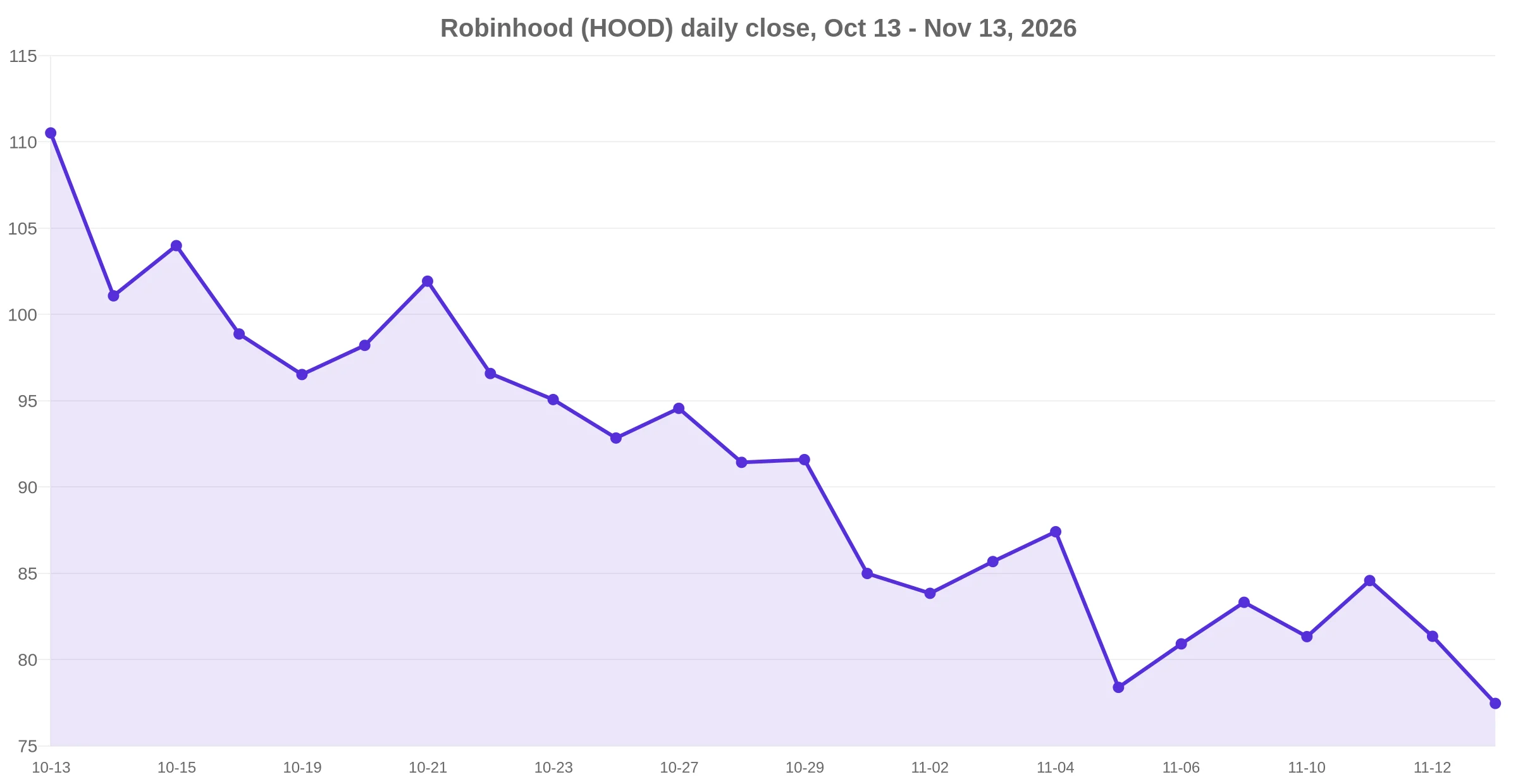
Robinhood shares were down 4.8% at $77.46 shortly before 16:30 UTC on Nov. 13, after the brokerage’s October operating data showed crypto notional volume falling 21% in the month and 48% from a year earlier to $17.0 billion, and as bitcoin itself slid 4.5% to $68,600.
Those are two separate problems sharing one headline, and separating them is what the price is actually doing. One is a company-specific volume trend that is a year old and was already visible in the third-quarter report. The other is a market-wide repricing of every listed business that collects a fee from crypto trading. Robinhood sits on both, and its equity carries more of the second than its revenue mix would suggest.
What the October release actually puts on the record
Robinhood published the figures after the close on Nov. 12 through its investor relations release . The document is a data table with a short preamble, not a management statement, so everything below is the company’s own reported figure rather than an interpretation.
| Monthly metric | Oct 2026 | Sep 2026 | Oct 2025 | Month | Year |
|---|---|---|---|---|---|
| Funded customers | 28.9M | 28.7M | 27.1M | +1% | +7% |
| Total platform assets | $383.2B | $395.9B | $342.6B | -3% | +12% |
| Net deposits | $15.1B | $6.1B | $5.6B | NM | NM |
| Equity notional volume | $325.5B | $323.6B | $320.1B | +1% | +2% |
| Options contracts | 288.6M | 287.9M | 266.7M | flat | +8% |
| Crypto notional volume | $17.0B | $21.4B | $32.5B | -21% | -48% |
| Robinhood App | $6.8B | $8.9B | $13.9B | -24% | -51% |
| Bitstamp | $10.2B | $12.5B | $18.6B | -18% | -45% |
| Event contracts traded | 5.9B | 5.6B | 2.5B | +5% | +136% |
| Margin book | $22.9B | $22.1B | $16.5B | +4% | +39% |
| Cash and deposits | $16.4B | $20.4B | $14.7B | -20% | +12% |
| Cash sweep balances | $30.8B | $32.3B | $34.2B | -5% | -10% |
Read down the crypto block and the shape of the problem is clear. The decline is not a small-account phenomenon that Bitstamp’s institutional flow is cushioning. The Robinhood App leg fell harder than the exchange leg on every comparison in the table: down 51% year over year against Bitstamp’s 45%, and down 24% in the month against 18%. Average daily crypto volume across both venues was $548 million in October, against $1,048 million a year earlier. Daily average crypto trades fell to 0.7 million from 1.1 million.
Everything else in the release points the other way. Equity notional volume rose 1% in the month and 2% year over year to $325.5 billion, on 22 trading days against 21 in September. Options were flat sequentially and up 8% annually. Event contracts, the prediction-market product that has become Robinhood’s fastest-growing line, reached 5.9 billion contracts, up 136% year over year. The margin book grew 4% in the month and 39% in the year to $22.9 billion, which is the line that tells you customers are still willing to borrow against their holdings.
Funded customers reached 28.9 million, an increase of about 130,000 in the month and 1.8 million in the year. Total platform assets of $383.2 billion were down 3% from September but up 12% from October 2025.
The 48% is a year-old number, and September was the outlier
The comparison that made the headline is October 2026 against October 2025. That base month sat at the tail of last year’s cycle, when $32.5 billion of monthly crypto notional was normal. The decline from that level began long before this week: in the third quarter, crypto notional volume was already $50 billion, down 38% year over year, and the company reported crypto revenue of $120 million, down 55%. We covered that quarter in detail when Robinhood’s crypto revenue fell 55% alongside record total revenues.
The more useful comparison is October against the quarter that just closed. Divide the third quarter’s $50 billion of crypto notional volume by three months and the average is $16.7 billion. October’s $17.0 billion is 2% above that run rate, not below it.
The monthly series explains why. September’s $21.4 billion was the spike; July and August together produced $28.6 billion, an average of $14.3 billion. So the -21% month-over-month print is September normalising, and October’s $17.0 billion sits 19% above the July-August base. On the company’s own numbers, crypto engagement has been flat to modestly improving since the summer, inside a range far below last year.
That matters for how the 4.8% move should be read. The volume collapse was disclosed on Oct. 27 with the third-quarter results and is already in the price. What changed on Nov. 13 is bitcoin, not Robinhood’s October.
Where $15.1 billion of client money went
The single most interesting number in the release is not the crypto line. It is the combination of $15.1 billion of net deposits with a $12.7 billion fall in total platform assets.
Add the deposits to September’s asset base and the arithmetic implies $411.0 billion. Robinhood reported $383.2 billion. The $27.8 billion difference is a residual, and it works out to 7.0% of the September asset base. Some of that is market depreciation on equities and crypto, some is the Trump Account assets that the company began including in platform assets in July, and the release does not decompose it. But the direction is unambiguous: customers added more money in October than at any point in the past year, and the average account still ended the month worth less than it started.
Per funded customer, platform assets were $13,259 at the end of October against $12,642 a year earlier, a 4.9% increase. Over twelve months, net deposits were $80.5 billion, a 23% growth rate against October 2025’s asset base.
The company’s own explanation for the cash line is worth quoting exactly, because it is the only forward-looking sentence in the release: cash and deposit balances of $16.4 billion were “down 20% from the end of September 2026” and “the month-over-month decline was mostly driven by strong customer net buying. This decline has largely reversed in early November.” Customers spent cash into the October dip, and the company says that reversed within days of the month closing.
The $15.1 billion figure also needs one deduction before it is read as organic demand. On the third-quarter results release, chief financial officer Shiv Verma said October net deposits had “already topped $13 billion month-to-date, including $6 billion from the Dell family’s contribution to Trump Accounts.” That single contribution sits inside the final $15.1 billion, which puts the rest of October’s inflow near $9.1 billion.
Nine billion dollars in a month is still 49% above September’s $6.1 billion and 63% above October 2025’s $5.6 billion. It is a healthy number. It is not the number the headline $15.1 billion implies, and the gap between the two is the difference between a franchise compounding on its own and one booking a single family’s pledge.
Crypto is now a 4% turnover business for Robinhood
Set the crypto book against the size of the platform and the scale of the problem changes character. October’s $17.0 billion of crypto notional volume is 4.4% of the $383.2 billion in platform assets. Equity notional volume of $325.5 billion is 85% of the same base.
In other words, a Robinhood customer now turns over their equity holdings roughly nineteen times for every one time they turn over crypto in a month. For a brokerage that built its crypto franchise on high-velocity retail trading, that is the structural change buried under the percentage signs.
Revenue per unit of activity tells the same story with a different sign. In the third quarter, $120 million of crypto revenue on $50 billion of crypto notional volume implies an average take rate of 24 basis points, or about a quarter of a cent per dollar traded. Apply that rate to October’s $17.0 billion and crypto revenue lands near $40.8 million for the month, against a third-quarter monthly average of $40.0 million. Flat, not collapsing.
Event contracts price differently. The third quarter produced $173 million of event-contract revenue on 16.4 billion contracts traded, which is about 1.05 cents of revenue per contract. Those contracts settle at $1 and trade in one-cent increments, so the revenue per contract is fixed by structure rather than by notional size. That is why 5.9 billion contracts in October can matter more to the revenue line than $17.0 billion of crypto notional.
The equity still trades as a levered bitcoin proxy
Here is the cross-asset picture over the month, measured from the Oct. 13 close to the Nov. 13 intraday quote.
| Asset | Oct 13, 2026 | Nov 13, 2026 | Change | Move per 1% of BTC |
|---|---|---|---|---|
| Robinhood (HOOD) | $110.52 | $77.46 | -29.9% | 1.85x |
| Coinbase (COIN) | $181.79 | $127.29 | -30.0% | 1.86x |
| Bitcoin | $81,795 | $68,600 | -16.1% | 1.00x |
| Nasdaq 100 (QQQ) | $743.57 | $675.02 | -9.2% | 0.57x |
| S&P 500 | 7,805.45 | 7,525.94 | -3.6% | 0.22x |
Both crypto brokers fell almost exactly 1.85 times as much as bitcoin over the same window. That is not a verdict on either management team. It is what a sector looks like when the marginal buyer is using the equity to express a view on the underlying asset, and the two names are interchangeable instruments for that trade.
The uncomfortable detail for anyone arguing that Robinhood has diversified away from crypto is the revenue mix. Crypto produced $120 million of the $1.42 billion in third-quarter net revenues, or 8.5%. Gold subscriptions reached a record 5.2 million, average revenue per user rose 5% to $200, event-contract revenue grew more than sixfold, and the company now counts 14 business lines above $100 million in annualised revenue. All of that is real. None of it has yet detached the equity’s daily correlation from bitcoin.
For the price action that set the backdrop, see our report on bitcoin’s break below its 200-day average after $1.62 billion of long liquidations.
What would make the bear case right
The bear argument is not that October was bad. It is that the fourth quarter’s crypto revenue prints well below the third quarter’s $120 million, and that the market has not finished marking the multiple down to reflect a smaller crypto business.
The October math does not get there on its own, for the reason set out above: $17.0 billion at the third-quarter take rate is roughly the same monthly revenue the third quarter already delivered. To break the bear case open, November and December have to be materially worse than October, and the early evidence is mixed. Bitcoin is 16.1% below its Oct. 13 level, with most of that decline concentrated in the past week, and notional volume usually follows price with a lag. Against that, the company says the October cash outflow reversed in early November, which implies customers were buying the dip rather than leaving.
The limitation on all of this is worth stating plainly. Monthly operating data is unaudited and, in the company’s own words, preliminary and subject to closing procedures. The release carries no revenue by asset class, so the take-rate arithmetic above is an implication, not a disclosure, and take rates move with product mix. The $27.8 billion asset residual folds together market moves, Trump Account flows and items the company does not break out. And the 4.8% decline cited at the top of this article is an intraday quote from a session that had hours left to run.
What to watch before the November print
The next hard data point is the November operating release, which should land in the second week of December on the same schedule as October’s. Between now and then, four things carry the argument.
Net deposits. October’s $15.1 billion was more than double September’s $6.1 billion and nearly triple October 2025’s $5.6 billion, but roughly $6 billion of it came from one family’s Trump Account contribution. The underlying flow was near $9.1 billion. A November number below that level would suggest the account growth is running on the government programme rather than on organic deposits.
Event-contract growth. Five percent month over month and 136% year over year is the only line large enough to offset a smaller crypto book. A flat month would remove the offset.
The crypto take rate. Watch whether crypto revenue falls faster than crypto volume when the fourth-quarter results arrive in late January. A stable rate means the mix is holding; a falling one means Robinhood is discounting to keep flow.
The price reference. HOOD closed at $78.39 on Nov. 5, its lowest close of the past month before this week, and at $81.35 on Nov. 12. A close below the Nov. 5 level would say the market is repricing the franchise rather than marking crypto to market. A reclaim of $81.35 would say the opposite. Those are the two levels the tape has actually established; neither is a forecast.
The macro frame is the one that matters most over a quarter rather than a day. Retail brokerage revenue is a function of activity, activity is a function of volatility and direction, and both are being set by a crypto market that has fallen 16% in a month while the S&P 500 gave up 3.6%. Until that relationship changes, Robinhood’s earnings will keep arriving in the same direction as bitcoin’s price, whatever the product lineup says.
Frequently Asked Questions
HOOD traded at $77.46 shortly before 16:30 UTC on Nov. 13, down 4.8% from the Nov. 12 close of $81.35. The move followed the October operating release, which showed crypto notional volume of $17.0 billion, down 21% in the month and 48% year over year, and coincided with a 4.5% fall in bitcoin to $68,600.
Crypto notional volume was $17.0 billion, down 21% from September’s $21.4 billion and 48% from October 2025’s $32.5 billion. The Robinhood App handled $6.8 billion of that, down 51% year over year, and Bitstamp handled $10.2 billion, down 45%.
Not one for one. In the third quarter, $120 million of crypto revenue on $50 billion of crypto notional volume implies a take rate near 24 basis points. October’s $17.0 billion at that rate implies roughly $40.8 million, which is close to the third quarter’s $40.0 million monthly average, because October’s volume was 2% above the quarter’s monthly run rate.
Crypto produced $120 million of the $1.42 billion in third-quarter net revenues, about 8.5%. Transaction-based revenue overall was $867 million, including $399 million from options and $173 million from event contracts.
Over the month to Nov. 13 it behaved like one. HOOD fell 29.9% while bitcoin fell 16.1%, a ratio of about 1.85 to 1, almost identical to Coinbase’s 1.86 to 1. The S&P 500 fell 3.6% over the same period.
Robinhood has not announced the date. The October data was released on Nov. 12, and the monthly releases have historically arrived in the second week of the following month, which points to early to mid-December for November.
Data: Robinhood Investor Relations , SEC EDGAR , CoinGecko , Yahoo Finance . Stock and bitcoin quotes are snapshots taken shortly before 16:30 UTC on Nov. 13, 2026 and will change.
This article is not intended as financial advice. Educational purposes only. Stock and cryptocurrency prices cited are snapshots taken shortly before 16:30 UTC on November 13, 2026 and will change.