


Two hundred of the most actively traded companies listed in the United Kingdom and the European Union now have a token that tracks their share price. Payward’s xStocks framework deployed its first batch of European equities on November 11, and the same company announcement that confirms the launch confirms the limit attached to it: distribution and eligibility are unchanged, and xStocks “continue to be unavailable to investors in the United Kingdom.”
The batch carries the framework past 1,500 tokenized assets across stocks, ETFs and IPOs. Payward says xStocks hold more than $1.1 billion in assets under management, have passed $45 billion in cumulative transaction volume and count more than 550,000 unique holders. The new tokens trade on Kraken and through xStocks Alliance venues from day one, and they sit in the DeFi venues where xStocks already circulate on Solana, Ethereum, TON, Ink and X Layer. That distribution network is the same one catalogued in our comparison of tokenized-stock platforms .
Two hundred names, and the machinery behind them
The first wave covers the 200+ most actively traded UK and EU listings, with further names to be added on a rolling basis. Each token is backed 1:1 by the underlying share, held at a regulated custodian for as long as the token trades. The execution and custody layer comes from GTN, the brokerage infrastructure provider that signed with Payward in July 2026 and now handles the traditional side of each token: buying the share, holding it in custody, and keeping the token matched to it.
That structure is what Payward credits for the speed of the rollout. “Tokenisation moves at the speed of the infrastructure beneath it,” said Ankit Shah, GTN’s Global Head of FinTech, in the release. “By combining GTN’s global brokerage and custody infrastructure with the xStocks framework, we are bringing UK- and EU-listed equities to a broader global audience.” GTN operates through six regulated entities, authorized by the FCA in the UK, the DFSA in Dubai, MAS in Singapore, the SEC and FINRA in the United States, the FSCA in South Africa and the SFC in Hong Kong, and covers 90+ markets.
Payward frames the expansion as the most significant broadening of the framework beyond US listings, and describes xStocks as the widest range offered by any tokenized equities framework. Both are company claims rather than independently audited rankings. The verifiable part is narrower and still substantial: a Jersey issuer, a Liechtenstein-approved prospectus, a Bermuda-licensed distributor and a London execution partner have combined to put 200 European cash equities on public blockchains in a single batch.
Mark Greenberg, Payward’s Chief Commercial Officer, put the case in the language of borders. “Access to capital markets is still drawn on a map, and it still depends on holding the right passport,” he said. “A portfolio should not have borders or trading hours. Over 200 UK and European listings onchain today is proof it works. Tokenizing every other international market is the next step.”
A certificate that tracks a share is not a share
The legal plumbing matters more than the marketing line, because it determines what a holder actually owns. Backed Assets publishes the product documentation for the tokens, and it classifies the instrument precisely: legal category, “Certificate (tracker of an underlying).” The base prospectus was approved in Liechtenstein by the FMA as of May 8, 2026, and remains valid until May 7, 2027, subject to supplements.
A tracker certificate is a claim on an issuer that follows an underlying asset. It is not a line on a company’s share register, and a holder’s rights run against the issuer rather than against the listed company. The economics can track the share price closely while the legal relationship runs through a Jersey vehicle and a Bermuda-licensed distributor rather than through the issuer of the stock itself.
The 1:1 backing claim deserves the same precision. Payward says every token issued is matched by a purchase of the underlying share, “so appetite from onchain investors feeds back into the order books of the publicly listed companies themselves.” Mechanically, a fully backed token structure requires the issuer or its market makers to buy shares when tokens are created and to release shares when tokens are redeemed. Net new demand reaches the public order book only to the extent creations outrun redemptions. Payward published no creation and redemption data on November 11, and no split of assets under management by region, so the size of that feedback loop into London or Frankfurt order books cannot be measured from the disclosure.
The regulatory footnotes say the same thing from another direction. xStocks are issued by Backed Assets (JE) Limited in Jersey and offered to eligible Kraken customers through Payward Digital Solutions Ltd, which holds a digital asset licence from the Bermuda Monetary Authority, terms set out in Kraken’s xStocks risk disclosure . In the European Economic Area, investment services connected to financial instruments are provided by Payward Europe Digital Solutions (CY) Limited under a CySEC licence numbered 342/17. The tokens are not, and will not be, registered with any local securities regulator, and they are not SEC-registered, FDIC-insured or SIPC-protected.
Why the UK sits outside its own tokenized market
The exclusion is the part of the announcement that will travel furthest in London. The batch tokenizes UK-listed companies; the release states plainly that the tokens remain unavailable to investors in the United Kingdom. Access was not widened for the market whose stocks were just placed onchain. Eligibility rules applied before November 11 apply after it.
Payward’s own framing makes the tension explicit. Greenberg’s passport line is usually read as a complaint about closed capital markets. Applied to this launch, it cuts the other way: a UK investor holds the right passport for the underlying shares and none for the token that tracks them. The token routes around a border that the underlying asset never had to cross.
What the UK does have is the venue side of the trade. Payward’s partnership with the London Stock Exchange , announced in September, committed both sides to tokenized UK equity structures and set out plans to tokenize the top 100 London-listed equities. Payward says the November 11 batch delivers on that plan, since the first wave covers UK as well as EU listings. The other half, trading, sits with the exchange rather than the issuer: in 2027, subject to regulatory approval, the London Stock Exchange intends to list xStocks and start trading them on LSE 24.
That sentence contains three limits that a casual read will miss. The exchange “intends” to list, which is a plan rather than a clearance. The listing is “subject to regulatory approval,” a condition the release does not say has been met. And the venue named is LSE 24, which the release identifies without describing its trading model. Anyone treating the 2027 reference as a confirmed listing date is ahead of the record.
What 41 times turnover says about the business
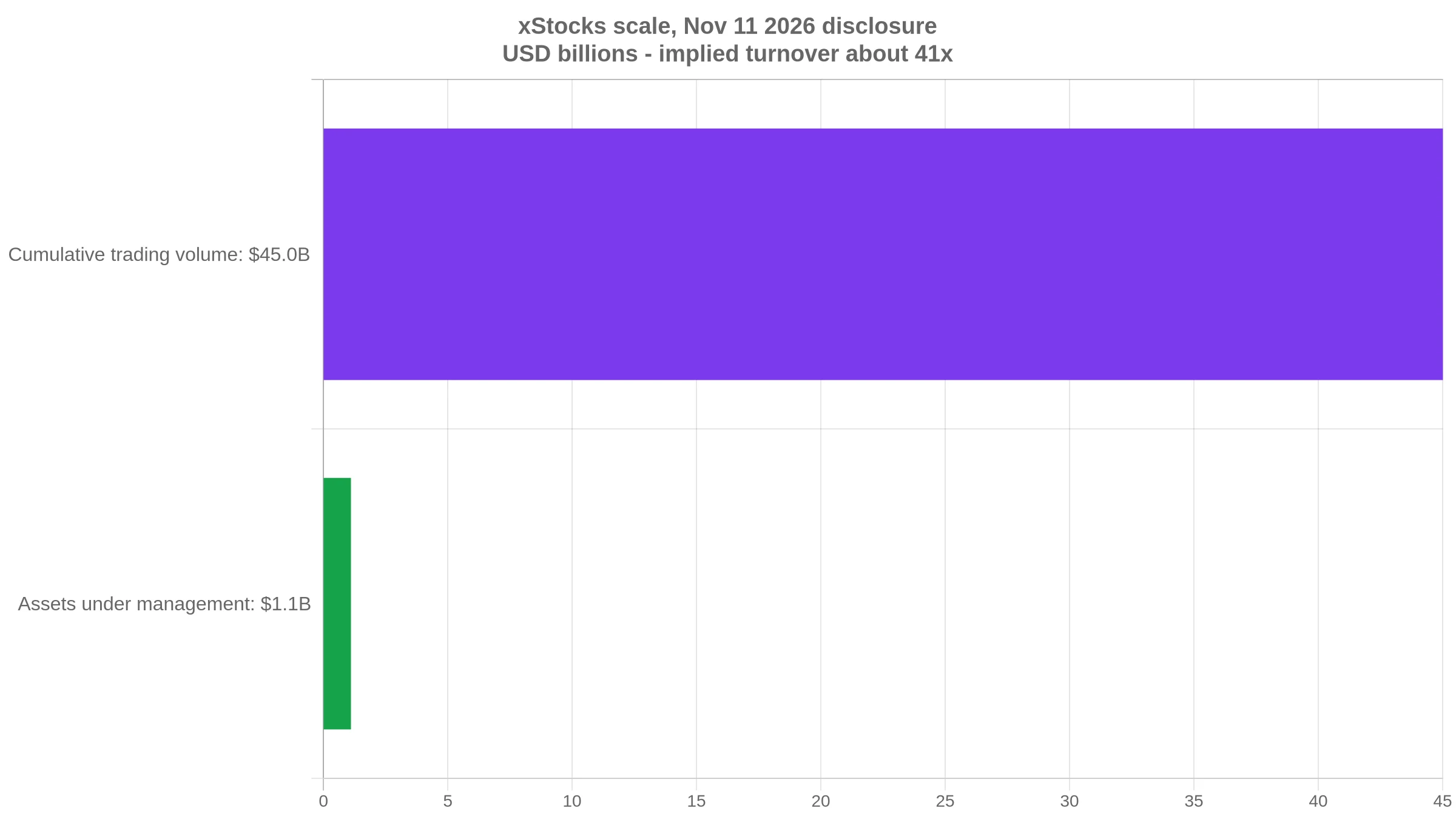
The disclosed figures allow a few calculations Payward did not publish. Cumulative volume of $45 billion against $1.1 billion of assets under management implies turnover of roughly 41x. Assets under management divided by 1,500 tokenized assets implies an average of about $733,000 per listed instrument. The same $1.1 billion spread across 550,000 holders implies an average balance near $2,000.
Read together, those ratios describe a trading and collateral instrument rather than a savings product. A framework whose cumulative volume runs 41 times its asset base is being used to move exposure, not to warehouse it, and an average holder balance of about $2,000 is retail-sized rather than institutional. That profile fits the product’s stated uses: trading on Kraken, collateral in DeFi, and settlement outside bank hours.
Every one of those ratios is built on lower bounds, because Payward disclosed “more than” and “over” rather than exact figures, and because assets under management includes the US stocks, ETFs and IPO tokens that predate this batch. The 200 European names are roughly 13% of the asset count, but their share of assets under management is undisclosed, so the revenue and flow contribution of the new batch is unknown. So is the split between tokens held on Kraken and tokens sitting in self-custody or DeFi contracts, which is where the collateral use case would show up.
The scale question also has a market-structure answer that the release does not address. Tokenized equities compete for the same order flow as contracts for difference, American depositary receipts and the overnight venues that already trade non-US names outside local hours. A 24/7 token is a different wrapper on that demand, not necessarily new demand. What distinguishes it is the settlement rail and the composability inside DeFi, and neither has produced public volume data by geography yet.
Hong Kong next, and the tests that would settle the case
Payward says hundreds of Hong Kong-listed equities will follow in the coming weeks, with further international markets after that. Asia is the harder test than Europe. The open question is whether Hong Kong’s rules on intermediaries and its clearing arrangements for listed shares can accommodate a token wrapper on the same terms as a London execution partner and a Liechtenstein prospectus did. Europe’s batch leaned on GTN’s brokerage footprint and an FMA-approved prospectus that classifies the token as a tracker certificate; the Asian leg would need comparable scaffolding market by market.
Several observable events will settle whether this launch is a structural shift or a pilot that scaled sideways. The Hong Kong batch, if it arrives in the stated window, would show the GTN-led model travels. A decision on the LSE 24 listing would show whether a major exchange is willing to trade the token wrapper alongside the share. The base prospectus expires on May 7, 2027, and its renewal is the next hard legal checkpoint.
The disclosure gap is the fourth test, and the cheapest for Payward to close. Publishing European assets under management, creation and redemption flows, and the share of tokens held in DeFi contracts would let the market measure the order-book claim instead of taking it on faith. Until then, the strongest verified facts are the ones in the announcement and the prospectus: 200+ tokenized European listings, more than 1,500 assets in total, $1.1 billion of assets under management, $45 billion of cumulative volume, and a UK equity market that investors in 110+ markets can now hold onchain while investors in Britain cannot.