

Ava Labs said on Nov. 9 that Avalanche will provide the core ledger technology to the clearing firm of the NYSE-affiliated digital alternative trading system now in development, making the blockchain the layer that records and settles trades in tokenized equities if the platform clears its regulatory approvals.
The disclosure came in a Nov. 9 announcement from Ava Labs , issued from New York. It separates two jobs that tokenization pitches usually bundle together: issuing a tokenized share on some chain, and settling a trade in that share on a ledger both counterparties trust. Avalanche has been handed the second job for a venue that does not yet have a launch date.
That assignment is new. In September, Avalanche was still a leading candidate for the NYSE-affiliated platform after ICE executive Michael Blaugrund said the network checked many of the boxes the exchange group was weighing, and the arrangement at that point did not amount to a signed deal. The Nov. 9 release turns a public signal into a named technology role at the clearing firm.
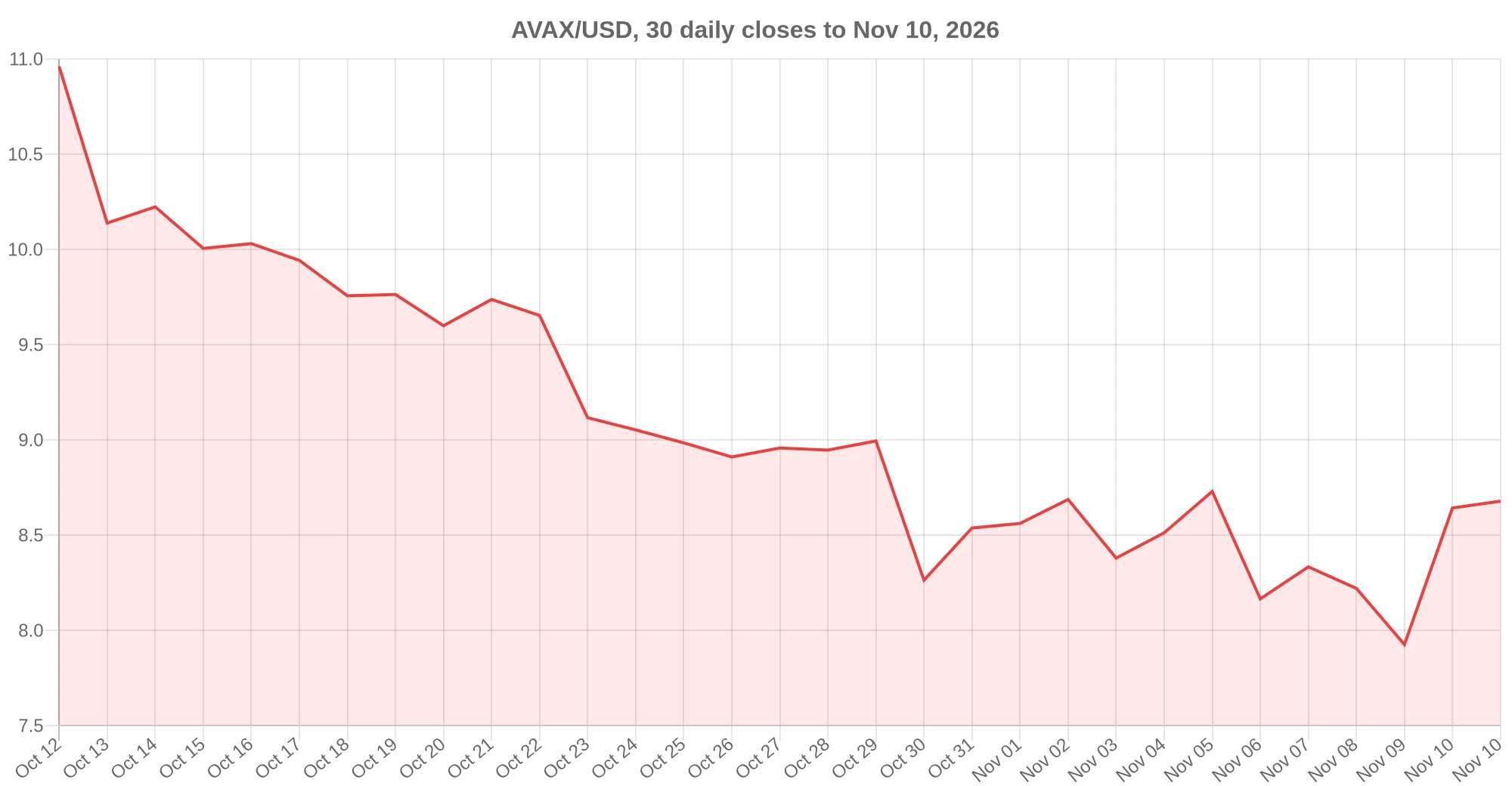
Avalanche’s native token traded at $8.68 at 00:50 UTC on Nov. 10, up 8.8% in 24 hours and 3.6% over seven days, with a market value of $3.87 billion against $521.8 million of daily volume, according to CoinGecko . The token is 94.0% below its November 2021 high of $144.96.
NYSE has said its affiliate is building the platform for the trading and onchain settlement of tokenized securities. Ava Labs’ role is narrower than owning that venue, and more specific than a logo partnership: the company supplies the ledger its clearing firm will run on.
What Ava Labs Is Actually Supplying
The customer named in the release is not the exchange. It is “the platform’s clearing firm,” which will use Avalanche as core ledger technology. That distinction matters because a clearing function carries obligations an issuance chain does not: matching both legs of a trade, establishing finality, and holding a record that survives a counterparty failure.
Ava Labs founder and chief executive Emin Gün Sirer described the requirement in operational terms. “It will support the platform’s 24/7 atomic settlement needs with dedicated infrastructure with predictable performance and costs, the control to meet its regulatory and operational requirements, and connectivity to a broader ecosystem of assets and liquidity,” he said in the release.
Read that list closely and three design choices appear. Settlement is described as atomic, meaning the two legs of a trade are designed to complete together rather than through a sequencing of promises. Performance and cost are described as predictable, which is a capacity commitment rather than a throughput record. And participation is controlled, which points to a permissioned validator or access set rather than an open network where anyone can write blocks.
The release does not specify which of Avalanche’s components the clearing firm will use, how validators are selected, or what the platform’s fee schedule looks like. Those are the details that would turn a technology designation into an operating system for a market.
The Settlement Ledger Is the Part NYSE Chose to Outsource
NYSE’s own framing puts the choice in plain terms. “At the NYSE, we’re looking at how blockchain technology can expand what we offer in equities, and we’re picking the right technology for each job,” said Dennis Lee, the exchange group’s head of digital issuance.
Lee then described the split that the architecture has to satisfy. “The upcoming digital trading platform will support equities listed on a range of blockchains, though the ledger that records and settles trades needs to be fast and reliable, let us control who can take part, keep costs predictable, and have a large community of developers behind it,” he said. “Avalanche meets all those needs.”
That is a multi-chain issuance model with a single settlement ledger at the center. A tokenized share could originate on another network, but the trade in it is recorded and settled on Avalanche. For readers tracking which chains “win” tokenized equities, the announcement is a reminder that the answer can be several chains at once, with a different chain holding the books.
It also shifts the standard for judging the deal. A venue does not need Avalanche to host the asset. It needs Avalanche to be the place where two parties stop disagreeing about who owns what.
Ava Labs’ Client List Has Been About Products, Not Venues
The release’s own company description lists JPMorgan Chase, Apollo, FIFA and the state of Wyoming among organizations working with Ava Labs, and it notes the firm is backed by Andreessen Horowitz. Those are substantial names, but most of the public work behind them has been product-shaped: a tokenized fund, a pilot, an issuance, a closed set of participants.
The company’s release makes that contrast explicit, arguing that blockchain work in capital markets has largely centered on individual products and limited pilots, and that operating next to a market operator demonstrates something different.
There is a real difference in failure modes, and it is the reason this announcement deserves more attention than a pilot. A tokenized fund can be unwound by its sponsor if the plumbing breaks. A settlement ledger inside a trading venue cannot. If it stalls, trades do not settle, and the venue’s subscribers carry the exposure. That is why clearing firms tend to buy redundancy and contractual performance guarantees rather than the cheapest block space, and why “predictable costs” appears in the vendor’s quote rather than in a marketing headline.
The Tokenized-Equity Stack Is Arriving in Separate Pieces
This deal is one component of a build-out that has been moving in public for months. On Oct. 28, DTCC’s tokenization service went live with 34 securities and 20 Wall Street firms , putting post-trade processing onchain for a defined set of instruments. Days later, Securitize expanded its onchain U.S. stock offering to 25 equities on Solana , taking the issuance side to a different network.
Put the three together and the outline of a market appears: issuance on one or more chains, settlement on another, and a clearing intermediary in between that has to reconcile both. That reconciliation is where interoperability claims get tested, and it is the part of the stack that no single announcement settles.
Avalanche’s position in that outline is now defined but not yet operating. The platform’s subscriber list, order types, trading hours outside U.S. sessions and cross-chain asset handling all remain undocumented in public materials, and each one changes how much the ledger actually has to do.
AVAX Is 94% Below Its 2021 High While the Plumbing Gets Built
The market has not priced this as a franchise win, at least not yet. AVAX traded at $10.96 on Oct. 12 and at $8.68 on Nov. 10, a decline of 20.8% across the period in which the tokenized-equity build-out was being announced piece by piece. Its 24-hour turnover of $521.8 million equals 13.5% of its $3.87 billion market capitalization, a ratio consistent with an actively traded large-cap altcoin rather than a repricing event.
Two readings are available and the evidence does not choose between them. One is that settlement infrastructure is a slow-moving revenue story whose economics accrue to the platform operator and its clearing partner before they reach a token holder. The other is that the market treats institutional ledger wins as unmonetizable for the underlying asset until fee flows are disclosed. Neither reading requires the Nov. 9 announcement to have moved the price, and the release gives no figure that would let a reader calculate what the platform is worth to Avalanche.
The absence of a number is the honest part of the announcement. Ava Labs has described a role, not a contract value. Until the clearing firm, the subscriber count and the fee mechanism are public, any estimate of revenue per trade is a guess dressed as analysis.
What the Announcement Does Not Say
The release does not name the clearing firm, does not give a launch date, and does not describe a regulatory approval timeline. It does not state that AVAX will be used to pay fees on the platform, and it does not commit the platform to Avalanche exclusively for all functions, since NYSE’s own executive describes equities listed across a range of blockchains.
It also does not describe how a tokenized share issued elsewhere would be represented on the Avalanche ledger, which is the technical question that determines whether the venue is genuinely multi-chain or simply multi-issuance with a single settlement rail.
What it does establish is a dated, attributable commitment from two named parties: Ava Labs will supply core ledger technology, NYSE’s head of digital issuance says the ledger meets the venue’s requirements, and the platform remains subject to approvals. Those three facts are the floor. Everything above them is projection.
Frequently Asked Questions
No. Avalanche is supplying core ledger technology to the clearing firm of an NYSE-affiliated digital trading platform that is still in development and subject to regulatory approvals. The exchange’s existing equities market is not part of the arrangement described on Nov. 9.
No launch date has been announced. Ava Labs said the platform is subject to applicable regulatory approvals, and neither the release nor NYSE’s quoted executive gave a timeline.
Avalanche, according to Ava Labs. The release says Avalanche provides the core ledger technology to the platform’s clearing firm, and NYSE’s head of digital issuance described that ledger as the layer that records and settles trades even when equities are listed on a range of blockchains.
The announcement does not say that. It describes Avalanche as the ledger for clearing and settlement but does not disclose a fee mechanism, revenue split or any direct claim on the token. AVAX traded at $8.68 at 00:50 UTC on Nov. 10, down 20.8% from its Oct. 12 level.
Tokenized securities, with equities as the stated focus. NYSE’s Dennis Lee said the platform will support equities listed on a range of blockchains, and Ava Labs said the design targets 24/7 trading, clearing and settlement for the platform’s subscribers.
Data: CoinGecko .
This article is not intended as financial advice. Educational purposes only.