



Ethereum destroyed 2,694.17 ETH in the thirty days to November 8, 2026, worth about $6 million at the day’s price, according to ultrasound.money ‘s burn tracker at 20:27 UTC. Annualised, that is 32,779 ETH, or roughly $73 million a year.
Set that against a market capitalisation of $271.98 billion and the arithmetic becomes uncomfortable. On November 8, Vitalik Buterin published a four-post thread arguing that Ethereum should stop treating fee burn as its valuation anchor and start treating ETH as a store of value instead.
Expanding on why I believe “ETH as store of value (SoV)” makes much more sense to focus on than “ETH as fee-burning token”. Three primary reasons: 1. ETH as fee-burning token never was as strong as it seemed. 2. Optimizing for ETH as fee-burning token would demand Ethereum and ETH function in ways that are very hard to make compatible with decentralization and capture resistance. 3. Meanwhile, optimizing for ETH as SoV is aligned with Ethereum focusing on its unique strengths (decentralization and CROPS). EIP-1559 (including its burn) is fine and good, we should keep them.
— vitalik.eth (@VitalikButerin) November 8, 2026
The thread is not a protocol proposal. It is an argument about what ETH holders should be pricing, and it arrives while ETH trades at $2,225.70, down 10.13% over thirty days and 55% below its all-time high, per CoinGecko at 20:25 UTC.
What the net present value argument actually says
The case for a fee-burning token rests on a piece of corporate finance. If an asset pays out a stream of cash, its value is that stream divided by a discount rate. Buterin sets out the formula plainly: “market cap = fees burned / discount rate”.
He then works an example. A token burning $1 billion a year, in stable equilibrium, at a 4% discount rate, implies a $25 billion floor. Anyone who could buy the whole asset below that price and sell just over 4% of their holdings annually would keep their share of the pie intact while beating the market. In theory, the arbitrage closes the gap.
The word that matters is “floor”. A floor is a promise that someone will pay you. And a promise is only as good as the balance sheet behind it.
The burn was never backed by money from outside crypto
Buterin’s first objection is the strongest one in the thread. “In 2021-23, Ethereum burned millions of ETH per year in this way,” he writes. “But here’s the problem: this was never a true floor.”
The reason is where the fees came from. Most of that burn was crypto-internal activity. If ETH had fallen tenfold, the profits funding those fees would have fallen with it, because the people paying were holding the same asset. “The floor argument only works if the backing of the revenue stream is external,” he writes.
He points to the extreme case to make the point land: an event he calls “that infamous $180m-fees-burned-in-one-day digital monkey sale”. A one-day burst of that size was demand for a specific product, not a durable cash flow, and it was funded by the same speculative pool it enriched.
His concession is that the mix has changed. “Today, Ethereum actually has a better claim to this external backing, because of the growing RWA economy,” he writes, before adding the counterweight: “perhaps precisely because it’s a normal stable mature business, it’s not going to randomly go crazy and burn $180m on a digital monkey sale.” External revenue is stickier.
But it does not arrive in bursts large enough to anchor a valuation. That is the distinction the thread turns on, and it is the one most of the fee-burn debate skips.
Run the numbers and the gap is 149 times
This is where the argument stops being philosophical. Take Buterin’s own framework and apply today’s data to it.
At a 4% discount rate, a $271.98 billion market cap implies annual fee burn of $10.88 billion. At $2,225.70 per ETH, that is 4.89 million ETH burned every year, or 4.00% of the 122.20 million ETH in circulation. Ethereum’s actual trailing thirty-day pace, annualised, is 32,779 ETH, or 0.027% of supply.
The market is pricing a floor roughly 149 times larger than the burn currently supports. Put another way, the burn-based floor implied by today’s activity is $1.82 billion, which is 0.67% of the market capitalisation it is supposed to justify.
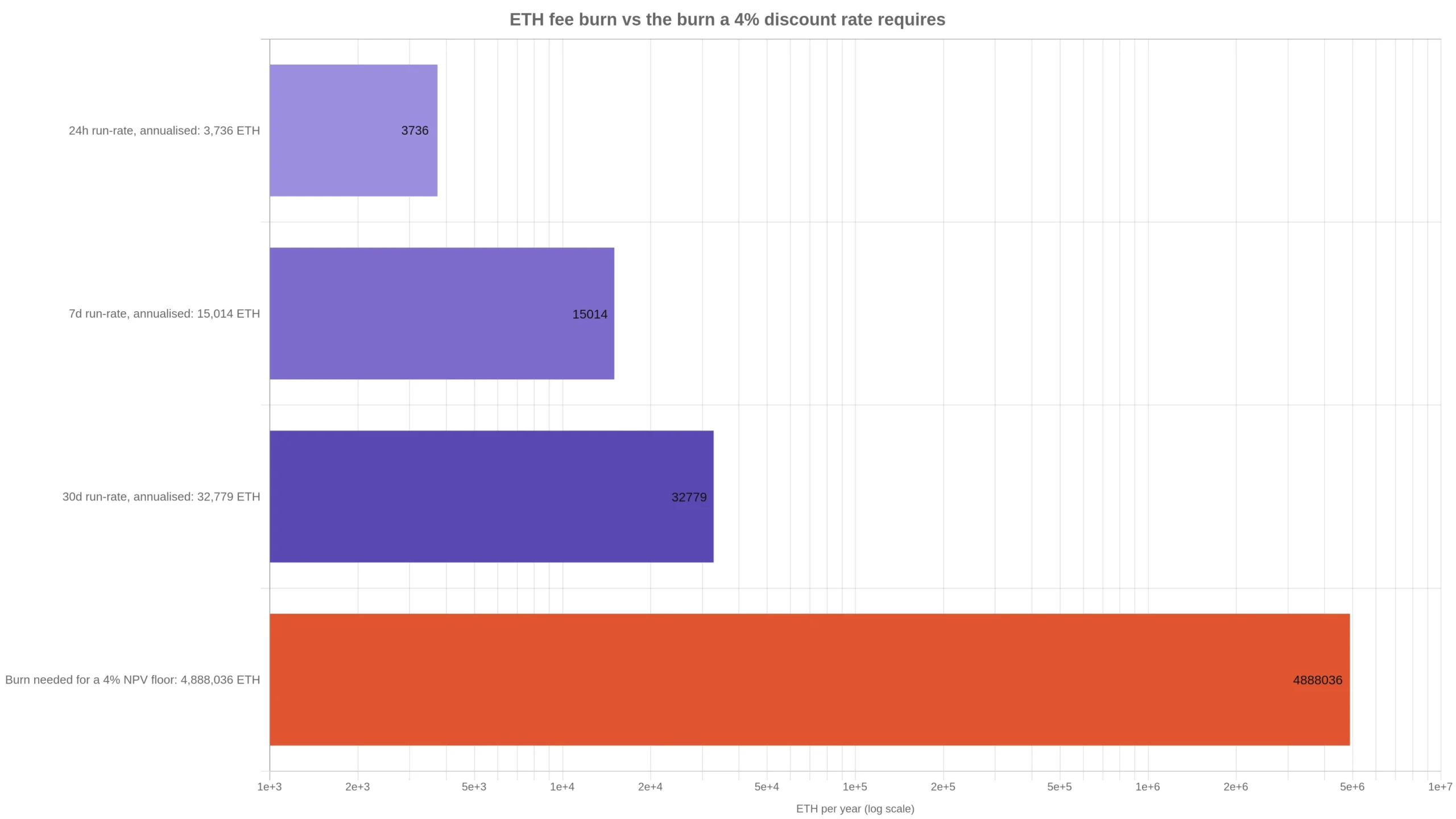
Chart: ETH burned per year at three run-rates against the burn a 4% discount rate requires. Data: ultrasound.money burn-sums API at 2026-11-08 20:27 UTC; market capitalisation from CoinGecko at 20:25 UTC. The x-axis is logarithmic, so equal distances represent multiples, not equal amounts.
| Metric | Value | Source |
| ETH burned, last 30 days | 2,694.17 ETH ($6.0 million) | ultrasound.money, 2026-11-08 20:27 UTC |
| Annualised at that pace | 32,779 ETH ($72.96 million) | Calculation from the above |
| ETH price and market cap | $2,225.70 and $271.98 billion | CoinGecko, 2026-11-08 20:25 UTC |
| Burn needed for a 4% floor | $10.88 billion, or 4,888,036 ETH a year | Calculation from the above |
| Required burn as share of supply | 4.00% a year | Against 122.20 million ETH circulating |
| Actual burn as share of supply | 0.027% a year | Calculation from the above |
| ETH burned since EIP-1559 | 4,643,511 ETH ($10.34 billion) | ultrasound.money, since 2021-08-05 |
| ETH burned since the Merge | 2,020,202 ETH ($4.50 billion) | ultrasound.money, since 2022-09-15 |
The historical line makes the same point from the other direction. Since EIP-1559 activated on August 5, 2021, Ethereum has burned 4,643,511 ETH, an average of about 882,000 a year. That average is 26.9 times today’s run-rate. The burn did not fall because Ethereum stopped working. It fell because the fee market normalised once the 2021 and 2022 demand waves passed.
What it would cost to run Ethereum like L’Oreal
Buterin’s second objection is about what a real cash-flow valuation would demand from the protocol. He is precise about the benchmark. “If we decide we actually want to optimize ETH for burning fees to justify a present-day ~$270B market cap, then Ethereum would essentially be functioning as a world-scale major corporation – it would be somewhere around L’Oreal (#55).”
His figure for that comparison is 0.58% of market capitalisation a year on research and development, which he says “would bankrupt the EF almost immediately”. Converting it: at $271.98 billion, 0.58% is $1.58 billion, which buys 700,000 ETH at today’s price. That is 0.573% of the circulating supply every year, routed through protocol funding rather than voluntary grants.
Buterin’s own arithmetic is that this would “cut validator revenue by 2/3”. Taken at face value, it implies total validator revenue of about 1.05 million ETH a year, or $2.34 billion, before a single dollar goes to anything other than research.
He adds the second half of the corporate analogy: governance. Surviving new technology waves, in his framing, requires “highly interventionist governance, for the long term”. Both requirements, he writes, are “far from conducive to optimizing capture resistance and decentralization”.
Why maximising the burn targets the wrong users
There is a distributional point buried in the thread that is easy to miss. “Optimizing for fee burning means optimizing for high gas prices to some degree,” Buterin writes.
That is a statement about who gets priced out. He names them: “some users who may need privacy and security the most.” A chain that maximises burn is a chain where the marginal transaction is the most expensive one, and the users most dependent on a cheap, private transaction are the ones who leave first.
The trade-off he describes is not between high and low fees. It is between a price that maximises revenue per transaction and a price that allows as much usage as the network can safely carry. Those two objectives pull in opposite directions, and protocol design has to choose.
What CROPS is meant to price instead
Buterin’s alternative is a different valuation metric, not a higher one. He argues that Ethereum’s distinctive assets are decentralization and “CROPS”, which he expands as “censorship and capture resistance, open source, privacy and security”.
His test for a store of value is blunt. “And what is the first and most important SoV-ish metric? To survive.” He then lists what survival looks like in engineering terms: conservative cryptographic tradeoffs, partial ossification, a high bar before accepting new precompiles or in-protocol rewards, multisig improvements, private holdings, and censorship-resistant inclusion.
He also makes a case aimed at institutions rather than ideologues. “For individuals, privacy is often viewed as an abstract ideology. For institutions, it’s prudent risk management, data protection law compliance, and a number of other things.” That is the commercial bridge: the same property can be sold as an ideology to one buyer and as compliance to another.
What the thread does not change
Buterin is explicit that EIP-1559 survives. “EIP-1559 (including its burn) is fine and good, we should keep them.” Nothing in the thread proposes removing the burn, changing the issuance curve, or altering validator economics. No EIP number is attached, no fork is scheduled, and no governance vote is open.
That distinction matters for anyone reading the thread as a policy signal. A co-founder’s post is a statement of preference. It is not a roadmap commitment, and Ethereum’s upgrade path is set through EIP review and the all-core-developers calls, not through social posts.
The market data refuses to cooperate with either story. At 20:25 UTC, ETH was down 0.19% over twenty-four hours and 1.39% over seven days. By 22:43 UTC the same CoinGecko series showed $2,120.58, down 4.97% over twenty-four hours. Measured against Bitcoin at $74,288, ETH sits at 0.02855, below the 0.0295 cited in this morning’s ETH/BTC reading . The ratio moved; the thread, public since 12:06 UTC, does not on its own account for a same-day slide of that size.
Signals that would settle the argument
The thread is testable, which is more than most narrative arguments manage. Three readings would settle it.
First, the burn run-rate. If fee burn sustains above 100,000 ETH a year for two consecutive quarters, the “crypto-internal only” critique weakens, because that level requires fee-paying demand beyond speculative bursts. If it stays in the 30,000 to 40,000 range, the critique holds.
Second, the share of fees coming from tokenised real-world assets. Buterin’s own concession is that external backing is what makes a floor real. A rising RWA share of gas spend is the measurable version of that claim, and it is the one number that would move the NPV case without a price rally.
Third, what happens to gas pricing in the next upgrade cycle. The Glamsterdam gas audit now under way tests whether repricing can be done without breaking invariants. If that work lowers the cost of ordinary transactions, it will also lower the burn, which is exactly the trade-off Buterin says he prefers.
The one thing the arithmetic rules out is the comfortable version of the bull case. ETH at $2,225.70 is not being valued on its fee burn, and at a 0.027% annual burn rate it cannot be. Whatever holds the $271.98 billion market capitalisation up, it is not the $73 million a year the network is currently destroying.
Disclosure: This article does not represent investment advice. The content and materials featured on this page are for educational purposes only.