


The European Commission announced an EU Crypto Sanctions Task Force on 6 November 2026, saying the new body will strengthen the bloc’s ability to detect and act on crypto routes used to get around EU sanctions. It followed the tenth meeting of the High-Level Expert Group on Union Restrictive Measures in Brussels, which Commissioner Maria Luís Albuquerque chaired on 5 November, with the European Anti-Fraud Office (OLAF) taking part in the discussion ( Commissioner Albuquerque’s statement ).
“That is why I am pleased to announce the launch of the EU Crypto Sanctions Task Force,” Albuquerque said, describing it as “an important step in strengthening our capacity to detect and tackle attempts to circumvent EU financial sanctions through crypto assets.”
The Commission published no mandate, budget, staffing plan, legal instrument or start date alongside that sentence. Under the EU’s division of labour, member states investigate suspected breaches and set the penalties, while the Commission monitors whether the 27 apply restrictive measures consistently and issues guidance ( Commission overview of EU sanctions ). A task force announced without those details is first a coordination decision, and only later an operating agency.
What the tenth meeting actually covered
The Commission’s preview of the meeting listed three morning agenda items: emerging threats in the financial sphere, “such as the use of crypto assets to circumvent sanctions”; OLAF’s investigative work on circumvention, which the anti-fraud office presented to member states; and a review of how consistently national authorities enforce the same rules ( Commission preview of 5 November ).
In the afternoon, EU Sanctions Envoy David O’Sullivan convened the eighth Sanctions Coordinators Forum with partners from the United Kingdom, the United States, Japan, Canada, Australia, New Zealand, South Korea, Liechtenstein, Norway, Switzerland, Iceland and Ukraine. That is twelve delegations in one room, and it is the coalition the crypto task force would have to work inside if it is to reach wallets and venues outside the EU’s jurisdiction.
Albuquerque framed the enforcement problem in terms of fairness between member states rather than of new prohibitions. “We cannot allow loopholes, uneven enforcement or circumvention to undermine our collective efforts,” she said, adding that uniform application is what keeps pressure on Russia credible.
The High-Level Expert Group is a forum, not a rule-making body. Its output is coordination and advice, and the 6 November statement describes discussion rather than decisions. Nothing in it changes what EU operators are legally obliged to do.
Twenty-one packages, and a 106-day gap
The Council adopted the 21st sanctions package on 23 July 2026, a package whose measures reached crypto networks that Brussels linked to Russian value flows ( BlockchainReporter’s coverage of the 21st package ). The task force announcement came 106 days later, a gap that matters because the legislative work and the enforcement work run on different clocks. Drafting a package takes months of unanimity building; following the money takes analysts, subpoenas and cross-border casework.
Albuquerque made that distinction explicitly. “But adopting sanctions is only the beginning. Their real impact depends on how effectively and consistently we implement and enforce them.”
The Commission’s own economic justification for pressing harder is that the earlier packages are biting. In its 5 November release, the Commission said Russian growth slowed from 4.9% in 2024 to 1% in 2025 and is expected to stay near stagnation in 2026 and 2027. On those figures the slowdown is 3.9 percentage points, or roughly 80% of the 2024 growth rate, in a single year.
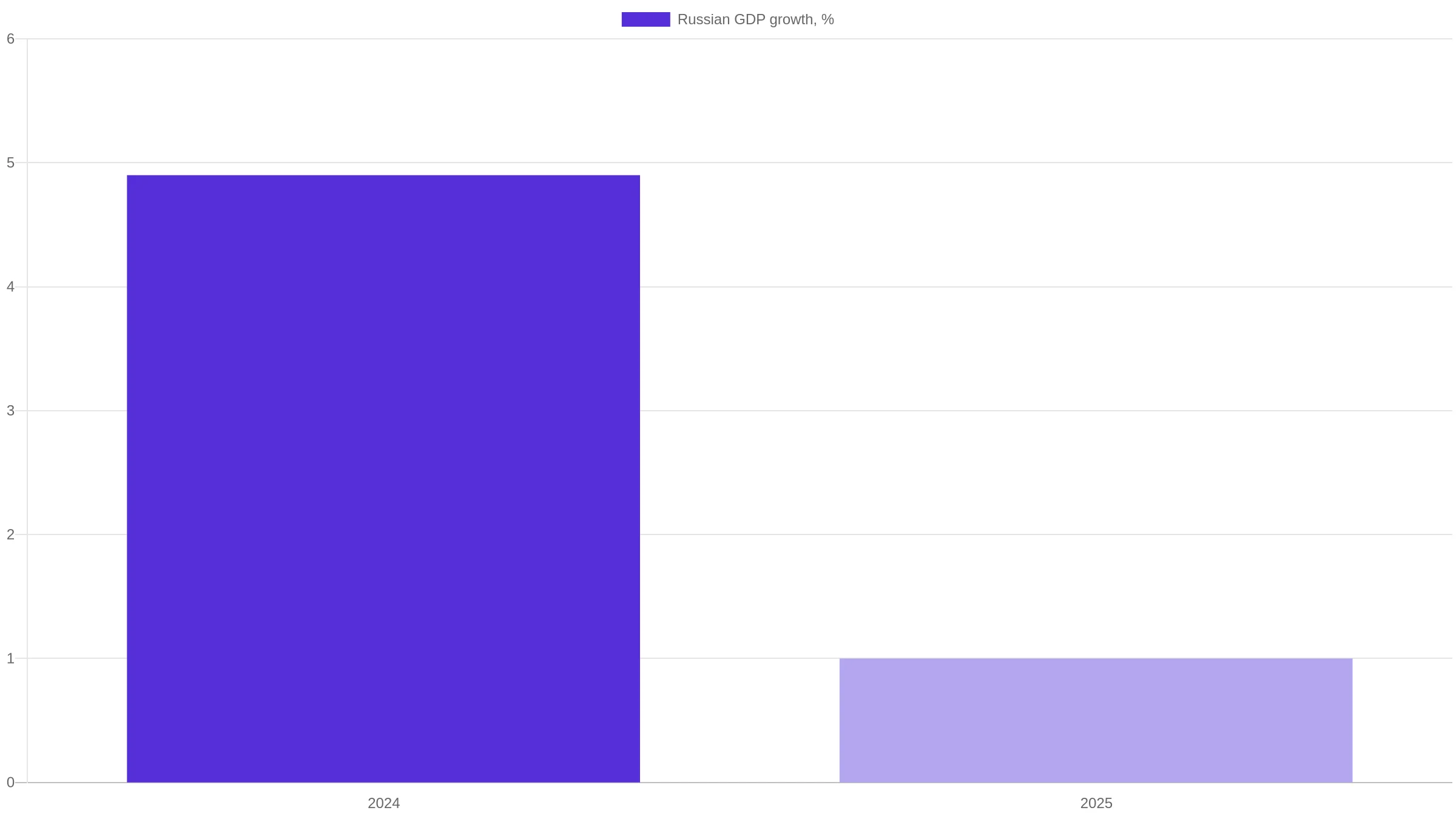
Russian GDP growth as reported by the European Commission on 5 November 2026. The Commission expects near-stagnation in 2026 and 2027.
Where crypto sits in the enforcement chain
The EU operates more than 40 sanctions regimes, and the crypto exposure runs through a short list of chokepoints: exchanges and custodians that hold client assets, wallet providers that custody keys, stablecoin issuers that can freeze balances, over-the-counter desks that settle large transfers off order books, payment processors that convert between bank money and tokens, and the analytics firms that score addresses for banks and venues.
Each of those chokepoints already sits inside an obligation. What has been missing is a single place where a detection from one member state becomes actionable intelligence for the others. Albuquerque described the task force as a capacity problem rather than a legal one. “We know that this is a technically complex and rapidly evolving area,” she said. “We will not allow new technologies or third-country jurisdictions to become safe havens for sanctions evasion.”
The statement does not say whether the task force will run its own blockchain analysis, receive suspicious transaction reports, second staff from national authorities, or act only as a clearing house for cases that member states bring to it. Each option implies a different budget and a different relationship with OLAF, which the Commission says is already investigating sanctions circumvention.
The same week brought a harder instrument from Washington
On the same day, the US Treasury’s Financial Crimes Enforcement Network barred US financial institutions from processing fund transfers for MEXC Global, citing what it described as at least $16.7 billion in transactions tied to sanctions evasion, cybercrime and other illicit activity ( BlockchainReporter’s report on the FinCEN order ). That order has immediate legal effect on US banks and on any institution that clears through them, and it names a specific counterparty.
The EU announcement does the reverse. It names an institution to be built and no target to be cut off. Brussels has not matched Washington this week with a designation of a named exchange, and the Commission’s statement does not refer to the US action at all. The two tracks are converging on the same risk, with different instruments and different timelines, and the EU’s is the slower of the two by design, because enforcement authority here belongs to national capitals.
What changes for exchanges, issuers and users
None of the following is written into the Commission’s statement. It follows from where enforcement attention is now pointed, and operators should plan for it rather than be surprised by it.
Expect more document requests on the source of funds behind transfers that touch Russian-linked addresses, more held withdrawals while a compliance team works through a counterparty, and more demand for travel-rule data from correspondent venues. Expect the cost of that work to fall hardest on smaller licensed firms in the EU, which is one route to consolidation: a mid-sized VASP that cannot staff 24-hour screening may narrow its product set or stop serving higher-risk corridors instead of absorbing the fines.
For users, the practical risk is over-compliance. A lawful resident of the EU with a Russian passport, or a business that traded with Russian counterparties before 2022, can find a transfer frozen while an exchange asks for documents that did not previously exist. Keeping contracts, invoices and tax records for older transfers is the cheapest insurance available, and it is the first thing an investigator asks for.
What to watch, and what has not been said
Five checkpoints will show whether the task force becomes an operating capability or stays a communiqué. First, whether the Commission publishes a mandate that names a legal basis, a head and a budget. Second, whether OLAF seconds investigators into it or merely attends. Third, whether it produces referrals that national authorities act on, since those referrals are the only measurable output a coordination body has. Fourth, whether it aligns with the twelve-partner forum that met the same afternoon. Fifth, whether any EU designation of a crypto business follows, which would move Brussels from coordination to targeting.
The Commission has not said when any of that will be published, and it has not attached a date to the task force’s first working session. Until it does, the announcement is a statement of intent from a commissioner who has now made crypto enforcement part of her sanctions remit.
Frequently Asked Questions
It is a body announced by the European Commission on 6 November 2026 to strengthen the EU’s ability to detect and act on crypto transactions used to circumvent EU financial sanctions, particularly those adopted against Russia.
Commissioner Maria Luís Albuquerque announced it at the close of the tenth meeting of the High-Level Expert Group on Union Restrictive Measures, held in Brussels on 5 November 2026, with the statement published the following day.
No new legal instrument was published with the announcement. Investigations and penalties remain with national competent authorities, and the Commission’s role is to monitor and coordinate consistent enforcement across member states.
Exchanges, custodians, wallet providers, stablecoin issuers, over-the-counter desks, payment processors and blockchain analytics providers that screen transactions for EU-regulated institutions are the businesses most exposed to closer scrutiny.
FinCEN’s 6 November order bars US financial institutions from processing transfers for MEXC Global and names a specific counterparty. The EU measure names no target and creates a coordination body, so its effect depends on cases that member states and OLAF bring to it.
This article is for information only and is not investment advice.