


ZetaChain has put Governance Proposal 2 on chain, and the vote is the last step before the project retires its own Layer 1. If it passes, every ZETA balance is recorded at block 20,755,000 around Dec 9, 2026, the chain halts at that height, and the token is reissued on Solana as a native SPL asset at a one-to-one ratio under the same ticker. Voting closes on Nov 7, three days after the proposal was submitted.
The migration notice published with the proposal is explicit that none of this is settled yet: “Nothing moves until it passes.” For holders the practical question is narrower than the governance language suggests. Anyone holding ZETA in their own wallet has a claim to file, a minimum balance to clear, and a class of positions that cannot be claimed at all unless they are unwound before the snapshot.
The proposal also carries the commercial plan that justifies the move. ZetaLabs, the project’s private AI application for markets, launches on Dec 9 with ZETA as its token, and the company is asking holders to approve the retirement of the chain that has hosted the token since 2024 in order to put the asset inside the ecosystem where that product will run.
What Proposal 2 changes, and what it leaves alone
The vote covers four mechanical changes. The first is the chain: ZetaChain’s Layer 1 is replaced by Solana, and the old network “halts at the same height and is not restarted,” according to the notice. The second is the token standard: ZETA becomes a native SPL token with nine decimals, no freeze authority, and no mint authority once the snapshot total has been minted. The third is staking: validator rewards stop at the snapshot height, and the emissions that would have paid them are burned instead of distributed. The fourth is distribution: a one-time claim through ZetaHub, or automatic conversion on an exchange.
The claim design matters more than it might appear. The snapshot total is minted before the portal opens and the mint authority is then revoked, which means the supply that exists on Solana is fixed at the moment of migration. No third-party bridge is involved, so there is no wrapped asset to redeem and no bridge contract holding the backing. The portal opens on Dec 9 at hub.zetachain.com/migrate, and the process is a signature naming a Solana address rather than a transfer: “No fee, no SOL needed, and never a seed phrase,” the notice states.
Two things stay as they are. ZETA on Ethereum as an ERC-20 token is untouched by this proposal, and vesting schedules keep their original dates. The proposal is a change of chain and of token standard, not a redenomination: the maximum supply stays at 2.1 billion minus whatever has been burned.
The vote closes Nov 7, and a no vote keeps the September decision
The proposal was submitted on chain on Nov 4 and the voting window runs 72 hours, which puts the close on Nov 7. That is a short window for a decision that terminates a network, and the reason it is short is that the direction was already approved. In September, a prior vote endorsed the migration with 99.4% support , and that result set the policy rather than the mechanics. Proposal 68, as the notice calls it, remains the standing direction.
The current ballot is therefore narrower than a referendum on whether to leave. It fixes the date, the block height, the claim rules and the burn schedule. If it fails, the notice says the September direction still stands and ZetaChain “returns with a revised proposal,” with nothing moving on the current terms. Holders are voting on the terms, not on the destination.
That distinction has a practical consequence for anyone waiting to see how the vote goes before acting. A failed ballot would not restart the chain permanently; it would restart the drafting process. The only outcome that cancels the migration outright is a reversal of the September decision, which this proposal does not put to a vote.
Who has to act before the snapshot
Most holders do not need to do anything on Dec 9, and the notice says so directly. The exceptions are concentrated in one group: anyone whose ZETA is held inside a contract. The published rules divide holders as follows.
| Position on Dec 9 | What the published terms say | Action required |
|---|---|---|
| Liquid ZETA in a self-custody wallet | Claim through ZetaHub by signing a message that names a Solana wallet. Minimum 10 ZETA at the snapshot to claim. | Claim from Dec 9 |
| Staked, unbonding or unclaimed rewards | Credited in full at the snapshot. Staking rewards stop at the snapshot height. | None; no unstaking needed |
| ZETA held on an exchange | Converted without holder action. Each venue announces its own conversion window. | Wait for the exchange notice |
| Wrapped or pooled ZETA | “ZETA inside contracts and pools cannot be claimed by a key.” | Unwrap and exit pools before the snapshot |
| ZRC-20 assets bridged to ZetaChain | Claimed back on the original chain from Dec 9, with a $5 minimum per token. | Claim from Dec 9 |
| ZETA on Ethereum (ERC-20) | Not changed by this proposal. | None |
The 10 ZETA floor is small in dollar terms at current prices, roughly 35 cents, but it is a hard threshold rather than a rounding rule. Balances below it are not claimable through the portal according to the published terms. The instruction to exit pools is the item most likely to be missed, because a holder who staked through a liquid staking or vault product may not think of the position as contract-held at all.
What the burns do to ZETA supply
The supply schedule is the part of the proposal with the clearest arithmetic. The notice commits to twelve monthly burns through 2027 of “about 4.6 million ZETA each,” drawn from undistributed validator emissions that would otherwise have been paid to secure a chain that no longer exists. Multiplied out, that is roughly 55.2 million ZETA burned over the year, or about 2.6% of the 2.1 billion maximum supply.
The dollar value of that burn is modest. At $0.03485, the price recorded by CoinGecko at 05:46 UTC on Nov 6, 55.2 million ZETA is worth about $1.92 million, or roughly 41% of the $4.71 million the token traded in the previous 24 hours. A burn of that size is a supply statement rather than a liquidity event, and the notice frames it that way: the emissions are burned “on the schedule they would have been emitted,” so the published release calendar does not change.
The other half of the supply picture is dilution that will not arrive. Purchaser and core contributor vesting completes on Jan 1, 2027, and the notice states that no newly released ZETA will be sold in 2027. Roughly 1.70 billion ZETA, or 81.2% of the 2.1 billion maximum, already circulates, which leaves about 396 million tokens unissued or locked before any burn is applied.
Retiring a Layer 1 to run an AI product
The strategic case in the notice is that a chain built for cross-chain messaging has less value than an application that needs users, payment rails and agent infrastructure, and that Solana already has all three. ZetaLabs is described as a private AI app for markets in which chats, research and memory are encrypted by the user, with one interface drawing on multiple models and live market data. Access can be paid in ZETA, USDC or card, with a ZETA discount and a lock for premium access from the first quarter of 2027.
This is the second migration to Solana that BlockchainReporter has covered in two weeks. Akash Network announced in late October that it would move its chain to Solana, and the pattern is the same: a network with its own validator set concludes that the security budget and the liquidity are better rented than owned. For ZETA holders the trade is explicit. They give up staking yield and a chain they secure, and receive a token that sits inside an application and an ecosystem with deeper markets.
The migration also strands the interoperability business the chain was built for. ZetaChain’s Layer 1 held and moved assets on Bitcoin, Ethereum and Solana without wrapping, and that function ends with the halt. The notice handles the residue with a claims process: any asset still held as a ZRC-20 token at the snapshot can be claimed back on its original chain from Dec 9, with a $5 minimum per token. Holders of those assets are the group with the strongest reason to read the terms before the snapshot rather than after it.
ZETA trades near its record low before the ballot
ZETA changed hands at $0.03485 at 05:46 UTC on Nov 6, down 7.53% in 24 hours and 4.98% over seven days, according to CoinGecko. The market capitalisation was $59.4 million against a fully diluted value of $73.2 million, on $4.71 million of daily volume. The token is 98.8% below its February 2024 record of $2.85, and down 26.3% from $0.04727 on Oct 8.
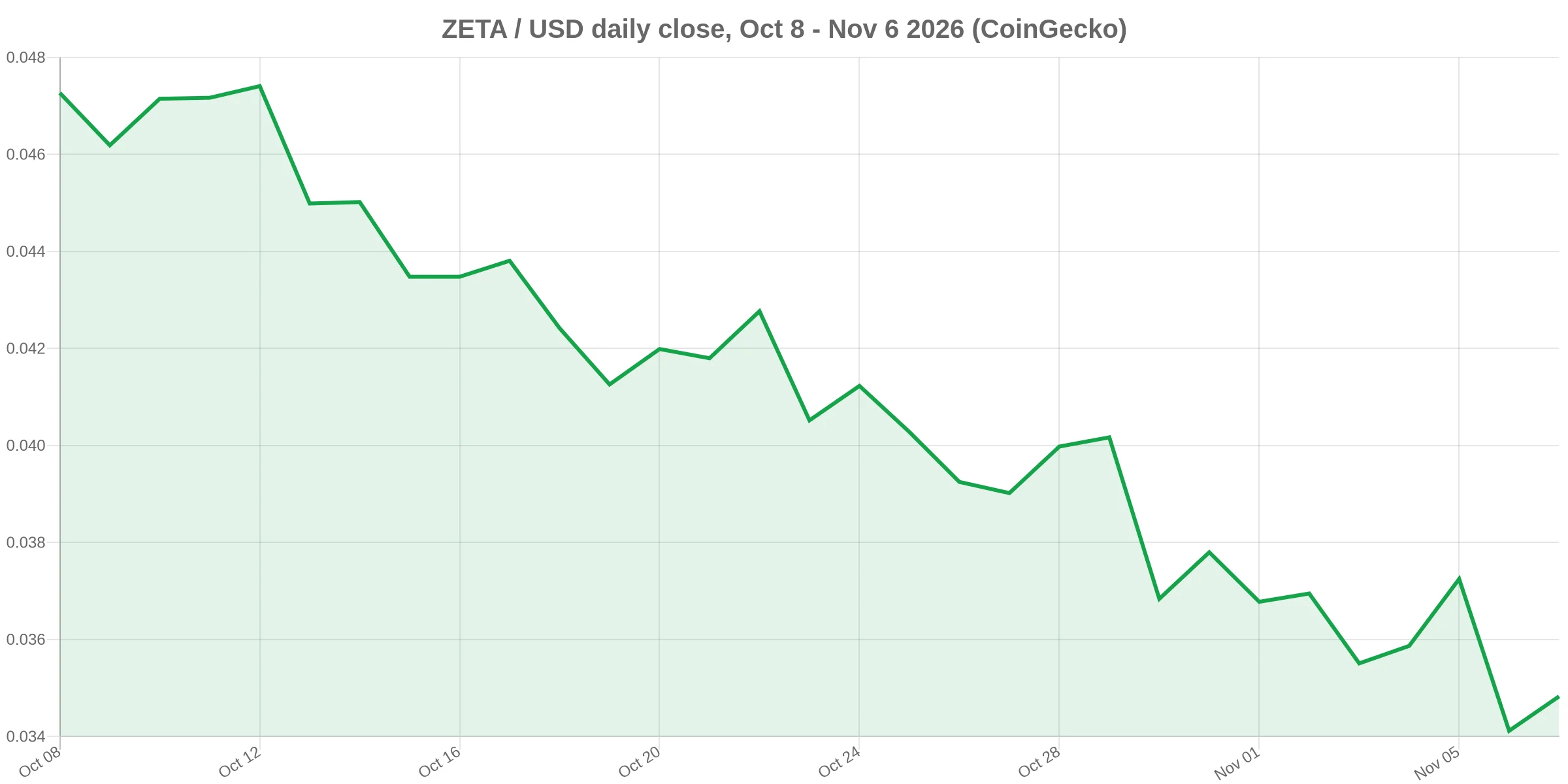
The decline is not specific to ZETA. Bitcoin traded at $75,552, down 6.04% in 24 hours, ether at $2,220.72, down 8.28%, and Solana at $89.24, down 6.95% over the same window. A token with a $59 million market cap and $4.7 million of daily volume will move further than the majors in a risk-off session, and the available evidence does not establish the governance vote as the cause of the move. The vote is a scheduled event that holders can price, not a shock.
What the price does establish is the scale of the decision. The entire ZETA market is now worth less than the $73.2 million implied by its maximum supply, and the migration is being executed at that valuation. The burn schedule that looks small against the 2024 high is a larger share of the float at current prices, and the 10 ZETA claim threshold is a few cents rather than a few dollars.
What has to happen between Nov 7 and Dec 9
Three items sit between the vote and the halt. The first is the security review. The portal and the migration programme are under independent review by Hacken, and the notice commits to publishing the report before the portal opens. The second is disclosure of the SPL mint address and the migration programme address, both promised before Dec 9. The third is the exchange side: each venue sets its own conversion window, and the notice does not name which exchanges have confirmed support or on what timetable.
Those gaps are the ones to watch. A published audit report and a published mint address are verifiable, and a holder can check both before signing anything. Exchange support is not verifiable in advance from the project’s own material, and a holder who leaves ZETA on a venue with no announced conversion plan is relying on that venue rather than on the proposal. The notice recommends no action before Dec 9, and for self-custody holders that is consistent with the mechanics. For exchange holders it assumes the venue executes.
The last open item is the migration’s own success condition. A one-to-one reissue preserves the token count but not the network effect, and the value of ZETA after Dec 9 depends on whether ZetaLabs attracts paying users in its first quarter. The proposal secures the mechanics. It does not secure the demand, and no part of the published material offers a revenue forecast or a user target that would let a holder test the claim.
Frequently Asked Questions
The proposal sets a snapshot at block 20,755,000, expected around Dec 9, 2026. The chain halts at that height and is not restarted, but this only happens if Governance Proposal 2 passes. Voting closes on Nov 7.
No. There is no bridge in the process. Holders claim through the ZetaHub portal from Dec 9 by signing a message that names a Solana wallet, with a minimum of 10 ZETA at the snapshot. The project states the portal never asks for a seed phrase or a transaction.
They are credited in full at the snapshot, including unbonding balances and unclaimed rewards. No one needs to unstake. Staking rewards stop at the snapshot height because the chain that paid them is being retired.
No. The snapshot total is minted before the portal opens and the mint authority is then revoked. About 55 million ZETA of undistributed validator emissions will be burned through 2027 in twelve monthly burns of roughly 4.6 million each, and the maximum supply stays at 2.1 billion less the burned amount.
Unwrap and exit pools before the snapshot. ZETA sitting inside a contract or a pool cannot be claimed by a key, so a holder with a wrapped or vaulted position has to unwind it before Dec 9 or lose the claim path.
The direction approved in the September vote still stands, and ZetaChain says it would return with a revised proposal. Nothing would move on the current terms, including the Dec 9 date and the block height.
Data: CoinGecko , ZetaHub governance . Prices are from 05:46 UTC on Nov 6, 2026.
Not investment advice. ZETA prices and market data are from CoinGecko at 05:46 UTC on Nov 6, 2026. Migration terms are those published by ZetaChain and remain conditional on the governance vote passing.