



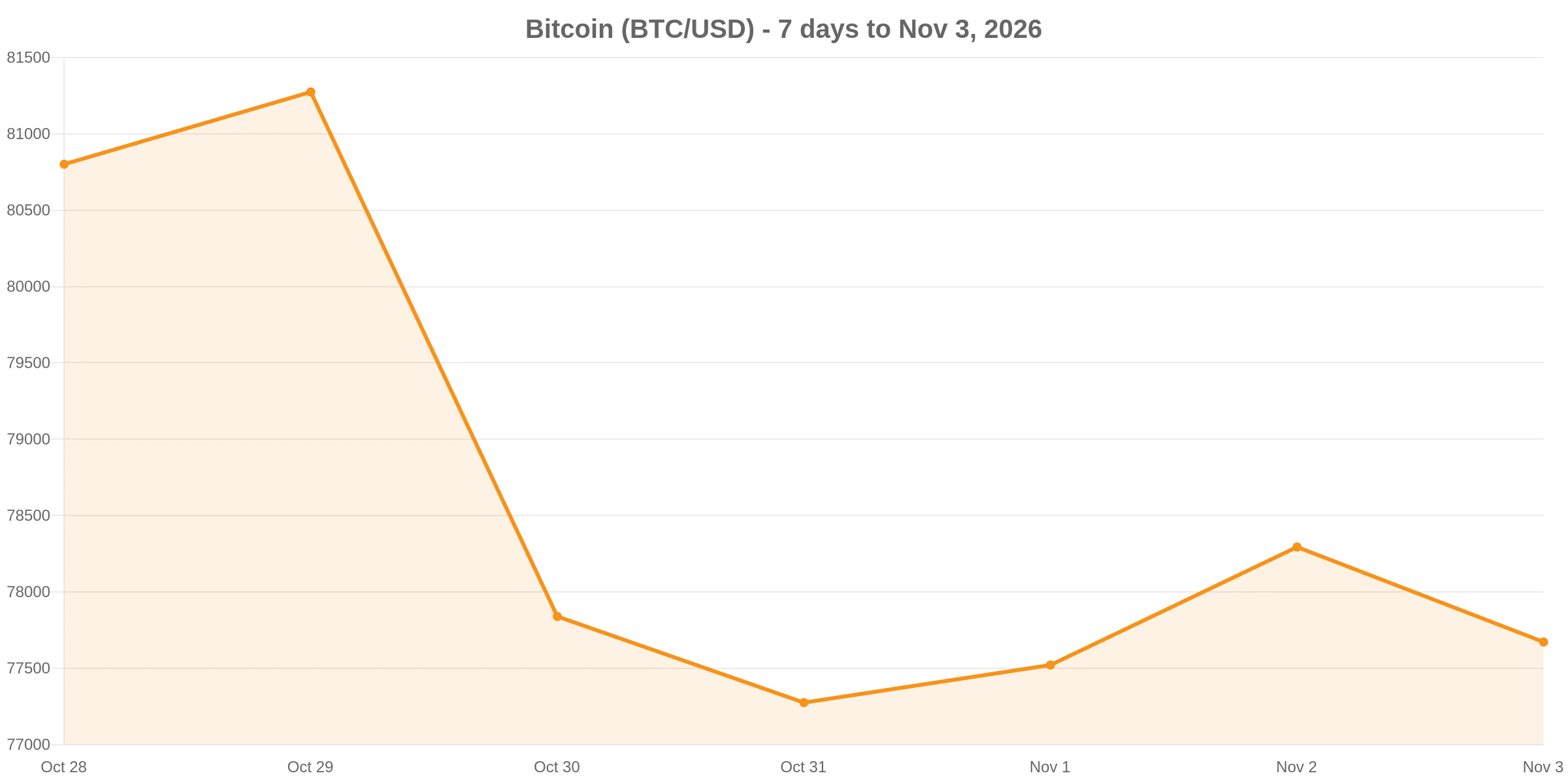
Bitcoin changed hands at $77,262 at 13:26 UTC on 3 November, down 0.35% over 24 hours and still inside the $76,700–$78,300 range it has held since the 30 October Binance hack selloff, according to CoinGecko . The more interesting number belongs to Hyperliquid: the HYPE token is up 9.29% over seven days even as Bitcoin slipped 3.11% across the same window.
The arithmetic is straightforward. A $1,000 position in HYPE on 27 October was worth about $1,093 by 3 November. The same $1,000 in Bitcoin was worth about $969. A buyer asking which crypto to buy this week is looking at two different trades — a steady major and a smaller asset with momentum — and the answer depends on which risk they are being paid to take.
Where the majors stand after the Binance selloff
Ethereum traded at $2,276.91, up a marginal 0.07% on the day and down 1.42% for the week. BNB sat at $698.68, down 5.26% over seven days as Binance worked through the aftermath of the $6.3 billion hack. XRP was the standout among large caps, up 2.43% on the day to $1.28, though it remains down 1.57% for the week. Solana lagged, down 6.94% over seven days to $92.48.
That dispersion — XRP up, BNB and Solana down, Bitcoin flat — is the clearest sign the market is repricing individual catalysts rather than moving as one. Bitcoin’s slide below $77,000 was driven by a semiconductor-led equity rout ahead of the U.S. midterms, not by a crypto-specific shock. The majors have since stabilized even as trading volumes stay light.
The backdrop for the buy-now question is the U.S. midterm election on 3 November and a Federal Reserve whose next rate decision is still being priced. Bitcoin has spent the past two sessions digesting those inputs on top of the Binance outflow data, which is why the tape reads flat even as individual tokens from XRP to HYPE are moving on their own catalysts.
The market-cap math behind Hyperliquid’s 9% week
Hyperliquid’s HYPE token carries a market capitalization of about $20.2 billion, up 9.29% on the week. That is roughly a quarter of XRP’s $80.8 billion and about a 77th of Bitcoin’s $1.55 trillion. The ratios matter for anyone treating this as a best-crypto-to-buy decision rather than a vibes call.
A move back to XRP’s market cap would price HYPE near $337, roughly a 4x from today’s $84.30. Reaching even Ethereum’s $278 billion would imply more than 13x. Those are not predictions — they are the ratios a buyer implicitly underwrites when they choose a smaller asset over a larger, slower one. The trade-off is the same one every small-cap presents: more upside per dollar if the catalyst keeps working, more drawdown risk if it stops.
Framed the other way, a 10x from HYPE’s current size would take it to $202 billion — past BNB and into Ethereum’s neighborhood — while a 2x on Bitcoin requires adding roughly $1.5 trillion of new capital. The first is plausible if buybacks keep compounding; the second is a much heavier lift.
Why HYPE is the coin to watch this week
Hyperliquid’s buyback program is the catalyst behind the move. The protocol routes trading-fee revenue and, since early October, a share of its USDC reserve yield into automatic open-market HYPE purchases, then burns the bought-back tokens rather than redistributing them. Data tracker Strata puts cumulative buybacks at roughly $1.39 billion, including about $63 million of HYPE over the past 30 days, per CoinGecko’s HYPE page .
On 3 November the protocol is expected to distribute about $15.3 million in USDC reserve yield through its AQAv2 mechanism — fresh capital that feeds the same buyback loop. A deflationary buyback is a concrete, dated reason for the weekly outperformance, not a vague altcoin-rotation story. It also explains why HYPE can keep grinding higher in a week when Bitcoin, Ethereum and Solana are all red or flat on the Hyperliquid seven-day tape.
The case for staying with Bitcoin instead
The countercase is equally concrete. Hyperliquid’s 9% weekly gain has already happened; the buyback is a known, mechanical event rather than a surprise. A token that climbs on buybacks can hand those gains back just as fast if platform trading volume cools, because the buyback is funded by the fees that volume generates.
Bitcoin, by contrast, is being repriced around a different set of facts. Tether disclosed it holds about 150,000 bitcoin , worth more than $11.5 billion, adding another large holder to a market that already counts Strategy’s multi-billion-dollar treasury. Those positions do not guarantee a rally, but they raise the cost of a sustained selloff. The honest framing is a choice between momentum that is already visible and accumulation that is still building.
Frequently Asked Questions
Bitcoin is trading inside a two-week range after the Binance hack selloff, with Tether’s 150,000 BTC disclosure and the U.S. midterms acting as near-term catalysts. The seven-day tape is still slightly negative at minus 3.11%, so the answer depends on time horizon rather than any single level.
Hyperliquid’s fee-funded buyback program is the main driver. The protocol buys HYPE on the open market using trading-fee revenue and USDC reserve yield, then burns the tokens. Cumulative buybacks of roughly $1.39 billion and a $15.3 million reserve-yield distribution on 3 November are supporting the move.
A price near $337 is the arithmetic result if HYPE’s market capitalization rose to match XRP’s roughly $80.8 billion. That is a 4x ratio, not a forecast, and it would require buyback-driven demand to persist while broader crypto sentiment stays constructive.
Bitcoin and Ethereum remain the most liquid assets and carry the least single-project risk. Smaller tokens such as HYPE offer more upside per dollar but a deeper drawdown if their specific catalyst, in this case platform volume and buybacks, weakens.
Note: prices and market-capitalization figures are from CoinGecko as of 13:26 UTC on 3 November 2026 and change constantly.
Disclosure: This article does not represent investment advice. The content and materials featured on this page are for educational purposes only.