




Bitcoin traded near $81,347 on Thursday, October 22, down 3.9% over 24 hours, after sliding from a 24-hour high of $84,778 to an intraday low of $80,989, according to CoinGecko data. The selloff is not one story but three running at once: Brent crude jumped above $111 a barrel on reports that the United States and Israel have drawn up plans for renewed strikes on Iran, Meta and Tesla earnings revived doubts about how much companies are spending on artificial intelligence, and the resulting risk-off move forced leveraged bitcoin longs out of their positions.
Bitcoin’s market capitalization sat near $1.64 trillion at the low point, with 24-hour trading volume of roughly $34 billion. Ethereum fell harder, down 4.0% to about $2,392, while most large-cap alternatives tracked bitcoin lower. The drop erased much of Wednesday’s recovery, when bitcoin approached $85,000 before sellers stepped back in.
Three Pressures, One Selloff
The clearest way to read the day is as three separate pressure points that landed within hours of each other. The first is energy: Brent crude futures rose as much as 3.3% to $112.37 a barrel on Thursday morning after The New York Times reported that U.S. and Israeli militaries have drawn up plans for a “short but intensive” operation against Iran after the November 3 midterm elections, citing unnamed U.S. officials. Higher oil prices revive the inflation trade, which pushes back the date at which the Federal Reserve can be expected to cut rates, and bitcoin has spent the past two years trading like a long-duration risk asset.
The second pressure is the technology sector. Meta reported third-quarter results on October 21 with revenue of $64.60 billion, up 26% year over year, but capital expenditures of $34.91 billion for the quarter and full-year 2026 capital-spending guidance of $135 billion to $145 billion. Free cash flow turned negative at $2.12 billion. Tesla, reporting the same day, cut its 2026 capital-spending forecast in its 10-Q to “in excess of $20 billion” from more than $25 billion, after spending $4.73 billion in the quarter against roughly $7.5 billion that analysts expected. The message the market took from both: the AI buildout is either too expensive to keep funding or too uncertain to keep betting on, and tech shares sold off in response.
The third pressure is leverage. Bitcoin’s slide from $84,778 to $80,989 took out a dense cluster of long positions that had piled in during Wednesday’s rally, and the cascade of forced selling deepened the move in the overnight hours. The drop in open interest on major exchanges through Thursday morning was consistent with longs being closed or liquidated rather than new shorts pressing the market.
Oil Above $111 Reopens the Inflation Trade
Brent crude settled into a range around $111 to $112 a barrel on Thursday, with West Texas Intermediate near $99. The trigger was a report that planning for a renewed strike campaign is progressing, even though it is not certain the plans will be approved. President Donald Trump said the United States is “not negotiating with Iran” and that “something will happen fairly soon,” which traders read as a signal that the oil premium is not about to disappear.
For bitcoin, the transmission runs through rates. Sustained oil above $110 keeps headline inflation elevated and gives the Federal Reserve less room to ease. The counterweight on Thursday was flow: U.S. spot bitcoin ETFs absorbed roughly $524.8 million on Wednesday, per Farside Investors data, which is why the decline looks more like a positioning flush than a collapse in demand. Spot buying and leverage liquidation are both visible in the same day’s tape.
Meta and Tesla Reframe the AI Trade
Meta’s own framing was confident. “Our investments are paying off, the core business is strong, and we’re seeing velocity across the board,” founder and chief executive Mark Zuckerberg said in the company’s third-quarter results . The market focused instead on the numbers behind that sentence: costs and expenses up 68% year over year and capital spending guidance that keeps rising.
Tesla’s cut drew the sharper reaction because it read as a retreat from the AI narrative itself. “Lower capex suggests less of an ‘all-in’ approach to the AI arms race than one would expect from Elon,” Ryan Lee, senior vice president of product and strategy at Direxion, told Bloomberg. Tesla’s 10-Q also confirmed it still holds 11,509 bitcoin at an acquisition cost of $386 million, carried at a fair value of $962 million as of September 30. That holding has appreciated sharply this cycle even as Tesla holds rather than adds, a detail that ties the AI selloff back to bitcoin through Tesla’s bitcoin position .
Here is the arithmetic that makes the tech move matter for crypto: Meta’s single-quarter capital spending of $34.9 billion is roughly 1.7 times Tesla’s newly lowered full-year 2026 floor of $20 billion. When the companies that anchor the AI trade start spending less or disappointing on returns, the risk premium rises for every speculative asset that trades in the same risk bucket as tech equities, and bitcoin now trades with a high correlation to the Nasdaq.
Where Bitcoin Could Find a Floor
From the 24-hour high of $84,778 to the low of $80,989, bitcoin gave up $3,789 per coin. Multiplied across roughly 20.1 million coins in circulation, that is about $76 billion in market value erased between the session’s peak and trough before the partial recovery back above $81,000.
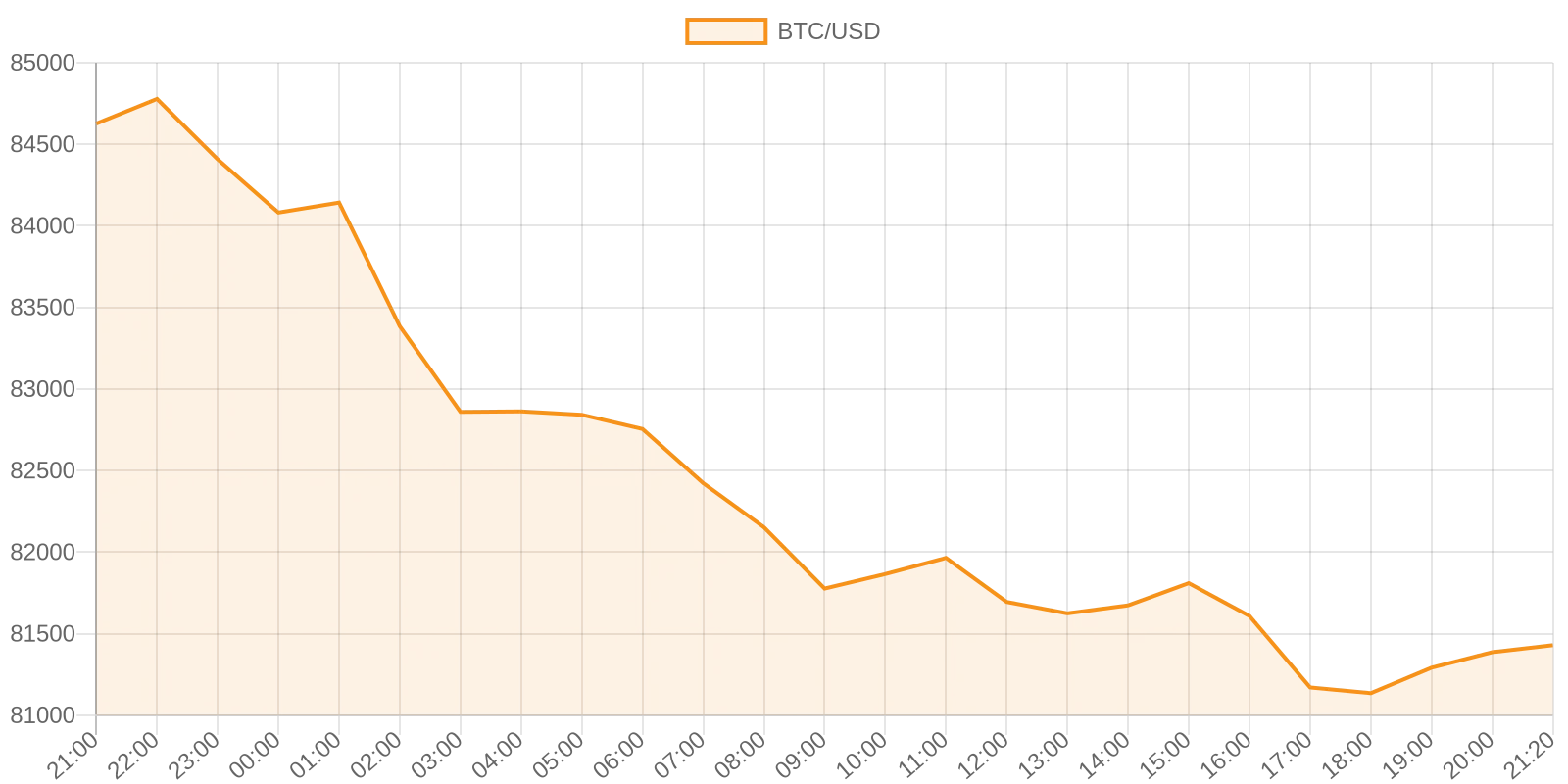
The levels are now data, not guesses. Immediate support sits at the $80,989 low, with the psychological $80,000 level just beneath it; a daily close below $80,000 would put the late-September trading region near $78,000 to $79,000 in view. Resistance is the $84,000 area bitcoin rejected on Wednesday, with the 24-hour high of $84,778 above it. “Bitcoin getting a daily close below the 50D SMA likely sends it to the bull market support band,” analyst Benjamin Cowen wrote on X on October 22, flagging the 50-day moving average as the level that determines whether this is a pullback or something deeper.
None of that is a forecast. The day’s move is best described as a leverage flush meeting a macro catalyst, and the direction from here depends on whether oil keeps climbing and whether the tech selloff extends into another session. A daily close back above $84,000 would suggest buyers have absorbed the flush and reframed the dip, which is the scenario tracked in the broader buy-the-dip debate around $82,000 .
Frequently Asked Questions
Bitcoin fell to about $81,347 on Oct. 22 as three pressures hit at once: Brent crude topped $111 on reported U.S.-Israel plans for renewed Iran strikes, Meta and Tesla earnings revived AI-spending fears that hit tech stocks, and leveraged longs were liquidated as bitcoin slid from $84,778 to a low of $80,989.
Bitcoin was down about 3.9% over 24 hours near $81,347, after a 24-hour range of $80,989 to $84,778. From high to low the move erased roughly $76 billion in market value before a partial recovery above $81,000.
The first support is the $80,989 24-hour low, with the psychological $80,000 level just below it. A daily close under $80,000 would open the late-September region near $78,000 to $79,000. Resistance sits at $84,000, the level bitcoin rejected on Wednesday.
Yes. U.S. spot bitcoin ETFs took in roughly $524.8 million on Wednesday, Oct. 21, per Farside Investors data, which is why Thursday’s decline looks more like a positioning flush than a collapse in spot demand.
Oil is one of three pressures, not the sole cause. Brent crude above $111 revives the inflation trade and delays rate-cut expectations, but the move was amplified by the tech-sector selloff and by leveraged bitcoin longs being forced out between $84,778 and $80,989.

