



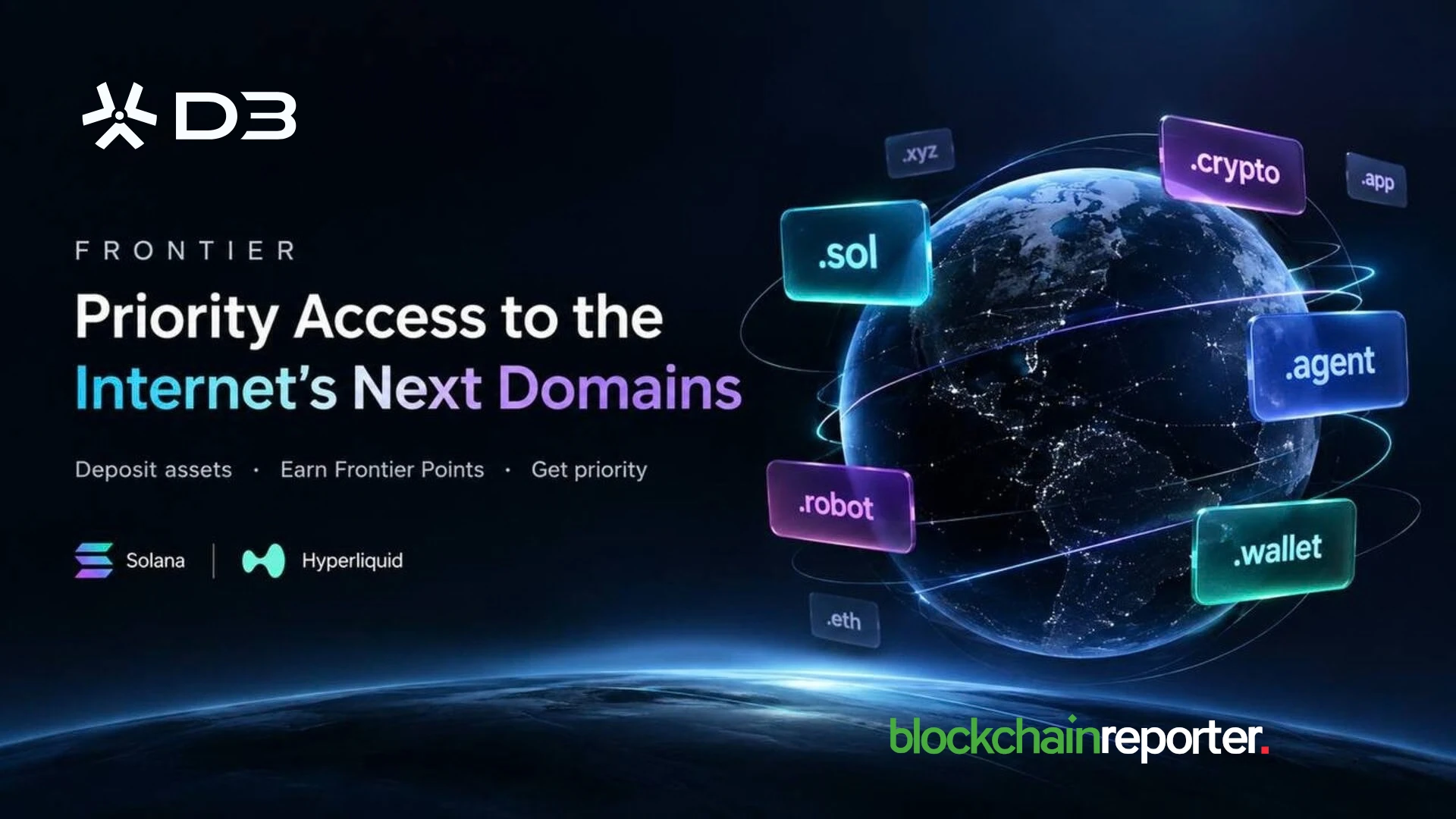
D3, the core contributor to Doma Protocol, has launched Frontier at Korea Blockchain Week in Seoul. The membership program lets crypto holders deposit assets with vault providers on Solana and Hyperliquid, earn Frontier Points, and use them to line up for domain names in the new extensions from ICANN’s 2026 round. According to the Frontier program page , deposits opened on September 28. The points are meant to decide who ranks first when several members want the same name.
The timing follows ICANN’s first application round for new generic top-level domains (TLDs) since 2012. The window closed on August 12, and on September 22 ICANN said 1,616 of the 1,663 submitted applications are moving forward after fee payment. D3 says those applications include .agent, .crypto, .wallet, .sol and .robot. ICANN hasn’t published the applied-for list yet. It noted that some applicants have disclosed their own strings, and Reveal Day is due no later than October 14. The 2012 round added roughly 1,200 extensions, .xyz and .app among them.
How vault deposits turn into a place in line
Points accrue daily. Per D3’s program pages, every eligible dollar in a vault earns one Frontier Point a day, multiplied by a rate for the current epoch and, for some vaults, an extra boost. The first epoch runs to March 2027 at 4x, the second to September 2027 at 2x, so early deposits earn more. D3 says Frontier launches with two vaults: a Solana vault supported by Loopscale that accepts SOL, and a Hyperliquid vault supported by Hyperion DeFi (Nasdaq: HYPD) and Upshift. Vaults on other major chains are due in the coming months. D3 says it doesn’t hold the deposits, and withdrawals follow each vault’s own terms.
The points get spent later. Members first back the extensions they want. Once a participating registry opens name selection, they commit points to specific names, set a sealed maximum price and reserve funds. The registry fixes its first-year price up front, and the highest-ranked order that covers it gets the name. D3 describes a launch sequence in which eligible trademark owners get first access in a Sunrise period, Frontier runs the first phase open to the public for at least seven days, and general sale follows, which ends Frontier’s priority. Some registries may run private or restricted phases before any of that.
Why D3 is pitching domains to crypto holders
Fred Hsu, D3’s CEO and co-founder, put the case in terms of a recurring cycle. “Every cycle, the crypto industry goes looking for real assets with real history,” he said, and he argues domains qualify. The pitch sits inside a wider push to bring real-world assets onchain. Doma, in D3’s description, is a DNS-compliant blockchain that makes domains programmable, tradeable digital assets, and D3 calls that category DomainFi. Frontier borrows a mechanic DeFi users already know, deposit and earn, and applies it to a different prize: a place in line for names that don’t exist yet.
Several parties have a stake. For the vault providers, Loopscale, Hyperion DeFi and Upshift, points come on top of whatever each vault pays under its own terms. Scott Lee, Head of Korea at the Solana Foundation, said Solana’s role as the first supported vault gives its ecosystem an on-ramp to the expansion. Hyunsu Jung, CEO of Hyperion DeFi, pointed to .hype among the new extensions and said Hyperliquid’s community gets access from day one. D3 says more than 20 TLD applicants and registries are taking part and keep control of pricing and policy. It also says anyone holding eligible assets can join with no registry relationship or broker, arguing that in 2012 the in-demand names went to insiders and a small circle of domain investors.
What Frontier does not promise
Frontier doesn’t sell names today. D3’s own disclosures say participation doesn’t reserve, allocate or promise any domain before a participating registry’s launch process. Frontier Points are non-cash: they can’t be sold, withdrawn or traded, and they don’t pay a domain’s registration price. Deposits sit with independent providers under their own fees, risks and withdrawal conditions, and D3 says the program’s benefit is points and priority, not a guaranteed return.
The road to actual names is long. ICANN still has to publish the applied-for strings, then run evaluation, objection and contention-resolution stages, and D3’s page points to the first extensions going live in 2027, with timing varying by extension. The announcement doesn’t say which registries have signed on or how many of the extensions it cites will end up participating. It also leaves open which of the 1,616 applications clear ICANN’s process, and which strings land in contention with rival applicants.

.jpg)