


Bitcoin has entered the most important week of 2026 at a price range of $76,000 to $80,000, and futures markets have already begun to deflate.
Its current trading price is close to $77,462, which is little changed from the previous day's price, but still a considerable drop from its September 3 top of $82,300.
This period is structurally different from prior phases of consolidation because two binary events - a Federal Reserve rate decision and the Senate’s first procedural vote on comprehensive crypto market structure legislation - collided.
The current market dynamics indicate that traders have made clear decisions regarding which risks to prioritize and which ones to overlook.
The Deleveraging Signal
The amount of Bitcoin available for purchase had a significant fall from 321,497 BTC to 278,151 BTC between September 3 and September 11.
This amounts to 43,346 BTC in vacated positions, a decrease of 13.5%.
It should be noted that this decline did not occur as a consequence of mechanical sell-offs caused by falling prices.
Bitcoin fell by only 5% during that time. The fall was planned, with a focus on the days leading up to this week's events.
According to Santiment's numbers , open interest is now around 20% lower than it was before the surge in the middle of August sent Bitcoin soaring over $80,000.
Crucial to the order is the fact that risk mitigation occurred before the catalysts, not after they happened.
As a result of traders realizing that the risks connected with binary events cannot be adequately controlled while using leverage, they have taken a proactive stance toward reducing risk.
The story is the same on the spot market. With a total of $19.23 million in redemptions, BlackRock's iShares Bitcoin Trust had the biggest outflow of any US spot Bitcoin ETF on September 11.
On the other hand, IBIT has total assets of $60.6 billion; thus, this sum is barely 0.03% of that.
The structural process is crystal clear: when ETFs are redeemed, spot sales occur, and in a market where the free float is lower, those sales have a greater impact on price than they would in 2024.
The Political Binary
The Digital Asset Market Clarity Act is scheduled for a cloture vote by Senate Majority Leader John Thune on September 15 at 2:15 PM Eastern. Important legislation pertaining to the structure of the crypto market is being examined for the first time in its entirety by the chamber.
The Republicans currently hold 53 members, but they will need at least seven Democrats' votes to advance (and maybe even more if a member of their own party decides to dissent) to pass a bill.
More than 114 Democratic Party elements were inserted in the revised 630-page draft that was published on September 10.
A new registration category for "non-decentralized" DeFi protocols with recognizable operators monitoring consensus rules, functionality, or operations has been introduced as the most significant upgrade.
This category explicitly excludes distributed ledger technology and the software code.
From 18% before, prediction markets have raised the 2026 passing probability of the measure to 22.5%.
The bill might remain in limbo "for years" if the vote fails, according to White House crypto advisor Patrick Witt, and there is no clear way for it to be brought back to the floor.
An alternative that would be more laborious and controversial but would achieve the same goal of regulatory clarity would be assertive rulemaking at the SEC and CFTC.
It all comes down to the exceptional ethics provision.
The revised version forbids government workers, officials, and their spouses from creating or supporting digital assets; the Justice Department will be responsible for enforcing this prohibition; and the law will expire in January 2029.
According to Democrats, the language doesn't take President Trump's holdings in World Liberty Financial and TRUMP memecoin seriously enough.
During a meeting with his advisors on September 12, Trump discussed these similar restrictions; White House advisor Witt described Trump as "the ultimate decider" when it came to any changes.
The Macro Overlay
Market prices have changed significantly , and the Federal Reserve's rate decision is due in just 72 hours. Futures showed a 70% chance of a 25 basis point boost as of September 10, up from 52.2% a month earlier.
Crypto aficionados were led to believe that this climate would see rate cuts, but that is not the case.
Brent crude prices have risen to over $107.50 due to the present macroeconomic climate , which includes surprisingly strong PPI statistics and escalating tensions in the Middle East.
A major obstacle is besetting tech stocks : Anthropic CEO Dario Amodei and other AI professionals have called for a slowdown in the industry's development rate, which led to a 1.72% dip in Nasdaq futures early Monday.
In premarket trading, Nvidia's share price fell more than 2%, while Intel, AMD, and Marvell all saw 5-6% drops in price.
There are investors who are somewhat skeptical of the warnings about AI. If regulatory hurdles benefit existing businesses, as Michael Burry said, then it's logical to assume that these corporations are attempting to stifle competition.
Regardless of the causes behind it, the market's reaction was quick.
The Structural Read
Although there has been some volatility in the correlation between Bitcoin and tech stocks, the current fall in AI stocks poses an additional threat to risk assets in general.
Crucial takeaway from the derivatives reset: traders have eliminated portfolio leverage, making spot flows the principal price driver in both cases.
Due to their design, ETFs allow spot flows to significantly impact a finite number of shares.
Over the span of three weeks in August, net inflows totaling $3.8 billion catapulted Bitcoin's price from around $63,000 to $81,700. A slight but discernible change in that trend has been noticeable within the last week.
According to Garrett Jin's on-chain analysis , there is a 70% chance that $60,000 will be the cycle bottom, which means that we are still less than halfway through the current consolidation phase.
Next support is seen between $76,000 and $77,000, and a possible breakdown might lead to the $74,000 to $75,000 range if spot demand keeps showing weakness. A rise in spot demand and a price movement above $82,500 would open the door to a price range of $83,000 to $86,000.
Leverage reduction, spot exposure mitigation, and capital reserve building are all parts of the market's positioning that incorporate both scenarios.
The only thing left is a definitive answer, and the market is structured to take the hit in either case.
What Other Technical Readings Show
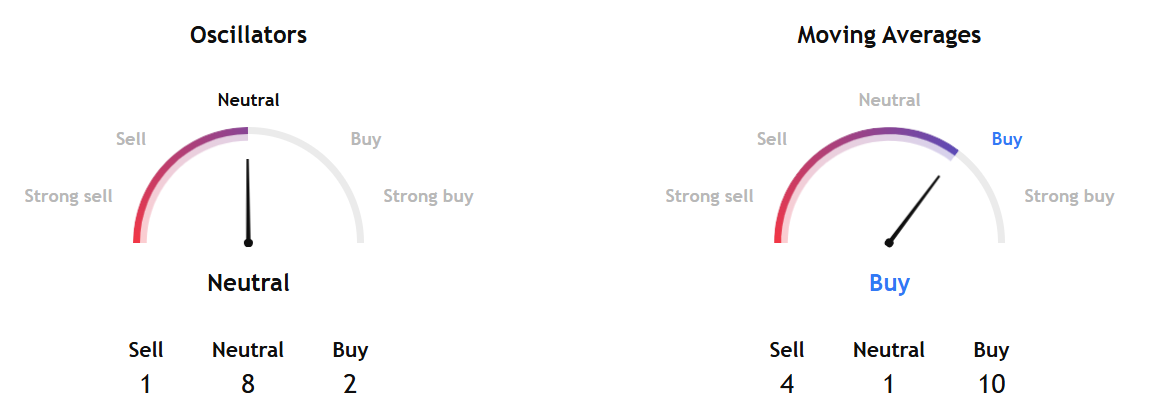
TradingView's technical analysis overview for the coming week based on key data from moving averages, oscillators, and pivots shows a buy sign.
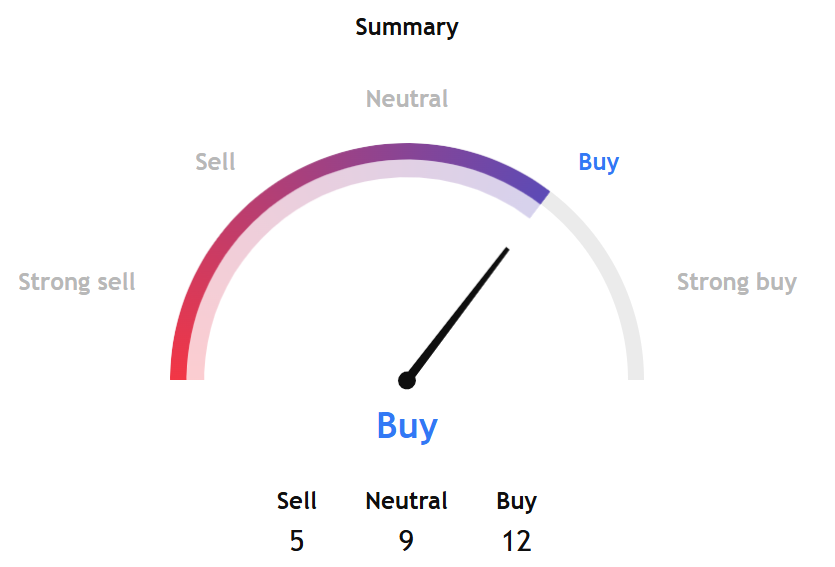
But the short-term sub gauges point to a neutral stance, while the long-term indicators continue to show a buy signal.
Separately, InvestTech's Algorithmic Overall Analysis points to a hold and its one to six weeks Recommendation gave a negative score.
The research said, "Bitcoin has broken down from an approximate horixontal trend channel in the short term after investors have sold at ever lower prices. A negative signal has been triggered and further decline for the currency is indicated."
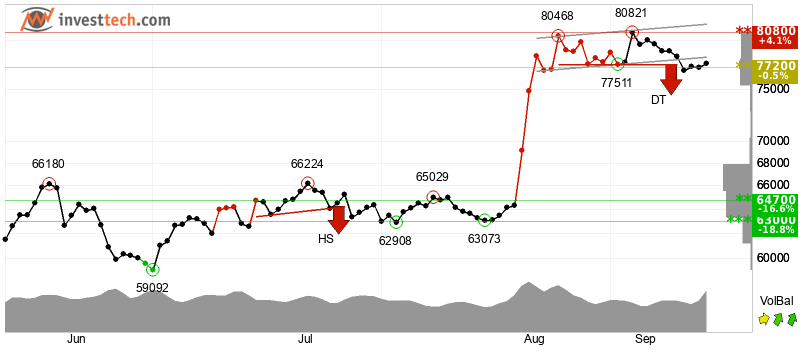
InvestTech said, "The price has reacted back after a false break of the double top formation. A significant penetration of $77,511 will again give new negative signals to the currency, while a break of the opposite side of the formation will be a strong positive signal."
The research added, "The currency is testing support at $77,200. This could give a positive reaction, but a downward breakthrough of 77,200 means a negative signal. The currency is overall assessed as technically negative for the short term."