Introduction
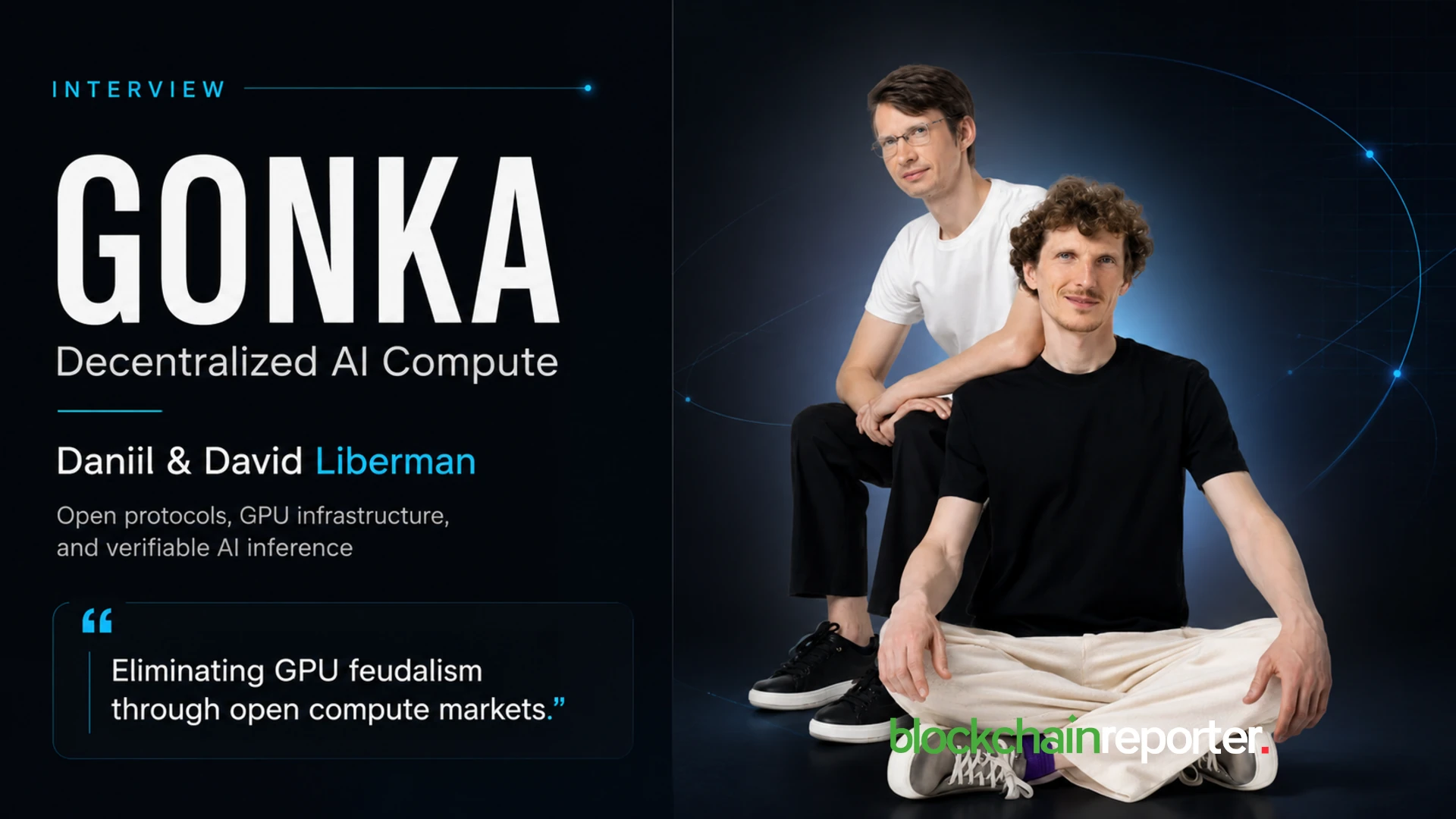
In an exclusive interview with Daniil and David Liberman, the co-creators of Gonka , we get to know their vision for reshaping AI infrastructure through decentralized compute networks. As the demand for artificial intelligence (AI) keeps on expanding to outpace the availability of GPUs and data center capacity, both co-creators believe that the future doesn’t only lie in building more centralized facilities but in connecting existing high-performance computing resources by means of open protocols.
During the conversation with BlockchainReporter, Daniil and David Liberman explained how Gonka is aimed at handling the growing AI compute shortage by eliminating what they describe as “GPU feudalism,” and establishing a permissionless marketplace for AI inference. Moreover, they also explored the economic impact of decentralized AI, the role of governments in fostering open infrastructure, and why verifiable compute is going to be essential as AI agents and autonomous applications become mainstream.
Interview Section
How can Gonka address the AI power crisis without building exclusive data centers?
The basic mistake is assuming AI compute requires a single massive facility. It does not. Gonka turns independent GPU clusters into one logical network. We are not eliminating data centers. We are eliminating the assumption that one corporation must own all of them. The AI power crisis is not just a lack of GPUs, there’s also a shortage of grid connections, permits, and time. Decentralization solves this by incorporating infrastructure that is already built. Bitcoin proved that protocol incentives can build physical infrastructure faster than corporations. Satoshi did not announce a data center strategy, right? He wrote a protocol, and the data centers appeared. Gonka applies this exact principle to AI compute.
Why is using untapped GPUs better than growing traditional AI data centers?
We focus on high-performance professional hardware, not just any idle consumer GPU. Globally, there is a massive amount of capable hardware locked inside independent data centers, universities, and enterprise setups. Connecting them has three massive advantages. First, deployment is much faster because the buildings and cooling already exist. Second, a global network is highly resilient. It does not go down if a single local power grid fails. Finally, it creates radical competition. Centralized hyperscalers just scale their current architecture, but decentralization forces true hardware innovation. Bitcoin mining efficiency improved by roughly 300,000x over 15 years. Specialized AI hardware will follow this same ASIC path if the protocol creates demand and rewards efficiency.
What insights did you obtain from processing massive AI workloads across 26 countries?
In a decentralized network, local outages or policy shifts do not cripple the entire system. We also learned that verification is everything. It is never enough for a host to simply claim they have GPUs. We use a transformer based Proof of Work and Sprint mechanisms. This means hosts briefly prove their real AI capable hardware, leaving the vast majority of compute available for useful AI tasks. Ultimately, the token price does not matter. The decisive metric for the network is useful AI computation per day.
What is meant by “GPU feudalism,” and how does decentralized AI end it?
GPU feudalism is the terrible scenario where people become tenants on someone else’s compute estate, paying rent for every act of intelligence. AI itself is pure information. The model fits on a flash drive, but the monopoly lives in the data center. If five companies and two states control the infrastructure, eight billion people become dependents. Gonka changes this by making verified compute a permissionless economic primitive, turning a system of landlords and tenants into an open market.
What are the top economic and technical challenges for decentralized AI compute today?
The primary economic challenge is rewarding actual work. Proof of Stake rewards capital, but AI needs to reward the people who bring useful hardware and improve efficiency. Gonka relies on compute weighted governance, where influence is based primarily on verified computational contribution. On the technical side, verifiable inference is the hardest problem. The network has no central referee, so it must mathematically guarantee that a host is running the exact model requested without silent quantization or censorship. We are moving from proving that decentralized aggregation works to proving it has the operational discipline of critical infrastructure.
How can emerging economies benefit from decentralized AI compute?
Small countries cannot each beat the US or China one by one. They need equal access through shared infrastructure and open protocols. If your engineer cannot afford tokens, your country cannot afford productivity. Instead of attempting to build expensive and second tier national firewalls, 200 countries can coordinate through a shared protocol. This turns local data centers into global export industries and guarantees sovereign access to the intelligence layer.
What policies should governments adopt to accelerate decentralized AI?
Governments should not try to regulate their way out of a monopoly. They need to build an alternative that makes the monopoly unnecessary. Policymakers should establish clear tax and energy rules for GPU hosts and mandate that public procurement supports open standards. Most importantly, policy must recognize that a permissionless compute protocol is not the author of every workload passing through it. You do not hold an internet service provider responsible for the entire internet, and the same logic applies to decentralized compute networks.
How will AI inference redefine compute economics?
Training gets the headlines, but inference is where models become real economic infrastructure. As AI integrates into every piece of software, inference shifts compute from a hidden cloud asset into a measurable unit of production. In Gonka, GPU owners earn directly from verified compute. This exposes the bloated margins of traditional cloud providers to open competition. Our goal is not just a twenty percent discount on cloud compute. It is to force the marginal cost of intelligence radically downward.
Why should emerging Asian economies prefer shared AI compute over competing with the U.S. and China?
The centralized artificial intelligence (AI) race is designed for only a handful of superpowers to win. A country without compute will negotiate with AI like a tenant negotiates with a landlord. Access to advanced chips is already being weaponized as state policy. Shared infrastructure does not guarantee complete independence, but it creates essential bargaining power and an exit option. It offers sovereignty through real tools, not dependency through corporate allowances.
Can decentralized AI completely replace conventional cloud providers?
It will not happen immediately. Conventional clouds will still handle managed databases, compliance programs, and legacy enterprise software. However, decentralized networks will dominate exactly where their architecture shines. That means open source inference, global access, and true censorship resistance. Gonka aims to be the common compute protocol, similar to how CUDA became the developer standard for GPUs. Eventually, cloud companies may simply become interfaces operating on top of a decentralized settlement layer.
What role will decentralized compute play in advancing AI agents?
Answer. AI agents turn compute from a one off query into a continuous dependency. When agents start writing code, moving money, or operating robotics, trust will simply not be enough, you will need mathematical proof. A financial agent without verifiable inference is a bank account operated by a black box. Just as decentralized finance users rely on immutable smart contracts, agent users need a verifiable guarantee that the correct model executed their task without tampering or degradation.
How did your time at Snap shape Gonka’s development?
Answer. We learned to distrust convenient narratives and look at actual system data. Growing up with scientist parents during the Soviet collapse made us obsessed with institutional fragility and systems that fail ordinary people. We know firsthand that small performance improvements compound into massive economic shifts at scale.
What landmarks will determine the future of decentralized AI compute?
The future will not be decided by token speculation, but rather by measurable milestones like recurring, useful AI computation processed per day. We also need to see the arrival of specialized AI ASICs driven by protocol rewards, mirroring the trajectory of Bitcoin. Proving model integrity on every single request is another non-negotiable requirement. Ultimately, the most important landmark is establishing universal basic access. This means giving people sovereign access to compute, agents, and robots, rather than just handing them an income check and making them dependent on a corporate gatekeeper.
Concluding Remarks
Throughout the interview, Daniil and David Liberman showed a vision in which decentralized AI compute is evolving into a foundational layer of the global AI economy. Instead of competing with traditional cloud providers on their own terms, Gonka is set to unlock underutilized GPU infrastructure, encourage hardware innovation through protocol-based incentives, and provide developers and organizations with open, resilient access to computational power.
Both co-creators believe that the long-term success of decentralized AI will be measured not by token prices anymore but by real-world AI computation, verifiable inference, and universal access to intelligent infrastructure. As AI continues to transform industries around the globe, they believe open compute protocols can play a critical role in making AI more accessible, transparent, and resistant to centralized control.