


Stockholm, Sweden, May 26th, 2026, Chainwire
A new on-chain venue for prediction markets goes live today — no KYC, no disputed markets and no centralized gatekeeper – and anyone can list a market and earn from it’s creation.
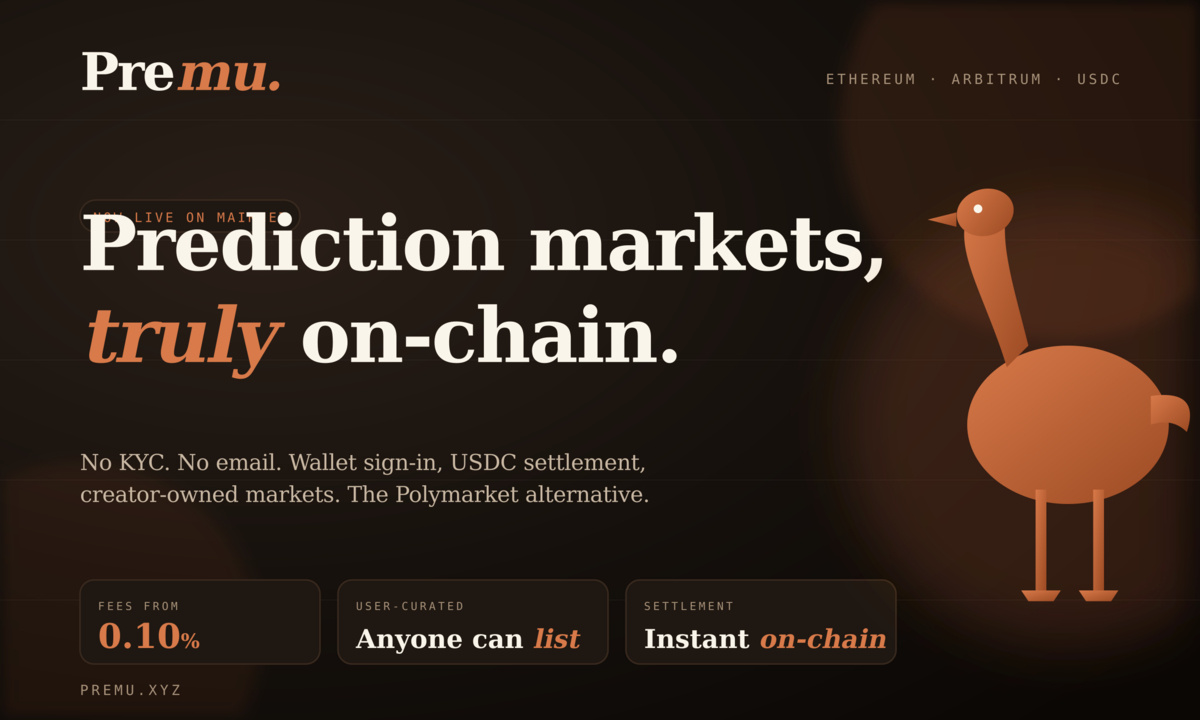
Premu , a decentralized prediction-market platform, today announced the public launch of premu.xyz , bringing wallet-native, fully on-chain prediction markets to Ethereum and Arbitrum. The platform combines the breadth of mainstream event markets — politics, sports, crypto, and world news — with a high-frequency “fast market” engine that resolves five-minute BTC, ETH, and SOL up/down outcomes around the clock. From day one, Premu is positioned as a direct, credibly-neutral alternative to centralized incumbents like Polymarket and Kalshi.
Built differently from Polymarket and Kalshi
The two largest prediction-market venues in the world today both operate on a custodial, permissioned trust model. Polymarket requires geofencing and a Polygon-bridged USDC balance held in a Magic-link smart-contract wallet whose recovery is tied to email; Kalshi is a CFTC-regulated U.S. derivatives exchange that requires full KYC, social security number collection, and bank account linkage before any user can place a single contract. Both venues maintain unilateral control over who can list a market, which markets get resolved, and how quickly a withdrawal clears. Premu was built to replace every one of those frictions:
- No KYC, no email, no account creation. Users can connect a self-custodial wallet — MetaMask, Coinbase Wallet, or any WalletConnect-compatible app — sign one message, and trade. There is no identity verification, no document upload, no waiting list, and no geographic block enforced at the protocol layer.
- Instant on-chain settlement in USDC. Every deposit, trade, and withdrawal settles directly against Premu’s audited vault contracts on Ethereum and Arbitrum mainnet. Funds are never held in an operator-controlled omnibus account, never bridged through a custodial sidechain, and never subject to multi-day clearing windows or discretionary holds. A user can withdraw at any time without operator approval — the smart contract is the only counterparty.
- Permissionless market creation, with creator revenue share. Any wallet can launch a binary market on any question by posting a 250 USDC creator bond. Of that bond, 200 USDC seeds a Hanson logarithmic market-scoring-rule (LMSR) subsidy that bootstraps two-sided liquidity from the very first trade, 25 USDC covers the platform listing fee, and 25 USDC is a slashable performance bond that protects traders from spam or bad-faith markets. Creators earn an ongoing share of every dollar of fee revenue generated by markets they list — paid into a transparent on-chain ledger and claimable at any time. On Polymarket and Kalshi, the venue captures 100 percent of fee revenue and end-users have no path to listing their own markets at all.
- Fees as low as 0.10 percent. Premu’s maker-taker schedule starts at 0.10 percent — among the lowest in the prediction-market category — and steps down further as lifetime volume grows. Kalshi’s fee model can exceed 7 percent of expected value on small contracts; Polymarket’s trader-fees-plus-relayer-overhead stack typically lands materially higher than Premu’s posted rate.
A Trading Experience Built for Retail, Priced for Professionals
For users who prefer a familiar onboarding flow, Premu also offers a one-click sign-in path through email or Google. These accounts are automatically provisioned with a dedicated on-chain wallet whose private key is encrypted at rest, giving non-crypto-native users the same on-chain settlement guarantees without the friction of seed-phrase management. Whichever path a user takes, every trade settles on Ethereum or Arbitrum mainnet in USDC.
Premu’s homepage surfaces a continuously updated mix of trending, breaking, and high-volume markets, while a “Fast Markets” rail runs short-duration BTC, ETH, SOL, BNB, XRP, DOGE, and HYPE up/down contracts that resolve every few minutes against live spot prices. These synthetic contracts are priced using a transparent volatility-and-drift model derived from a rolling seven-day realized-volatility estimate, with the assumed annual volatility and prior return frozen at market creation and published on-chain so any participant can independently verify the quoted odds.
Mainnet From Day One, With on-chain Proof
Premu’s vault contracts are live on Ethereum mainnet and on Arbitrum. Both contracts implement the ERC-2612 permit standard, so deposits can be authorized with a single signature — no separate approval transaction, no wasted gas. Withdrawals are subject to a short on-chain maturity window and can be executed by the user at any time, eliminating the multi-day waits and discretionary holds that characterize centralized prediction venues.
The platform’s full feature set — including a public leaderboard ranked on realized profit and loss, shareable position tickets, a real-time activity ticker, in-app comments and reactions, and a live support channel is available immediately at premu.xyz .
About Premu
Premu is a decentralized prediction-market protocol settling on Ethereum and Arbitrum in USDC. The platform’s mission is to make event markets a permissionless, low-fee, on-chain primitive — usable by anyone with a wallet, accountable to no gatekeeper, and verifiable end-to-end. Premu was built to be a credible alternative to Polymarket, Kalshi, and the broader category of custodial prediction venues, for traders who want depth and breadth without surveillance, geographic restrictions, KYC friction, or counterparty risk — and for creators who want to capture economic upside from markets they originate, not just the platform.
Premu operates at premu.xyz and maintains updates, market activity highlights, and leaderboard information through its @premu_xyz account on X.
Contact
Mr
Chadi Farhat
Premu.xyz
pr@premu.xyz
This article is not intended as financial advice. Educational purposes only.