



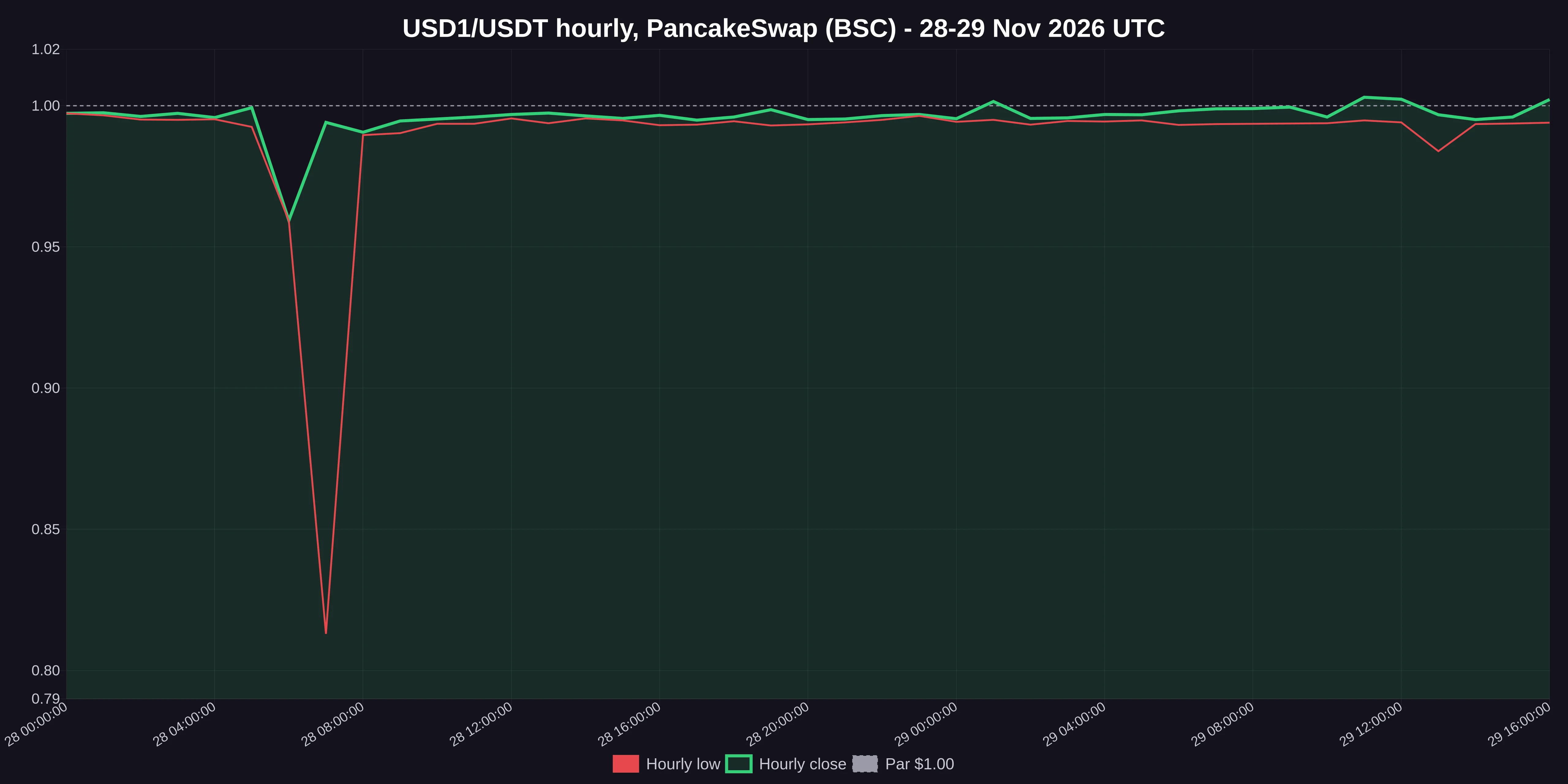
At 07:00 UTC on Saturday, the deepest USD1 trading pool on BNB Chain quoted the stablecoin at $0.8130. The candle had opened at 95.94 cents. It closed at 99.41. In between, $12.53 million changed hands in a PancakeSwap pool that holds $5.24 million of liquidity today, and anyone who sold at the bottom of that hour took an 18.7% haircut on a token the issuer describes as redeemable one-for-one for a U.S. dollar.
The hour before had been quieter by a factor of 26. Volume in the same pool was $296,490 between 05:00 and 06:00 UTC. It rose to $7.76 million in the 06:00 candle, which broke from 99.93 cents to a low of 95.92, then to $12.53 million in the 07:00 candle. Across those two hours, $20.3 million traded, roughly 68 times the volume of the hour that preceded them, according to GeckoTerminal’s hourly data for the USD1/USDT pool .
That pattern is consistent with a liquidity event rather than a solvency event: violent, brief, and concentrated in the hours when the order books are thinnest. It is also the kind of print that outlives its own hour, because a screenshot of 81 cents travels further than the recovery that followed it. What the record actually shows is worth separating from what a single candle implies.
Nineteen cents inside 60 minutes
The pool’s own hourly series tells the story in five lines. Between 01:00 and 05:00 UTC the pair never left a 99.25 to 100.45 cent band, and the largest hourly volume in that stretch was $677,597. Nothing in that window looked like stress.
| Hour (UTC, 28 Nov) | Open | Low | Close | Volume |
|---|---|---|---|---|
| 05:00 | $0.9958 | $0.9925 | $0.9993 | $296,490 |
| 06:00 | $0.9993 | $0.9592 | $0.9594 | $7,759,239 |
| 07:00 | $0.9594 | $0.8130 | $0.9941 | $12,532,420 |
| 08:00 | $0.9941 | $0.9896 | $0.9906 | $1,407,929 |
| 09:00 | $0.9906 | $0.9903 | $0.9946 | $804,232 |
The arithmetic of the wick is blunt. A holder who sold 100,000 USD1 at the $0.8130 low received $81,300. The same size sold at the hour’s close, sixty minutes later, fetched $99,410. The difference is $18,110, and it was not paid to the issuer or to a redemption desk. It went to whoever was standing on the other side of a market order inside an automated pool with $5.2 million of depth.
The same hour on Solana was shallower. USD1’s Raydium pool against USDC printed a low of $0.9311 and closed at 99.56 cents, a venue with $9.9 million of reserves now. A wick that deep in one pool and roughly a third as deep in another is the signature of venue-specific liquidity, not a uniform repricing of the claim on the issuer.
Two numbers for one event, and the gap between them
CoinGecko’s aggregate series records a different low for the same morning: $0.9394 at 07:05 UTC, the deepest discount in USD1’s history on that dataset, and 6.06% below par. The gap between the two figures, 18.7% in the PancakeSwap pool against 6.1% in the aggregate, is not a contradiction. It is a methodology difference, and it decides how alarming the story sounds.
An aggregator weights venues and filters outliers; a single pool’s candle records the worst fill that actually cleared inside that pool. The aggregate version says a $2.5 billion stablecoin briefly traded six cents light. The pool version says one market maker’s inventory, or one seller’s market order, cleared nineteen cents light for a few minutes in a venue holding $5.24 million. Both are true. Only one of them describes what most holders could have transacted at.
By 16:00 UTC on Sunday, the PancakeSwap pool was quoting $1.0022 and had traded $838,735 in the previous 24 hours. CoinGecko’s aggregate quote stood at $0.99856, with $496.9 million of global volume behind it. The discount had closed in both datasets. What had not closed was the question of what produced it.
What the issuer promises, in its own words
USD1’s public documentation is unusually direct about the backing, and unusually quiet about the plumbing. “USD1 is redeemable 1:1 for U.S. dollars,” the project’s USD1 page states. “USD1 is backed by dollars and U.S. Government Money Market Funds.” Lower on the same page: “USD1 is 100% backed by U.S. cash, U.S. government money market funds, and other cash equivalents, to help ensure stability and liquidity at all times.” The design it describes, from reserve structure to the nine networks USD1 settles on, is set out in more detail in BlockchainReporter’s earlier explainer on USD1 .
The attestation cadence is monthly, not daily, and the page says so plainly: “USD1 reserve reports are published for transparency purposes only and are published on a monthly basis.” That sentence is doing more work than it appears to. A monthly report can confirm that reserves matched supply at month-end. It cannot tell a holder on a Saturday morning whether the redemption window is open, how long a queue is, or which counterparty is honoring par.
Nor does the page describe a self-serve redemption portal. It directs users to buy from “our trusted partners and protocols” and offers a contact route “about minting.” For a token distributed across nine networks, including BNB Chain, Ethereum, Solana, Tron, Aptos, Mantle, Plume, Monad and Morph, the difference between a 1:1 claim on an issuer and a 1:1 price in a pool is the whole story of Saturday’s candle: the claim was never the thing that traded.
The statement that addressed the token, not the dollar
World Liberty Financial did publish an account of the overnight move, at 12:37 UTC on 28 November, and it was about the WLFI token’s perpetual futures rather than the stablecoin’s pool pricing. “We are aware that overnight, Binance automatically closed WLFI perpetual futures positions on both the long and short sides,” the project wrote. “WLFI had no involvement in these actions and has no control over how these positions are managed, closed, or settled.”
We are aware that overnight, Binance automatically closed WLFI perpetual futures positions on both the long and short sides. We have also seen reports from users whose positions were profitable prior to closure but resulted in losses upon settlement.
We want to clarify that Binance independently operates and manages its perpetual futures markets, including its auto-deleveraging mechanisms. WLFI had no involvement in these actions and has no control over how these positions are managed, closed, or settled.
— WLFI (@worldlibertyfi) November 28, 2026
The statement says what the project did not do. It does not address the $0.8130 print in its own deepest stablecoin pool, and no public document I could locate attributes the break to a specific seller, a specific redemption, or a specific counterparty. That absence matters for how the event should be filed: the mechanism is visible in the data, the motive is not, and the gap between them is where speculation usually enters. The WLFI token’s 54% two-hour fall and the stablecoin’s wick share a morning, not a proven causal chain.
Eleven percent of the float gone in 48 hours
The number that survives the candle is the supply. CoinGecko’s market-cap series for USD1 was $2.852 billion at 17:00 UTC on 27 November. By 16:48 UTC on Sunday it read $2.537 billion. That is $315 million, or 11.1% of the float, removed in two days. Because the price sat within a fraction of a cent of par at both ends of the window, the change is mostly supply rather than valuation: tokens were burned, redeemed, or moved out of the measured float.
Turnover ran hot alongside it. Sunday’s $496.9 million of 24-hour volume equals 19.6% of the $2.537 billion market cap, a ratio no stablecoin reaches in calm conditions. The two deepest pools, meanwhile, now hold $5.24 million on BNB Chain and $9.9 million on Solana, which is thin relative to a $2.5 billion token and thin relative to the $20.3 million that moved through one pool in two hours on Saturday. The float shrank while the trading venues that price it stayed small.
What the data cannot show is direction of intent. A burn, a bridge-out, and a redemption all reduce measured supply, and only the issuer’s attestation separates them. Anyone asserting that $315 million was redeemed for dollars on demand is asserting something the public record does not yet contain. The honest reading is narrower: the float contracted by an eighth in 48 hours, and part of that contraction followed the deepest discount the token has recorded.
The collateral underneath the peg
The stablecoin and the token that sponsors it are now very different sizes. WLFI trades at $0.01646, down 4.8% over 24 hours, 95% below its September 2025 high of $0.3313, with a market capitalization of $521 million against 31.66 billion tokens in circulation out of 96.62 billion total. USD1’s market cap is $2.537 billion, roughly five times the value of the token that lends the project its brand.
That ratio matters because the two assets now price different things. A $521 million equity-like token standing behind a $2.5 billion dollar claim is not a solvency statement either way, because the reserves sit with the issuer and are attested separately from the token’s price. But the confidence channel runs one way: when the token falls, the stablecoin’s price is exposed to holders who treat the two as one credit, and Saturday showed how quickly that repricing can reach a pool.
What would turn a wick into a break
Three observations would separate Saturday’s liquidity event from something worse, and all three are checkable without private data.
The first is the monthly attestation covering November, which should disclose whether reserves matched the $2.537 billion float at month-end and whether the $315 million contraction was redeemed in cash or simply moved. Its publication date and its reserve composition are the test; a delay past the usual cadence would be the first genuine warning.
The second is pool depth. If BNB Chain’s $5.24 million and Solana’s $9.9 million hold or grow while daily volume falls back toward the $300,000-an-hour baseline, Saturday was an inventory problem. If reserves keep shrinking while supply keeps falling, the venues that price USD1 are being starved, and the next large seller gets a deeper wick for the same size.
The third is the peg band itself. USD1’s hourly closes on BNB Chain have held between $0.9906 and $1.0030 since the event. A sustained run of closes below $0.99, with volume above $5 million an hour, would mean sellers are no longer transacting against market makers but against each other. That is the condition under which a 1:1 redemption claim gets tested in public, and it has not happened yet.
For now the record reads the way most liquidity events read after the fact: an $0.8130 print, an aggregate low of $0.9394, a recovery to par inside the hour, and a float that came out of the weekend $315 million smaller. The pool print and the recovery both happened; only one of them is likely to circulate as evidence.
Frequently Asked Questions
It traded below par and recovered. CoinGecko’s aggregate low was $0.9394 at 07:05 UTC on 28 November, while PancakeSwap’s main USD1/USDT pool printed an hourly low of $0.8130 and closed that hour at $0.9941. By 16:00 UTC on 29 November the pool quoted $1.0022 and the aggregate $0.99856. A peg break normally means sustained trading below par plus a redemption channel that stops honoring 1:1, and neither is documented here.
The issuer states that USD1 is 100% backed by U.S. cash, U.S. government money market funds and other cash equivalents, and that it is redeemable 1:1 for dollars. Supporting evidence is published as monthly attestation reports rather than a daily proof-of-reserves feed, so backing is verified at month-end, not intraday.
The pool is an automated market maker holding $5.24 million of liquidity. A large market sell moves its quoted price mechanically, and in the 07:00 UTC hour on 28 November $12.53 million traded in that pool against $296,490 in the hour before. Public data does not identify the seller or the reason for the order, so the cause remains unproven even though the price path is fully recorded.
The project’s USD1 page describes 1:1 redeemability and points users to partner venues for acquiring tokens plus a contact route for minting. It does not publish a self-serve redemption portal or redemption queue data, which means the practical test of the claim runs through the issuer and its partners rather than through an on-chain function.
This article is not investment advice. Price and pool data were captured from CoinGecko and GeckoTerminal on 29 November 2026 at 16:00 UTC and will change.
The post USD1 Hit 81 Cents in a Single Hour. Eleven Percent of the Float Left in Two Days appeared first on Blockchainreporter .