




Extended has spent three weeks asking its points holders to sign a distribution agreement for a token that did not yet exist. On Monday the token exists. Before Kraken prints a price for XTEN, 300 million of the tokens will already be sitting in user accounts on the exchange that issued them, staking will have opened a day earlier, and the only way back out of a staked position will run through a seven-day queue.
The company put the date in public in a post from its official account: “XTEN launches on 30 November.” What that sentence does not carry is the shape of the supply arriving with it. Extended’s own documentation does, and the schedule is more interesting than the date.
Two dates, and only one of them has a market
The first event comes before any listing. Extended delivers tokens to the people who earned Extended Points on its perpetual futures exchange and signed the XTEN Community Distribution Terms before the token generation event. Extended’s staking documentation fixes the sequence without ambiguity: “XTEN staking goes live on 29 November, once the initial token distribution is complete.”
That single line is the closest thing to a timestamp for the distribution itself. The documentation tells holders that signing before the TGE means receiving XTEN “before XTEN is admitted to trading on Extended and other venues”, and that signing afterwards means delivery “on a rolling basis once you sign”. It does not publish an hour for the transfers, and it does not promise one.
The second date is the market. Kraken’s listings account said on 27 November that trading starts 30 November . The post carried the date without a pair list or an opening hour, which leaves the first tradable print dependent on venue operations rather than on a published schedule.
The float is 30%, the unlock is 32.9%, and the difference belongs to the desk
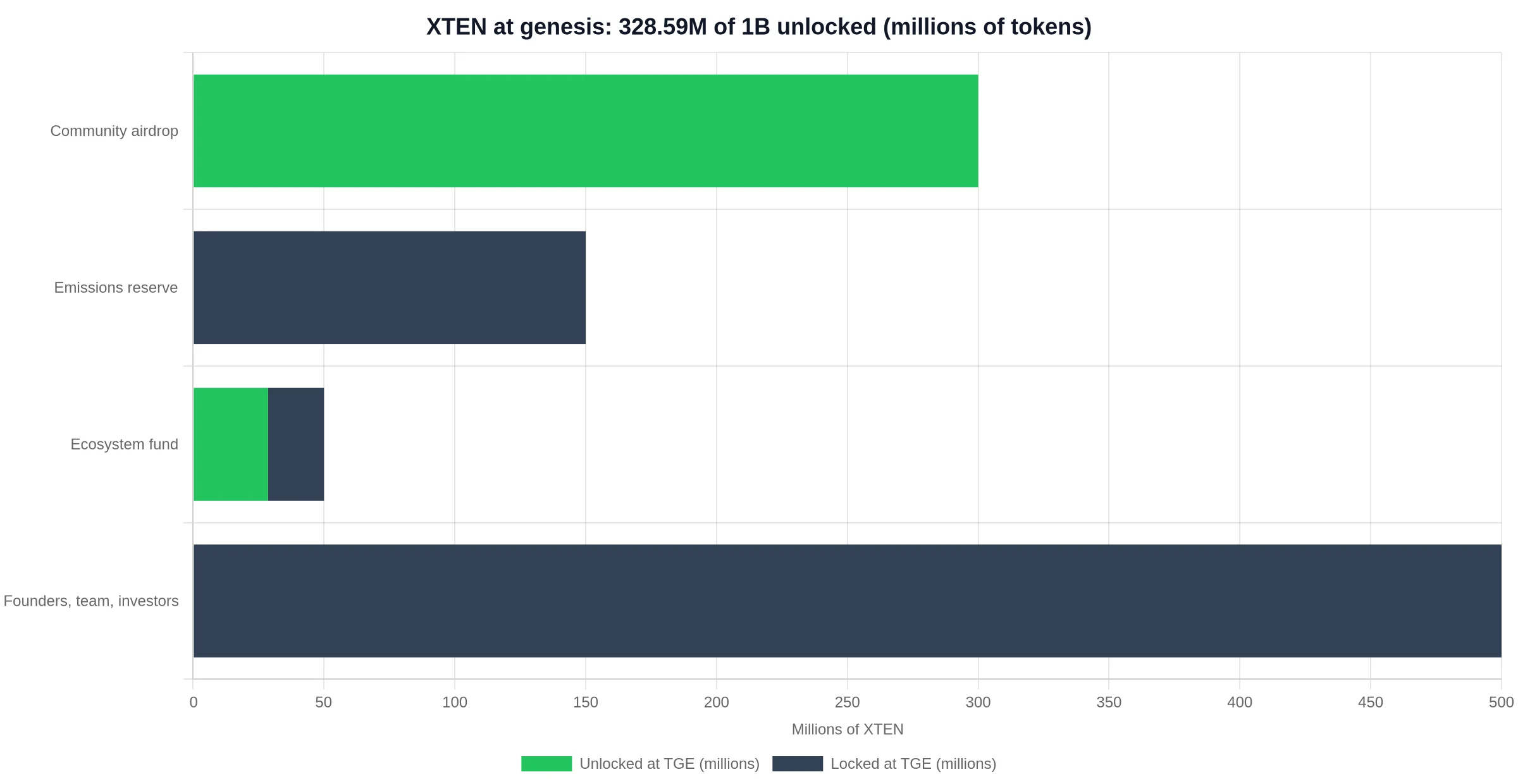
Max supply is fixed at 1,000,000,000 XTEN, minted at genesis, with no inflation and no mint function. The community allocation is the largest single block that moves on day one:
“300,000,000 XTEN, 30% of the genesis supply, is allocated to eligible participants in the Extended Points programme, fully unlocked at TGE.”
That is the headline number, and it is also the one most likely to be misread. Extended separates what is unlocked from what can actually trade. Its tokenomics page states that “Free float at TGE comprises only the claimed Community allocation, up to 300,000,000 XTEN or 30% of supply.” Total unlocked supply at the event is higher, roughly 32.9%, because 28,589,286 XTEN from the Ecosystem Fund is also unlocked. Those tokens sit in a public wallet reserved for incentives, partnerships and grants, not in the hands of claimers.
The difference between 32.9% unlocked and 30% free float is who holds it. Multiply 328,589,286 unlocked tokens by the pre-launch mark of $0.15966 recorded at 05:20 UTC on 29 November, and the unlocked supply is worth about $52.5 million. The tradeable share is worth about $47.9 million at the same mark. Neither figure is a valuation anyone has to defend, because the token has never traded on a spot venue. They are simply what the arithmetic says before the first order book exists.
Inside the 300 million there is a smaller number worth naming. Extended discloses that 17,384,355 XTEN of the community allocation is attributable to Points earned by its own market-making desk, run by X10 Ltd between December 2024 and April 2026. That is 5.8% of the pool, and it belongs to the operating company rather than to outside users. The documentation says some of it is expected to support XTEN liquidity, with the mechanics disclosed before deployment, and the remainder will move to the Ecosystem Fund.
A claim you have to sign for, in a shorter list of countries than the app
Nothing lands automatically. Holders log in, accept the terms, sign with the wallet that controls the account, and choose where the allocation is delivered. The receiving account can be selected once and cannot be changed afterwards. Tokens arrive in an Extended account, not at a deposit address, and the documentation is explicit that “Exchange deposit addresses and other custodial addresses cannot receive XTEN.”
The excluded-jurisdiction schedule is longer than most airdrops and includes four countries that would otherwise be core markets. Extended’s terms list North Korea, Iran, Cuba, Afghanistan, Myanmar, Syria, Iraq, Yemen, Crimea and Sevastopol plus the non-government-controlled areas of Donetsk, Kherson, Luhansk and Zaporizhzhia, the United Kingdom, Seychelles, the United States and Canada.
The European Union gets a different treatment. Holders there can claim, hold, stake and transfer, but they cannot trade the token on Extended at launch: “XTEN spot trading will not be available on Extended for EU users at launch.” That restriction is the reason a second venue matters more than usual for European holders, and the reason the Kraken date carries weight beyond a routine listing.
The deadline is 23:59 UTC on 31 December 2026. Extended states that “Any allocation not accepted by the close of the window is transferred to the Ecosystem Fund.” Identity checks are not generally required, though every claim passes location, sanctions and wallet screening, and the company reserves the right to ask for more.
Staking opens first, and the exit is not instant
Staking is the only documented mechanism on day one that can take supply off the market, and it comes with a constraint that will shape the first week of price discovery. Staked XTEN is non-transferable, and unstaking runs through a seven-day queue during which the tokens earn nothing and do not count toward a League tier.
The reward schedule is published as a formula rather than a fixed rate: APR equals 3% multiplied by the square root of 150,000,000 divided by total staked. The 150,000,000 XTEN Emissions Reserve is the sole source, released from genesis supply and never replenished. Run the formula forward and the shape becomes clear. With 100 million XTEN staked the rate is about 3.67%. At 200 million it falls to 2.60%, and at 300 million, the full size of the community pool, it lands at 2.12%, which matches the table in Extended’s documentation.
League tiers begin at 500 XTEN staked and run to King at 5,000,000, where the trading fee discount reaches 30% and the Vault Extra Yield multiplier reaches 5x on a boosted deposit cap of $2 million. A holder deciding whether to sell into the first week is therefore also deciding whether to lock tokens for a fee discount whose value depends on how much they trade. Validators are not live yet. Until they are, rewards are credited daily at 00:00 UTC through a default prover, and operator self-stake requirements start at 5,000,000 XTEN once the validator set is announced.
What the perp market already thinks it is worth
XTEN has no spot price, but it has had a derivatives market. Hyperliquid’s pre-launch contract for the token was quoted at a mark of $0.15966 at 05:20 UTC on 29 November, against $0.15748 a day earlier, with an oracle price of $0.16148. Open interest stood at 13,142,050 XTEN and 24-hour notional volume at $431,437, according to the venue’s public market data .
Those numbers describe a thin book, and the arithmetic says so. At the mark, the fully diluted value of 1 billion tokens is about $159.7 million, while open interest is worth roughly $2.1 million, or 4.4% of the 300 million tokens allocated to claimers. Daily volume of $431,437 is about 0.27% of fully diluted value. A pre-launch perp can be pushed by a single sized order, so the mark is a reference point, not a forecast of where spot will open. The mark also sits well below where private capital has priced a comparable business: Variational raised $110 million at a $1.5 billion valuation earlier in November, roughly nine times XTEN’s implied fully diluted value at the current mark.
Kraken gives the second price, not the first
The venue question matters because Extended’s own exchange will not serve every holder. The protocol settles on Arc, the Layer 1 built by Circle for financial markets, after a migration from Starknet that the documentation dates to 22 October 2026. USDC moved to native Arc USDC through Circle’s Cross-Chain Transfer Protocol, ETH is held as wETH, and cirBTC replaced wBTC as the Bitcoin-backed collateral asset. USDT and wBTC stopped being supported on 8 October.
That architecture puts XTEN on a chain with a single institutional sponsor and native cross-chain transfers, which is tidy for settlement and narrow for liquidity. Venue risk is not theoretical in this market either: Lighter froze withdrawals and returned $5 million in November after third-party code leaked an API key. A Kraken listing gives holders outside Extended’s permitted jurisdictions a venue they may already have an account with. Whether it also gives them depth is a separate question, and one the first 24 hours of volume will answer better than any announcement.
The half of the supply that cannot move until next winter
Founders, team and investors hold 500,000,000 XTEN, half of the supply, and none of it unlocks before month 12. Team tokens then vest in 36 equal monthly instalments from month 13 to month 48. Investors receive 25% at month 12 and the remainder monthly to month 48. The first meaningful supply shock after launch is therefore not a gradual drip but a cliff a year out, and it will arrive whether or not the token has found a market by then.
On the other side of the ledger, Extended says total supply can only fall. Fees paid in XTEN may be burned, though the ability to pay fees in the token is expected to be introduced after the TGE. Group entities may buy on the open market for treasury and supply management, including potential burns where authorised, but the documentation is careful: “Further details will be published if and when a buyback programme is launched.” No programme has been announced.
Three things to watch when the first print lands
The claim rate is the first. If a large share of 300 million tokens goes unclaimed past the December deadline, that supply returns to the Ecosystem Fund rather than disappearing, which changes who holds the overhang. A low claim rate moves that supply to the Ecosystem Fund; it does not remove it from the market.
The second is whether staking absorbs anything. The emissions curve pays more when less is staked, so a low staked balance produces a higher headline APR and a larger daily sell reward for those who do stake. Watching the staked total against the 300 million pool will say more about holder intent than the first hour of price action.
The third is the relationship between open interest and spot volume. Pre-launch open interest of 13.1 million XTEN is a bet on a price that does not exist yet. If that position rolls into spot or unwinds against thin liquidity, the first day’s range will be set by derivatives flow rather than by claimers selling what they received.
Data: Extended documentation , Hyperliquid .
This article is for information only and is not investment advice. Token launches carry the risk of total loss, and pre-launch derivatives prices are not spot prices.
The post XTEN Unlocks 30% of Supply Tomorrow. Staking Opens Today and the Exit Takes Seven Days appeared first on Blockchainreporter .