




Finance and central bank deputies from 14 Asian economies agreed in Kyoto on 26 November to build a standing forum for digital asset policy, and gave it no rules to enforce. The co-chairs’ statement says the deputies “agreed on the modality to advance policy dialogue on retail and wholesale payment connectivity, as well as on regulatory approaches to digital assets, through the establishment of the AMRO Cross-Border Digital Payments Program and its dedicated Working Group.”
That sentence is the whole crypto commitment in a statement of roughly 350 words. The meeting ran on 25 and 26 November and was the last under the 2026 co-chairship of Japan and the Philippines. It produced six outcomes: the entry into force of the amended Chiang Mai Initiative Multilateralisation and its Rapid Financing Facility, AMRO’s 2027-2029 work plan, a governance principle for paid-in capital, the Asian Bond and Financial Markets Initiative roadmap to 2030, progress on disaster risk financing, and the digital assets working group. The crypto item is one bullet of 40 words, with no funding line and no operational milestone.
What the text leaves out is as clear as what it contains. There is no definition of digital assets, no licensing standard, no stablecoin rule, no date for a proposal and no list of covered assets. The working group sits under the ASEAN+3 Macroeconomic Research Office, the region’s surveillance body, not under a regulator with rule-making power. Its results go to finance ministers and central bank governors in Nagoya in May 2027.
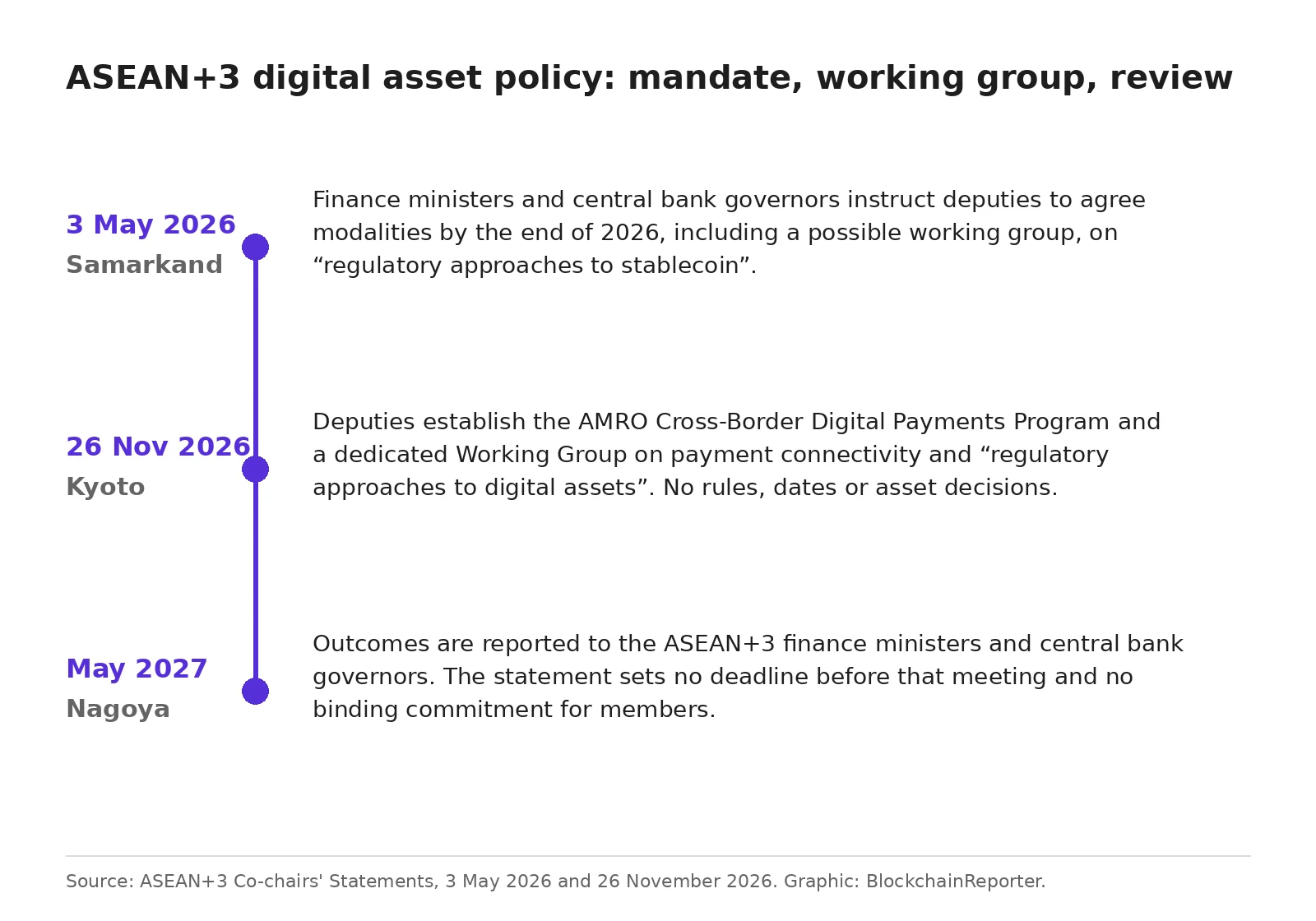
The mandate was met, and widened
Kyoto closes a task set 207 days earlier. At the finance ministers’ and central bank governors’ meeting in Samarkand on 3 May, the joint statement read: “we instruct the Deputies, with AMRO’s support, to agree on appropriate modalities by the end of this year – such as the possible establishment of a dedicated Working Group (WG) – to continue deepening policy dialogue on retail and wholesale payment connectivity, and regulatory approaches to stablecoin.”
Two things changed on the way to Kyoto. The “possible” working group became an established one, housed inside a named program. And “stablecoin” became “digital assets”. The May instruction ran 47 words and the November outcome 40, so the wording tightened while the scope widened from a narrow payment token to the whole asset class.
The deadline was met with 35 days to spare before the end of 2026. The May statement had described cross-border digital payments as “a new area of cooperation” in the ASEAN+3 finance process, phrasing that usually precedes years of study. This time the deputies turned a mandate into an institution in seven months.
Why 14 economies want one table
The group joins the 11 ASEAN members with China, Japan and South Korea. Divergence in domestic rules is the reason it exists. South Korea’s Financial Services Commission published a draft Digital Asset Act on 24 November that would cap a major shareholder’s stake in an exchange at 20%, allow up to 34% with approval, require bank-majority consortia to issue won stablecoins in the first phase, and reopen initial coin offerings. Japan co-chaired the Kyoto meeting through its Ministry of Finance and the Bank of Japan. ASEAN members differ as widely, from licensed regimes to markets still drafting their first crypto law.
For a payments firm, that means 14 licensing tests, 14 views on what a stablecoin is and 14 positions on whether a token is a security. A working group cannot harmonise those rules. It can map them, and AMRO already has the research base: the May statement welcomed its report on cross-border payments and regional connectivity, which put tokenisation next to monetary sovereignty, financial stability and capital flow management as issues to weigh.
Set the digital bullet against the meeting’s financing items. The CMIM Rapid Financing Facility is a live emergency tool. The ABFMI roadmap has a 2030 horizon and named instruments. The working group has a mandate to talk. The financing items are mature; the digital asset item is at the start of its process.
The sub-regional track is already active. On the sidelines, the deputies of China, Japan and South Korea held a separate trilateral meeting chaired by Korea, according to Japan’s Ministry of Finance . Vice Minister of Finance for International Affairs Atsushi Mimura co-chaired the Kyoto meeting with the Bank of Japan. The three Northeast Asian economies have their own reasons to coordinate before the wider group meets.
What payment connectivity requires
Retail cross-border payments need three things at once: a common message standard so two systems can read each other’s instructions, a currency-conversion mechanism that prices and settles the exchange, and a rule for who carries fraud, error and reversal risk. Wholesale payments add a fourth: access to central bank money outside its home jurisdiction, which is where monetary sovereignty and capital controls enter the design.
Each of those is a national policy choice before it is a technical standard. A country can link its fast-payment system to a neighbour’s and still restrict who may hold the local currency overnight. It can accept a stablecoin for merchant payments and refuse it for settlement between banks. That is why the AMRO report the ministers welcomed in May listed tokenisation alongside monetary sovereignty, financial stability and capital flow management rather than treating it as a payments-engineering problem.
The working group’s value, if it has one, is to put those choices on a single page. A member writing its first licensing law can see what 13 others did, which parts were contested and which produced unintended flows. That is pre-regulatory work, and it is the kind that decides whether the next country copies a model or invents one.
What the group can deliver before Nagoya
Three products are plausible by May 2027. A stocktake of member regimes, which AMRO is equipped to compile. A shared vocabulary, so that “stablecoin” and “digital asset” mean the same thing in 14 capitals. And a list of friction points in retail and wholesale payments, which is where the mandate started.
Anything binding is not on the table. The statement gives the group no authority over national rules, no dispute process and no deadline for members to converge. That follows the pattern of the process: the CMIM is a consensus-based swap arrangement, and regional financial integration has run through technical work and peer review rather than supranational rule-making. Earlier central bank work on cross-border stablecoin settlement ran into the same boundary, with supervisors flagging risks while institutions built pilots.
The institutional horizon is longer than the review date. AMRO’s endorsed work plan runs from 2027 to 2029, two years past the Nagoya meeting, which suggests the payments program is designed to outlast the current ministers.
The domestic track is moving faster and with more force. Korea’s bill, if enacted, would cap a major shareholder’s exchange stake at 20%, or 34% with approval, strip voting rights on shares above the limit and give existing exchanges three years to comply, with up to three more for smaller ones. Enforcement already runs ahead of the regional dialogue: South Korea blocked 27 unregistered crypto exchanges in October. Those are decisions with dates. The regional group will discuss the same questions without the power to decide any of them.
A working group that never binds can still change behaviour. Technical notes become the reference document when a small member writes its first licensing law. Shared definitions reduce the cost of a passporting argument. Peer review gives a finance ministry political cover for an unpopular rule. None of that appears in a communiqué, and all of it depends on whether AMRO staffs the program.
The word that disappeared
“Stablecoin” does not appear in the Kyoto statement. Neither do bitcoin, crypto, tokenisation or the name of any member economy. The statement also does not name the working group’s chair, its members, its budget or its meeting schedule.
The substitution matters for anyone reading the meeting as a signal on Asian stablecoin policy. The May mandate was built around stablecoins. The November outcome is built around digital assets. A broader term keeps every option open, including the option of not deciding who supervises a dollar-pegged token issued across borders. It also lets the group discuss tokenised deposits, central bank money and exchange tokens without reopening the stablecoin argument first.
What to watch before Nagoya
Four markers will show whether the group becomes a drafting body. First, whether AMRO publishes a work programme with named deliverables before May. Second, whether membership includes securities and payments regulators, not only finance ministries and central banks. Third, whether the Nagoya statement returns to stablecoins with specific language. Fourth, whether any member cites the group’s output in its own rulemaking.
The base case is modest: a research programme, a mapped set of regimes and a report to ministers in a little over five months. For a region that has watched crypto rules arrive one country at a time, a shared table is a small step. The deputies have now put one in place, and the first test of whether it matters is what AMRO publishes before Nagoya.
Frequently Asked Questions
It is a working group under the AMRO Cross-Border Digital Payments Program, established by finance and central bank deputies at their Kyoto meeting on 26 November 2026. Its remit is policy dialogue on retail and wholesale payment connectivity and on regulatory approaches to digital assets.
No. The co-chairs’ statement sets no licensing standard, no stablecoin rule and no deadline for members to align. The group has no authority over national regulation, and its outcomes are reported to ministers and central bank governors in Nagoya in May 2027.
The 11 ASEAN member states plus China, Japan and South Korea, for 14 economies in total. Finance ministry and central bank deputies represent them in the process.
The May statement asked deputies to agree modalities by the end of 2026 and called a working group “possible”, with a focus on “regulatory approaches to stablecoin”. The November statement establishes the working group and the AMRO program, and broadens the remit to “digital assets”.
There is no date. The next checkpoint is the ASEAN+3 Finance Ministers’ and Central Bank Governors’ Meeting in Nagoya in May 2027, where the working group’s outcomes will be reported and discussed.
Data: ASEAN+3 Co-chairs’ Statement, Kyoto, 26 November 2026 ; Joint Statement of the 29th ASEAN+3 Finance Ministers and Central Bank Governors’ Meeting, 3 May 2026 ; Korea Financial Services Commission draft Digital Asset Act, 24 November 2026 ; Japan Ministry of Finance meeting page .
Disclosure: This article does not represent investment advice. The content and materials featured on this page are for educational purposes only.
The post ASEAN+3 Creates a Digital Assets Working Group Without Writing Any Rules appeared first on BlockchainReporter .