


Key takeaways
- US spot Bitcoin ETFs recorded about $2.05 billion in combined net outflows over four straight sessions ending November 24, per Farside Investors, with BlackRock’s IBIT accounting for roughly $1.77 billion.
- Bitcoin is back above $60,000 after trading as low as about $55,300 on November 21, according to Glassnode.
- Reclaiming $60,000 does not by itself confirm the correction is over: holders who bought near that level may sell into the rebound.
- Bitcoin trades far beyond US ETFs, so outflows are not proof of further downside, but a recovery that holds despite redemptions would be a stronger signal.
- Thanksgiving closes US markets, so the missing ETF data is not a sign of improved demand. Friday’s session will be more telling.
The Bitcoin recovery above $60,000 is offering some relief after a brutal November sell-off, but the money flowing through US spot Bitcoin ETFs tells a less encouraging story. The funds recorded more than $2 billion in combined net outflows over four consecutive trading sessions ending November 24.
Bitcoin’s return to the psychologically important price level follows a difficult week in which the cryptocurrency traded as low as approximately $55,300.
The rebound is welcome. What is less clear is whether buyers have returned with enough capital to sustain it.
Bitcoin ETFs Are Still Losing Money
The scale of the recent withdrawals deserves more attention than the recovery itself.
According to Farside Investors, US spot Bitcoin ETFs recorded net outflows of $582.3 million on November 19, followed by another $669.2 million the next day. Withdrawals continued on Monday and Tuesday, bringing the combined total across those four trading sessions to approximately $2.05 billion.
BlackRock’s iShares Bitcoin Trust accounted for roughly $1.77 billion in net outflows during that period.
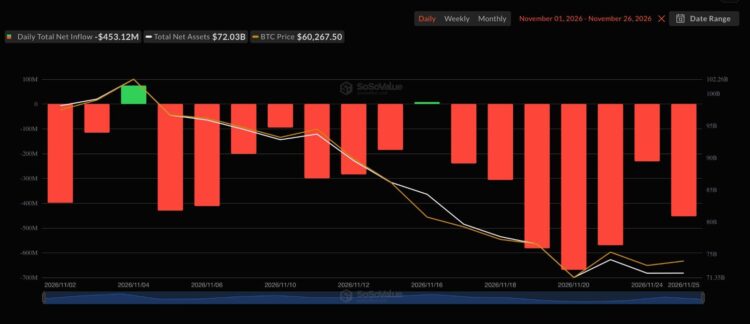
Wednesday’s figures are still subject to final reporting confirmation, although available data points to further withdrawals.
These numbers do not mean that every institutional investor is abandoning Bitcoin. ETF shareholders include different types of investors, from financial advisers and asset managers to individual traders. Some may be reducing risk, while others could be unwinding positions that were never intended as long-term investments.
What the figures establish is that the ETF market has experienced persistent net redemptions, even after Bitcoin’s substantial decline.
That is not the response bulls would ideally want to see from buyers following a major correction.
Bitcoin’s Drop Below $60,000 Exposed a Deeper Problem
Earlier this week, Bitcoin fell below $60,000 again after an initial recovery above $64,000 failed to hold.
Glassnode’s November 24 report, titled The Canary in the Coal Mine , documented the severity of Bitcoin’s latest decline. The cryptocurrency reached approximately $55,300 on November 21, falling beneath the lows established during the summer.
That matters because investors who bought during previous corrections may now be sitting on losses despite having entered the market at what appeared to be relatively attractive prices.
Glassnode’s historical data reveals another uncomfortable detail. Long-term holders recently accounted for more than 75% of Bitcoin’s realized losses before their share fell back toward 50%. Similar periods of selling at a loss appeared during previous bear markets, although that alone does not establish that Bitcoin has reached a bottom.
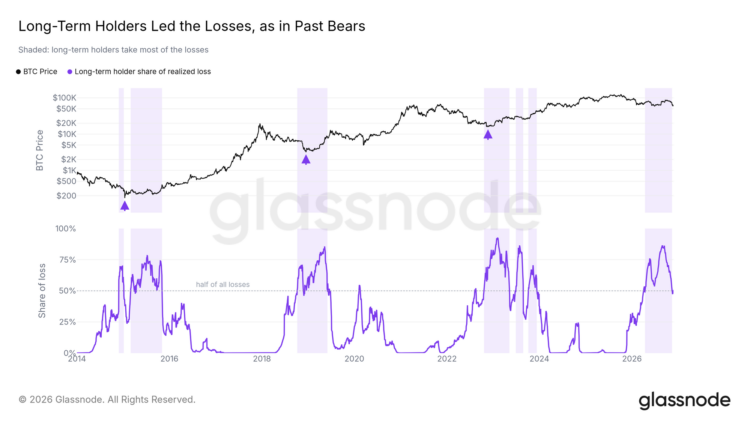
Their behavior becomes particularly important when Bitcoin starts recovering.
Some holders may use a rebound to reduce their exposure or exit positions closer to their original purchase price. Others may be willing to hold through further volatility. Which group dominates will influence how much buying is required to sustain the next move higher.
A price that previously attracted buyers can become an area of selling pressure when the market approaches it from below.
This is one reason why reclaiming $60,000 should not automatically be interpreted as confirmation that the correction has ended.
A Market Bottom Does Not Require Everyone to Turn Bullish
There is a credible argument against interpreting persistent ETF outflows as evidence that Bitcoin must fall further.
Markets can begin recovering before investor sentiment improves. In fact, waiting for every major indicator to turn positive can mean missing a substantial portion of a reversal.
Glassnode’s latest research offers some historical perspective. Bitcoin’s realized losses relative to capital inflows over the preceding year have reached their highest intensity since the FTX collapse in 2022. Previous episodes of heavy losses have occurred near major market bottoms, but severe selling alone is not enough to confirm that a recovery is underway.
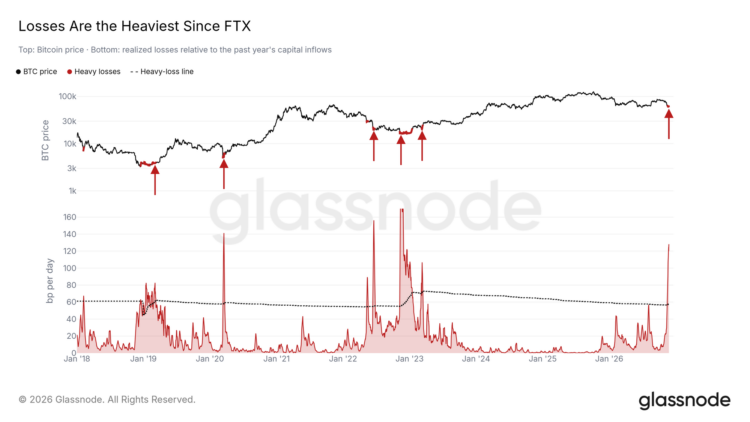
Bitcoin also trades across a much broader market than US exchange-traded funds. Direct purchases, overseas exchanges and other investment vehicles can absorb selling even when American funds experience redemptions.
The distinction is between evidence that a market can recover and evidence that it has already established a sustainable recovery.
Bitcoin’s latest bounce demonstrates that buyers are willing to step in at lower prices. It does not yet establish whether those buyers can absorb additional selling at higher levels.
If Bitcoin begins to hold its gains despite persistent ETF withdrawals, that would itself be an encouraging development. It would suggest that demand elsewhere in the market is capable of offsetting some of the pressure coming from the funds.
For now, the price and ETF data leave that question open.
Thanksgiving Could Make Bitcoin’s Next Move Harder to Read
Thursday’s Thanksgiving holiday adds another complication to the recovery. US equity markets are closed, removing a regular trading session for American spot Bitcoin ETFs while cryptocurrency exchanges continue operating.
The absence of new ETF flow figures during the holiday should not be confused with an improvement in institutional demand.
With fewer traditional financial market participants active, Bitcoin’s immediate price movements may also provide an incomplete picture of how investors are responding to the recent sell-off.
Friday’s shortened US trading session and the subsequent return to normal market hours will provide more useful evidence.
For traders, the important signals are whether Bitcoin can retain its recent gains, whether ETF redemptions begin to ease and whether buying remains strong enough to absorb selling when normal market participation resumes.
The $60,000 level may dominate the headlines, but the more convincing recovery will be the one that can survive without depending entirely on temporary relief from selling pressure.