




The Swiss National Bank and eight financial firms will test whether a single distributed ledger can hold central bank money, commercial bank money and securities at the same time. The announcement published on 24 November names the partners: UBS, SIX, Zürcher Kantonalbank, PostFinance, Banque Cantonale Vaudoise, Basler Kantonalbank, Sygnum Bank and Seturion, a settlement platform. It calls the work an exploratory project for a Swiss Financial Ledger, and it sets no launch date.
That omission is the story. Switzerland has spent several years building the plumbing to settle tokenised assets in central bank money, first through Project Helvetia with the BIS Innovation Hub and then through the Agorá prototype for cross-border payments. The new project asks a different question: whether one domestic platform can do both jobs — settle Swiss franc payments and move securities — without the two-track workaround the SNB has relied on so far.
Nine institutions, one board, and an observer
The release is short on mechanics and specific about membership. Nine institutions sit in the project, counting the central bank. A Helvetia Strategic Board has been created to run the discussion, and the Swiss Bankers Association attends as an observer rather than a participant.
“To streamline the discussions, a Helvetia Strategic Board has been established, comprising these institutions and with the Swiss Bankers Association as an observer,” the release states. It does not name a chair, a voting rule, a budget or a work plan. Nor does it give the size of any institution’s contribution, which matters when the participants include the country’s largest bank and its main securities infrastructure operator.
The stated objectives are narrow and procedural: “The project’s key objectives are both to evaluate technical design and architecture options and to define governance models and operational frameworks.” In plain terms, the group is being asked to choose a design and write the rulebook before anyone commits capital to a production system.
Two Helvetia rails the ledger would have to merge
Project Helvetia, as the SNB describes it on its own project page , tests two approaches to the same problem. The BIS Innovation Hub , which ran the first two phases with the SNB and SIX, describes the work as a multi-phase investigation into settling tokenised assets in central bank money. The first is an integrated model: a wholesale central bank digital currency, described as a Digital Swiss Franc and reserved for financial institutions, issued on the SIX Digital Asset Platform so that cash and tokenised assets sit on one DLT infrastructure and transfer together on a delivery-versus-payment basis.
The second is a synchronised model: tokenised assets settle on a DLT platform while the cash leg stays in traditional central bank money, coordinated through a link to the Swiss Interbank Clearing system. The SNB says the financial market infrastructure SeturionX already uses that RTGS link in a production environment.
A single Swiss Financial Ledger would have to accommodate both designs or pick one. The release does not say which. It says only that the project will examine a platform “on which central bank money, commercial bank money and securities can interact seamlessly” — a description broad enough to cover the integrated model, the synchronised model, or a hybrid that has not been built yet.
One participant already runs a live version
The most concrete detail sits on the SNB’s Helvetia page rather than in the announcement. SeturionX, operated by project participant Seturion, runs what the SNB calls a “small DLT trading system” licensed by FINMA. Its DLT assets settle on the public Ethereum blockchain, and the cash side settles in the SIC system.
That makes one of the eight partners a live reference implementation rather than a design exercise. It also sets a benchmark the exploratory project has to beat: a production rail that already works, with a licence, on a public chain, and with settlement finality anchored in the central bank’s own RTGS system. Whether Seturion’s production platform is in scope for the new ledger is not stated in the release.
What Agorá actually measured
The cross-border baseline comes from Project Agorá , the BIS and Institute of International Finance initiative that the SNB cites as the parent of this work. Agorá brings together eight central banks, including those of five major reserve currencies, and more than 40 financial institutions.
Its real-value testing in July 2026 is the closest thing to a public scorecard. Twenty-eight financial institutions and central banks completed transactions worth roughly CHF 800,000 across 17 scenarios and 30 transactions, with individual payments between CHF 9,000 and CHF 125,000. The average time from payment initiation to settlement was about 80 seconds, and roughly 250 public and private sector staff took part.
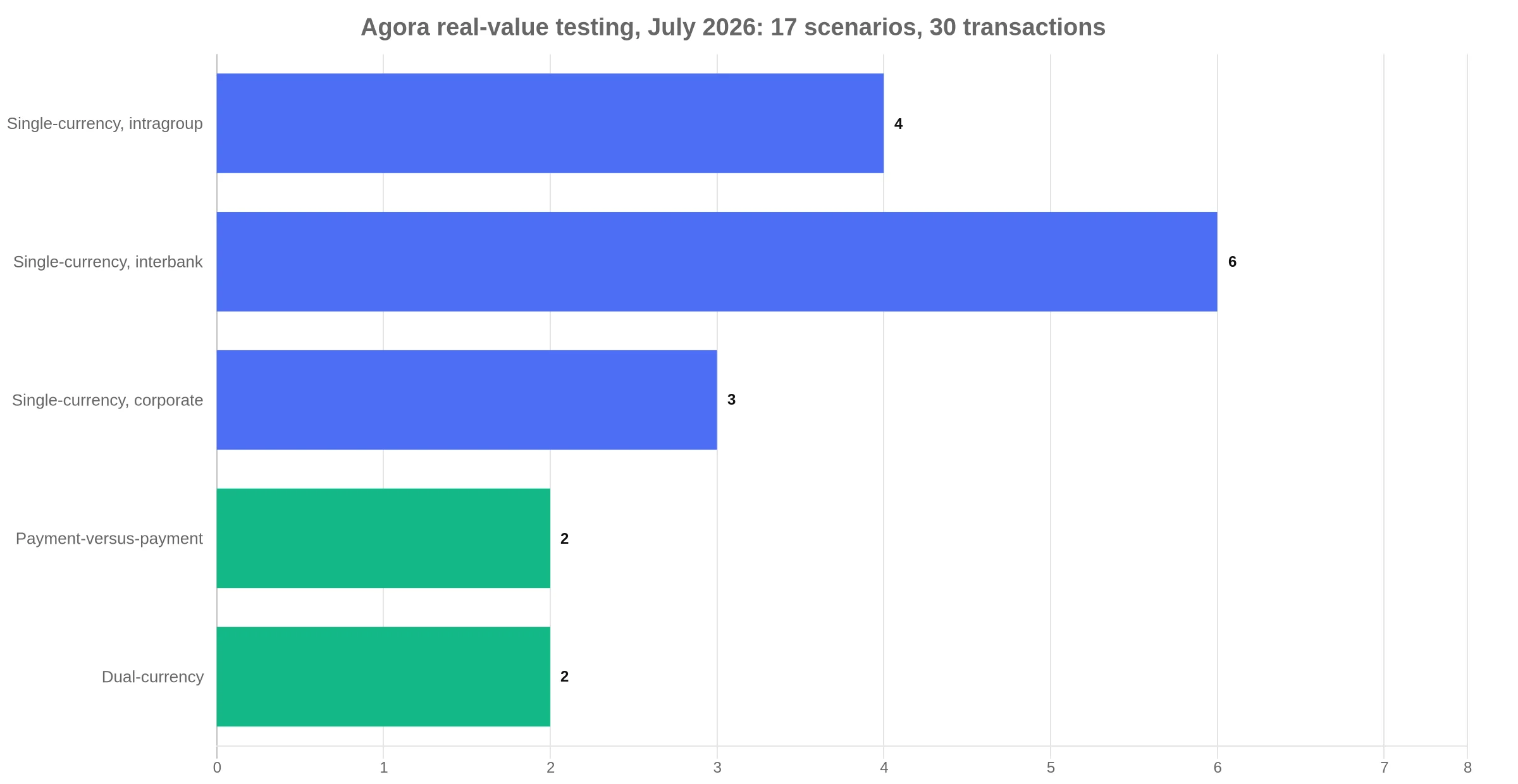
The arithmetic puts the test in perspective. Thirty transactions across 28 institutions is 1.07 payments per participant. The CHF 800,000 total works out to CHF 26,667 per transaction, and the largest single payment, at CHF 125,000, was 4.7 times that average. With about 250 staff involved, the exercise used roughly eight people per transaction.
None of that is a criticism of the design. It is what a controlled test looks like before a platform handles real volume: the BIS notes the prototype was not integrated with existing RTGS and core banking systems, and that messages moved using established ISO 20022 formats including pacs.008, pacs.009 and camt.053. The 80-second figure describes a laboratory, not a market.
The domestic test adds a leg Agorá never settled
Agorá tested payments: single-currency corporate and interbank transfers, intragroup transfers, dual-currency payments and payment-versus-payment. The scenarios split 13 single-currency, two dual-currency and two PvP. Securities were not part of the exercise.
The Swiss Financial Ledger explicitly adds them. That is the harder half. A securities leg turns a payment into a delivery-versus-payment transaction, which requires the cash and the asset to settle together or not at all, and it pulls in custody, corporate actions and the legal question of when settlement becomes final. The release names securities as one of the three things the ledger would hold, but it does not describe the asset model, the custody arrangement or which ledger the securities would live on.
The eligibility rule is the binding constraint
Helvetia’s access rules are already written, and they explain why the participant list looks the way it does. To use the wholesale CBDC in the pilot, an institution needs a sight deposit account with the SNB, admission to the SIC payment system and onboarding on the SIX Digital Asset Platform, according to the SNB.
That is a narrow door. It limits the cash leg to institutions already inside the central bank’s settlement perimeter, which is why the project’s eight firms are banks, the exchange operator and a settlement platform rather than fintechs or custodians. The SNB also keeps the exit open: “The pilot does not, however, constitute a commitment on the SNB’s part to introduce wCBDC on a permanent basis.”
The timeline is longer than the announcement implies. The SNB says Project Helvetia will run until at least June 2028, with an extension possible. The wholesale CBDC pilot that began on 1 December 2023 is 1,089 days old as of 24 November 2026, and the SNB now says the Helvetia pilot will run until at least June 2028. No permanent issuance decision is attached to either date.
What the release leaves blank
Four gaps matter for anyone reading this as a signal about the digital franc. There is no phase number, so the project’s place in the Helvetia sequence is unclear. There is no date for a first transaction, a prototype or a report. There is no statement on whether the ledger would replace the SIX Digital Asset Platform, the SIC link, or both. And there is no indication of who would operate the platform if it were built.
The SNB is explicit that the announcement is not a launch. “Today’s Swiss financial market infrastructure is highly efficient. The project for a Swiss Financial Ledger explores a potential extension to this system and should not be interpreted as an indication that such a financial ledger will be launched or that the SNB will issue tokenised central bank money for financial institutions,” the release says.
Read against the Agorá numbers, that caution is proportionate. A platform that settled 30 payments worth CHF 800,000 in July has not been tested for the volumes a domestic securities market would generate. The next milestone to watch is not another announcement but a first settlement on the Swiss ledger with a securities leg attached — and a participant list that extends beyond the nine names published this week.
Why the banks want one ledger
The commercial case is reconciliation. Tokenised money is already moving inside regulated structures: HSBC’s tokenised money market fund runs on Ethereum with a 0.38% charge, and the CFTC’s December agenda for 24/7 trading puts tokenisation in the clearing session. Once cash and securities sit on separate rails, every trade needs a bridge, and every bridge is a place where settlement can fail.
A single ledger removes that bridge, at least in theory. It also concentrates operational risk in one platform and hands its operator a role close to that of a central securities depository. The SNB’s release does not address that trade-off, and the governance work it describes is where the answer will be written.
For now the project is a feasibility study with a nine-name board, a June 2028 horizon and an explicit promise not to promise anything. That is a modest step. The novelty is the third leg. Helvetia already settled digital bonds against wholesale central bank money; the Swiss Financial Ledger adds tokenised commercial bank money to the same platform, which is why the design choices that follow will matter more than the announcement itself.
Frequently Asked Questions
It is an exploratory project announced by the Swiss National Bank on 24 November 2026, with UBS, SIX, Zürcher Kantonalbank, PostFinance, Banque Cantonale Vaudoise, Basler Kantonalbank, Sygnum Bank and Seturion. It will study whether one distributed ledger platform can settle central bank money, commercial bank money and securities together.
No. The release states the project should not be read as an indication that such a ledger will launch or that the SNB will issue tokenised central bank money for financial institutions. The SNB also says its wholesale CBDC pilot is not a commitment to permanent issuance.
Agorá, run by the BIS Innovation Hub and the Institute of International Finance, tested cross-border wholesale payments with eight central banks and more than 40 institutions. The Swiss Financial Ledger would cover domestic transactions and add a securities leg, which the Agorá scenarios did not include.
Financial institutions that hold a sight deposit account with the SNB, are admitted to the SIC payment system and are onboarded on the SIX Digital Asset Platform. The SNB sets the conditions in a binding document that participants must sign.
No date has been announced. The SNB says Project Helvetia will run until at least June 2028 and that an extension is possible. The new project’s timeline review and any decision on permanent wholesale CBDC remain open.
The post The Swiss Financial Ledger Starts as a Feasibility Test, Not a Digital Franc appeared first on BlockchainReporter .